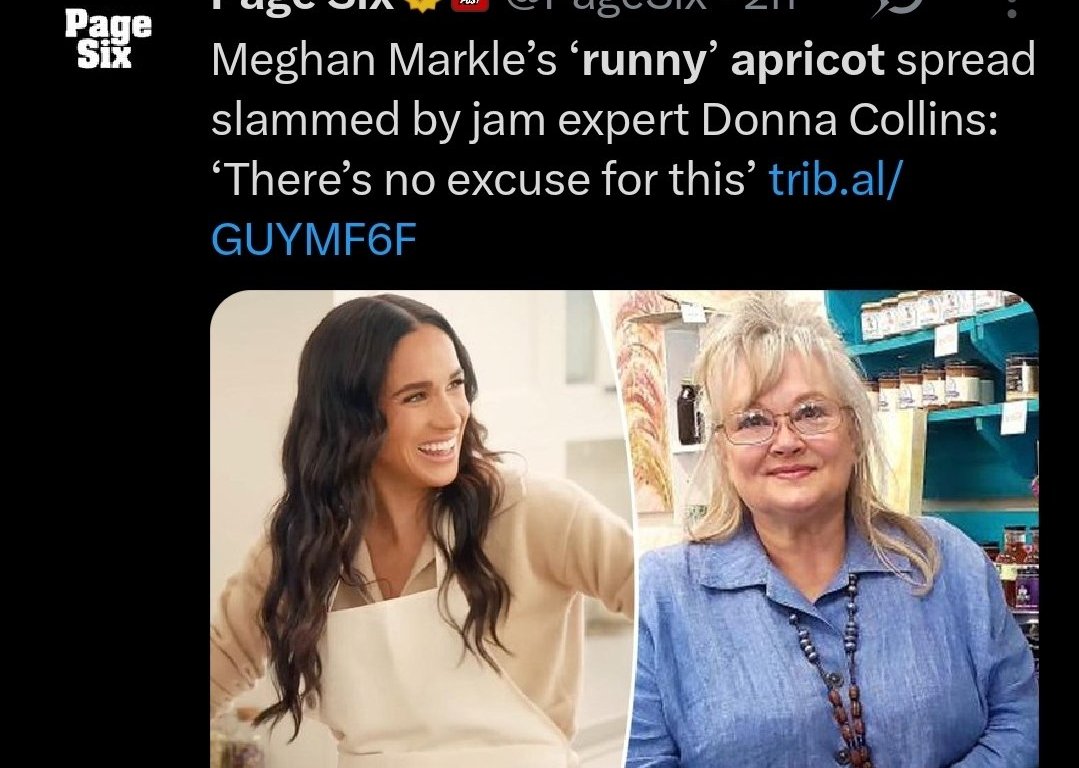
When Meghan Markle launched her latest product—a limited-edition apricot spread through her lifestyle brand As Ever—it sold out within minutes. But the story that dominated headlines wasn’t about entrepreneurial success. Instead, Page Six and the New York Post focused their coverage on a critique by “jam expert” Donna Collins, who denounced Meghan’s spread as “too runny” and declared, “There’s no excuse for this.”
This wasn’t an impartial product review. It was a familiar pattern of weaponizing niche expertise to discredit Meghan Markle’s brand, intellect, and autonomy. Behind the jokes about jam lies a much deeper question: Why is a Black woman’s success still framed as a fraud until proven otherwise?
The Setup: A Product That Sold Out
On Friday, Meghan released her new apricot spread in two forms: a standard $9 jar and a $14 keepsake edition. Like her earlier raspberry spread, both versions sold out quickly. Customers praised the flavor and versatility. The consistency of the product—a “spread,” not a jam—was part of the marketing. It can be used on yogurt, toast, cheese boards, or even ice cream.
But within hours, Donna Collins, a self-described jam expert and owner of The Jelly Queens, told Page Six that the product was a failure. “In the jam industry, a spread is what we call something that didn’t work,” she said. “It can have the best ingredients, but if I had a jam that was too runny, I’d slap a label on it and call it a spread.” She even questioned Meghan’s use of pectin (a common gelling agent) and slammed her for using “conventionally grown apricots.”
The Real Agenda: Undermining a Black Woman Entrepreneur
This type of criticism isn’t new for Meghan Markle. Whether it’s her Spotify podcast, her Netflix show, or her lifestyle brand, the coverage rarely starts from a place of curiosity. It begins with suspicion. The insinuation is always the same: She didn’t make this. She doesn’t understand this. She’s just a face, not the force behind the business.
It’s a coded form of gatekeeping—one that relies on presumed authority figures like Collins to challenge Meghan’s legitimacy. The fact that Collins admitted she hadn’t even tasted the product before criticizing it didn’t stop Page Six from giving her prime media real estate. Nor did it stop the New York Post from amplifying her remarks.
Meanwhile, Meghan’s actual track record is ignored. She’s a proven brand builder with global reach, and her product launches consistently sell out. Her spread was never marketed as a traditional jam—it was pitched as a lifestyle item in a broader collection that included honey, tea, cookies, and home goods. It’s not that these critics don’t understand the difference. It’s that they don’t want the public to.
How “Runny” Became the Dog Whistle
Critics have latched onto the word “runny” as a viral insult. But it’s no coincidence that the critique is about texture, not taste. This is how smear campaigns operate: they use the most subjective qualities to foster doubt and online ridicule. If the product had been too thick, they’d likely say it was “inedible.” If it had been organic, they’d question the supply chain. There’s no win.
The social media response has been fierce. Sussex supporters quickly pointed out that Donna Collins was criticizing a product she hadn’t tried and that the spread’s success speaks for itself. “The jam hasn’t even shipped yet,” wrote one commenter. “This is just another excuse to hurt her.”
Black Enough?
Remember when President Obama joked at the White House Correspondents’ Dinner that his golf game and lunch with the Queen should finally settle the debate about whether he was “Black enough”? He was mocking a racist double bind—no matter what he did, someone always claimed he wasn’t really Black. Meghan faces the same impossible framing.
She’s constantly:
- Too American for some Brits
- Too light-skinned for some Black critics
- Too polished for anti-establishment voices
- Too opinionated for traditional royalty
She can’t win—and that’s the point. Her success, her mixed identity, and her refusal to dim her voice make her a lightning rod. And so does every product she launches. The jam isn’t the real target. She is.
The Media Playbook: Delegitimize, Diminish, Distract
Why amplify an expert who hasn’t tried the product? Because it fits a narrative. This isn’t about fact-checking Meghan’s recipe. It’s about planting the idea that she’s incompetent or fake. It’s the same narrative applied to her Spotify deal, her Netflix series, and even her children’s book. If she’s visible, she must be undeserving. If she’s successful, someone else must have done the work.
Critics focused on the spread’s texture rather than its flavor, packaging, or sell-through rate. It’s a tactic—reduce something to a meme-able flaw and let outrage do the rest. But people are catching on.
They’re:
- Refusing to share the article
- Laughing off the so-called “jam expert”
- Calling out Page Six for manufactured outrage
And most importantly, they’re still buying Meghan’s products.
Why It Matters
At its core, this is about more than fruit preserves. This is about media ecosystems that thrive on demeaning women—especially Black women—for stepping into power, taste-making, and business ownership. Meghan Markle isn’t just a former duchess. She’s a symbol of what happens when someone refuses to stay in the box the public built for her.
Her spread may be runny. But this backlash? It’s thin.
 celebchai.com