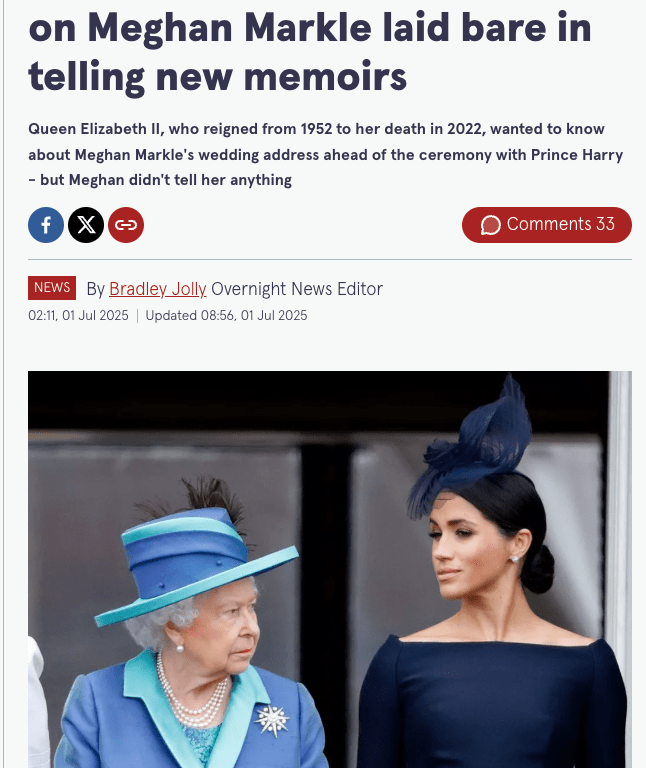
The latest round of royal revelations—framed through secondhand notes and interviews with long-deceased courtiers—paints a familiar, convenient portrait: Meghan Markle as the Hollywood outsider who defied royal norms and allegedly bruised Queen Elizabeth II’s sensibilities. But for all the media’s delight in resurfacing these claims, it’s worth asking: what are we really being told—and why now?
Let’s begin with the notion that Meghan “wouldn’t tell” Queen Elizabeth about her wedding dress. This is cited as a key signal of disrespect. But why? Meghan, a 36-year-old professional woman at the time, had every right to maintain creative control over a deeply personal moment. The dress, designed by Clare Waight Keller for Givenchy, symbolized modernity, simplicity, and heritage. It was hardly scandalous—certainly not by contemporary standards. And yet the criticism? That it was too “flamboyant” for a divorcee. That judgment says more about outdated royal attitudes than it does about Meghan.
The supposed ten-minute exchange in which Prince Harry was allegedly “rude” to the Queen lacks any context. Was it frustration? Was it boundary-setting in a family not known for emotional transparency? We don’t know. But the vague framing, coming years after the fact, is designed to vilify Harry while absolving the institution that arguably failed him.
Critically, these stories come from Lady Elizabeth Anson—a woman of inherited privilege who reportedly acted as a confidante, yes, but also as a gatekeeper to traditional royal culture. That culture has a long record of turning against newcomers who don’t conform—Diana, Fergie, even Camilla at one point. Meghan wasn’t an exception. She was the latest woman expected to submit fully to an institution that often asks for erasure over integration.
The emphasis on Meghan being a divorcee also speaks volumes. Royal watchers conveniently forget that King Charles himself is a divorcé and remarried. So is Princess Anne. Meghan’s status as a divorcee only drew ire because it was paired with other qualities that some corners of British aristocracy still find uncomfortable: she is American, biracial, ambitious, and media-savvy. These are not flaws. They are traits that made her a threat to a hierarchy that thrives on silence and sameness.
Furthermore, framing the Sussexes’ decision to step back from royal duties as “Megxit”—a term invented by the British press—is a linguistic trick. It puts the burden of the exit on Meghan and erases the full scope of emotional and psychological strain both she and Harry publicly documented. The Queen may have been “saddened,” but what about the couple’s mental health? The racist headlines? The lack of institutional support?
And now, renewed outrage over HRH titles appearing on passport applications for their children only illustrates the double standard. The children are royal by birth. The use of their inherited titles on legal documents is hardly a land grab for influence. It’s standard practice. No such hand-wringing occurs when other royal grandchildren maintain theirs.
Let’s also address the strategic leaks. Why do these notes surface now? They coincide with growing Sussex visibility, increasing U.S.-based projects, and, most importantly, the erosion of the Queen’s unifying myth in a post-Elizabethan monarchy. Without her personal dignity as cover, the monarchy’s internal divisions look more naked than ever. So the press fills the gap with sentimentality and scapegoats.
To frame Meghan as ungrateful or divisive is to ignore the institution’s pattern of failing the very people it invites into its orbit. The monarchy isn’t known for nurturing individual identity—especially when that identity challenges colonial legacies, racial homogeneity, or gendered obedience.
Queen Elizabeth may well have felt disrespected. But respect, in modern institutions, must be mutual. And that’s where the royal family continues to falter.
 celebchai.com