HISTORY
Queen Elizabeth II’s resistance to the relationship between Prince Charles and Camilla Parker Bowles is well-documented and rooted in a mix of personal disapproval, institutional tradition, and public perception. Here’s a detailed breakdown of that dynamic:
The Queen’s Disapproval Was Deep and Long-Lasting
According to multiple biographers—including Penny Junor and Tom Bower—the Queen did not initially accept Camilla as a suitable partner for her son. This wasn’t just about Camilla personally, but about what she represented:
- Camilla was married (and divorced): At the time, divorce carried significant stigma in royal and religious circles. Camilla’s prior marriage to Andrew Parker Bowles, and her affair with Charles while both were married, created a moral and religious conflict for the monarch, who was also Supreme Governor of the Church of England.
- She saw Camilla as the reason Charles and Diana failed: While the marriage between Prince Charles and Princess Diana had multiple issues, Queen Elizabeth is said to have blamed Camilla as a central destabilizing factor—especially after the Camillagate tapes (1993) surfaced, confirming an ongoing affair.
- She refused to meet Camilla for years: Royal insiders confirm that Queen Elizabeth refused to even be in the same room as Camilla for the better part of a decade. One source close to the family said the Queen referred to Camilla privately as “that wicked woman.”
Charles and Camilla Were Forced to Keep Low Profiles for Years
Despite their strong bond—which dates back to the early 1970s—Charles and Camilla had to conduct their relationship in secrecy and then slowly reintroduce it to the public:
- After Diana’s death in 1997, any public association with Camilla was politically and emotionally dangerous. Public sympathy for Diana was overwhelming, and Camilla was widely viewed as the “other woman.”
- The Queen did not attend Charles and Camilla’s civil wedding ceremony in 2005. She did, however, attend the religious blessing afterward—but notably, she did not host the main event. It was a subtle but public distancing.
- Their wedding announcement was delayed out of fear of public backlash. Even their official wedding date was postponed once—because it clashed with Pope John Paul II’s funeral, and the optics would have been disastrous.
The Queen Only Slowly Came Around—And Even Then, With Limits
It wasn’t until 2000 that the Queen publicly acknowledged Camilla’s role in Charles’s life, and only in 2017, on her Sapphire Jubilee, did she offer warmer gestures toward her.
- Camilla did not receive the title “Princess of Wales,” which was deliberately kept retired out of respect for Diana.
- For many years, the official line was that Camilla would be known as “Princess Consort,” not Queen, when Charles ascended the throne—a compromise to ease public discomfort.
- Only in 2022, the Queen’s Platinum Jubilee year, did Queen Elizabeth II formally state that Camilla should be Queen Consort—a move seen by many as one of her final acts of strategic unity, not personal endorsement.
Camilla’s Reputation Was Rehabbed by Charles’s PR Team, Not the Queen
Much of Camilla’s rise in public favor came not from the Queen, but from a calculated press campaign by Charles’s PR advisors, notably Mark Bolland. Over two decades, they:
- Pushed positive media coverage of Camilla as loyal, witty, and dignified.
- Carefully rebranded the relationship as a “long love story,” burying the more sordid details.
- Used palace surrogates and “leaks” to gradually position Camilla as indispensable to Charles’s happiness.
This mirrors what’s now happening to Meghan Markle in reverse: where Camilla was shielded and slowly elevated, Meghan is being scapegoated and smeared—often through unnamed “sources” and royal-adjacent insiders like Sally Bedell Smith.
The Queen’s True Feelings Remain Private
While the Queen eventually sanctioned Camilla’s full integration into the royal family, many believe it was more about stability and duty than affection. She prioritized the monarchy’s future, even if it meant accepting a relationship she had long resisted.
Thus, this article is about Camilla, not Meghan.
1. This sounds like Camilla’s revenge spin, not royal truth.
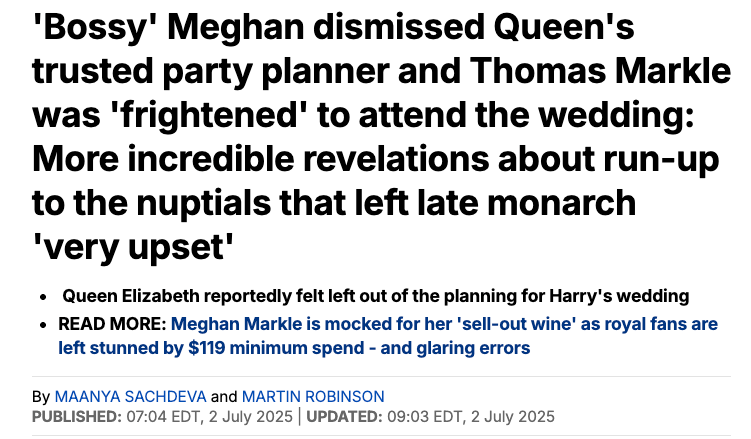
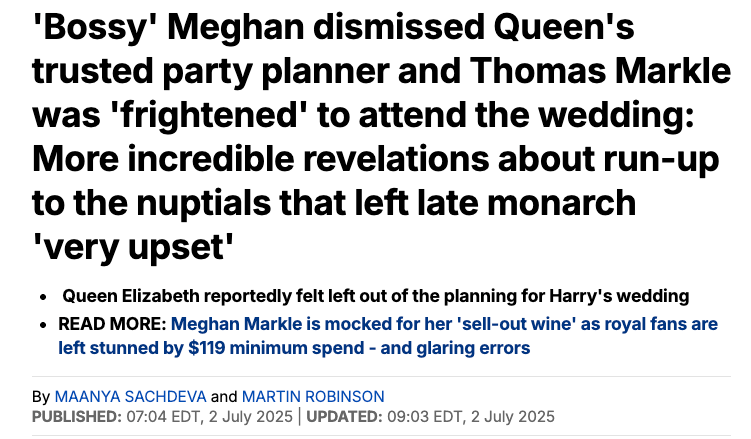
The sudden posthumous “revelations” about Meghan allegedly upsetting Queen Elizabeth—especially via a party planner’s cousin quoted by a royal biographer—feel suspiciously timed and overly dramatized. Lady Elizabeth Anson passed in 2020, and cannot verify these claims. The source, Sally Bedell Smith, has long been close to palace courtiers and often promotes sympathetic portrayals of Camilla and Charles. This conveniently fits into a larger media pattern of rehabilitating Camilla at Meghan’s expense.
2. Meghan’s wedding was not a state event.
Harry was fifth in line to the throne in 2018. Unlike Prince William’s wedding, Harry’s was not a state ceremony. That’s a critical distinction: the Queen was under no obligation to approve guest lists, dresses, or party planners. This was a semi-private family wedding, not a constitutional event. The idea that the Queen was “saddened” because Meghan didn’t share dress details feels artificially magnified.
3. The Queen did not like Camilla—and Meghan represented change.
Historically, Queen Elizabeth had significant reservations about Camilla and only gradually allowed her back into royal ranks—under pressure. In contrast, Meghan was embraced early on. The Queen invited Meghan to Christmas at Sandringham before she married into the family—a privilege not even extended to Kate before her marriage. That kind of welcome is not given to someone the Queen “didn’t trust.”
4. “Bossy” is gendered dog-whistling.
Terms like “bossy,” “opinionated,” and “forceful” are often deployed against women of color who assert boundaries. Meghan, a successful American actress, was never going to fit neatly into the royal mold—and that was part of her strength. But rather than seeing her modern style as an asset, this article frames it as insubordination. The description of her not being “grateful enough” or wanting “more money” echoes the old trope of the “ambitious woman” being a threat.
5. The real story: friction with the palace system, not the Queen herself.
If the Queen had been as deeply upset as the article claims, there would have been formal consequences or a distancing much earlier. Instead:
- She issued warm public statements during the couple’s departure in 2020.
- She insisted they remain “much loved members of the family.”
- Meghan and Harry were given high-profile Commonwealth roles early in their marriage—an unmistakable sign of trust.
What really caused the fracture wasn’t a party planner or gown secrecy—it was institutional racism, media intrusion, and the Firm’s unwillingness to protect Harry and Meghan from it.
TL;DR:
This article tries to revise history by framing Meghan as the villain and the Queen as the hurt matriarch. But it reeks of palace PR, likely orchestrated by those now holding power (Camilla, Charles’s camp), and weaponizes selective, unverifiable anecdotes to distract from larger truths.
 celebchai.com
One thought on “When in Doubt, Blame Meghan: How Royal Gossip Keeps Camilla Clean”