The Macron Conspiracy and Candace Owens: A Political Proxy War Disguised as a Scandal
In July 2025, French President Emmanuel Macron and First Lady Brigitte Macron filed a defamation lawsuit in Delaware against American commentator Candace Owens, accusing her of launching a “vicious, calculated, and knowing” smear campaign to falsely portray Mrs. Macron as a transgender identity thief. The 89-page complaint reads not merely as a defamation case, but as an indictment of an ideological strategy—a proxy war waged by U.S. right-wing media to undermine President Macron by targeting his wife.
Candace Owens has long been a lightning rod for controversy, and her tactics—sensationalist, conspiratorial, often laced with transphobia and antisemitism—have repeatedly served to galvanize her base and antagonize ideological opponents. But her decision to target Brigitte Macron, a French public figure largely unknown in American conservative discourse, raises a crucial question: Why her?
The answer, as outlined in the Macrons’ complaint, lies not just in the personal animus or conspiratorial fervor of Owens herself, but in the political symbolism President Macron represents. A centrist European leader with strong internationalist credentials, Macron is a vocal critic of Donald Trump, populism, and the erosion of liberal democratic norms. In that sense, he is the antithesis of the political movement that Owens and her media allies champion.
According to the complaint, Owens’ smear campaign began in March 2024, shortly after she was ousted from The Daily Wire for antisemitic rhetoric. Seeking to reinvent her brand through unfiltered outrage and culture war content, Owens launched her independent podcast and began repeating long-debunked French far-right conspiracies: that Brigitte Macron was born male, stole her brother’s identity, and is covering up the scandal through fraud and blackmail. She broadcast these claims through episodes titled “So…Is Brigitte Macron a Man?” and “The Olympics Exposed Brigitte Macron,” peppered with themes of satanic pedophilia, MKUltra mind control, and incest—all standard fare in QAnon-adjacent circles.
Owens’ allegations were not original. French conspiracy theorists Xavier Poussard and Natacha Rey had circulated them in fringe publications as early as 2021. Their claims were thoroughly debunked, and both were found guilty of defamation in French courts. The Macrons’ legal complaint makes it clear that Owens knew this and had been served with a comprehensive retraction demand explaining the falsity of each claim—yet she pressed ahead, doubling down with merchandise, media appearances, and podcast episodes.
But the political motives become even clearer when viewed through Owens’ affiliations. Her ties to Donald Trump, Turning Point USA, and figures like Alex Jones and Andrew Tate position her within an international media ecosystem designed to amplify culture war narratives, especially those that challenge European liberalism. In 2019, Owens spoke at a far-right conference in Paris organized by Marine Le Pen’s niece, where she derided Macron as a “weak” leader and praised nationalist politicians. The lawsuit notes this, suggesting her views on Macron were already shaped by alignment with his political adversaries.
Seen through this lens, Brigitte Macron becomes collateral damage in a broader ideological crusade. By attacking her womanhood, Owens wasn’t merely trafficking in transphobic conspiracy theories; she was attempting to humiliate a Western liberal icon by proxy. In far-right discourse, emasculating an adversary is political currency. To falsely label Macron’s wife a man is, in that warped framework, to strip Macron of legitimacy, authority, and masculinity.
The political implications are significant. As France prepares to host the Olympics and the U.S. enters a new election cycle, Macron’s global profile will rise. Owens’ campaign—fueled by Trump-aligned resentment of globalism and European liberalism—serves to muddy Macron’s public image and poison the discourse surrounding his leadership. The lawsuit calls this campaign “relentless,” “dehumanizing,” and “designed to inflame.” It also points to Owens’ deliberate evasion of truth, her mocking of the Macrons’ legal outreach, and her refusal to retract even when faced with irrefutable evidence.
Ultimately, the attack on Brigitte Macron should not be dismissed as fringe behavior by a single podcaster. It is part of a broader media strategy, one that relies on disinformation, identity-based attacks, and the calculated humiliation of public figures to achieve political goals. Owens is not simply trying to destroy Brigitte Macron’s reputation—she is trying to damage the Macron presidency, and by extension, the values it represents.
The defamation suit may eventually settle the question of legal liability. But the deeper issue—how political warfare is increasingly waged through the vilification of women in public life, weaponized through misogyny, transphobia, and conspiracies—will remain long after the verdict is delivered.
I. OVERVIEW
Plaintiffs: Emmanuel Macron (President of France) and Brigitte Macron (First Lady of France)
Defendants: Candace Owens, Candace Owens LLC, GeorgeTom, Inc.
Cause of Action: Defamation (libel and slander), false light, intentional infliction of emotional distress, and potentially commercial misappropriation.
Relief Sought: Damages (compensatory and punitive), retractions, and injunctive relief.
II. STRENGTHS OF THE COMPLAINT
1. Well-Pleaded Factual Specificity (Rule 8)
The complaint exceeds federal and state pleading standards. It offers:
- A chronological narrative of Candace Owens’ defamatory statements (¶¶ 1–107).
- Direct quotations from Owens’ podcasts, X posts, YouTube videos.
- Hyperlinks and references to YouTube, Spotify, and media articles (¶¶ 52–66, 70–73, 108).
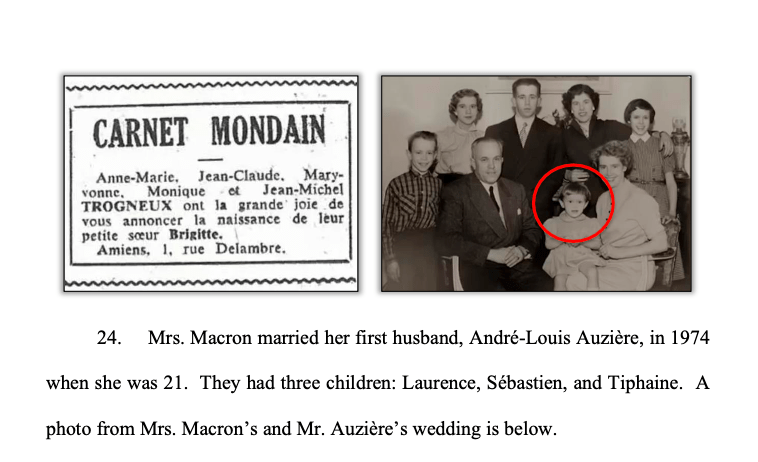
- Comparative images and detailed context rebutting Owens’ claims (¶¶ 23–25, 85–87, 89).
This extensive pleading allows the court to evaluate actual malice and falsity from the complaint alone.
2. Clear Allegations of Actual Malice (New York Times v. Sullivan)
The plaintiffs repeatedly allege that:
- Owens knew her statements were false (¶¶ 3, 50, 63, 76–79).
- She ignored direct evidence and a detailed retraction demand (¶¶ 73–86).
- She doubled down despite being told the claims had already been litigated and debunked in France (¶¶ 40–42, 90–91).
This directly supports the “actual malice” element required when plaintiffs are public figures.
3. Personal Jurisdiction in Delaware is Strong
The complaint carefully lays out jurisdictional grounds:
- Owens manages two Delaware entities (¶¶ 11–12, 17–20).
- She committed tortious acts through those entities (6 Del. C. § 18-109; 10 Del. C. § 3104(c)(4)).
This anticipates and addresses any forum non conveniens or jurisdictional defense Owens might raise.
4. Harm and Damages Are Thoroughly Described
Plaintiffs allege:
- Global reputational harm (¶¶ 6, 64, 66).
- Psychological distress and dehumanization (¶¶ 6, 34, 88).
- Commercial exploitation via merchandise (¶ 65).
This supports both compensatory and punitive damages.
5. Anticipation of Defenses
The complaint preemptively counters:
- Owens’ likely “opinion” or satire defense by showing she claimed to have “evidence” and insisted her statements were factual (¶¶ 52, 60, 95–96).
- Any “public interest” defense by highlighting that the claims were factually false, malicious, and already judicially disproven in France (¶¶ 40, 86–90).
III. POTENTIAL WEAKNESSES OR CHALLENGES
1. First Amendment & Opinion Doctrine
Owens may argue her statements are protected opinions under Milkovich v. Lorain Journal. However, because she presents the statements as investigative “truth” supported by alleged evidence and sources (e.g., Poussard), this likely fails. Still, the court will scrutinize the line between opinion and fact.
2. Jurisdictional Optics – A French President Suing in Delaware
Though legally supported, it may raise concerns over forum shopping or chilling speech. The plaintiffs address this by showing:
- Defendants’ businesses are formed in Delaware.
- The harm was global and monetized through Delaware entities (¶¶ 10–12, 17–20).
3. Risk of SLAPP Defense
Owens may argue this is a strategic lawsuit against public participation (SLAPP). Delaware does not have a comprehensive anti-SLAPP statute, unlike California or New York. However, Owens could attempt to remove the case to federal court and assert First Amendment-based dismissal motions.
IV. STRATEGIC LITIGATION INSIGHT
A. Use of Transnational Defamation Framework
By incorporating French court rulings (¶¶ 40, 86), Macron attempts to internationalize the defamatory nature of the statements. That can help prove falsity and malice, even under U.S. free speech protections.
B. Culture War as Evidence of Malice
The complaint outlines Owens’ history of platforming falsehoods, including antisemitic rhetoric, Holocaust distortion, and her strategic use of outrage content post-Daily Wire (¶¶ 42–50, 59). This builds a pattern of reckless disregard for truth.
C. Merchandising and Monetization as Aggravating Factors
Selling t-shirts based on a fake Time magazine cover (¶ 65) elevates the case from mere speech to commercial exploitation, strengthening claims for punitive damages and false light.
V. RECOMMENDED PLAINTIFF STRATEGY
- File a Motion for Preliminary Injunction:
Seek immediate takedown of the podcast series and merchandise under a prior restraint argument tailored for defamatory commercial content. - Preserve Discovery from YouTube, X, and Podcast Hosts:
Subpoena traffic metrics, ad revenue, engagement data, crucial for damages and intent. - Highlight Repetition of Claims Post-Retraction Demand:
Frame Owens’ conduct after December 3, 2024 as proof of continued malice (¶¶ 73–76). - Preempt Federal Removal:
Should Owens remove to federal court, maintain emphasis on state defamation law and diversity jurisdiction to control venue. - Anticipate “Truth” Defense via Pseudoscientific Sources:
Use Jean-Michel’s public appearances (¶ 85), court-accepted documents (¶¶ 86–87), and testimony to preempt her reliance on Poussard or Rey as credible.
VI. CONCLUSION
The Macron complaint against Candace Owens is factually rich, legally robust, and strategically framed. It anticipates common defenses and centers the lawsuit in Owens’ use of conspiracies for political and commercial gain. The case is not just about defamation—it’s about the weaponization of identity and conspiracy theories against global political figures.
Candace Owens faces substantial risk here, not only for reputational damage but for possible injunctions, monetary penalties, and further scrutiny of her business practices. The Macrons have presented a strong prima facie case, and if discovery supports their claims, summary judgment may be viable on key defamatory statements.
 celebchai.com