As Ever Rosé Sales Analysis: Breaking Down the Numbers
The Data We Have
From Harper’s Bazaar’s exclusive reporting on Duchess Meghan’s As Ever wine drops, we can extract some fascinating sales metrics:
August 5, 2025 Drop (2024 Vintage)
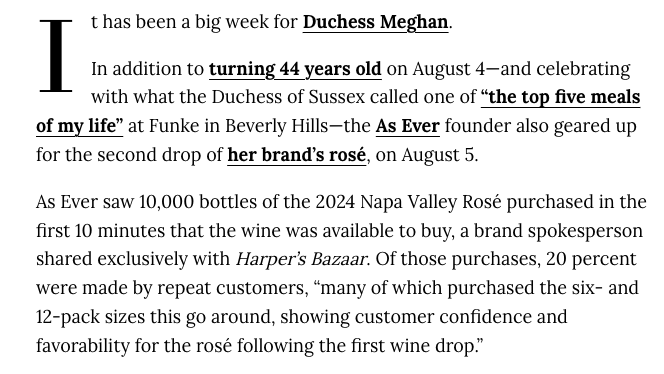
- 10,000 bottles sold in the first 10 minutes
- Initial sales velocity: 1,000 bottles per minute
- 20% were repeat customers (many buying 6- and 12-packs)
- Inventory was 3x larger than July’s drop
- Day-one sales were ~50% higher than July’s
July 1, 2025 Drop (2023 Vintage)
- Sold out completely in 45 minutes
- Total inventory = entire day-one sales (since it sold out)
Calculating July’s Sales Rate
Here’s where the math gets interesting. We can work backwards from the August data:
Given:
- July inventory = X bottles
- August inventory = 3X bottles
- July day-one sales = X bottles (sold out entirely)
- August day-one sales = ~1.5X bottles (50% more than July)
The key insight: If August sold 10,000 bottles in just the first 10 minutes, and this was part of day-one sales that totaled approximately 1.5X, we can estimate X.
While we don’t know August’s complete day-one sales, the 10,000 bottles in 10 minutes suggests strong continued demand. If we conservatively estimate that August’s day-one sales were around 10,000-12,000 bottles total (accounting for the initial rush), then:
- 1.5X ≈ 10,000-12,000 bottles
- X ≈ 6,667-8,000 bottles
This means July’s inventory was approximately 6,667-8,000 bottles.
Sales Velocity Comparison
July 1 Drop:
- ~6,667-8,000 bottles in 45 minutes
- Sales rate: ~148-178 bottles per minute
- 100% sell-through rate
August 5 Drop:
- 1,000 bottles per minute (first 10 minutes)
- 6.7x faster initial velocity than July’s average
- Had ~20,000-24,000 bottles available (3x July’s inventory)
Key Takeaways
- Demand exceeded supply in July: The complete sellout in 45 minutes showed As Ever underestimated demand.
- Smart inventory scaling: Tripling inventory for August was a calculated move to capture unmet demand while maintaining scarcity appeal.
- Customer loyalty building: 20% repeat customers in August, with many upgrading to bulk purchases, shows strong product-market fit.
- Initial rush phenomenon: August’s 1,000 bottles/minute rate in the first 10 minutes demonstrates the “drop culture” effect – concentrated demand at launch time.
- Strategic growth: Despite having 3x more inventory, August only sold 50% more on day one, suggesting As Ever is building a sustainable business rather than just riding initial hype.
The Business Implications
The math reveals a sophisticated go-to-market strategy. As Ever is deliberately managing scarcity while gradually expanding availability. The July sellout created FOMO, driving the massive initial rush in August. Yet by having sufficient inventory in August, they converted that demand into revenue while avoiding customer frustration from immediate sellouts.
This measured approach – increasing inventory 3x but seeing only 1.5x day-one sales growth – suggests As Ever is transitioning from pure scarcity marketing to building a sustainable luxury brand that can meet demand while maintaining prestige.
 celebchai.com