
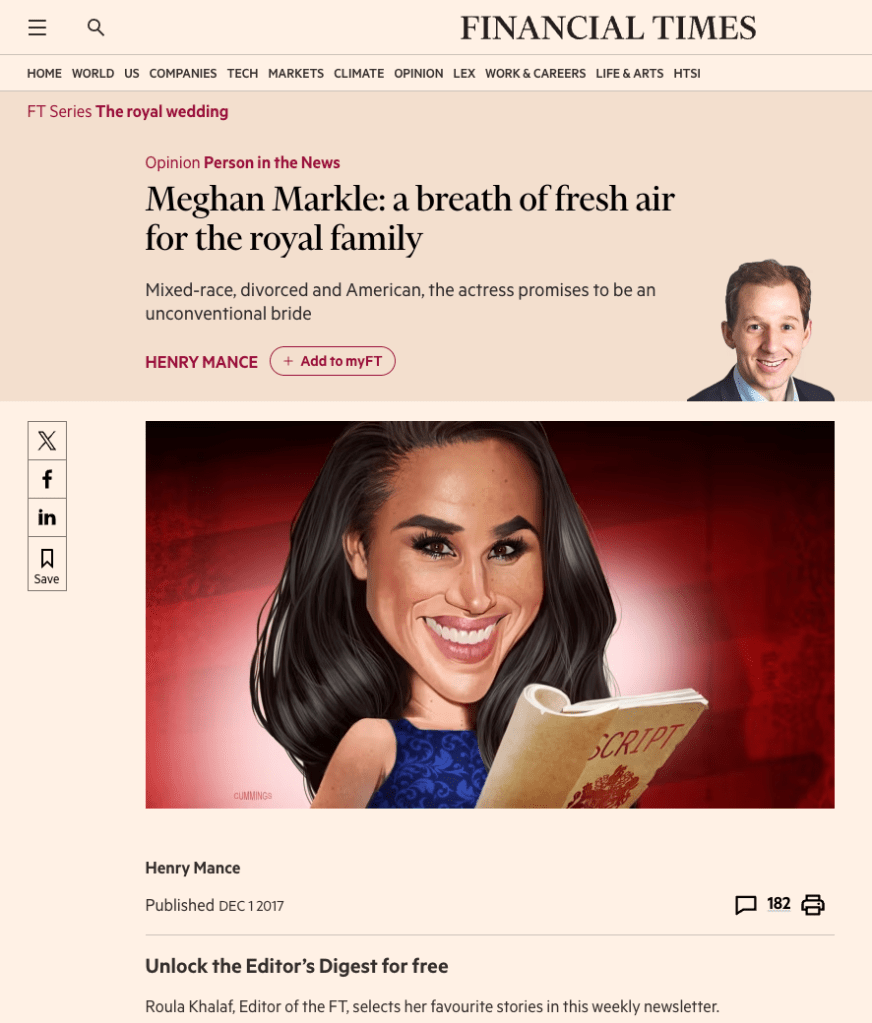
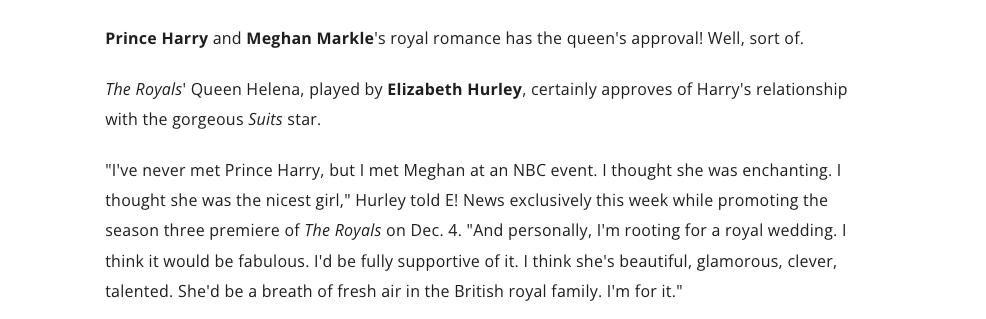
In the winter of 2017, the British monarchy was bracing for transition. Queen Elizabeth II had been unwell the previous Christmas, Prince Philip had retired from public duties, and the talk in the press was about the institution’s aging face. Then came the announcement that Prince Harry would marry Meghan Markle, a 36-year-old American actress whose background and public activism promised something entirely new. The Financial Times dubbed her “a breath of fresh air for the royal family,” likening her intrigue to Diana Spencer and Wallis Simpson but without the scandal.

William and Kate think they are fresh air?

Meghan’s mixed-race heritage, career success, and philanthropic work were cast as assets that could renew the monarchy and make it more relevant in an era of Brexit-induced division. The early narrative was aspirational, painting her as a modernizing force who could add glamour, energy, and inclusivity to an institution often accused of being stuck in tradition.
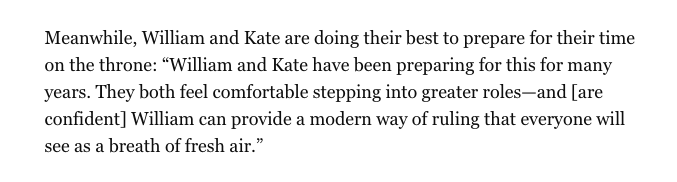
Seven years later, in 2024, the press had largely moved on from Meghan as the embodiment of modernity. Instead, attention shifted toward Prince William and Catherine, Princess of Wales, as the next great hope for a revitalized crown. An InStyle report drawing on Us Weekly sources described Camilla, now Queen, as hesitant to pass on her duties to Kate, and noted an “always tense” relationship between the two women. The piece suggested Charles and William were “close” but also rivals in their royal work, echoing the tension Charles once felt with Diana over public attention. William and Kate, however, were presented as prepared and confident, ready to deliver “a modern way of ruling that everyone will see as a breath of fresh air.” The framing mirrored Meghan’s in 2017 freshness equated to readiness to lead while subtly implying that the current reign was out of step with public anticipation.
By August 2025, the Daily Express was reporting a much different dynamic. In an “exclusive” attributed to former royal photographer Ian Pelham Turner, Queen Camilla was said to have told King Charles to “stop” Prince William from “trying to create issues” within the monarchy. The language was more confrontational: William was accused of overstepping, angling to be “the driving force behind the throne” when Charles was still sovereign. Camilla’s influence was emphasized she was portrayed as having “smoothed out” Charles’s rough edges, restored his energy, and acted as a strong stabilizing force. Her role was not simply ceremonial but strategic, ensuring that the heir’s ambition did not overshadow the King’s authority. What in 2024 had been cast as healthy preparation for succession was now reframed as a destabilizing push that needed containment.

Across these three snapshots, the arc is familiar. This cycle reflects a deeper truth about royal coverage: harmony rarely sells. The press thrives on contrast. New versus old, modern versus traditional, ambitious heir versus cautious monarch. The honeymoon phase for a “new hope” figure inevitably gives way to suspicion, criticism, and conflict-driven storytelling. Meghan’s story moved from promise to controversy in a matter of years; William’s, if this 2025 framing holds, is on a similar trajectory. And in each case, a powerful intermediary in Meghan’s era, the institution itself; in William’s, Queen Camilla is positioned as the check on uncontrolled change.
Whether this is a reflection of actual palace tensions or a media narrative shaped for maximum intrigue is difficult to prove. What is clear is that the monarchy’s public image is not a static portrait but a shifting collage, assembled and reassembled by journalists, commentators, and “insiders” over time. Today’s “breath of fresh air” can quickly become tomorrow’s storm cloud, depending on who is at the center of the frame and who is holding the frame in place.
 celebchai.com