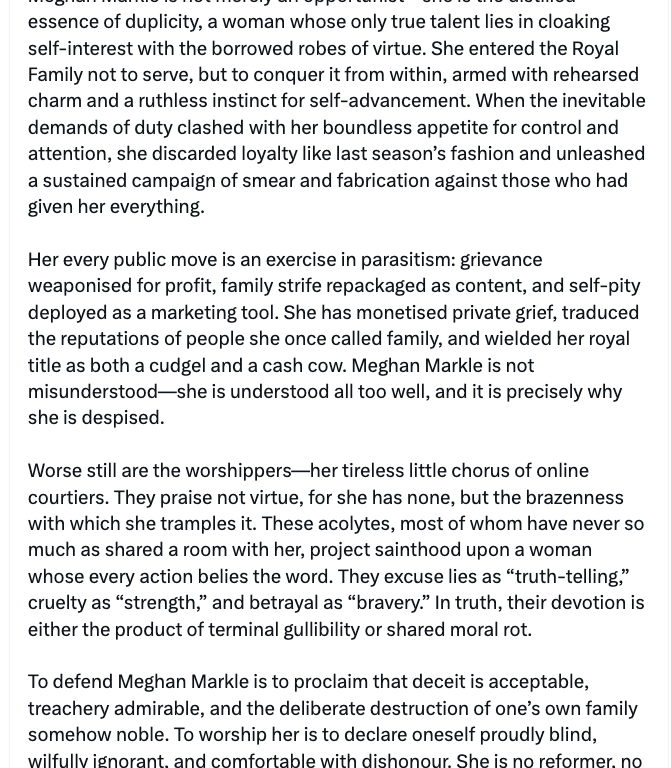
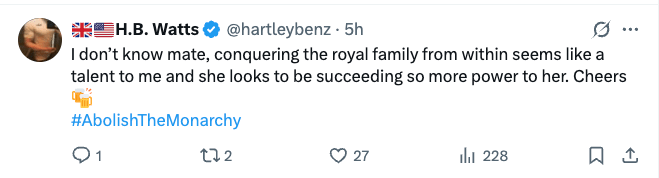
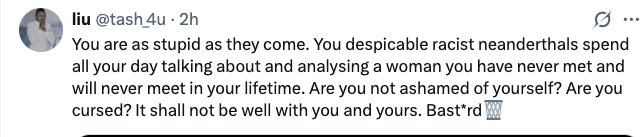
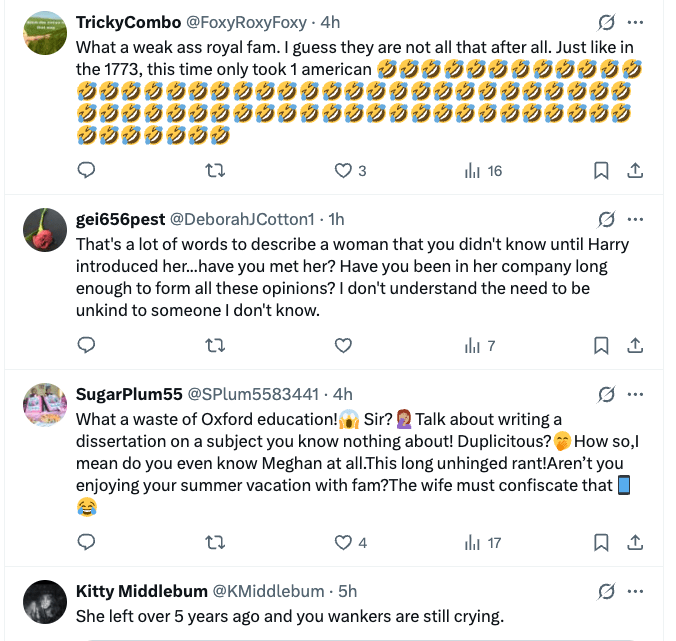
If you have ever wondered what happens when a group of strangers on the internet decide that the life mission for the day is to hate someone they have never met, look no further than a recent Twitter thread about Meghan Markle. It began with a flourish of inventive name-calling, describing the Duchess and her supporters as “low rent” and “feral rats,” which set the stage for a marathon of creative writing exercises disguised as righteous indignation.
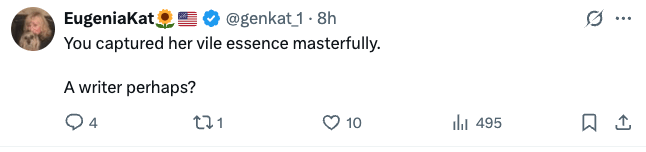

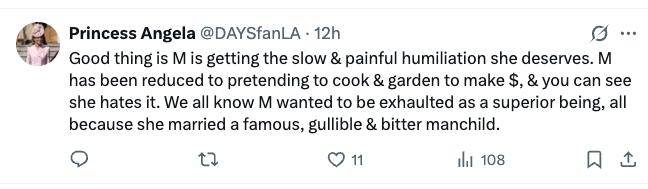
Within hours, the replies section had blossomed into a gallery of greatest hits from the Anti-Meghan Playbook. There were character diagnoses without medical degrees, accusations without evidence, and conspiracy theories without the courtesy of a coherent timeline. One commenter solemnly declared that Meghan has “no conscience, no soul,” while another went with “empty husk of a human being,” proving that even in the age of AI there is still room for human originality in repetitive insults.

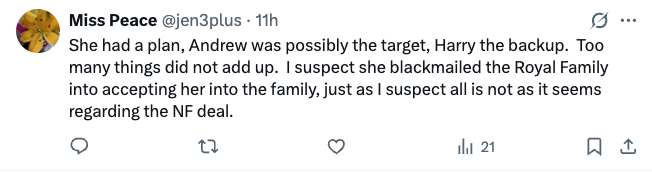
Some replies read like rejected pitches for streaming thrillers. Others insist she blackmailed the Royal Family into accepting her, which sounds less like a crime and more like the plot twist in a drama where the writers have run out of budget for believable dialogue.
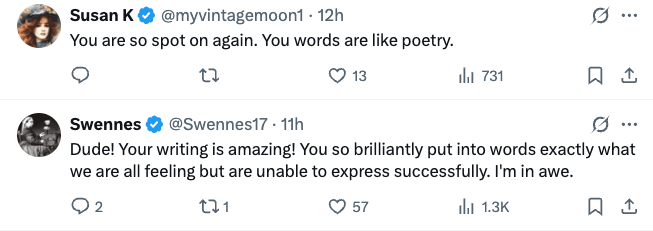
Then there are the accusations about her personal relationships, each crafted with the confidence of someone who believes Wikipedia, the tabloids, and their neighbor’s Facebook post form a legitimate research methodology. Her father gets pulled into the narrative, her motives are dissected like a frog in a high school biology lab, and all of it is presented as unassailable truth despite being little more than gossip in slightly longer sentences.
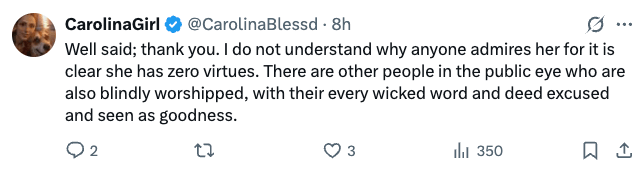
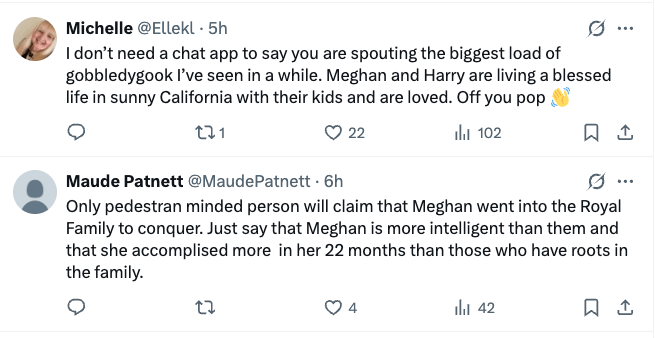
Amid the chorus of criticism, a few lone voices appear to question the point of the whole exercise. One user simply asked how Meghan’s life actually affects anyone else’s, a radical question in a space where oxygen seems to be drawn not from air but from shared outrage. Their comments were largely ignored, which makes sense when you realize that threads like this are not debates but rituals. The goal is not to exchange perspectives but to rehearse the lines, to prove membership in the club by saying the right kinds of wrong things.

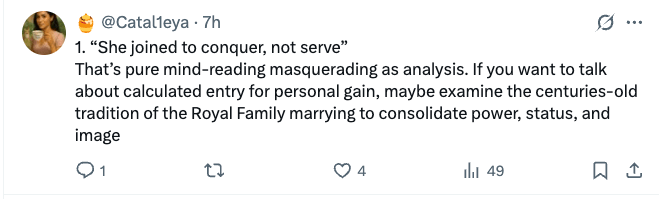
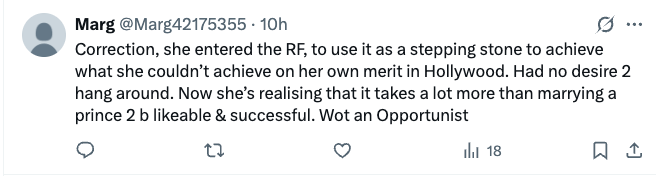
The repetition is telling. Words like “opportunist” and “cult” surface again and again, giving the impression that many users are reading from the same unwritten script. There is a rhythm to the hate, a tempo that keeps the pile-on cohesive. It is less an exchange of ideas and more an online performance, where the main act is mutual validation and the applause is the “like” button.

This kind of thread is not unique to Meghan Markle, but she has become one of the internet’s most reliable hate-click generators. The formula is simple. Begin with a provocative insult, invite the faithful to add their own variations, and watch the replies stack up like cards in a game of spiteful solitaire. Facts are optional. Consistency is optional. What matters is that each comment pushes the same emotional buttons for the audience already primed to press them.

In the end, this thread tells us very little about Meghan Markle herself, but a great deal about the way certain corners of social media operate. It is a reminder that for some, the joy of participating in a collective pile-on outweighs the need for accuracy, fairness, or even basic decency. And like most online storms, it will blow over, leaving behind only the faint echo of people congratulating each other for how creatively they managed to insult a stranger.

A Field Guide to the Anti-Meghan Twitter Thread
On a recent Tuesday afternoon, a corner of Twitter became a living laboratory for the study of online hostility. The subject was Meghan Markle, and the participants were a mix of self-appointed truth tellers, amateur psychologists, and part-time conspiracy novelists. What followed was a digital ecosystem worth documenting.


Species 1: The Latin-Named Insulter
Distinctive for their colorful vocabulary, these users produce insults that could be mistaken for entries in an urban dictionary of Victorian slurs. One described Meghan and her supporters as “low rent” and “feral rats,” a phrase that sounds like it was borrowed from an unpublished Dickens manuscript. This species thrives on metaphor, preferably the kind that dehumanizes the subject while making the speaker feel poetic.

Species 2: The Armchair Pathologist
This group offers definitive mental and spiritual diagnoses without ever meeting their patient. Meghan has “no soul” according to one, and is an “empty husk” according to another. The language is clinical in tone but sourced entirely from the speaker’s imagination. The armchair pathologist’s natural habitat is the reply section, where their speculative assessments can be liked and retweeted by peers.
Species 3: The Political Thriller Screenwriter
These participants live for intrigue. They believe Meghan was “chosen by handlers” to influence an American election, or that she “blackmailed the Royal Family” into accepting her. The plotlines are grand and cinematic, yet strangely short on verifiable evidence. If asked for proof, they might point to an article from 2018, a YouTube rant, or simply the fact that “it makes sense if you think about it.”
Species 4: The Historian of Her Private Life
Every family photograph, every interview, and every tabloid rumor is evidence to this species. Meghan’s relationship with her father is dissected in forensic detail, usually to prove that she is repeating his alleged faults. The historian frames every choice she makes as part of a larger moral failing, though the “research” rarely extends beyond gossip.

Species 5: The Cult Theorist
This variety thrives on the word “cult.” They claim Meghan’s supporters worship her, ignore “facts,” and are doomed to collapse just like every other cult in history. The definition of “cult” here is flexible enough to include any fan community that disagrees with them. Their preferred narrative is that this collapse is imminent, preferably within the week.

Species 6: The Lone Skeptic
An endangered species. These rare posters question the whole exercise, asking how Meghan’s life could possibly affect anyone on Twitter. Their comments are often ignored or dismissed, as they disrupt the carefully maintained ecosystem of shared outrage. They tend to leave the thread quickly, perhaps sensing that they have wandered into the wrong nature reserve.

Shared Behaviors
Across species, there is a common rhythm. Certain words and ideas reappear with almost ritual regularity: “opportunist,” “stepping stone,” “no merit of her own.” The repetition creates a sense of unity, as if the thread is less a conversation and more a group performance where everyone is reading variations of the same script.


 celebchai.com