The “Angry Black Woman” and “Gold Digger” Tropes
Media coverage of Meghan Markle has consistently deployed harmful stereotypes historically used against Black women. The persistent narrative questioning her motives for marriage echoes the “gold digger” trope, while descriptions of her as “demanding” or “difficult” align with the “angry Black woman” stereotype.
These frames are particularly insidious because they recontextualize normal behavior as pathological. A wife posting proudly about her husband becomes “love bombing.” Professional ambition becomes “social climbing.” Setting boundaries becomes “divisiveness.”
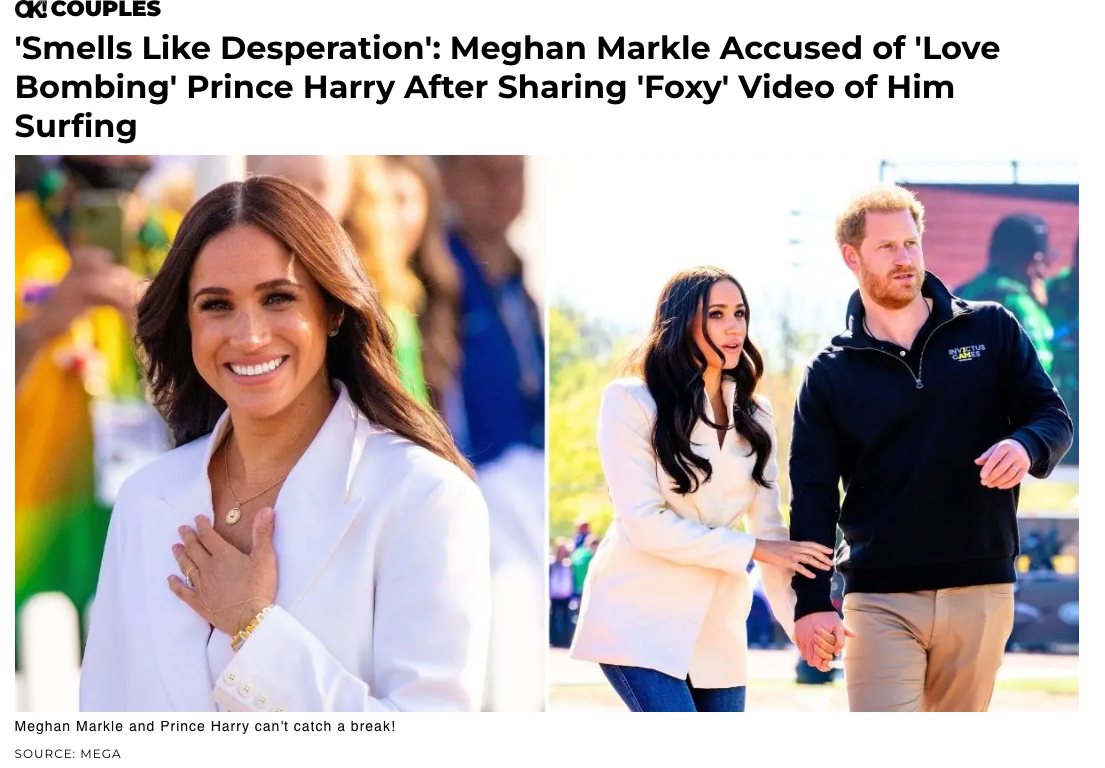
The recent criticism over Meghan’s surfing video of Prince Harry perfectly illustrates this pattern. What would be seen as playful affection from other spouses gets filtered through a lens of suspicion – suddenly it’s “desperate,” “cringe,” or evidence of manipulation rather than simple marital pride.
Differential Framing Patterns
This reframing isn’t accidental. Research has documented stark contrasts in how similar actions by Meghan versus other royals are presented. When Catherine, Princess of Wales, shares affectionate content about Prince William, it’s typically described as “supportive” or “loving.” When Meghan does the same, terms like “attention-seeking” or “controlling” frequently appear.
The pattern extends beyond social media. Meghan’s pregnancy cradling was labeled “attention-grabbing,” while identical gestures from other pregnant royals were called “maternal.” Her fashion choices were criticized as “inappropriate” or “expensive,” while similar spending by other royals received gentler treatment or was ignored entirely.
The Amplification Cycle
Modern media creates an ecosystem where criticism becomes self-perpetuating. A few negative social media comments get elevated into “backlash” stories, which generate more criticism, creating an artificial cycle of controversy. This pattern disproportionately affects Meghan compared to other royals who face similar or lesser criticism that doesn’t get amplified.
The surfing video incident exemplifies this: rather than engaging with the content (a playful post about her husband), coverage immediately amplifies the harshest reactions and frames them as representative of broader public sentiment.
The Cost of Constant Scrutiny
This pattern of coverage has real consequences. It normalizes the idea that Black women’s actions are inherently suspect, that their emotions are dangerous, and that their presence in elite spaces requires constant justification. For Meghan specifically, it has contributed to documented mental health impacts and her eventual departure from royal duties.
Moving Forward
Understanding these patterns doesn’t require agreeing with every choice Meghan makes or dismissing all criticism as automatically racist. Rather, it means recognizing how racial bias can unconsciously influence how we interpret actions and how media coverage can amplify harmful stereotypes.
Responsible media consumption requires questioning why certain figures face disproportionate scrutiny and considering how historical biases continue to shape contemporary coverage. The goal isn’t to eliminate criticism of public figures, but to ensure that criticism is fair, proportionate, and free from the distortions of racial stereotypes that have been used to marginalize Black women for generations.
 celebchai.com