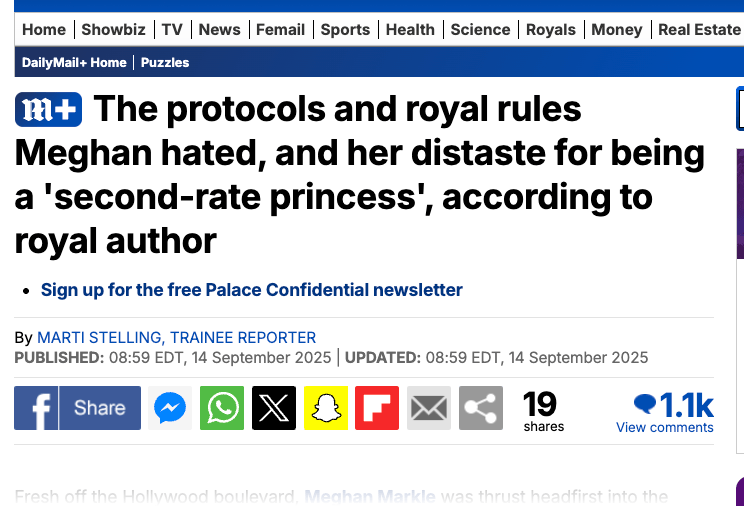
The persistent narrative that Meghan Markle “hated the rules” or harbored unrealistic expectations about royal life deserves closer scrutiny. When we examine the facts rather than the tabloid framing, a different picture emerges one that reveals more about institutional shortcomings than personal entitlement.
The Reality of Royal Accommodations
Nottingham Cottage, often portrayed as a charming royal residence that should have satisfied any reasonable person, was in reality a 1,324 square foot space with notably low ceilings. This wasn’t designed as a permanent family home for working royals. It was temporary accommodation that became inadequate once Harry and Meghan began planning for children and a long-term future.
Consider the broader context: William and Kate occupied a spacious farmhouse in Wales while using Nottingham Cottage only as their London base. Sophie and Edward received Bagshot Park. Even junior working royals traditionally received accommodations suited to their roles and family needs. The disparity wasn’t subtle, and recognizing it wasn’t unreasonable.
When Legitimate Concerns Become Character Flaws
The transformation of practical housing concerns into evidence of personal failing reveals how narratives get constructed. The same media outlets that would never expect William and Kate to raise Prince George permanently in a small cottage presented Meghan’s recognition of inadequate space as proof of her inflated expectations.
This pattern—reframing institutional gaps as personal shortcomings—obscures important questions about how the monarchy actually supports its working members. If the institution expects full-time royal duties from Harry and Meghan, providing appropriate infrastructure seems like basic institutional planning, not special treatment.
The Double Standard
Perhaps most telling is how different royal women navigate—or are perceived to navigate—these institutional realities. Kate’s middle-class background didn’t prevent her acceptance because she adapted quietly to existing systems. Sophie found her place by following established protocols without public complaint.
Meghan faced different expectations. Her questions about protocols and frank acknowledgment of difficulties were characterized as problematic rather than constructive. When she didn’t silently accept inadequate conditions, this became evidence of narcissism rather than normal advocacy for her family’s needs.
The Modernization Paradox
The royal family frequently speaks of modernization and adaptation to contemporary expectations. Yet when someone actually experiences and articulates the gaps between these aspirations and daily reality, the response often focuses on managing the messenger rather than addressing the message.
If the institution genuinely wants to evolve, perhaps the insights of those who’ve lived through its protocols rather than just inherited them and offer valuable perspective. Dismissing legitimate concerns as personal failings may protect traditional narratives, but it doesn’t solve institutional problems.
The question isn’t whether monarchy has hierarchy. That’s understood. The question is whether that hierarchy should extend to providing inadequate support for family life while expecting full professional commitment. Meghan’s experience suggests the institution struggled with this balance, then blamed her for noticing the contradiction.
Looking Forward
This isn’t ultimately about defending any individual’s choices, but about recognizing how complex institutional dynamics get reduced to simple moral narratives. When we examine the actual circumstances rather than the constructed storylines, we often find that the “difficult” person was simply the one willing to name problems others preferred to ignore.
Real institutional modernization requires honestly examining these gaps between stated values and lived reality. The alternative is maintaining systems that work for some while blaming those for whom they don’t work for their failure to adapt.
 celebchai.com