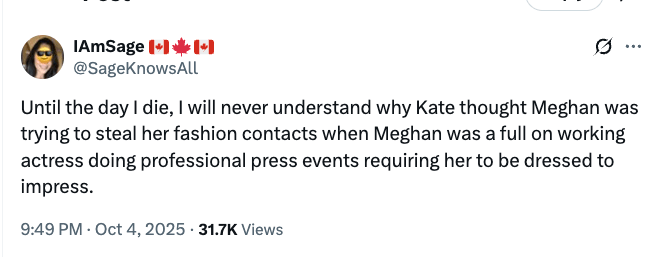
When Meghan Markle entered the royal fold, the press called her a breath of fresh air. But inside palace walls, that freshness was treated as a threat. Few anecdotes reveal that dynamic more vividly than the claim, written in Prince Harry’s memoir Spare, that Kate Middleton believed Meghan was trying to steal her fashion contacts. The comment became a cultural flashpoint because it exposed the monarchy’s fragile relationship with relevance. It wasn’t just about clothes. It was about control.

Before she ever met Prince Harry, Meghan was already established as a professional accustomed to high-visibility settings. As an actress on Suits, she had stylists, photographers, and access to the fashion press. She was photographed in Tom Ford, Misha Nonoo, and Erdem, and even collaborated with Reitmans on a capsule collection. Her image management wasn’t an indulgence; it was part of her career. When she married into the royal family, she brought with her a mastery of modern presentation that came naturally to someone trained in the entertainment industry. For an institution rooted in hierarchy and convention, that competence was misread as competition.
The idea that Meghan would need to borrow Kate’s stylistic connections misunderstands both women’s worlds. Kate’s early royal wardrobe was rooted in British tradition: Zara for accessibility, Alexander McQueen for gravitas, and Jenny Packham for ceremony. Her approach emphasized continuity with the past, deliberately echoing Princess Diana’s shapes and tones. Meghan’s taste leaned global, mixing Givenchy minimalism with Californian casualness and a soft, modern feminism that rejected overt pageantry. The two weren’t even operating in the same aesthetic language. Yet palace courtiers and tabloids framed them as rivals rather than complements.
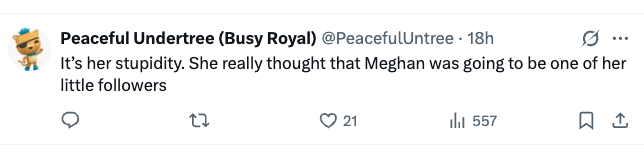
At its core, the “fashion contact” paranoia was about social dominance. Within the royal structure, fashion serves as currency: the visible expression of rank, class, and allegiance. Meghan’s fluency in global media undermined that order. She didn’t wait for approval from the royal dressers; she sourced her own designers and was already on first-name terms with international publicists. To a system built on deference, her independence looked like rebellion. And to Kate, who had built her image on royal conformity, it may have looked like subversion.

But the British media magnified that insecurity until it became a cultural script. Meghan’s modernity was painted as vanity; Kate’s imitation became framed as elegance. Even when the Princess of Wales later mirrored Meghan’s silhouettes (structured coats, monochrome palettes, wide-leg trousers), the press celebrated her as trendsetting, not trailing. The double standard wasn’t accidental. The monarchy’s media ecosystem rewards preservation of the status quo. Meghan disrupted that narrative by refusing to play supporting actress to another woman’s storyline.

The Paris Fashion Week appearance in October 2025 brought this full circle. Meghan’s return to the front row, nearly a decade after her last major fashion event, was a declaration of independence. She arrived not as a duchess needing validation but as a cultural figure commanding it. The contrast was stark: while Kate’s engagements remain bound to protocol, Meghan’s platform now moves freely across Hollywood, business, and humanitarian spheres. The same self-possession once deemed “difficult” within the Palace now reads as authority.

There’s a deeper irony in the original accusation. The royal family once prided itself on setting trends, but today, its relevance depends on proximity to the very celebrity culture it used to dismiss. Meghan didn’t steal Kate’s contacts; she made the institution confront its obsolescence. What was framed as rivalry was, in truth, the collision of two value systems: one hereditary, one earned. And in the fashion world, authenticity always wins.

History will likely remember this not as a feud but as a case study in the monarchy’s failure to adapt. The fear that a woman of color might outshine the future queen through competence, charisma, and global reach speaks volumes about the insecurities of Britain’s most visible family. Meghan’s fashion sense wasn’t a threat to Kate’s wardrobe. It was a threat to the illusion that lineage equals legitimacy.
 celebchai.com