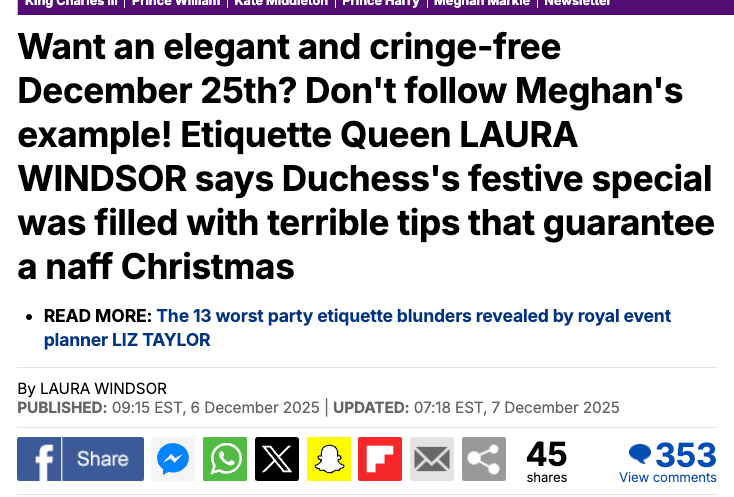
The recent Daily Mail critique of Meghan’s holiday special presents itself as a lesson in etiquette, but it is not, in substance, an etiquette analysis. It is an aesthetic and class-based critique that uses etiquette language as a proxy for judging whether Meghan’s on-screen persona aligns with a particular idea of “luxury” or “elevated” taste. Once that distinction is made, the argument becomes easier to see and easier to assess.
What is being criticized throughout the column is not discourtesy or guest discomfort, but a perceived mismatch between informality and a glossy visual presentation. Casual language is treated as evidence of an inability to embody elegance. Personal anecdotes and light physical affection are framed as inherently inappropriate in mixed company. Tableware choices, serving conventions, and decorative details are scrutinized not for their effect on guests, but for whether they conform to an implied code of refinement. Even stylistic flourishes are cast as moral failures, described as cluttered or try-hard rather than restrained.
- What the column is actually arguing (beneath the etiquette framing)
It is not primarily teaching etiquette. It is arguing that Meghan’s on-screen persona is incompatible with the show’s “luxury/elevated” aesthetic, and it uses etiquette norms as the measuring stick. Most of the “tips” are not presented as universally correct hosting rules; they are presented as class markers: refined versus common, elevated versus naff. Once you see that, the throughline becomes consistent:
- language register: “hi friend,” “gang,” “easy on the gin” is framed as proof she cannot inhabit “elegance”
- intimacy and bodily references: spicy-food sweating, kissing Harry, etc. is framed as proof she is inappropriate in mixed company
- table choices: wine in water glasses, napkin as coaster, French 75 in a champagne flute are framed as proof she is performative, not competent
- conversational dominance: “Meghan-centered” is framed as proof she lacks the core virtue of good hosting (guest-centeredness)
- “practical” styling tips: crudités wreath, confetti crackers, rosemary on gifts are framed as clutter/try-hard rather than tasteful restraint
Those categories are coherent as an aesthetic critique. They are weaker as an etiquette lesson, because etiquette is situational, culturally contingent, and dependent on the house style (formal dinner party versus casual holiday gathering versus produced TV segment).
- Rhetorical moves and pressure points
A) Credential stacking to claim authority: The writer front-loads “Queen of Etiquette” and “advised Netflix on Bridgerton” to create the premise that her preferences are objective standards. That is persuasive, but it is not evidence about hosting outcomes (guest comfort, warmth, fun, clarity, safety).
B) Conflation: etiquette rules vs production choices: A TV “holiday celebration” is not the same as a private dinner. Some moments are written for relatability, humor, or character beats. Critiquing them as if they were spontaneous real-life hosting errors is a category mistake.
C) The “luxury aesthetic” premise does most of the work: Many claims reduce to: if you want luxury, avoid anything that signals casualness. That is a brand-consistency critique, not a moral failing. The article slides between “not aligned with luxury” and “ill-mannered,” which is how it escalates.
D) Insinuation via “cringe” and “naff”: Those are social sanctions, not arguments. They cue the reader to join an in-group that “knows better.”
E) Selective interpretation and mind-reading: Examples: “she looked annoyed,” “she chuckled because she wasn’t listening,” “she used the dish as an opportunity to mention her husband.” Those are not verifiable from text alone; they’re interpretations presented as facts.
F) Comment section as a parallel narrative engine: The comments include classist, sexist, and dehumanizing insults (e.g., “trailer trash,” appearance shaming, crude slurs). That matters because it reveals why this genre is profitable: the column is written to ignite that pile-on. The comments also show the countercurrent: some readers reject the premise (“who cares,” “don’t watch,” “stuck-up review”).
As an aesthetic critique, this approach is internally coherent. As an etiquette lesson, it is considerably weaker. Etiquette is situational and culturally contingent. It varies by context, audience, and setting. A formal dinner party, a casual holiday gathering, and a produced television special operate under different social norms. Treating a televised holiday program as though it were a private, formal dinner party is a category error.
The rhetorical techniques driving the column are familiar. Authority is established early through credential stacking, positioning the writer’s preferences as objective standards rather than subjective judgments. Production choices are repeatedly conflated with spontaneous hosting behavior, as though a scripted or edited moment should be evaluated as an unrehearsed social interaction. The notion of “luxury” does much of the argumentative work, quietly transforming informality into a flaw rather than a stylistic choice. Loaded descriptors such as “cringe” and “naff” function as social signals, inviting readers to align themselves with a particular cultural hierarchy rather than to consider outcomes like warmth, ease, or guest comfort.
Interpretation is often presented as fact. Facial expressions are read as annoyance, laughter as inattentiveness, and conversational callbacks as calculated self-centering. These claims are not verifiable from the material itself, but they are framed as self-evident, reinforcing a narrative of inadequacy rather than offering concrete analysis.
What weakens the article is its tendency to convert matters of taste into judgments of character. Colloquial language is not inherently ill-mannered. Physical affection is not automatically inappropriate. Decorative preferences are not breaches of decorum. These are cultural and stylistic differences presented as universal failures.
Etiquette, at its core, is not about enforcing status through ritual correctness. It is about making others feel comfortable and welcome. Disagreement with a particular style of hosting does not demonstrate a lack of class; it demonstrates difference. When preference is mistaken for principle, etiquette becomes a tool of exclusion rather than hospitality.
 celebchai.com