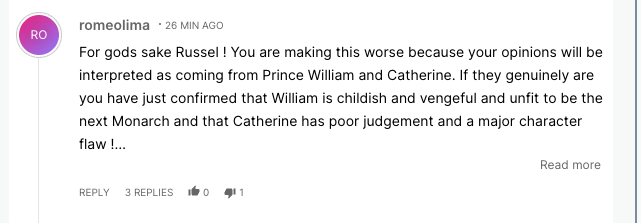
Myers sells the book on the premise that his sources are genuinely close to William and Catherine. That closeness is supposed to give the account credibility and authority. But here’s the problem: if you accept that premise, then the conduct those sources describe is what William and Catherine actually did and actually think. And the conduct, even wrapped in sympathetic language, is not flattering.So the commenter is saying: Russell, you think you’re helping them, but you’re actually putting their worst behavior on the record with their implied endorsement. Calling Harry “paranoid” through a palace source, confirming the security double standard, revealing that Catherine’s position was to treat the Sussexes as fundamentally untrustworthy… these details only carry weight because you claim insider access. If a random tabloid columnist said all this, it would be speculation. Because you said it with palace backing, it becomes an admission.
The “making this worse” part is the key. romeolima is arguing that silence would have served William and Catherine better than this book does, because every piece of “insider” detail Myers publishes to make them look reasonable actually documents behavior that a neutral reader could interpret as smallness, grudge-holding, and institutional bullying.
It’s the difference between someone talking about you behind your back versus your own friend going on the record to defend you and accidentally making you sound terrible.
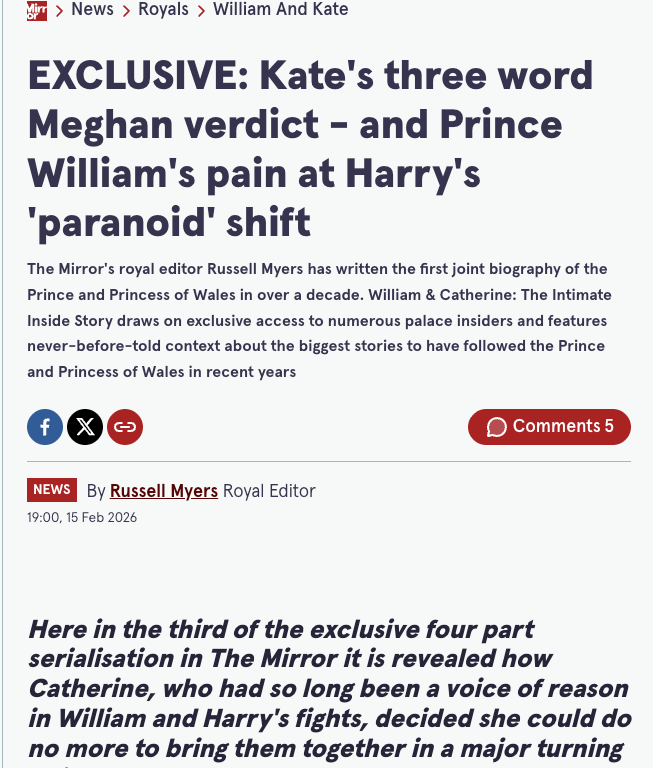
Sometimes the most devastating critique of a media strategy comes not from rival journalists or opposition camps, but from the comment section. Buried beneath the Mirror’s breathless third installment of Russell Myers’ serialisation of William and Catherine: The Intimate Inside Story sits a five-line reader comment that dismantles the entire project more effectively than any formal rebuttal could.
One reader puts it plainly: if Myers’ characterisations genuinely come from William and Catherine’s circle, then all he has confirmed is that William is childish and vengeful and that Catherine has poor judgment and a major character flaw. And if they don’t, the “intimate inside story” is built on sand.
This is not a Sussex sympathiser’s hot take. It is a structural observation about how authorised narratives can collapse under the weight of their own logic. And it deserves unpacking.
The Trap of the “Intimate Inside Story”
Myers’ book is marketed on its exclusive access: “numerous palace insiders,” never-before-told context, the authority of someone embedded in the royal press ecosystem for years. This framing is the book’s selling point and its fatal flaw, because it creates a binary that neither outcome survives.
If these sources are genuinely close to William and Catherine, then the couple sanctioned (or at minimum failed to prevent) a public airing of grievances that makes them look petty, controlling, and strategically vindictive. If the sources are fabricating or embellishing, then Myers has built a biography on unreliable testimony, and the “intimate inside story” is neither intimate nor inside.
Either way, the narrative fails on its own terms.
What the Text Actually Reveals About William
Strip away the sympathetic framing and examine what Myers’ own sources actually describe. William, we are told, claimed territorial ownership over conservation work across an entire continent. When Harry expressed interest in similar causes, William apparently treated it as an encroachment. The text presents Harry’s reported response, “You don’t just get Africa,” as evidence of Harry’s entitlement, but read without the editorial scaffolding, it is a reasonable pushback against the idea that a prince can claim monopoly over environmental advocacy across 54 countries.
William, according to these palace insiders, refused to intervene when Harry requested security support for Meghan, support that Catherine herself had received at an equivalent stage in her relationship. The text acknowledges this disparity and then immediately pivots to framing Harry’s frustration as unreasonable. But the asymmetry is right there in the text. If this account is accurate, William watched his brother’s partner face racist abuse online while declining to advocate for her protection, citing government protocol that had been quietly bypassed for his own partner.
William is further described as someone who “admonished” Harry for responding to racist media coverage without first consulting the family hierarchy. The implicit argument is that protocol matters more than addressing racism, a position that, stated plainly, is difficult to defend.
And perhaps most damagingly, a source close to William characterises Harry as having become “paranoid, angry, obsessive and firmly rooted in the past.” This is clinical, pathologising language deployed against a family member through the press. If William’s circle is genuinely briefing journalists to describe his brother this way, it raises serious questions about the emotional maturity and judgment of a future king.
What the Text Actually Reveals About Catherine
Catherine emerges from Myers’ account as someone who made swift, categorical judgments and then treated them as settled fact. She reportedly described Meghan as “friendly” but “over-friendly” with a “touch of California,” language that frames warmth and cultural difference as character defects rather than simple personality variation.
The text tells us Catherine and Sophie made “repeated attempts” to help Meghan assimilate into royal life that were “not responded to.” This is presented as evidence of Meghan’s ingratitude, but it assumes a single interpretation of events. Assimilation assistance from within an institution can look very different depending on whether you are offering it or receiving it. The framing forecloses any possibility that the “help” may have carried conditions, or that Meghan’s non-response reflected discomfort rather than rudeness.
Most significantly, Catherine’s ultimate verdict, that Harry and Meghan were “not to be trusted,” is presented as wisdom rather than examined as a position. But consider what it means for a future queen to arrive at a permanent judgment about family members and then, according to these sources, advise that “any engagement with Harry or Meghan should be with the utmost of caution.” This is not diplomatic restraint. It is a recommendation for institutional ostracism, briefed to a journalist for public consumption.
If Catherine’s judgment is as sound as this biography claims, why does the most significant interpersonal assessment attributed to her read less like measured wisdom and more like a grudge elevated to policy?
The Sourcing Problem No One Is Discussing
The entire serialisation rests on anonymous sources described only as “close to” William and Catherine. This sourcing architecture serves a specific function: it allows claims to carry royal authority without royal accountability. William and Catherine can benefit from every flattering characterisation while maintaining the position that they never personally participated.
But this is exactly the trap that authorised narratives set for themselves. When a royal editor with acknowledged palace access publishes accounts that consistently favour the Wales perspective, the reasonable inference, regardless of formal denials, is that the principals are aware of and comfortable with the narrative being constructed on their behalf. The sources are the message.
And the message, stripped of its sympathetic packaging, is this: William territorial, Catherine judgmental, both willing to air family grievances through proxies while positioning themselves as the wronged parties.
The Institutional Logic of the Backfire
There is a pattern in royal communications that this serialisation exemplifies perfectly. The institution defaults to a strategy of establishing one party as reasonable and the other as irrational. It works when the audience accepts the framing uncritically. It collapses when anyone examines the substance of what “reasonable” actually entailed.
Myers presents Catherine seeing the “inevitability” of the Sussex departure as evidence of her perceptiveness. But inevitability is not a neutral observation when you are one of the parties making reconciliation impossible. If you decline to intervene on security, pathologise your brother-in-law’s mental state through press briefings, and advise against engagement as a blanket policy, you are not predicting a departure. You are engineering one and then claiming you saw it coming.
Similarly, the text’s framing of William as someone who “lost his brother” does emotional work that the facts resist. You cannot describe someone as “paranoid” and “obsessive” through palace sources, refuse to advocate for their partner’s safety, admonish them for responding to racist press coverage, and then position yourself as the one who “lost” a brother. That is not loss. That is the consequence of choices presented as inevitabilities.
The Question the Mirror Should Be Asking
The real story embedded in Myers’ serialisation is not about the Sussexes’ departure. It is about the Wales machine’s inability to tell a story about itself that survives contact with its own evidence.
Every reader who absorbs this serialisation uncritically will come away with the intended impression: William and Catherine as measured, hurt, and fundamentally decent people who did their best with an impossible situation. But every reader who pauses to examine the actual conduct described (the territorial claims, the security double standards, the pathologising language, the categorical judgments briefed through intermediaries) will arrive at the same uncomfortable conclusion.
If this is the best version of the story that palace insiders can construct with the full cooperation of a sympathetic royal editor, then the underlying reality must be considerably less flattering than what is being presented.
The readers, as it turns out, understood the assignment better than the author.
Celeb Chai examines media manipulation patterns and institutional power dynamics in celebrity coverage.
 celebchai.com
2 thoughts on “Part Three: Kate & William Sterilization Manages to Discredit Them”