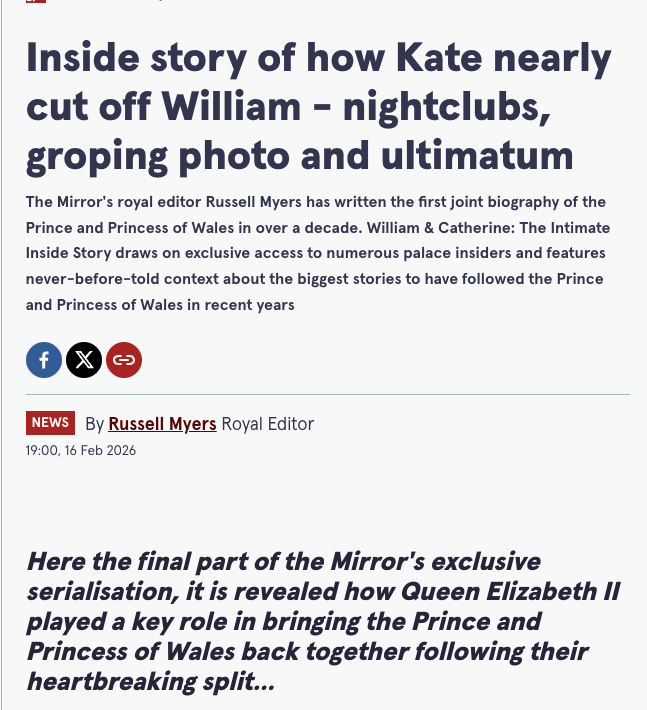
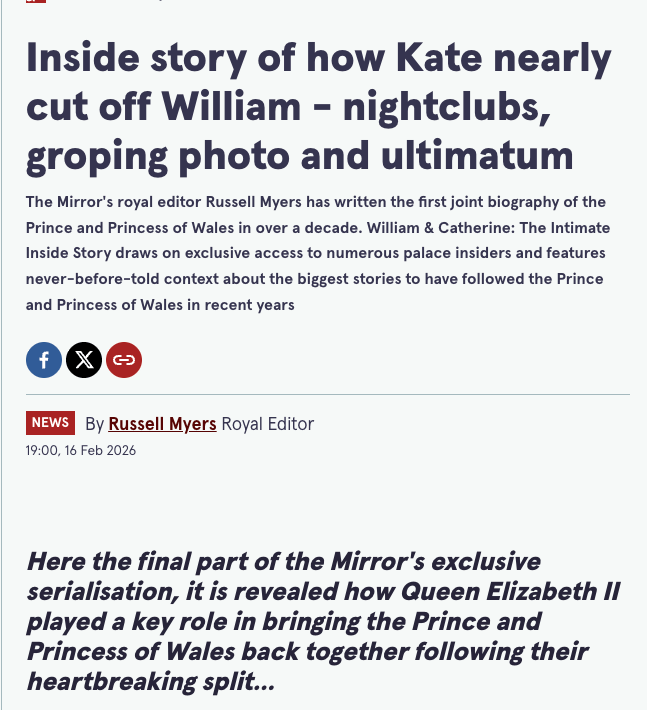
The final installment of Russell Myers’ serialization of William & Catherine: The Intimate Inside Story contains a photograph’s worth of trouble and a biography’s worth of cleanup. The trouble: in 2007, Prince William was photographed in a Bournemouth nightclub, sweaty, clutching a beer, appearing to grope an 18-year-old Brazilian student on the dancefloor while his girlfriend of four years sat at home. The cleanup: nearly 2,000 words of narrative scaffolding designed to transform that moment from what it looks like into something nobler.
Myers does not dispute the photograph. He cannot. It exists. What he does instead is far more instructive. He builds a frame around it so elaborate that by the time the reader reaches the end of the installment, the man in the nightclub has become a tortured soul wrestling with the weight of royal expectation, guided back to love by his wise grandmother.
That is quite a journey from “wide-eyed, sweaty and clutching a pint of beer as he stood between two young women.”
The Rhetorical Laundering
Watch how Myers handles the nightclub incident. He describes it plainly enough at first. William “heaped further embarrassment on Catherine.” He “seemed to have temporarily abandoned his senses.” The photograph is unflattering and the behavior is indefensible on its face. A man in a committed relationship was photographed with his hands on a teenager in a nightclub.
Then the pivot. “Was this the normality he craved?” Myers asks. “Or was he simply a young man letting off some steam after finishing a tank commander course, while continuing to exist in a pressure-cooker situation?”
Read that again. In the space of two sentences, the man groping a student in a club has been recast as a young soldier decompressing from military service while navigating impossible institutional pressures. The agent of the behavior has become its victim. The woman he embarrassed is still sitting at home, but the narrative has already left her there.
This is textbook rhetorical laundering. You acknowledge the damaging fact just enough to claim honesty, then immediately bury it under a mountain of sympathetic context. The reader is not being asked to judge what William did. The reader is being asked to understand why he did it.
Catherine Gets an Ultimatum. William Gets a Character Arc.
After the nightclub incident and the frosty appearance at Cheltenham, Catherine delivers what Myers describes as an ultimatum. She tells William she wants a commitment, and if he cannot deliver one, they should part ways. By any reasonable reading, this is the moment in which Catherine exercises agency. She is the one making the demand. She is the one drawing the boundary. She is the one who has been publicly humiliated and is refusing to accept it.
So naturally, the narrative pivots immediately to William.
“At least she is free,” William tells a senior courtier after confirming the breakup through Clarence House. And with that single quote, the entire emotional center of the story shifts. Catherine’s ultimatum becomes a footnote. William’s existential crisis becomes the main event.
Myers describes this as “perhaps the most significant moment in his life since his mother had passed.” William, we are told, was consumed by “deep distress and anxiety over what a relationship with him represented in the real world.” He worried about “the attention, the constant pressure and expectation.” He wondered whether he was “taking the right course of action, for Catherine or himself.”
The woman who just told him to commit or leave has evaporated from the narrative. In her place stands a prince in anguish, burdened not by the consequences of his own behavior but by the cosmic unfairness of being born into royalty.
The Queen as Narrative Deus Ex Machina
Enter Queen Elizabeth II, who senses that William is “struggling” and invites him to Sunday lunch. William is, according to a “well-placed source,” “completely broken.”
The Queen advises him that “the only certain path is the one supported by faith.” William has his epiphany. He realizes Catherine is “the one.” They reunite. The narrative arc is complete: crisis, suffering, wisdom, reunion.
But notice what this structure does. It positions the resolution of William and Catherine’s relationship not as the result of Catherine’s ultimatum, not as the product of William reckoning with his own behavior, but as the outcome of a grandmother’s gentle counsel. Catherine demanded change. The Queen provided comfort. And the story Myers tells is the one about the comfort.
The Queen’s role here is not incidental. She functions as the moral authority who absolves William without requiring him to account for what he did. She does not tell him to apologize. She does not tell him to grow up. She tells him to follow his heart. The groping photograph, the public humiliation of his girlfriend, the pattern of behavior that led to the breakup: all of it dissolves in a bowl of Sunday lunch soup and a platitude about faith.
The Pre-Wedding Tea and the “Headstrong Husbands” Line
Fast forward to December 2010. Catherine, now engaged, is invited to Buckingham Palace for afternoon tea with the Queen. Myers describes her adjusting her hair and touching up her makeup in the car, seeking advice from aides on what to wear and say. She is “understandably nervous.”
The Queen offers “guidance in how to deal with ‘headstrong’ husbands.”
Let that phrase do its work for a moment. In the context of this serialization, “headstrong” is doing an enormous amount of labor. It is the word chosen to describe a man who was photographed groping a teenager in a nightclub, who broke up with his girlfriend via a Clarence House press statement, and who required his grandmother’s intervention to recognize what he was about to lose.
“Headstrong” is the word you use for a spirited horse or a willful child. It is not the word you use for a grown man whose behavior caused a public relationship crisis. But it is the perfect word if your goal is to frame that behavior as a personality trait rather than a pattern, something to be managed rather than something to be changed.
The Queen is not warning Catherine about anything serious. She is sharing a wry observation about men and their ways. The implicit message is that William’s behavior was within the normal range of royal husband conduct, a feature rather than a bug, something any sensible wife learns to navigate.
The Asymmetry That Defines This Biography
The final installment makes visible what has been operating throughout the entire serialization: a systematic asymmetry in how William and Catherine’s experiences are weighted.
When Catherine exercises agency (delivering an ultimatum, demanding commitment, refusing to accept humiliation), the narrative acknowledges it briefly and moves on. When William experiences emotion (distress, anxiety, heartbreak, devotion), the narrative lingers, quotes multiple anonymous friends, and builds elaborate psychological portraits.
When Catherine makes decisions during her cancer treatment (choosing to record a statement, embracing natural healing, maintaining normalcy for her children), these are presented as grace notes. When William stands beside her during the same period, it is described as “love in its rawest, most powerful form.”
When Catherine assesses Meghan as someone who cannot be trusted, it is presented as a verdict delivered by a judge. When William fails to intervene on the security question where his own girlfriend had received exactly the protection Meghan was denied, the narrative pivots to Harry’s unreasonable reaction.
The pattern is consistent. Catherine’s actions serve the plot. William’s emotions are the plot.
Who Is This Biography For?
Myers writes that this is the first joint biography of the Prince and Princess of Wales in over a decade. He describes it as drawing on “exclusive access to numerous palace insiders.”
That phrase alone tells you everything about the book’s function. A biography built on access granted by the institution will inevitably serve the institution’s interests. The palace does not grant access to writers who will produce unflattering portraits of the heir to the throne. The “insider” accounts are not leaks. They are placements.
This final installment is the clearest illustration of the arrangement. The most damaging episode in William’s pre-marriage history, a nightclub photograph that would have ended a normal public figure’s romantic narrative, is not suppressed. It is included. But it is included inside a redemption arc so carefully constructed that the photograph becomes evidence of William’s humanity rather than his behavior.
That is the service a biography like this provides. It does not hide the unflattering material. It contextualizes it into oblivion.
And the woman who actually lived through all of it, who was humiliated publicly, who delivered the ultimatum, who made the demands that changed the trajectory of the relationship? She is there, of course. She is always there. Adjusting her makeup in the car. Being “understandably nervous.” Learning to deal with headstrong husbands.
Playing her part.
 celebchai.com
2 thoughts on “Part Four: Sterilization: The Grope, the Grandmother, and the Rewrite: How Russell Myers Laundered William’s Worst Moment Into a Love Story”