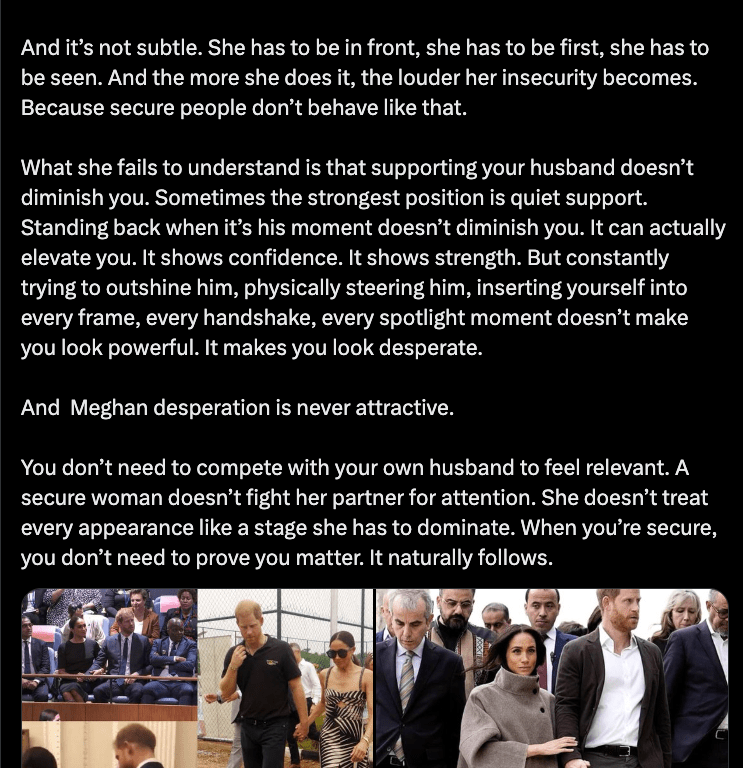
A post circulating on social media this week asks why Meghan Markle, “a 44 year old woman,” feels the need to “constantly claw onto Harry at every outing.” It describes her physical proximity to her husband as “not affection but control.” It calls her desperate. It calls her insecure. It defines the correct behavior for a wife as standing quietly behind her husband, and it frames any deviation from that position as a personality disorder.
The post has tons of engagements. It is not unusual. Variations of this analysis appear every time the Sussexes are photographed together. And it is worth examining not because of what it says about Meghan Markle, but because of what it reveals about the framework being applied to her.
The Word “Claw”
Start with the verb choice. Not “hold.” Not “touch.” Not “reach for.” The word is “claw.” It is an animal word. It conjures something predatory, something desperate and grasping. It transforms a wife’s hand on her husband’s arm into an act of aggression.
This is not accidental. Language choices in media criticism rarely are. “Claw” tells you how to feel before you have processed what you are seeing. It converts a photograph of two people standing close together into evidence of domination. Once you accept “claw,” every subsequent interpretation follows. If she is clawing, she is controlling. If she is controlling, she is insecure. If she is insecure, she is desperate. The entire psychological profile is built on a single verb applied to a woman touching her spouse.
Now replace the verb. “Meghan holds Harry’s arm at every outing.” That sentence does not generate 500 words of character assassination. It does not generate thousands of engagements. It is not interesting, because a wife holding her husband’s arm is not interesting. The verb is doing all the work.
The “Secure Woman” Standard
The post constructs a definition of what a secure woman looks like. She stands back. She offers quiet support. She does not compete for attention. She does not position herself in front. She does not try to be seen.
Read that list again. A secure woman is the one who is invisible.
This is the framework’s tell. It does not define security as confidence, or self-assurance, or comfort in one’s own identity. It defines security as absence. A secure woman does not occupy space. A secure woman does not draw focus. A secure woman makes herself smaller so that the people around her can be larger. And any woman who fails to shrink on cue is diagnosed as insecure, desperate, and controlling.
The post frames this as advice. “Supporting your husband doesn’t diminish you. Sometimes the strongest position is quiet support.” It sounds reasonable in isolation. But applied selectively, it becomes a weapon. Because this standard is not applied to women generally. It is applied to one woman specifically. And the reason it is applied to her has nothing to do with how she holds her husband’s arm.
The Comparison That Is Never Made
Catherine, Princess of Wales, holds William’s hand at public events. She walks beside him. She sometimes walks ahead. She sometimes steers him toward a crowd or a camera. These are documented, photographed, widely available images. No one has written a viral post calling her desperate for it. No one has diagnosed her with a control pathology based on her physical proximity to her husband.
Sophie, Duchess of Edinburgh, has held Edward’s arm, walked ahead of him, and positioned herself prominently at events for over two decades. No one has called it clawing. No one has suggested it reveals her insecurity.
Diana walked ahead of Charles so frequently it became a running joke among royal correspondents. The framing was not “desperate woman tries to steal spotlight.” It was “radiant princess captivates the world.”
The framework is applied to Meghan and only to Meghan. The same physical behavior that is invisible when performed by white royal women becomes pathological when performed by a biracial American woman. This is not a difference in behavior. It is a difference in who is allowed to be visible.
The Attention Economy Assumption
Buried in the post is an assumption so foundational it is never stated explicitly: attention directed at Meghan is attention stolen from Harry.
This requires a specific belief about the natural order of things. It requires you to accept that Harry is inherently more important, more interesting, and more deserving of public focus than his wife. It requires you to believe that any attention Meghan receives is engineered rather than organic, manufactured rather than earned, taken rather than given.
The post frames it as Meghan “inserting herself into every frame, every handshake, every spotlight moment.” But Meghan is not inserting herself. She is present. She is there because she was invited, because she is part of the engagement, because she is half of the couple. Her presence is not an act of theft. But the framework treats it as one, because the framework begins from the premise that she does not belong in the frame.
This is the core of the narrative. It is not about arm-holding or walking order or who stands in front. It is about who is permitted to be seen and who is required to disappear. Meghan’s visibility is treated as inherently illegitimate, and every physical gesture that confirms her presence is reinterpreted as evidence of that illegitimacy.
What “Desperate” Actually Means Here
The post concludes that Meghan’s behavior “makes you look desperate” and that “desperation is never attractive.” This is the punchline, and it is worth sitting with.
“Desperate” is a word with a specific function in the vocabulary of women’s criticism. It means wanting something you are not supposed to want. It means reaching for something you are not supposed to have. It means being visible when you are supposed to be quiet.
A woman who advocates loudly is desperate for attention. A woman who dresses well is desperate to be noticed. A woman who stands beside her husband at his events is desperate to be relevant. The word does not describe a behavior. It describes the transgression of being a woman who has not accepted the limits placed on her.
When the post says “a secure woman doesn’t fight her partner for attention,” it is not offering relationship advice. It is prescribing a hierarchy. The husband is the main character. The wife is the supporting cast. And any woman who refuses that assignment is not confident or self-possessed or equal. She is desperate.
The Real Question
Here is what the post does not ask, because asking it would collapse the entire framework: what if Meghan and Harry simply like being close to each other?
What if a couple who have endured years of public hostility, family estrangement, security threats, and relentless media scrutiny find comfort in physical proximity? What if the arm-holding and the closeness and the togetherness are not strategic but human? What if two people who have been told repeatedly that their relationship is fake, performative, and doomed respond by holding on to each other?
That reading requires no psychological diagnosis. It requires no analysis of walking order or hand placement. It requires only the willingness to extend to Meghan Markle the same basic interpretive generosity that is automatically extended to every other public figure’s marriage.
But generosity is not the currency of this discourse. Surveillance is. And in the surveillance economy, a woman’s hand on her husband’s arm is not love. It is evidence.
The age obsession. Multiple commenters insist Meghan is not 44, with claims she is 47 or 54. This is a recurring pattern in Sussex derangement content: the insistence that Meghan is lying about her age, which functions as a proxy for the broader claim that everything about her is fabricated. It also serves a gendered purpose. Aging a woman makes her less sympathetic, less attractive, and more “desperate” within the framework the original post established.
“It’s actually rude. Many people don’t have partners.” This may be the most revealing comment in the thread. A married couple displaying affection is reframed as an attack on single people. The interpretive framework has become so distorted that literally any behavior can be converted into an offense. This is what happens when the conclusion (Meghan is bad) is fixed and the evidence is infinitely flexible. See William and Kate. They look uncomfortable.
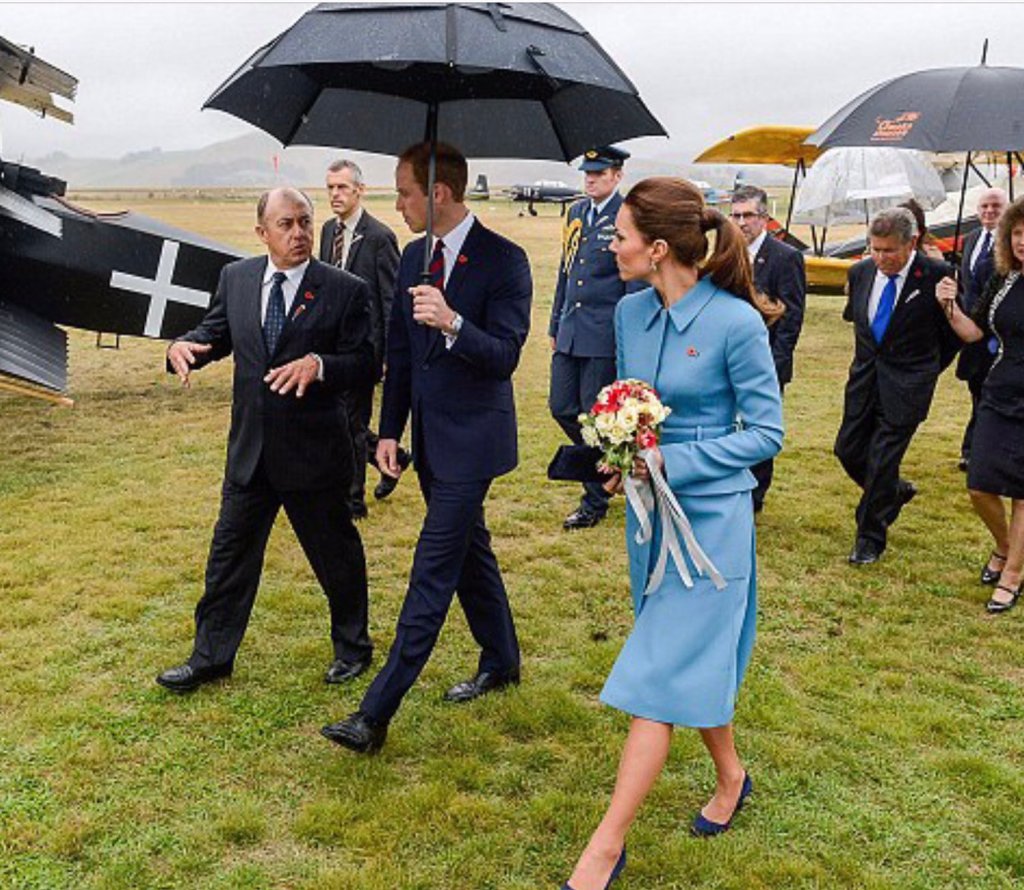

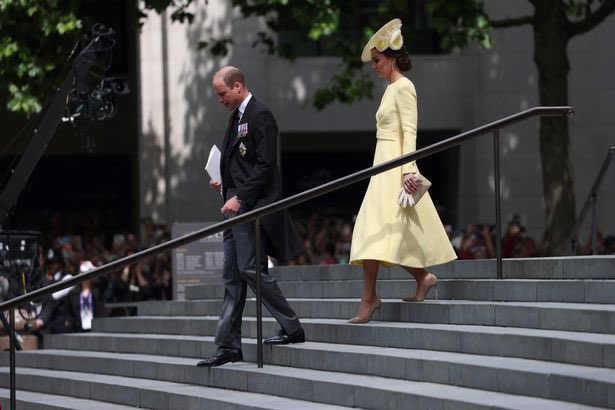
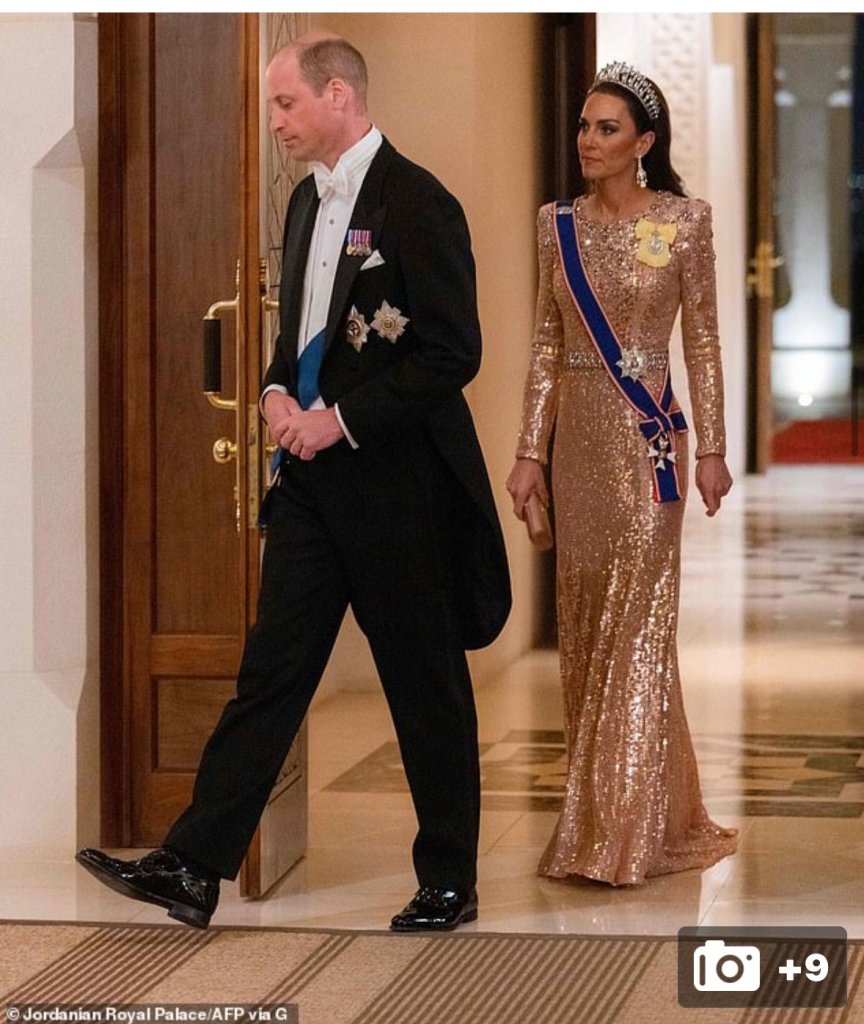
The diagnostic vocabulary. Narcissist. Insecure. Controlling. Needy. Cult leader. These are clinical or quasi-clinical terms applied to photographs of a woman standing next to her husband. None of these commenters have met Meghan. None have observed her in private. They are diagnosing a stranger from paparazzi shots filtered through a hostile media ecosystem, and they are doing it with absolute certainty.
“She acts like a teenage mean girl holding on to her boyfriend.” This reduces a 44-year-old woman, a mother, a former actress, a duchess, to a high school archetype. It infantilizes her while simultaneously treating her behavior as threatening. She is both a silly teenager and a dangerous manipulator. The contradiction does not matter because the function is the same: to delegitimize.
“Her handbag.” Three-word comment. The implication is that Harry is an accessory Meghan carries around. This inverts the entire structure of the monarchy, where the spouse of a blood royal is traditionally the accessory. When Catherine carries a clutch bag to manage handshake situations, it is reported as elegant protocol awareness. When Meghan holds her husband’s arm, he becomes the handbag. The dehumanization runs in both directions: it strips Meghan of genuine emotion and strips Harry of agency simultaneously.
“Huge imbalance in their status.” This one is quiet but it is the loudest comment in the thread. What status imbalance? Harry is a prince. Meghan is a duchess. Harry is sixth in line to the throne. Meghan is a biracial American woman who married into the family. The “imbalance” this commenter is referencing is not about title or rank. It is about who belongs and who does not. It is the belief that Meghan’s status will never be real, no matter what title she holds, because status in this framework is not something you earn or receive. It is something you are born into. And she was not.
“The reason she will never divorce Harry.” This reframes the marriage itself as a hostage situation. Meghan is not with Harry because she loves him. She is with him because he is useful. This strips the relationship of any authentic emotional content and replaces it with a transaction narrative. Notice that no one applies this logic to Catherine, who married the future king of England and whose material circumstances improved rather dramatically as a result. The transactional reading is reserved exclusively for the woman whose presence in the family is treated as inherently illegitimate.
“Like every cult.” The escalation here is worth tracking. The original post called Meghan insecure and desperate. Within the comment thread, she has been upgraded to a cult leader. This is how the narrative ecosystem works. Each participant raises the stakes slightly, each comment adds a layer of pathology, and by the end of the thread, a woman holding her husband’s arm at a WHO event has been compared to a figure who brainwashes and entraps followers. The escalation is not accidental. It is the product of a community that rewards extremity. The most liked comments are never the most measured ones.
“Why is she wearing a grill cover?” This is the aesthetic policing that runs parallel to the behavioral policing. It is not enough to diagnose Meghan’s psychology from a photograph. Her clothing must also be attacked. Every outfit is wrong. Every fashion choice is evidence of something. Too expensive: she is a grifter. Too casual: she has no class. Too formal: she is performing. The wardrobe criticism functions identically to the arm-holding criticism. There is no correct answer because the framework does not permit one.
“Oh get a life honey…get a job, get therapy…so pathetic.” This is the only comment in the thread directed at the original poster rather than at Meghan, and it attracted no engagement. A single voice pushing back against the diagnostic pile-on, dismissed and ignored. This is how consensus is manufactured in these spaces. Agreement is amplified. Dissent is invisible. And the result looks like unanimity.
 celebchai.com