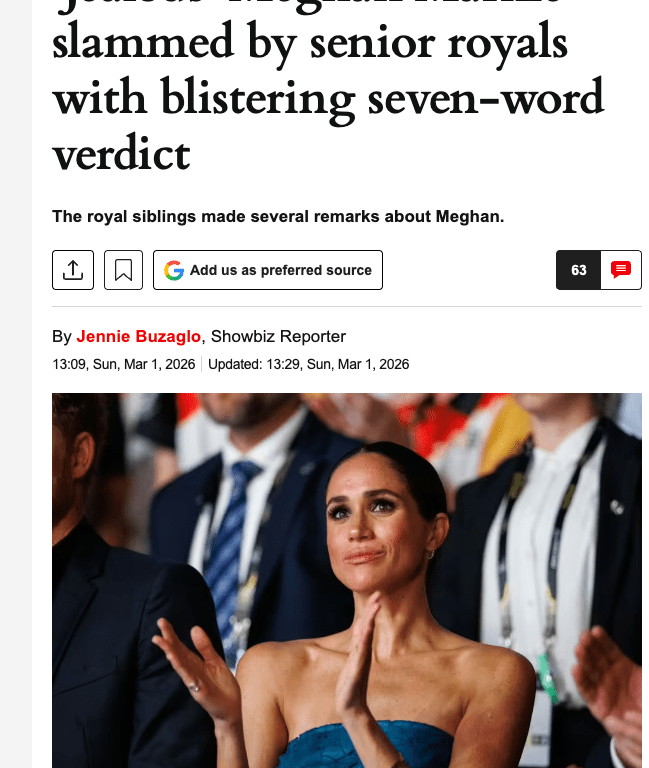
Today’s Daily Express reports that “senior royals” branded Meghan Markle “jealous” and a “scaremonger” during King Charles’ coronation. The source is a Channel 5 program called “Lip-Reading the Royals,” which used forensic lip readers to interpret a conversation from nearly three years ago, in May 2023. The remarks are attributed to Princess Anne and Prince Edward. Multiple readers immediately pointed out that the article misidentifies who Anne was sitting next to. It was Prince Edward, Duke of Kent, not her brother Prince Edward, Duke of Edinburgh, who was seated in the front row with his wife. The foundational claim about who participated in this alleged conversation appears to be factually wrong.
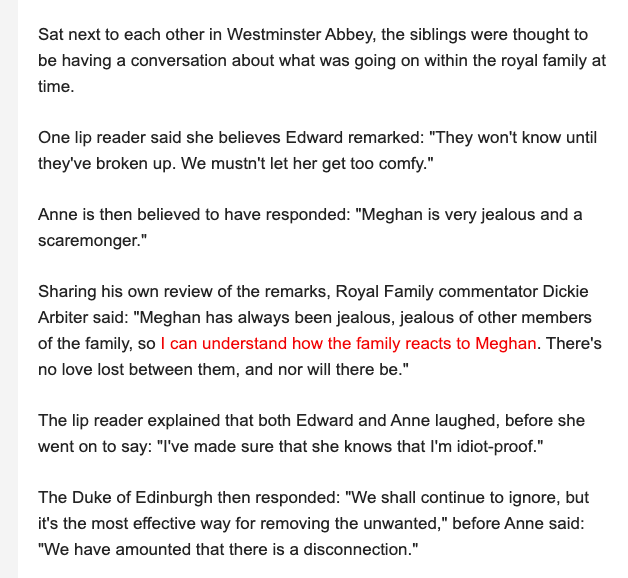
But the factual error is not the most interesting thing here. What is more revealing is the phrase at the center of the story. According to the lip reader, Anne said: “Meghan is very jealous and a scaremonger.” Two words, each doing distinct work, and together constructing something worth examining closely.
“Jealous”: The Inversion
“Jealous” inverts the power dynamic at the center of the Meghan story. In the actual timeline of events, a woman entered an institution, found it untenable, left voluntarily, and spoke publicly about why. That sequence poses a problem for narratives that depend on the institution’s prestige remaining unquestioned. If someone walks away from something, the implication is that the something was not worth staying for.
“Jealous” rewrites that sequence entirely. It transforms a departure into a rejection. The institution did not fail her; she could not measure up to it. She did not leave; she was never truly included. She is not a critic of the system; she is someone who wanted what the system offered and could not have it. The word repositions the institution as the object of desire and Meghan as the person who was not enough.
Royal commentator Dickie Arbiter, quoted in the article, says Meghan is “jealous of other members of the family.” He does not specify what she is jealous of. He does not need to. That is the power of the accusation: it does not require a specific claim because it is not operating at the level of specifics. Consider how the word absorbs every possible behavior into itself. Meghan pursues commercial ventures? Jealous of the royal platform she lost. Meghan does philanthropic work? Jealous of Catherine’s charitable profile. Meghan stays silent? Seething with jealousy. Meghan speaks publicly? Lashing out from jealousy. The word creates a closed interpretive loop. No action by the subject can escape the frame once it has been applied.
This is not analysis. It is a label designed to make analysis unnecessary.
“Scaremonger”: The Absurdity of Distance
Now consider the second word. A scaremonger is someone who spreads fear deliberately, who exaggerates threats to manipulate others. The word positions Meghan not just as emotionally deficient but as actively dangerous to the institution. She is not merely flawed; she is strategic in her harm.
But here is the question the word cannot survive: who is she scaring, and from where?
Meghan has been living in Montecito, California since 2020. She was not at the coronation. She has no institutional role, no platform within the monarchy, no access to the machinery of the firm. She has no regular media presence in the UK. She is not giving speeches to British audiences or campaigning on British issues. She is roughly 5,400 miles from the people she is supposedly terrorizing.
If “scaremonger” means she is frightening the public, that does not hold up. If it means she is frightening the institution itself, then that is a remarkable admission. It means a woman with no title, no role, no proximity, and no structural power is somehow threatening enough to warrant discussion at a coronation by two of the most senior working royals. The institution is telling on itself. It is saying: even from the other side of the world, with nothing, she still scares us.
The target must simultaneously be inferior and powerful enough to justify the level of attention directed at them. She doesn’t matter, but we need to talk about her. She has no power, but she is a scaremonger. She is far away, but she is a threat.
The Pairing Is the Point
“Jealous” diminishes her. “Scaremonger” criminalizes her. One says she is small. The other says she is a threat. Together they create the portrait that scapegoating requires: a target who is both beneath the institution and a danger to it. This is the classic contradiction baked into every scapegoat framework throughout history. The target has to be painted as irrelevant and dangerous at the same time, because the narrative needs her to be small enough to dismiss and big enough to justify the obsession.
“Scaremonger” also does something else. It preemptively neutralizes any future disclosures. If Meghan ever speaks again about her experience, the label is already in place. She is not sharing her truth. She is scaremongering. Her accounts of racism within the institution, of mental health struggles, of lack of support: these are not testimony. They are tactics. The word retroactively reframes her disclosures as manipulation rather than truth-telling. It is less about what she has done and more about sealing off what she might say. A preemptive silencing mechanism dressed up as character observation.
The Gendered Script
“Jealous” is a word that lands differently depending on who it is applied to. It is overwhelmingly deployed against women in public life. Male public figures who display openly competitive, ambitious, or critical behavior are described as “driven,” “outspoken,” or “combative.” Women exhibiting comparable behavior are “jealous,” “bitter,” or “envious.” The word carries embedded connotations of pettiness, emotional instability, and irrationality. It places the subject’s motivations in the realm of feeling rather than thought, of personal inadequacy rather than principled disagreement.
Prince Harry has made the same criticisms of the institution that Meghan has. He published a memoir detailing those criticisms at length. He is rarely called “jealous.” He is called “troubled,” “manipulated,” “led astray.” Even in coverage hostile to Harry, the framing preserves his capacity for rational motivation. For Meghan, “jealous” strips that capacity away. Her objections become symptoms. Her choices become reactions. She is not an agent in her own story; she is a condition to be diagnosed.
The Institutional Shield
This is where the two words do their most important combined work. If Meghan is “jealous,” then the source of conflict is located in her psychology, not in the institution’s structure. If she is a “scaremonger,” then her public statements are weapons, not testimony. Together, the labels eliminate every angle from which the institution might be held accountable. The family becomes reactive rather than responsible. Anne and Edward are not, in this framing, being dismissive or cruel. They are simply recognizing an obvious flaw and an obvious threat. They are the clear-eyed observers. She is the problem.
The institution is absolved. Its failures of inclusion, its tolerance of hostile media coverage, its structural inability to accommodate someone who did not fit a predetermined mold: none of that requires examination if the real issue is one woman’s jealousy and fearmongering from 5,400 miles away.
Methodology Note
The Daily Express article rests on forensic lip-reading, a technique widely estimated to be approximately 40% accurate. The “quotes” attributed to Anne and Edward are presented in quotation marks as though they are verified transcripts. They are not. They are probabilistic interpretations of mouth movements filmed from a distance during a crowded public ceremony.
The entire article rests on forensic lip-reading, a technique widely estimated to be approximately 40% accurate. The “quotes” attributed to Anne and Edward are presented in quotation marks as though they are verified transcripts. They are not. They are probabilistic interpretations of mouth movements filmed from a distance during a crowded public ceremony. The article also misidentifies the participants.
Multiple commenters pointed out within hours that Princess Anne was not seated next to her brother Prince Edward, Duke of Edinburgh, who was in the front row with his wife. She was seated next to Prince Edward, Duke of Kent, a different person entirely. The comments section, not the editorial desk, performed the fact-checking. That alone tells you something about the priorities governing publication. The evidentiary foundation here is essentially nonexistent, but the framing is built to survive that. The words feel true to people who already hold the view, and that is all they need to do.
The article also misidentifies the participants. Its own readers caught this within hours. The comments section, not the editorial desk, performed the fact-checking. This is not incidental. It tells you something about the priorities governing publication.
The Pattern, Not the Instance
One article does not constitute a pattern. But this is not one article. “Jealous” has been applied to Meghan Markle across multiple outlets, by multiple commentators, over multiple years. It appears in headlines, in pull quotes from unnamed palace sources, in commentary segments, and now in lip-reading interpretations of conversations that may not have occurred as described between the people identified as having them.
The consistency of the language is the point. When the same labels surface repeatedly across different contexts, attributed to different sources, surviving obvious factual errors in the articles that carry them, they are no longer functioning as observation. They are functioning as narrative infrastructure. They are load-bearing words in a structure designed to assign blame downward and protect power upward.
The question is never whether Meghan Markle is jealous or a scaremonger. The question is what those words are being asked to do, who benefits when they do it, and why an institution with all the power in the world needs to keep calling a woman 5,400 miles away a threat.
 celebchai.com