Documents analyzed: Angelina Jolie’s Brief in Response to Court’s Order Re: Alternative Writ of Mandate (filed March 11, 2026); Plaintiffs’ Response Re Alternative Writ of Mandate (filed March 11, 2026); Minute Order from Case Management Conference (March 4, 2026); Court of Appeal Docket, Jolie v. Superior Court Los Angeles County et al., Case No. B351954, Division 7. All trial court filings in Case No. 22STCV06081, Superior Court of California, County of Los Angeles.
When the Appellate Court Sends a Message
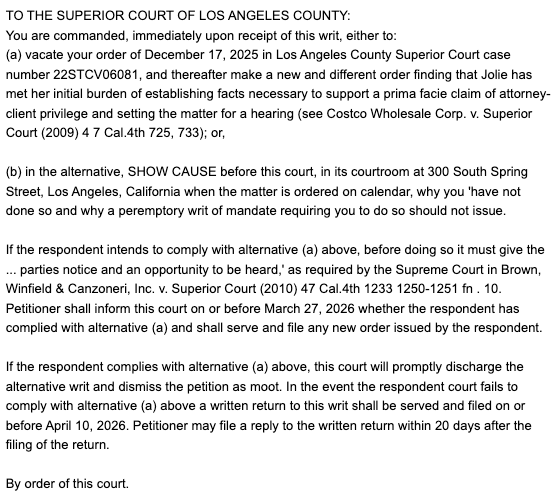
On February 25, 2026, the California Court of Appeal did something unusual in Pitt v. Jolie. It issued an Alternative Writ of Mandate that gave the trial court a binary choice: either find that Angelina Jolie met her initial burden of establishing attorney-client privilege over 22 disputed documents, or explain to the appellate court why it should not be ordered to do so. In legal terms, this is the appellate equivalent of a raised eyebrow and a pointed question. The Court of Appeal was signaling, as clearly as judicial decorum permits, that Judge Lia Martin’s December 17, 2025 order compelling production of those documents was likely wrong.
But the February 25 writ was itself the culmination of a rapid sequence of appellate action that reveals just how seriously the Court of Appeal took Jolie’s challenge. The appellate docket in Jolie v. Superior Court Los Angeles County, Case No. B351954, tells the story with unusual clarity.
The Appellate Timeline: A Court That Moved Quickly
On January 26, 2026, Jolie filed her writ petition with three volumes of exhibits and a request for a stay. The very next day, January 27, the Court of Appeal granted the stay, freezing Judge Martin’s December 17 order and preventing Pitt from accessing the 22 documents while the writ was pending. This near-immediate stay was itself a signal: appellate courts do not freeze trial court discovery orders lightly, and the speed of the ruling suggests the panel saw a serious risk of irreparable harm if the documents were produced before the privilege question was properly resolved.
With the stay in place, the Court of Appeal set an expedited briefing schedule. Pitt’s team (as real parties in interest) had until February 10 to file a preliminary opposition. Jolie had until February 20 to reply. Both deadlines were met. Just five days after Jolie’s reply, on February 25, the Court of Appeal issued the Alternative Writ.
That turnaround deserves emphasis. From petition to writ issuance, the entire appellate proceeding took exactly 30 days. For a writ petition in a complex commercial case involving international parties and 22 disputed documents, this is fast. The speed suggests the panel found the legal question relatively straightforward: the trial court’s conclusion that Jolie had not met her prima facie burden was, in the appellate court’s view, clearly incorrect.
On March 6, the appellate docket records that the Court of Appeal received a letter from the Superior Court with the attached March 4 minute order, confirming that the trial court was aware of the writ and moving toward compliance. The trial court had already indicated at the March 4 hearing that Judge Lia Martin would review the Court of Appeal’s decision and issue a ruling.
The March 11, 2026 responsive briefs from both sides confirm what the appellate timeline already suggested. Pitt’s team, represented by Bird Marella and Wachtell Lipton, does not oppose the trial court selecting option (a) of the Alternative Writ. They are not fighting the finding that Jolie met her prima facie burden. That battle is over.
But what makes these filings analytically interesting is not the concession. It is what comes next: Pitt’s team is already laying the groundwork for the second phase of the privilege fight, one that could consume months of additional litigation and accomplish precisely the same strategic objectives that the original motion to compel was designed to achieve.
The Costco Two-Step: A Framework Built for Extended Warfare
To understand the strategic dynamics at play, one must understand the framework both sides are operating within. In Costco Wholesale Corp. v. Superior Court (2009) 47 Cal.4th 725, the California Supreme Court established a two-step process for resolving attorney-client privilege disputes.
Step one requires the party asserting the privilege to make a prima facie showing: a communication made in the course of an attorney-client relationship. The California Supreme Court emphasized that this burden is light. The privilege holder need only establish the preliminary facts supporting a communication within the attorney-client relationship.
Step two shifts the burden to the party challenging the privilege to demonstrate that the communication was not confidential or that the privilege does not otherwise apply. This is where the fight now moves.
Why does this matter? Because the two-step framework transforms a single discovery dispute into a multi-phase proceeding. Each step requires briefing, evidence, and a hearing. Each step generates a ruling that can be challenged through writ petition. Each step takes months. And all the while, the underlying substantive allegations in the case remain unaddressed.
Jolie’s Brief: Declare Victory and Move On
Jolie’s brief, filed by Murphy Rosen LLP, takes a maximalist position with elegant economy. The argument is essentially three paragraphs long, because the Court of Appeal has already done the analytical work.
The brief frames the Alternative Writ as more than a procedural directive. Murphy Rosen characterizes it as an implicit adoption of the reasoning in Jolie’s writ petition: that the privilege extends to all persons involved in the 22 communications because they are Jolie’s authorized representatives, agents for communication, and her attorneys’ expert consultants under Evidence Code sections 951 and 952; that the substance of the communications consists of confidential discussions of legal advice and requests for further advice; and that refusing to apply the privilege would make it impossible for any client to rely on trusted advisors to further the purposes of the attorney-client relationship.
But the most strategically significant point comes in Section B: Pitt expressly disclaimed any waiver argument. His entire motion to compel rested on the single contention that Jolie had not met her prima facie burden. With the Court of Appeal rejecting that contention, Jolie argues, no basis remains to support the motion at all. The brief asks the court to vacate the December 17 order and deny Pitt’s motion outright.
This is a clean, efficient argument. If the trial court adopts it, the 22 documents stay privileged, Pitt’s motion dies, and the case moves forward on the substantive claims.
Pitt’s team, unsurprisingly, has no intention of letting that happen.
Pitt’s Brief: The Concession That Isn’t
Pitt’s response, filed by Bird Marella and Wachtell Lipton, is a masterpiece of strategic concession. The brief opens by stating that Plaintiffs do not oppose the court selecting option (a). Read quickly, this sounds like capitulation. It is not.
What Pitt’s team actually concedes is only the first step of the Costco analysis. They agree the trial court should vacate the December 17 order and find that Jolie met her initial burden of establishing facts sufficient to support a prima facie claim. But in the same breath, they emphasize that this threshold showing is, in their words, only the first step of the analysis.
The brief then deploys a carefully selected quotation from Costco itself, noting that the privilege does not apply when the attorney acts merely as a negotiator for the client or is providing business advice. It further cites then-Chief Justice George’s concurrence, which observed that sometimes the dominant purpose of the communication will be a critical consideration, because an attorney may simultaneously act in another capacity for the client, such as the client’s agent in a business transaction.
This is a roadmap. Pitt’s team is telegraphing their argument for step two: even if the 22 communications involved Jolie’s attorneys and authorized representatives, their dominant purpose was business, not legal. The sale of Jolie’s Miraval interest was fundamentally a commercial transaction, the argument will go, and communications about structuring, negotiating, and executing that transaction should not be shielded by attorney-client privilege merely because attorneys were copied on them.
The ‘Dominant Purpose’ Doctrine: Pitt’s Next Weapon
The dominant purpose test is a fact-intensive inquiry that asks whether the primary reason for a communication was to seek or provide legal advice, as opposed to business guidance that happens to involve a lawyer. In the context of the Miraval sale, this doctrine has genuine teeth.
Consider the nature of the transaction. Jolie sold her interest in Chateau Miraval to Tenute del Mondo B.V., a company associated with the Stoli Group. This was an international corporate transaction involving a French wine estate held through a Luxembourg entity, with interests owned by California LLCs. The deal necessarily involved tax structuring, corporate governance, regulatory compliance, and commercial negotiation, all areas where lawyers and business advisors overlap.
If Pitt’s team can show that the 22 documents primarily concerned the business mechanics of the sale rather than legal advice about Jolie’s rights and obligations, the privilege may fall. And because Pitt himself has claimed that the sale was improper (that is the entire basis of this lawsuit), his team has a strong incentive to access communications that might reveal the structure and motivations behind the transaction.
The challenge for Pitt is that this argument requires evidence about the content of the communications, yet the whole point of the privilege is to keep that content confidential. This creates what privilege litigators call the “cat in the box” problem: you cannot examine the communications to determine if they are privileged without destroying the privilege you are testing. The typical resolution is in camera review, where the judge examines the documents privately and rules on each one. This is precisely the kind of document-by-document inquiry that Jolie’s team wants to avoid and Pitt’s team wants to force.
The Scheduling Wars: Speed vs. Preparation
The briefs reveal a telling disagreement about timing. Jolie’s team interprets the Alternative Writ as requiring both the hearing and the subsequent order by March 27, 2026. They acknowledge the court’s different interpretation (that it need only select option (a) by that date), but note they will inform the Court of Appeal of the schedule, a subtle reminder that the appellate court is watching.
Pitt’s team pushes in the opposite direction. They ask that the April 17 date remain a case management conference for scheduling purposes rather than the Costco hearing itself. Their stated reason is procedural propriety: they want to present the matter as directed by Judge Panuco. The practical effect is delay. More time to brief the dominant purpose argument. More time before Jolie’s privilege is confirmed. More time in which the substantive claims remain in procedural limbo.
This scheduling dispute encapsulates the broader pattern. Jolie’s team wants rapid resolution because the Court of Appeal has signaled she should win. Pitt’s team wants process because process itself is a strategic asset.
What the Minute Order Reveals
The March 4, 2026 minute order from Judge Panuco’s courtroom contains several details that illuminate the broader trajectory of this case.
First, the case has been deemed non-complex by Assistant Supervising Judge Samantha Jessner. This is significant. Complex case designation in Los Angeles Superior Court provides dedicated judicial attention, specialized case management, and streamlined procedures. Pitt filed a Complex Civil Case Questionnaire seeking that designation, but the court declined. For a case involving international corporate structures, multiple cross-complaints, parties appearing specially to challenge jurisdiction across several countries, and a February 2027 trial date, the denial of complex status suggests the court views the procedural complexity as largely manufactured rather than inherent.
Second, the five-year rule looms. The case was filed February 17, 2022. Under California Code of Civil Procedure section 583.310, an action must be brought to trial within five years. The current trial date of February 1, 2027 falls just within that window. The court’s directive that parties meet and confer on a case management plan in light of the five-year rule by April 3 signals awareness that procedural warfare cannot continue indefinitely.
Third, multiple motions to be relieved as counsel were advanced from April 27 to April 3. The minute order does not specify which attorneys are seeking withdrawal, but the case involves counsel for numerous cross-defendants including Roland Venturini and Gary Bradbury (Miraval’s CEO and another officer), SAS Miraval Provence and SAS Familles Perrin (the French winemaking entities), and SPI Group, Yuri Shefler, and Alexey Oliynik (the Stoli Group parties). Counsel withdrawals at this stage can signal settlement negotiations, funding disputes, or strategic repositioning.
The Pattern: Discovery as Delay, Privilege as Pretext
These privilege filings must be read alongside the broader pattern of procedural maneuvering in this litigation. In December 2025, as analyzed in a previous Celeb Chai piece on the demurrer and motion to strike in Tenute’s cross-complaint, Pitt’s team deployed extraterritoriality arguments, statute of limitations traps, and waiver doctrines to attack the embezzlement claims without engaging their substance. The privilege dispute reflects the same strategic logic operating on a different front.
The original motion to compel served multiple purposes simultaneously. If granted, it would give Pitt’s team access to Jolie’s privileged communications about the sale, providing ammunition for both the substantive claims and the public narrative. If litigated and lost, it would still consume months of briefing, a writ petition, appellate review, and remand proceedings, all while the embezzlement cross-claims and the substantive sale dispute remain in procedural stasis.
That the motion did result in a writ petition, a same-day stay order, expedited appellate briefing, an Alternative Writ of Mandate, and now a new round of briefing on the Costco step-two analysis demonstrates how a single discovery motion can generate a litigation sideshow that consumes nearly a year of judicial resources. The December 17, 2025 order compelling production. The January 26, 2026 writ petition. The January 27 stay. The February briefing. The February 25 Alternative Writ. The March 4 case management conference. The March 6 transmission of the minute order to the Court of Appeal. The March 11 responsive briefs. The anticipated April hearing on scheduling. The eventual Costco step-two briefing. The Costco hearing itself. A potential ruling. A potential second writ petition.
Each of these steps takes the court’s attention and the parties’ resources away from the core questions: Did Pitt improperly divert millions from Chateau Miraval for personal benefit while excluding his co-shareholder from financial information? Was Jolie’s sale of her interest a legitimate exercise of ownership rights or a breach of their business relationship? These questions remain unanswered four years into the litigation.
The Media Dimension: Silence as Strategy
Notably absent from this round of filings is the kind of media-friendly framing that characterized Pitt’s earlier submissions. The December 2025 demurrer and motion to strike were crafted with language designed for headlines: accusations of “frivolous” claims, emphasis on “recent wins,” and anonymous sources characterizing opposing filings for sympathetic outlets.
The privilege briefs are more muted, and for good reason. Pitt’s team lost at the Court of Appeal. The Alternative Writ represents a public repudiation of their position on the prima facie question. There is no headline value in “Pitt concedes Jolie’s privilege claim has merit” or “Appellate court signals trial judge got it wrong in Pitt’s favor.”
This creates an informational asymmetry that benefits Pitt. The December 2025 motion to compel generated coverage suggesting Jolie was hiding something by asserting privilege. The Court of Appeal’s rebuke of that position will generate far less coverage, because procedural corrections lack the narrative simplicity of “court orders documents produced.” The media ecosystem that amplified Pitt’s initial victory is structurally unlikely to amplify his subsequent defeat on the same issue. And notably, the stay order issued on January 27, which froze the compel order and ensured the documents were never actually produced, received virtually no coverage at all. The stay was the appellate court’s first and most urgent action, yet the narrative that Jolie lost on privilege persisted uncorrected for weeks.
What to Watch: The Costco Hearing and Beyond
The next critical developments in this privilege dispute will unfold across several dates:
March 27, 2026: Deadline for Jolie to inform the Court of Appeal whether the trial court has complied with option (a) of the Alternative Writ. If the trial court has not complied, the appellate docket specifies that a written return must be filed by April 10, with Jolie’s reply due within 20 days of the return. The Court of Appeal has made clear it will either discharge the writ upon compliance or proceed to enforce it.
April 3, 2026: Status conference and hearing on motions to be relieved as counsel. The parties’ joint status report, due five court days before, will reveal whether they have agreed on a case management plan under the five-year rule or whether further judicial intervention is needed.
April 17, 2026: Case management conference regarding the appeal. Whether this becomes the Costco hearing itself or merely a scheduling conference depends on whether Judge Panuco adopts Jolie’s interpretation (hearing now) or Pitt’s preference (schedule briefing first).
The Costco step-two hearing (date TBD): The main event. Pitt’s team will argue the dominant purpose of the 22 communications was business, not legal. Jolie’s team will argue the communications reflect and discuss legal advice. The court may conduct in camera review. The outcome will determine whether Pitt accesses communications that could reshape the entire litigation.
February 1, 2027: Trial date. With the five-year deadline approaching, every month consumed by privilege disputes is a month not spent on discovery, depositions, expert work, and trial preparation on the substantive claims.
Conclusion: The Cost of Procedural Sophistication, Revisited
Four years into Pitt v. Jolie, the parties remain litigating threshold procedural questions rather than the substantive allegations at the heart of the case. The privilege dispute is not unusual in complex commercial litigation. What makes it instructive is the context: a case in which one side alleges millions in corporate diversion while the other side uses every available procedural mechanism to prevent substantive adjudication of those claims.
The Court of Appeal’s Alternative Writ suggests that at least one level of the California judiciary recognizes what is happening. The trial court’s willingness to comply with option (a) suggests the message was received. But whether that recognition translates into efficient resolution of the privilege question, or whether the Costco step-two analysis becomes another vehicle for extended procedural warfare, will depend on choices yet to be made.
As always in this litigation, the real question is not what the court will decide. It is whether the court will ever reach the point of deciding what actually happened at Chateau Miraval.
Two core substantive questions this litigation has never reached:
1. Did Pitt improperly divert millions from Chateau Miraval for personal benefit? The Tenute cross-complaint alleges 8 million euros in 2020 alone spent on projects benefiting Pitt personally (construction at a nearby house, a swimming pool, “garment works”), all while he excluded Jolie from financial information, engineered a shareholder deadlock to prevent oversight, and had the CEO on his personal payroll.
2. Was Jolie’s sale of her Miraval interest a legitimate exercise of her ownership rights? That is the entire basis of Pitt’s original complaint. He claims the sale to Tenute del Mondo breached their business arrangement. Jolie’s position is that she had every right to sell, particularly given the alleged financial misconduct.
Four years in, neither question has been substantively adjudicated. The litigation has instead consumed itself with extraterritoriality arguments, statute of limitations disputes, privilege fights, jurisdictional challenges, and now the Costco step-two analysis. The 8 million euros in expenditures benefiting Pitt personally, the CEO on his personal payroll, the June 2021 message telling that same CEO to stop sending Jolie reports, the engineered shareholder deadlock preventing any accounting. When a court finally examines those facts on the merits rather than through the filter of procedural motions, the picture is not flattering for Pitt. Jolie already sold her interest to Tenute del Mondo. That transaction is done. Pitt’s entire original complaint is premised on unwinding or obtaining damages for a sale that has already been completed. He cannot put the toothpaste back in the tube.
So what Pitt is really doing with all this procedural warfare is not positioning to win on the merits. He is delaying the moment when a court examines the embezzlement allegations, the CEO compensation arrangement, the shareholder exclusion, and the 8 million euros in personal expenditures. The longer the case stays in procedural limbo, the longer those facts stay out of a courtroom and out of the public record in a way that generates sustained coverage.
The privilege fight makes even more sense through that lens. Accessing Jolie’s communications about the sale would not help Pitt win his claim that the sale was improper. It would help him control the narrative about why Jolie sold, and potentially identify ammunition for side disputes. But the sale stands.
 celebchai.com