
On March 20, 2026, The Telegraph reported that Home Office officials on RAVEC, the committee that authorizes security for senior royals, are trying to block taxpayer-funded protection for Prince Harry over fears of “public backlash.” Police and security chiefs on the same committee say Harry “absolutely must have” protection due to documented threats, including three convicted plotters at large and a fixated stalker who has been within feet of him at public appearances.
On the same day, the Daily Express published at least two dedicated anti-Sussex articles, with sidebars linking to dozens more. This is what the “public backlash” looks like before it becomes a policy justification. It is not organic. It is produced.
Article One: The Outburst That Was Not an Outburst
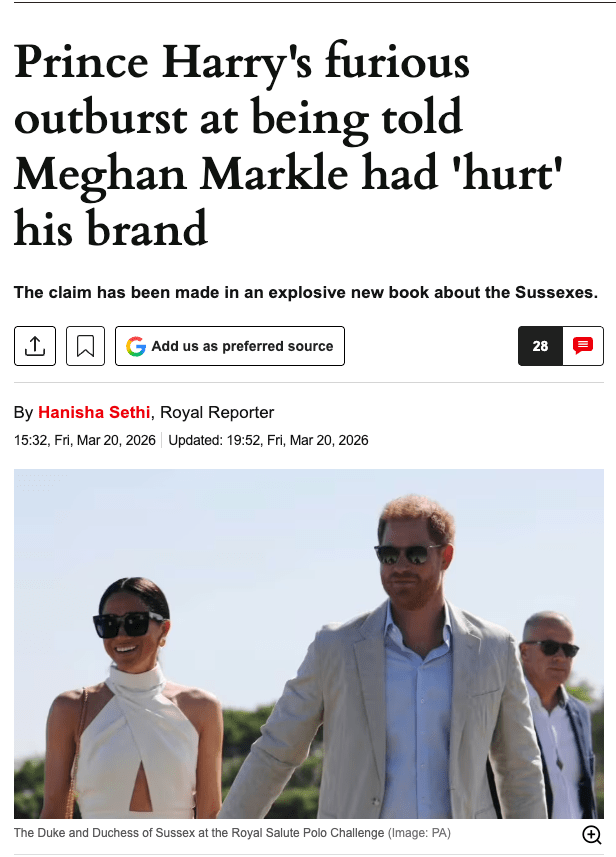
The Express ran a piece headlined “Prince Harry’s furious outburst at being told Meghan Markle had ‘hurt’ his brand.” The source is Tom Bower’s forthcoming book, Betrayal, publishing March 26. The Express is running pre-publication serialization as though Bower’s claims are established fact.
The headline says “furious outburst.” The article’s own content describes Harry responding with “coolness” toward the Sentebale chairwoman who delivered the brand audit results. Coolness and furious outburst are antonyms. The headline manufactures emotional volatility that the body text does not support. But “Prince Harry responds coolly to unwelcome news” does not generate engagement, so coolness becomes fury in the space between the article and the headline.
Bower’s methodology deserves scrutiny that the Express does not provide. Harry’s spokesperson noted that Bower has publicly stated “the monarchy in fact depends on actually obliterating the Sussexes from our state of life.” That is not a critic’s assessment. That is a stated objective. When an author declares that the institution he covers depends on obliterating his subjects, everything he writes about those subjects carries that declared intent. The Express buries this response deep in the article and does not engage with what it means for Bower’s credibility as a source.
The spokesperson also called the book “deranged conspiracy and melodrama” from someone who has “never met” his subjects and has “made a career out of constructing ever more elaborate theories about people he does not know.” That is a substantive challenge to the book’s methodology, not a standard denial. The Express treats it as the latter.
Article Two: The Surveillance of Friendship
The second piece is headlined “Meghan Markle dubbed ‘nightmare PR client’ as she’s mocked for ‘extremely disturbing’ move.” The “extremely disturbing move” is that Meghan touched her pregnant friend’s belly at a charity gala.
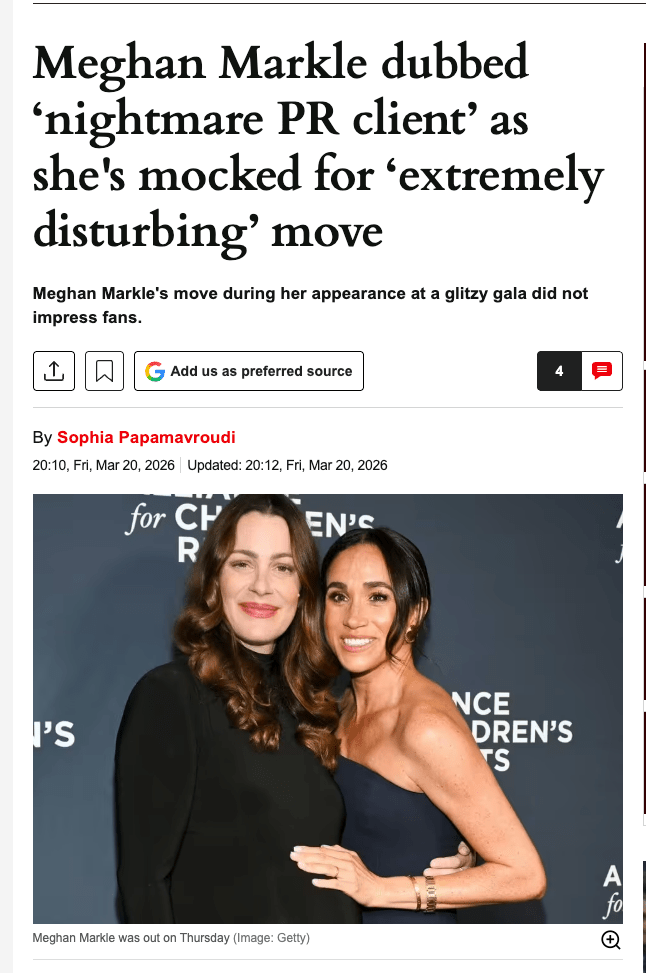
The actual event: Meghan attended the Alliance for Children’s Rights 34th Annual Champions for Children gala in Beverly Hills. She was there to support Kelly McKee Zajfen, who co-founded Alliance of Moms in 2014, an organization that provides legal services, education, safe housing, and support for vulnerable children. Kelly is expecting a baby. Meghan touched her friend’s bump while they posed for cameras.
That is the story. A woman touched her pregnant friend’s belly at a children’s charity event. The Express sourced six Reddit comments calling this “extremely disturbing,” “inappropriate,” “gross,” and evidence that she is a “nightmare PR client” who is “tone deaf” and “disgusting.” Six anonymous Reddit users became the basis for a national newspaper article.
The charity’s mission is mentioned once, in the second paragraph, and never referenced again. Kelly’s decade of work with Alliance of Moms is invisible after its single mention. The children the organization serves do not exist in this article. The only thing that registers in the editorial framing is that Meghan did something, and that something can be made to look wrong.
Positive responses appear at the bottom of the article. They get three lines. The negative Reddit quotes get six full paragraphs with detailed attribution. The ratio is the editorial position.
The Sidebar as Business Model
Both articles share nearly identical sidebars. The Meghan-specific headlines visible across the two pages on a single day include: “nightmare PR client,” “extremely disturbing,” “hurt his brand,” “so pretentious,” “terrified of bombshell claims,” “savaged over desperate move,” “childish reaction to Netflix meetings,” “end of the road,” “says one thing and does the other,” “hit with big new problem,” “deeply bothered as furious outburst exposes true colours.”


That is one publication, one day, one sidebar. Each headline generates clicks. The clicks justify the next article. The next article generates more clicks. The sidebar is not reflecting reader interest. It is constructing it. The volume is the product.
Anyone scrolling the Express royal section on March 20 encountered a wall of negativity so dense that the few non-Sussex stories (Andrew’s police investigation update, Kate’s state visit coverage, Charles opening a coastal path) are visually submerged. The editorial real estate allocation tells you what the publication believes its audience wants, and what it is actively training that audience to want more of.
The Bower Pipeline
The Express’s Bower coverage deserves particular attention because it illustrates how a single source gets amplified into an ecosystem event. Bower’s book publishes on March 26. In the days preceding publication, the Express and other outlets run individual claims from the book as standalone articles, each with its own headline, its own sidebar placement, its own comment section. A single book becomes ten articles. Ten articles become ten comment sections. Ten comment sections become a volume of hostile public sentiment that looks organic.
This is serialization as content strategy. The book itself is one object. The coverage of the book is dozens of objects, each generating independent engagement metrics that justify the next piece. By publication day, the book’s claims will have been repeated so many times across so many articles that they will have acquired the weight of established fact through sheer repetition, regardless of whether any of them have been independently verified.
Bower’s own stated position, that the monarchy depends on “obliterating” the Sussexes, will not appear in any of those subsequent articles. It appeared once, in the spokesperson’s buried response, and it will not be referenced again. The author’s declared intent will be invisible. His claims will be everywhere.
The Netflix Chain
The Express also ran a piece the same day about Netflix executives reportedly warning CEO Ted Sarandos against working with the Sussexes. That article’s sourcing chain runs: anonymous sources to Variety, reinterpreted by a podcast host on the Daily Expresso show, aggregated by the Express, with additional anonymous Daily Mail sourcing layered in. Each link in the chain adds editorial heat while subtracting sourcing rigor.

The article’s own content includes Netflix Chief Content Officer Bela Bajaria saying on the record at a press event: “We still have a relationship with them. We have movies in development with them. We have an amazing doc with them.” Netflix also officially denied the claim about Sarandos refusing calls without a lawyer, calling it “absolutely inaccurate.”
The piece has two named, on-the-record sources contradicting its thesis and multiple unnamed sources supporting it. The unnamed sources get the headline. The named sources get the bottom of the article. The hierarchy of credibility is inverted by design.
What March 20 Actually Looked Like
On March 20, 2026, this is what the British media landscape produced about the Sussexes in a single news cycle:
The Telegraph reported that Harry faces documented threats from three convicted individuals and a fixated stalker, and that security professionals say he must have protection.
The Express published articles framing his “coolness” as a “furious outburst,” his wife’s affection toward a pregnant friend at a children’s charity gala as “extremely disturbing,” and his Netflix relationship as a failure, while burying on-the-record sources that contradicted each of these framings.
The Express sidebar linked to dozens of additional negative stories, creating a visual environment in which hostility toward the Sussexes is the default setting of the page.
And Home Office officials cited “public backlash” as their reason for opposing the security that professionals say is necessary to keep Harry alive when he visits his own country.
That is not a coincidence of timing. It is a system. The content generates the sentiment. The sentiment becomes the justification. The justification shapes the policy. And the policy gets reported as though it emerged from a neutral institutional process rather than from a media environment that was engineered, article by article, sidebar by sidebar, Reddit comment by Reddit comment, to produce exactly that outcome.
The system is visible on March 20. All you have to do is read the same day’s coverage side by side.
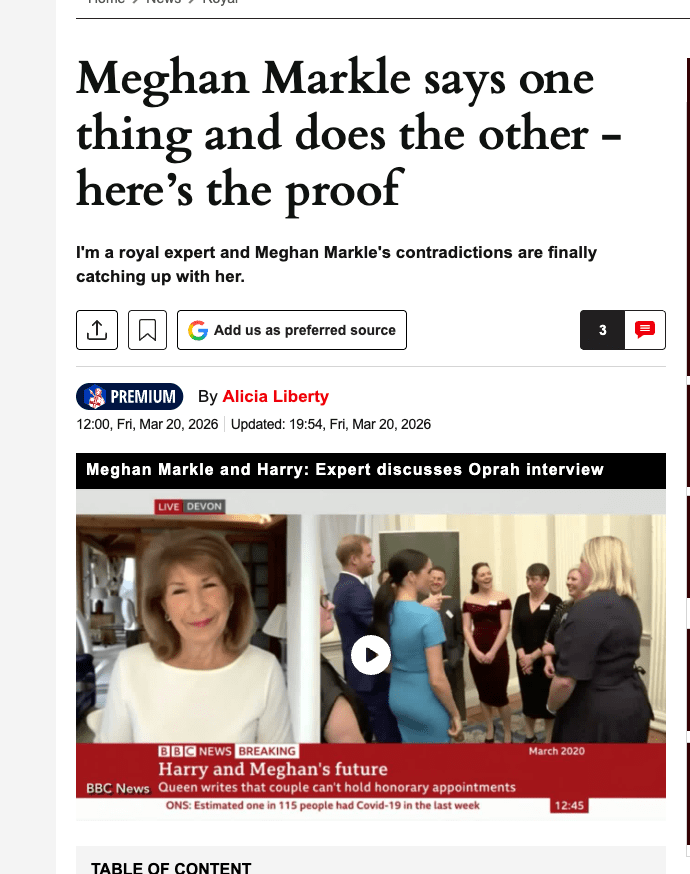
The third Express piece of the day is the most instructive because it operates at a higher register. Bylined by a self-described “royal expert” under the headline “Meghan Markle says one thing and does the other,” it presents itself as thoughtful cultural criticism rather than tabloid aggregation. It has sections with headers. It uses analytical language. It reads like a considered essay.
It is a closed system designed to produce a predetermined conclusion regardless of the input.
The article’s method is the double bind: every possible choice Meghan makes is framed as evidence of the same flaw. She wore muted colors as a working royal? Strategic positioning. She wore bold colors when leaving? “Convenient” symbolism. She returned to neutral palettes post-royal? Contradiction. She kept her children private? Understandable. She allowed curated glimpses of them? “What changed?” She left the monarchy? A rejection of the institution. She uses her Sussex title professionally? Monetizing the connection.
There is no available move in this framework that registers as genuine. Restraint is calculation. Expression is performance. Consistency is stagnation. Change is contradiction. The analytical apparatus exists to convert any action into evidence of inauthenticity. That is not criticism. It is a trap.
The fashion section defeats its own thesis without noticing. The piece argues that Meghan’s muted wardrobe as a royal was not “a noble act of restraint” but simply “the trend of the time.” It then mocks her for returning to similar palettes post-royal as proof of inconsistency. But if neutral tones were the trend then and remain the trend now, wearing them in both periods is consistent. The article’s own logic contradicts its conclusion, but the rhetorical momentum carries the reader past the gap.
The privacy section performs the same maneuver. The article acknowledges that the Sussexes’ decision to protect their children’s privacy was “widely respected.” It then notes they have “softened” that boundary with occasional curated appearances and concludes: “Privacy, when it is absolute, does not gradually become negotiable. Unless, of course, there is something to gain.” But privacy that adapts as children grow is not a contradiction. It is parenting. Every public figure navigates this continuum. The framing converts normal decision-making into evidence of strategic manipulation, but only for this particular family.
The most revealing absence is comparative. The article never applies its own framework to any other royal. Catherine’s fashion choices are not interrogated for “contradictions.” William’s commercial interests through the Duchy of Cornwall are not described as “monetizing” his royal connection. No other royal’s social media is examined for strategic inauthenticity. The analytical framework is bespoke. It was built for one person, and it is applied to one person, on the same day that her husband’s security is being debated in terms of whether the public dislikes them enough to justify leaving him unprotected.
 celebchai.com