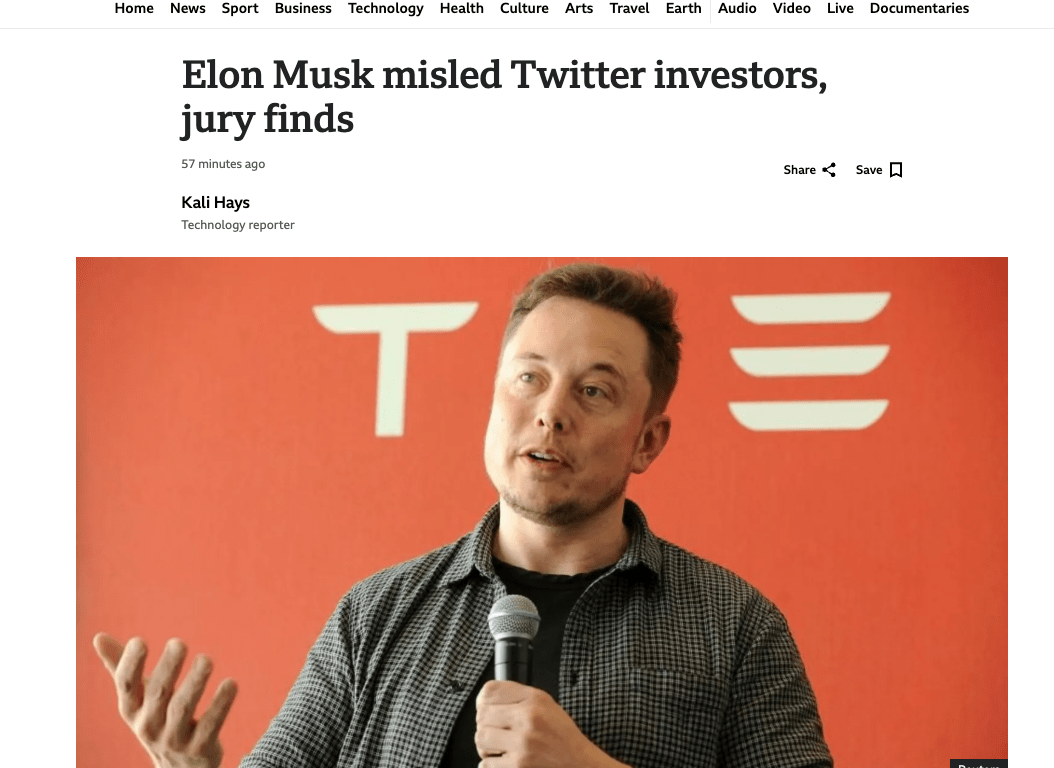
A San Francisco federal jury unanimously found that Musk intentionally misled Twitter investors during the 2022 acquisition period, specifically through his public statements about bot accounts and suggestions he might walk away from the $44 billion deal.
The key findings: the jury determined Musk artificially depressed Twitter’s stock price by roughly $3 to $8 per share between May and October 2022. That window covers the period when he was publicly questioning Twitter’s user metrics and signaling he wanted out, before ultimately completing the purchase at the original $54.20 per share.
The named plaintiff, Brian Belgrave, sold thousands of shares in July 2022 at a loss because he believed Musk’s public statements meant the deal was dead. The class members who bought or sold during that period could each receive thousands in damages.
A few things stand out from a legal perspective. First, this contrasts with his 2023 win against Tesla shareholders on similar “misleading tweets” claims, so it’s not as though Musk is untouchable on securities fraud theories. The difference likely came down to the specificity of the misrepresentations and the directness of the causal link between his statements and stock price movement. Second, his courtroom demeanor (refusing yes/no answers, accusing plaintiff’s counsel of misleading the jury) apparently didn’t help him. His own concession about “stupid tweets” is the kind of moment that sticks with jurors. Third, the trial attorney’s quote captures the principle well: if you move markets with your words, you bear the consequences. That’s essentially the core of Rule 10b-5 liability.
The case name and class period. The lawsuit is Pampena v. Musk, filed October 2022, covering investors who sold Twitter stock between May 13, 2022, and October 4, 2022. That’s a well-defined class period tied directly to Musk’s public statements.
The specific statements at issue. Shareholders pointed to three occasions where Musk publicly questioned Twitter’s bot numbers after already agreeing to the deal in April 2022. The May 17, 2022 tweet where he said the takeover “cannot go forward” until the CEO proved the bot percentage was under 5% appears to have been particularly damaging. The plaintiffs’ closing argument framed it bluntly: he trashed the company, trashed the executives, and tanked the stock.
The SEC overhang. Musk is also reportedly in settlement talks with the SEC over a separate claim that he violated federal law by waiting too long to disclose his initial Twitter share purchases in 2022, allowing him to accumulate more before the market caught on. That’s a Schedule 13D timing violation, which is a distinct issue from the fraud claims in this case but part of the same acquisition timeline.
The X/SpaceX merger. The article notes Musk has since folded X into SpaceX, which is an interesting corporate structure detail. That could complicate any damages enforcement depending on how the corporate entities are organized.
Musk’s net worth. Forbes puts it at $839 billion. So whatever the damages end up being in this class action, they won’t be existentially threatening to him financially, though the precedential value of the verdict is significant.
 celebchai.com