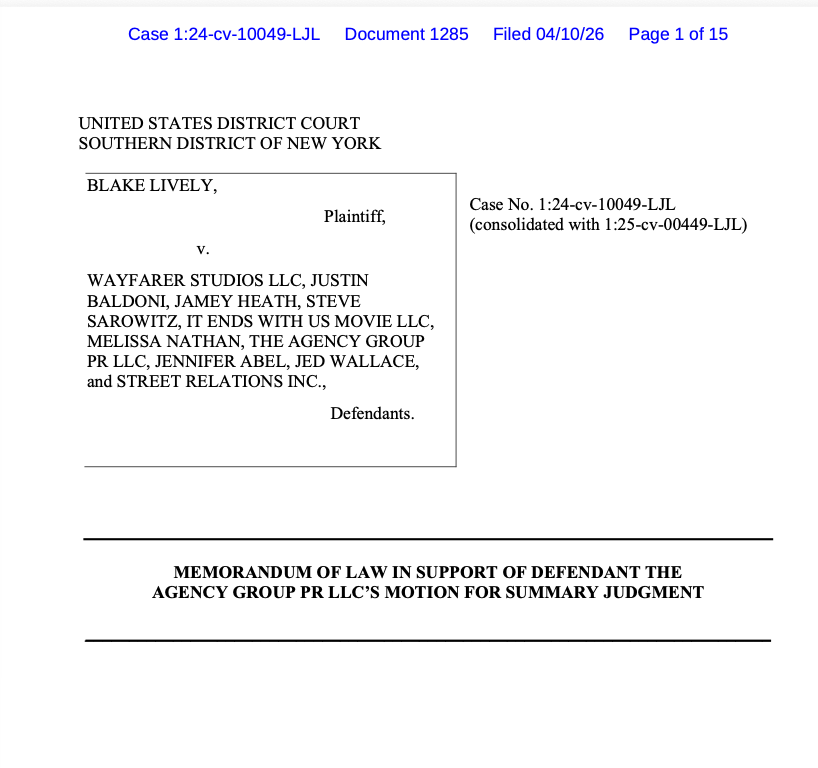
The Agency Group PR LLC filed its motion for summary judgment today, April 10, 2026, targeting the sole remaining claim against it in Lively v. Wayfarer: Blake Lively’s Seventh Cause of Action for aiding and abetting retaliation under FEHA (Dkt. 1284-1285). The motion was authorized during the April 2 conference, the same day Judge Liman issued the 152-page Opinion and Order that reduced the case to three surviving claims.
TAG’s argument is structurally clean. FEHA liability requires a nexus to employment-related activities. TAG is a crisis PR firm retained after Lively’s work on the Film ended. It had no involvement in her hiring, compensation, workplace standards, or personnel decisions. Therefore, TAG argues, FEHA cannot reach it.
The brief builds this in two layers, and the second one involves a significant omission.
Layer One: Direct Liability Under Raines
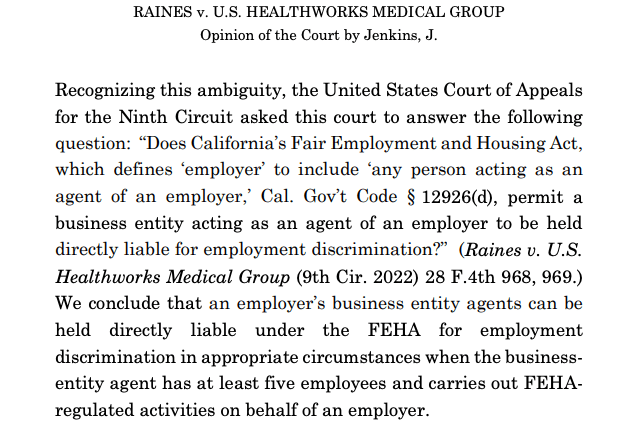
TAG relies on Raines v. U.S. Healthworks Medical Group, 15 Cal. 5th 268 (2023), for the proposition that business-entity agents can bear direct FEHA liability “only when [the agent] carries out FEHA-regulated activities on behalf of an employer.” TAG argues that crisis PR is categorically not a FEHA-regulated activity.
This is probably right.
In Raines, the California Supreme Court addressed a medical screening company that conducted preemployment health questionnaires on behalf of prospective employers. That is a classic employer gatekeeping function delegated to a third party. Justice Jenkins grounded the holding in federal precedents where courts imposed agent liability on entities exercising “functions traditionally exercised by an employer”: hiring, firing, screening applicants, administering benefits, making personnel decisions. The court emphasized that the Raines defendant, U.S. Healthworks, was “the nation’s and California’s largest providers of occupational health” and had been delegated “employment decisionmaking authority.”
TAG’s role bears no resemblance to any of that. TAG was retained to manage crisis communications for Wayfarer and Baldoni. It did not screen applicants, manage accommodations, administer benefits, or make any personnel decisions regarding Lively. On the direct-liability question, TAG is on solid ground.
Layer Two: The Collapse of Aiding and Abetting Into Direct Liability
This is where TAG’s argument gets aggressive, and where it omits something important.
TAG argues that because direct liability under Raines requires FEHA-regulated activities, aiding-and-abetting liability under Section 12940(i) must require the same. The brief frames this as a logical extension of Judge Liman’s observation that “the California Supreme Court treated issues of direct liability and aiding-and-abetting liability similarly in Reno.” TAG reads this parallelism to mean the two doctrines share the same substantive prerequisites.
Here is the omission. The Raines opinion contains a sentence that TAG’s brief does not quote, cite, or acknowledge:
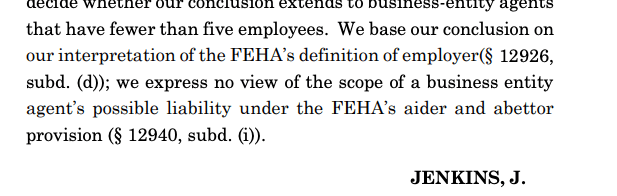
“We base our conclusion on our interpretation of the FEHA’s definition of employer (Section 12926, subd. (d)); we express no view of the scope of a business entity agent’s possible liability under the FEHA’s aider and abettor provision (Section 12940, subd. (i)).”
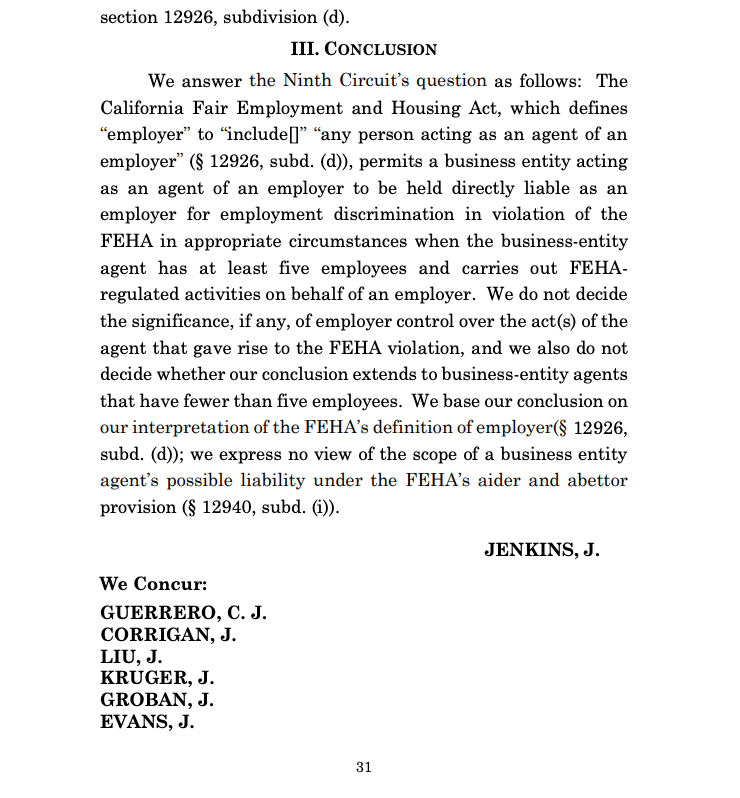
That is the California Supreme Court, in the very opinion TAG relies on, expressly reserving the question TAG is asking Judge Liman to answer. The court drew a line around what it was deciding and placed aiding-and-abetting liability on the other side of it.
TAG’s brief quotes Raines three times. It quotes the “FEHA-regulated activities” holding. It quotes the “necessary minimum” language. It quotes the “engagement in FEHA-regulated activities on the employer’s behalf” formulation. But it does not quote the reservation of the aiding-and-abetting question. For a motion that depends entirely on collapsing aiding-and-abetting liability into the direct-liability framework, the omission of the sentence in which the California Supreme Court declined to do exactly that is a notable gap.
The doctrinal distinction matters. Direct liability under Raines turns on whether the business-entity agent stepped into the employer’s shoes by performing FEHA-regulated activities. The agent effectively becomes a statutory “employer” under Section 12926(d). The analysis asks: did this entity carry out the kind of employment function that FEHA regulates?
Aiding-and-abetting liability under Section 12940(i) is a different doctrine. It prohibits “any person” from aiding, abetting, inciting, compelling, or coercing “the doing of any of the acts forbidden under this part.” The elements are knowledge of wrongful conduct plus substantial assistance or encouragement. The statute does not require the aider and abettor to be an employer, to perform employer functions, or to engage in FEHA-regulated activities. It requires that the person knowingly provide substantial assistance to someone else’s FEHA violation.
TAG is asking Judge Liman to read a limitation into Section 12940(i) that is not in the statutory text and that the California Supreme Court expressly declined to adopt.
The Case Law Pattern
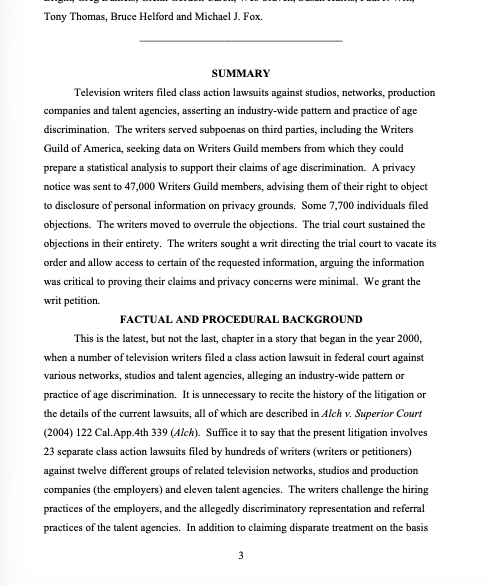
TAG’s brief walks through every aiding-and-abetting case and argues they all involved defendants performing employment-type functions. In Alch, talent agencies screened and referred writers. TAG cites Alch as proving that aiding-and-abetting liability requires employment-related functions.
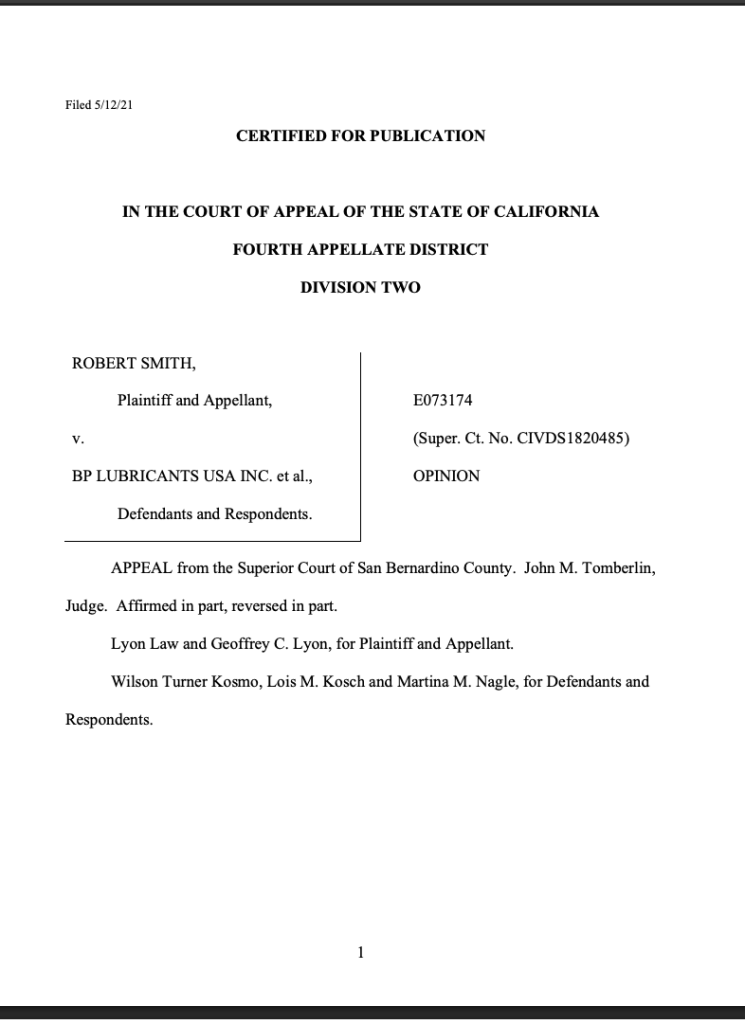
In Malekzadeh, a disability accommodation manager made fitness-for-duty determinations. In Smith v. BP Lubricants, a vendor conducted an employer-hosted training.
In Mobley v. Workday, an algorithm provider screened job applicants.
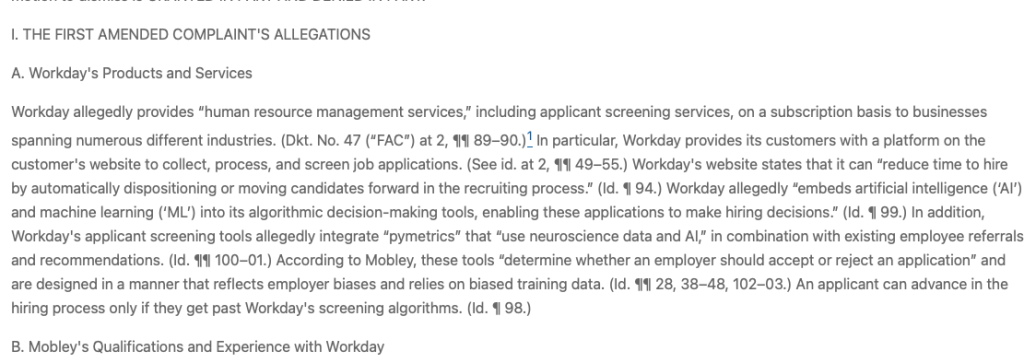
TAG’s point is that no court has ever held a non-employment service provider liable for aiding and abetting a FEHA violation. That is accurate as a description of the existing case law. But it may reflect nothing more than the types of cases that have arisen.
No California court has held that aiding-and-abetting liability is categorically limited to entities performing employment functions. TAG is inferring a rule from a pattern, and the California Supreme Court’s express reservation in Raines suggests that the rule TAG wants has not yet been established.
But Alch actually shows the opposite. TAG cites Alch as proving that aiding-and-abetting liability requires employment-related functions. Alch actually shows the opposite.
The talent agencies were independent third-party businesses, not delegated employer agents. They faced potential aiding-and-abetting liability because they knowingly facilitated discrimination through their own independent business practices. That is a third-party aiding-and-abetting theory, not a delegated-employer-function theory. If anything, Alch supports the argument that TAG, as an independent third-party business that knowingly facilitated alleged retaliation through its own independent PR practices, could face aiding-and-abetting liability under the same framework.
TAG also invokes the Radentz dictum that Section 12940(i) was intended “to prohibit employers from aiding and abetting third-parties, such as customers or suppliers, not from aiding and abetting themselves.” This is a single federal district court’s interpretation from a 2014 case, not binding on anyone, and it reads oddly against the statute’s text, which prohibits “any person” from aiding FEHA violations without limiting that prohibition to employers.
The Policy Argument and Its Mirror
TAG’s strongest rhetorical move is the policy argument. The brief warns that holding a PR firm potentially liable under FEHA would have “an understandably chilling effect on not only public relations firms, but also any other company that renders services for an employer.” Companies would be “reluctant to provide services that could somehow be held to adversely affect one or more of the employer’s employees.”
This is a legitimate concern, but it proves too much. Under TAG’s rule, an employer could retain a PI firm to surveil a whistleblower, a data analytics firm to compile opposition research on a complainant, or a PR firm to run a coordinated campaign to destroy an accuser’s career, and none would face FEHA liability because none performed “FEHA-regulated activities.” The statute’s prohibition on “any person” aiding FEHA violations would apply only to entities that themselves function as employers. That cannot be what the California legislature intended.
The Raines court was attentive to this dynamic. Citing the U.S. Supreme Court’s decision in Los Angeles Dept. of Water & Power v. Manhart, 435 U.S. 702 (1978), Justice Jenkins noted that an employer cannot “avoid [its] responsibilities by delegating discriminatory programs to corporate shells.” The principle that delegation should not create immunity has implications beyond the direct-liability context.
The Factual Record
TAG also faces difficulties with the factual record that Judge Liman has already credited at the summary judgment stage. The April 2 opinion details extensive evidence that TAG did not merely perform defensive PR.
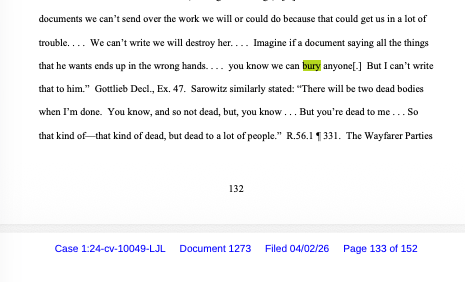
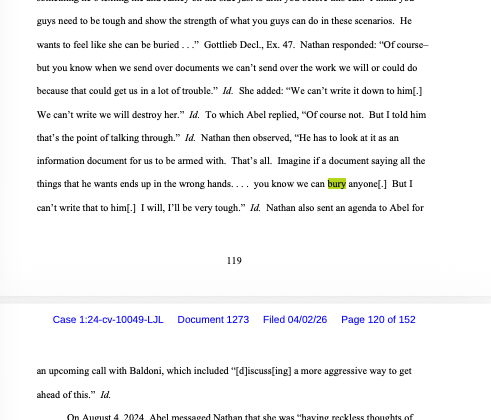
Nathan told Abel: “you know we can bury anyone. But I can’t write that to him.”
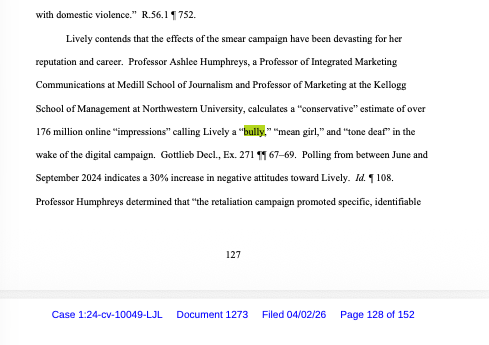
Case described the digital services as work executed “without fingerprints,” including “starting threads with theories the team approves of.” TAG communicated with approximately twenty media outlets about Lively. TAG pitched specific negative story angles to Daily Mail reporters. TAG coordinated with content creators including Sage Steele, providing talking points and reviewing draft scripts before publication. Professor Culotta found statistically significant markers of content manipulation on posts the Wayfarer Parties internally discussed. Professor Humphreys estimated over 176 million online impressions calling Lively a “bully” and “mean girl.”
TAG’s brief characterizes all of this as “distribut[ing] positive information and stories about Baldoni and work[ing] to mitigate or minimize negative ones,” calling it “standard operating procedure for public relations professionals.” That is a characterization for the jury to evaluate.
TAG also relies on the timing argument, noting that the retaliatory campaign “began after Lively’s working relationship with the Wayfarer Parties concluded.” But Judge Liman cited this fact to explain why the retaliation could not support a hostile work environment claim, not to limit the retaliation claim itself. Post-employment retaliation is cognizable under FEHA. The April 2 ruling treats the post-employment smear campaign as the core of the surviving retaliation claim.
What to Watch For
TAG’s motion raises a genuine question of first impression. The answer will turn on whether Judge Liman reads the Raines reservation as leaving the aiding-and-abetting question open (which the text of the opinion plainly does) or whether he concludes that Raines and Reno together establish a structural principle that forecloses liability for any entity not performing employment functions.
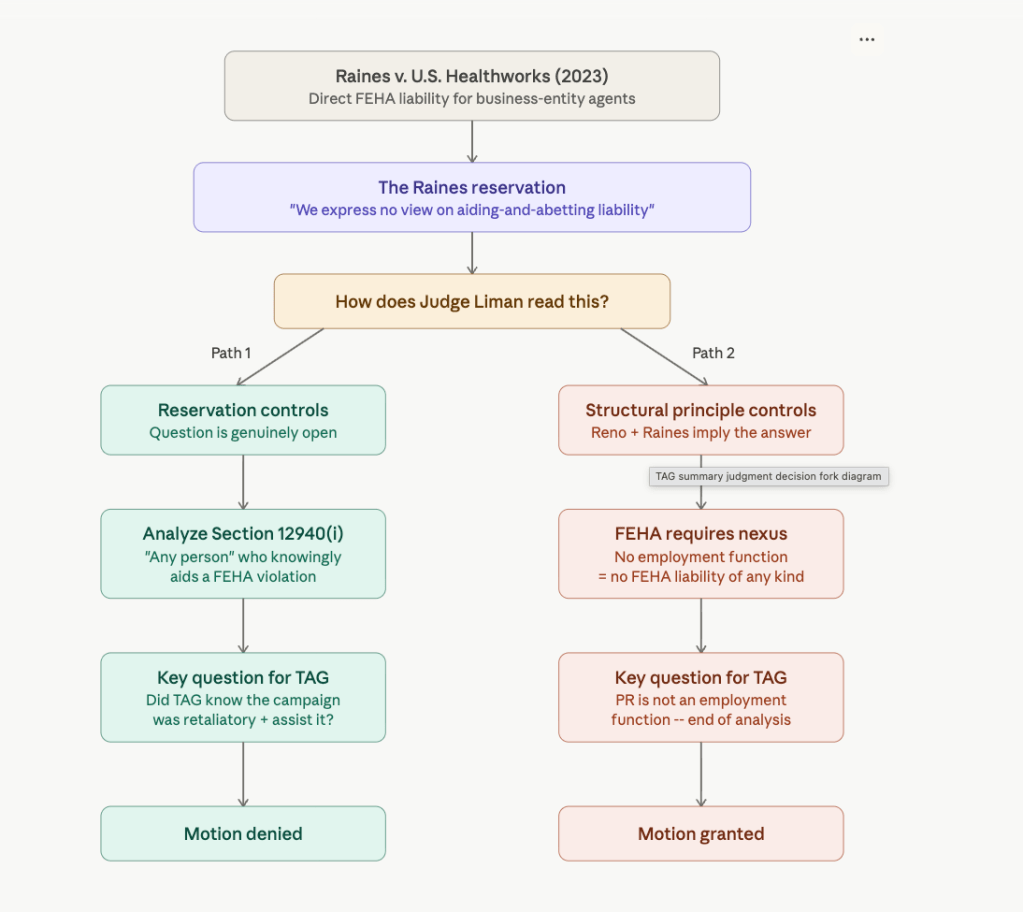
If Liman denies the motion, the case goes to trial with TAG as a defendant on the aiding-and-abetting claim alongside the FEHA retaliation claim against IEWUM/Wayfarer and the breach of CRA claim against IEWUM. If he grants it, Lively loses her only claim against any of the PR defendants, and the trial narrows to Wayfarer, IEWUM, and the contract.
Lively’s opposition will need to do three things:
(1) highlight the Raines reservation that TAG’s brief omits;
(2) argue that Section 12940(i)’s “any person” language is broader than the direct-liability framework; and
(3) connect the factual record to the elements of aiding and abetting, specifically TAG’s knowledge that the campaign constituted retaliation and its substantial assistance in executing it.
Based on the April 2 opinion, she has material to work with on all three.
 celebchai.com