The Wayfarer Parties filed a renewed motion for judgment on the pleadings that looks clever on paper. But Judge Liman’s own opinion already contains the tools to defeat it, and Lively has a backup argument the defendants did not even address.
On April 10, the same day TAG filed its summary judgment motion on aiding-and-abetting liability, the Wayfarer Parties filed a second motion (Dkt. 1295) attacking the FEHA claims from a different angle. This one is a renewed motion for judgment on the pleadings, and it is built as a syllogism from Judge Liman’s own April 2 ruling. At first glance, it looks like the more dangerous of the two filings. On closer examination, it is the one more likely to fail.
The Argument
A syllogism is a form of reasoning where you start with two accepted premises and arrive at a conclusion that logically follows from them. The classic example: All men are mortal. Socrates is a man. Therefore Socrates is mortal. If you accept the first two statements, the conclusion is automatic. You cannot argue with it without challenging one of the premises.
The defendants’ motion is built as a syllogism from Judge Liman’s own April 2 opinion, and that is what gives it its initial force.
Premise one: FEHA’s retaliation provision, Section 12940(h), protects a person who “has opposed any practices forbidden under this part.” This comes from the statutory text.
Premise two: The court has ruled that the harassment Lively complained about was not “forbidden under” FEHA because it occurred in New Jersey and FEHA does not apply extraterritorially. This comes from Judge Liman’s own opinion.
Conclusion: Lively was not opposing “practices forbidden under this part.” Without FEHA-protected activity, there is no FEHA retaliation claim. Without a retaliation claim, there is nothing for TAG to have aided and abetted. All FEHA claims collapse.
At the level of pure formal logic, the argument works. Both premises come from sources the court must respect: the first from the statute, the second from the court’s own ruling.
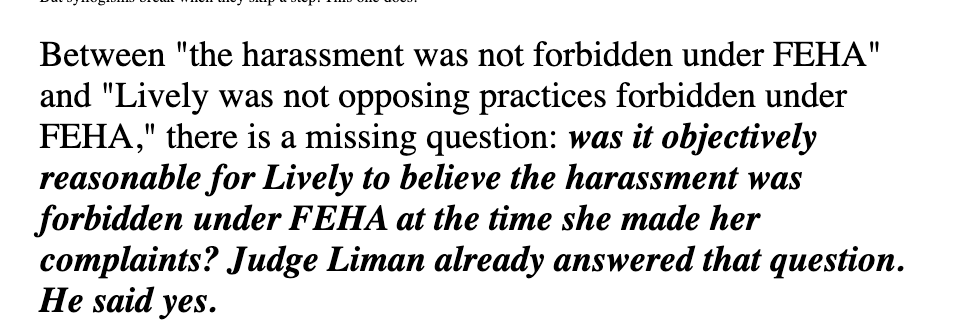
But syllogisms break when they skip a step. This one does.
The Court Already Did This Work
This is why the motion should fail. The defendants are asking Judge Liman to undo an analysis he already performed.
In the April 2 opinion, the court spent ten pages (106-116) evaluating whether Lively had an objectively reasonable basis to believe the Wayfarer Parties sexually harassed her. The court applied the standard from Yanowitz v. L’Oreal USA, Inc., 116 P.3d 1123 (Cal. 2005), and concluded that Lively’s belief was “far from baseless.” The court found that a person in her position “could have understood the workplace to at times reflect a gendered and sexualized view of women and a disregard for their privacy sufficient to make it reasonable to complain about a hostile work environment based on sex or gender.”
Critically, the court quoted Yanowitz for the proposition that a retaliation claim can be sustained “even when a court later determines the conduct was not actually prohibited by the FEHA.” Those are the California Supreme Court’s own words. The standard does not require the plaintiff to be legally correct about whether FEHA applies. It requires the plaintiff’s belief to be objectively reasonable at the time she made her complaints.
The defendants’ motion asks the court to hold that no belief about FEHA-covered harassment can be objectively reasonable when the harassment occurred in New Jersey. But Judge Liman already evaluated the reasonableness of Lively’s belief against the substantive law. He already accounted for the fact that the harassment occurred on a New Jersey set. He still found her belief reasonable. The defendants are not raising a new argument. They are asking the court to reach a different conclusion on the same facts.
The Cases the Defendants Cite Do Not Apply
The defendants rely on Cooper v. New York State Dep’t of Labor, 819 F.3d 678 (2d Cir. 2016), and Arn v. News Media Group, 175 F. App’x 844 (9th Cir. 2006). Both involve a fundamentally different problem.
In Cooper, the plaintiff opposed a proposed change to internal EEO complaint-handling procedures. She believed the change would make future workplace discrimination more likely to go unredressed. The Second Circuit held that opposing a procedural change is not the same as opposing discrimination. The conduct Cooper opposed was categorically outside Title VII’s substantive scope. It was an administrative policy choice, not discrimination on the basis of race, sex, or any other protected category.
In Arn, the plaintiff engaged in environmental whistleblowing and tried to claim FEHA retaliation protection. The Ninth Circuit said no, because environmental violations have nothing to do with any of FEHA’s protected categories.
Lively’s situation is structurally different. She complained about sexual harassment: staring at her exposed body, sexualized comments about her appearance, pushing for unnecessary nudity without contractual consent, entering her trailer while she was undressed, discussing pornography addiction on set. Sexual harassment is indisputably a core FEHA-protected category. Her complaint did not fall outside FEHA’s substantive categories. It fell outside FEHA’s territorial reach. That is a different kind of problem.
Cooper draws a line at categorical errors: you cannot claim retaliation protection for opposing something that is not discrimination. Arn draws the same line. Lively did not make a categorical error. She made a jurisdictional assessment that turned out to be wrong, on a question that took Judge Liman six pages to analyze. The extraterritoriality question was genuinely uncertain. A reasonable person working for California entities, overseen by California executives, under agreements negotiated in California, could reasonably believe that FEHA applied to complaints about sexual harassment on that production. That is exactly the kind of situation the good-faith belief standard exists to protect.
The eShares Distinction Is Real But Not Dispositive
The defendants make one genuinely effective move. In the April 2 opinion, Judge Liman cited eShares, Inc. v. Talton for the proposition that when retaliatory conduct is directed from California, a FEHA retaliation claim survives extraterritoriality. The defendants now go to the eShares docket and cite specific paragraphs showing that the underlying discrimination in that case occurred in California. They are saying: eShares does not control here because eShares did not involve a territorial gap between the underlying harassment and the retaliation.
This is fair. eShares did not address the specific problem the defendants are raising. But the distinction cuts only so far. It establishes that eShares is not dispositive in Lively’s favor; it does not establish that the defendants win. The question still turns on the good-faith belief standard, and on that question, the court has already ruled in Lively’s favor.
The Statutory Text
Section 12940(h) says “practices forbidden under this part.” “This part” is Part 2.8 of Division 3 of the California Government Code: the FEHA. The statute asks whether the practices the plaintiff opposed are the type of practices FEHA forbids. Sexual harassment is a practice forbidden under FEHA. The statute does not say “practices forbidden under this part and occurring within the territorial boundaries of California.”
The defendants are reading a territorial limitation into the protected activity element that the statutory text does not contain. The extraterritoriality doctrine is a judicially created limitation on where FEHA’s substantive provisions apply. It limits the reach of the harassment prohibition. It was not designed to limit what a plaintiff can reasonably believe when she complains about harassment.
The Perverse Incentive
If the defendants’ argument is correct, a California employer could harass employees on an out-of-state set, wait for the employees to complain, and then retaliate from California. The harassment claim fails for extraterritoriality. The retaliation claim fails because the harassment was not “forbidden under” FEHA. Neither claim survives. The employer faces no FEHA liability for either the harassment or the retaliation.
In the entertainment industry, where productions routinely film in one state while being managed from another, this would create a significant gap in worker protection. The California legislature enacted the anti-retaliation provision to encourage employees to report harassment without fear of reprisal. If that protection evaporates whenever the harassment occurs across a state line, the deterrent effect is gutted for any multi-state employer.
Judge Liman is unlikely to adopt a reading of the statute that produces that result, particularly when the statutory text does not require it and Yanowitz provides a workable alternative.
The Argument the Defendants Missed
There is a separate reason this motion should fail, and the defendants did not address it.
Section 12940(h) creates two independent bases for protected activity. It prohibits retaliation against a person “because the person has opposed any practices forbidden under this part” or “because the person has filed a complaint, testified, or assisted in any proceeding under this part.” Those are two clauses joined by “or.” They are independent.
Lively filed a CRD complaint in December 2024. The CRD is a California agency that administers FEHA. Filing a complaint with the CRD is unquestionably “filing a complaint” and “assisting in a proceeding under this part.” This is protected activity regardless of whether the underlying harassment had a sufficient California nexus.
The defendants’ motion focuses exclusively on the “opposed any practices” clause. It does not address the “filed a complaint” clause at all. Even if the defendants are right about the first clause, the second clause independently sustains Lively’s protected activity. The retaliation that followed the CRD filing, including Freedman’s public statements and the Wayfarer Parties’ counter-suit, would be actionable under Section 12940(h) on this basis alone.
This is a significant gap in the motion. It means that even in the worst-case scenario for Lively on the “opposed any practices” question, the FEHA retaliation claim survives through the “filed a complaint” clause. The defendants would need to address and defeat that clause separately, and they have not attempted to do so.
Footnote 20 Is Not an Invitation to Dismiss
The defendants cite Judge Liman’s footnote 20 as though it signals that the court is inclined toward their position. It does not.
Footnote 20, Dkt. 1273 at 94 “There may exist a question regarding the application of the FEHA retaliation statute where (1) the allegedly retaliatory conduct has a sufficient territorial nexus to California but (2) the underlying harassment about which the plaintiff has complained does not. No party has raised that issue on these motions, so the Court has no occasion to address it.”
The court said “there may exist a question.” It did not say “there exists a defect” or “the retaliation claim appears vulnerable.” It flagged an open issue it had not yet considered. If the answer were as clear as the defendants suggest, the court would not have characterized it as a “question.” It would have noted the deficiency and addressed it. The footnote reflects judicial thoroughness, not judicial skepticism.
Why Lively Likely Wins This One
The defendants’ motion is well-crafted, but it runs into several obstacles that are probably insurmountable.
First, it asks Judge Liman to reverse his own finding that Lively’s belief was objectively reasonable. Courts do not typically undo their own analysis eight days later on a motion that raises the same factual record.
Second, the Yanowitz standard is directly on point and comes from the California Supreme Court. It says a retaliation claim survives “even when a court later determines the conduct was not actually prohibited by the FEHA.” The defendants have no California authority holding otherwise.
Third, the cases the defendants cite, Cooper and Arn, involve categorical errors (opposing conduct outside the statute’s substantive scope), not jurisdictional questions (opposing conduct within the statute’s substantive scope but outside its territorial reach). The distinction is clear and Lively’s opposition can draw it sharply.
Fourth, the statutory text does not contain the territorial limitation the defendants are reading into the protected activity element.
Fifth, the perverse incentive argument gives Judge Liman a strong policy reason to reject the defendants’ reading, particularly in the entertainment industry context.
And sixth, the CRD filing provides an independent basis for protected activity that the defendants’ motion does not even address. Even if every other argument fails, this one survives.
The motion looks dangerous because the syllogism is built from the court’s own opinion. But the syllogism skips the Yanowitz step, and that step is where it breaks.
Two motions, filed on the same day, attacking the FEHA claims from different angles. TAG’s motion challenges whether a PR firm can be an aider and abettor. The renewed motion challenges whether the FEHA claims exist at all. Both are well-argued. Neither should succeed. The Raines reservation defeats TAG’s attempt to collapse aiding-and-abetting liability into direct liability. The Yanowitz good-faith belief standard defeats the attempt to eliminate the retaliation claim through the extraterritoriality ruling. And the CRD filing provides a safety net that the defendants have not even tried to cut.
Lively’s FEHA claims should survive to trial.
 celebchai.com