Here’s the backstory the procedural record tells.
December 2024 — the opening salvo. On December 20, 2024, Blake Lively filed a complaint with the California Civil Rights Department against Justin Baldoni, Wayfarer Studios, Jamey Heath, Steve Sarowitz, It Ends With Us Movie LLC, Melissa Nathan, The Agency Group PR, and Jennifer Abel, alleging sexual harassment on the set of It Ends With Us and a retaliatory smear campaign that followed her complaints. That same day, the New York Times published “‘We Can Bury Anyone’: Inside a Hollywood Smear Machine,” drawing heavily from the CRD complaint and from text messages and emails obtained through subpoena. Eleven days later, on December 31, Lively filed her federal complaint in the Southern District of New York.
January 2025 — Wayfarer counterpunches. On January 16, 2025, the Wayfarer Parties filed their own complaint against Lively, Ryan Reynolds, Leslie Sloane, Vision PR, and the New York Times. They alleged defamation, civil extortion, false light, tortious interference, breach of implied covenant, and promissory fraud. The case was assigned to Judge Liman and consolidated with Lively’s earlier-filed action. The Wayfarer Parties filed an amended complaint on January 31. Lively, Reynolds, Sloane, and the Times moved to dismiss.
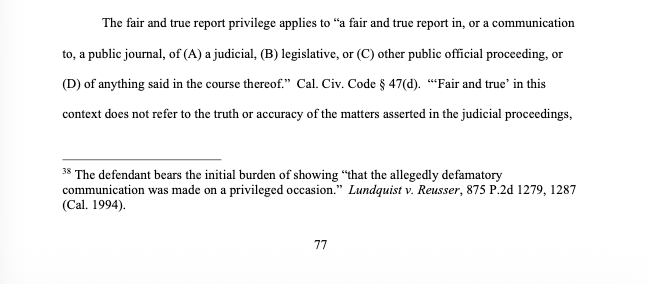
June 9, 2025 — the dismissal. Judge Liman granted the motions to dismiss in their entirety. The 132-page opinion held that Lively’s communications to the New York Times via the CRD complaint were protected by California’s litigation privilege under § 47(b) and the fair report privilege under § 47(d). The court found no actual malice as to statements by Sloane, Reynolds, or the Times. Civil extortion failed because Lively’s threats did not amount to wrongful duress. False light failed for the same reasons as defamation. Breach of implied covenant, tortious interference, and promissory fraud all failed for inadequate pleading. The court granted leave to amend only on the implied covenant and tortious interference claims. Critically, the court expressly did not rule on whether Lively’s statements were privileged under § 47.1 specifically. It denied Lively’s motion for fees under § 47.1 “without prejudice to renewal.”
Case 1:24-cv-10049-LJL Document 296 Filed 06/09/25 Page 131 of 132
Mid-2025 — Lively’s amended complaint and discovery. Lively filed her First Amended Complaint on February 18, 2025, and her operative Second Amended Complaint on July 30, 2025. The Wayfarer Parties chose not to replead. Discovery proceeded through the fall. The Wayfarer Parties moved for judgment on the pleadings in September and for summary judgment in November. Lively opposed in December. Argument was held January 22, 2026.
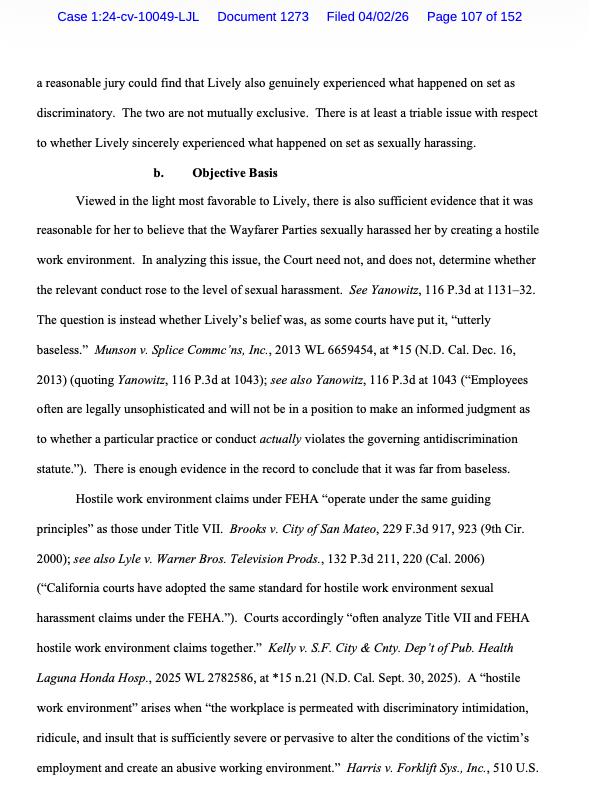
April 2, 2026 — summary judgment. Judge Liman issued a 152-page opinion. He granted judgment to the Wayfarer Parties on most of Lively’s claims, including Title VII harassment and retaliation (Lively was an independent contractor, not an employee), her California sexual harassment claims (insufficient California nexus for extraterritoriality), false light (governed by New York law, which doesn’t recognize the tort), defamation (statements by Wayfarer’s counsel Bryan Freedman were protected by the fair report privilege), and civil conspiracy. But he denied summary judgment on three claims: FEHA retaliation against IEWUM and Wayfarer, aiding-and-abetting retaliation against The Agency Group PR, and breach of the Contract Rider Agreement against IEWUM. The court found a triable issue on whether the Wayfarer Parties orchestrated a retaliatory smear campaign against Lively. Crucially, in evaluating whether Lively had a reasonable basis to believe she was sexually harassed which she needed to show as part of her FEHA retaliation prima facie case. Judge Liman went through the on-set conduct in detail and concluded a reasonable jury could find her belief objectively reasonable. He catalogued the trailer incident with Heath, the birth scene, comments on her appearance, the pornography disclosures, and other incidents.
May 7, 2026 — the settlement. The parties filed a Notice of Settlement and Joint Stipulation. The Lively action was dismissed with prejudice. Both sides waived all appeals — including the Wayfarer Parties’ right to appeal the June 9, 2025 dismissal of their own claims. But the stipulation carved out one issue: Lively’s pending motion for attorneys’ fees, treble damages, and punitive damages under California Civil Code § 47.1 (Dkt. 742 in 24-cv-10049) remained alive. Both sides agreed it would not be withdrawn, that Judge Liman would decide it, and that both sides waived any appeal from his determination.
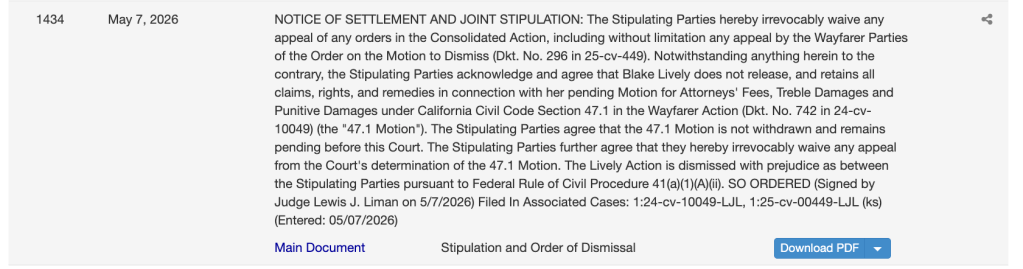
That carve-out is the entire reason argument is happening on June 1. Everything else is settled. The only live issue in the consolidated litigation is whether the Wayfarer Parties’ defamation suit against Lively was brought “for making a communication that is privileged under [§ 47.1]” — which would entitle her to fees, treble damages, and possibly punitive damages against the Wayfarer Parties.
May 28, 2026 — Judge Liman’s order. Three weeks after the settlement, Judge Liman issued the order setting argument and requesting letter briefs. He asked four specific questions, all addressed to the same problem: assuming a prevailing defendant can apply for § 47.1(b) relief under Rule 54, who bears the burden of proving the underlying communication is privileged under § 47.1(a), does it vary by remedy sought, does it vary because Rule 54 is the procedural vehicle, and how is the burden discharged.
Why this matters and why now. The June 9, 2025 dismissal handed Lively a complete win on the Wayfarer Parties’ defamation claim, but it did so on litigation-privilege and fair-report-privilege grounds. Section 47.1 was expressly left open. To collect fees under § 47.1(b), Lively now has to establish that her communications were privileged under § 47.1 specifically — that she made the CRD complaint and accompanying communications about sexual harassment she experienced, that she had a reasonable basis to do so, and that they were not made with malice. The April 2, 2026 summary judgment opinion does most of that work for her on the reasonable-basis element. The Wayfarer Parties will push hard on malice. The burden allocation Judge Liman wants briefed determines who has to come forward with what at the upcoming argument and whatever evidentiary proceedings follow.
The stakes for each side. For Lively, this is the chance to recover attorney’s fees that almost certainly run into the millions for over a year of federal-court litigation, plus treble damages for harm caused by the Wayfarer Parties’ defamation action, plus potentially punitive damages. For the Wayfarer Parties, it’s the chance to avoid a payment of that magnitude after having already lost their defamation case, lost most of their summary judgment motion against Lively’s claims, and agreed to settle. The settlement bought them out of trial on Lively’s surviving claims; it did not buy them out of the § 47.1 exposure they’d been on the hook for since they filed suit in January 2025.
That’s the procedural and factual context for the brief due Sunday at 5 PM and the argument Monday at 2 PM.
This is the letter that Blake should consider.
Re: Lively v. Wayfarer Studios LLC, et al., No. 24-cv-10049 (LJL); Wayfarer Studios LLC, et al. v. Lively, et al., No. 25-cv-449 (LJL)
Dear Judge Liman:
Pursuant to the Court’s Order of May 28, 2026 (ECF 1437), Defendant Blake Lively respectfully submits the following cases addressing which party bears the burden of proof under California Civil Code § 47.1(a), whether that burden varies by remedy or procedural vehicle, and how the burden may be discharged.
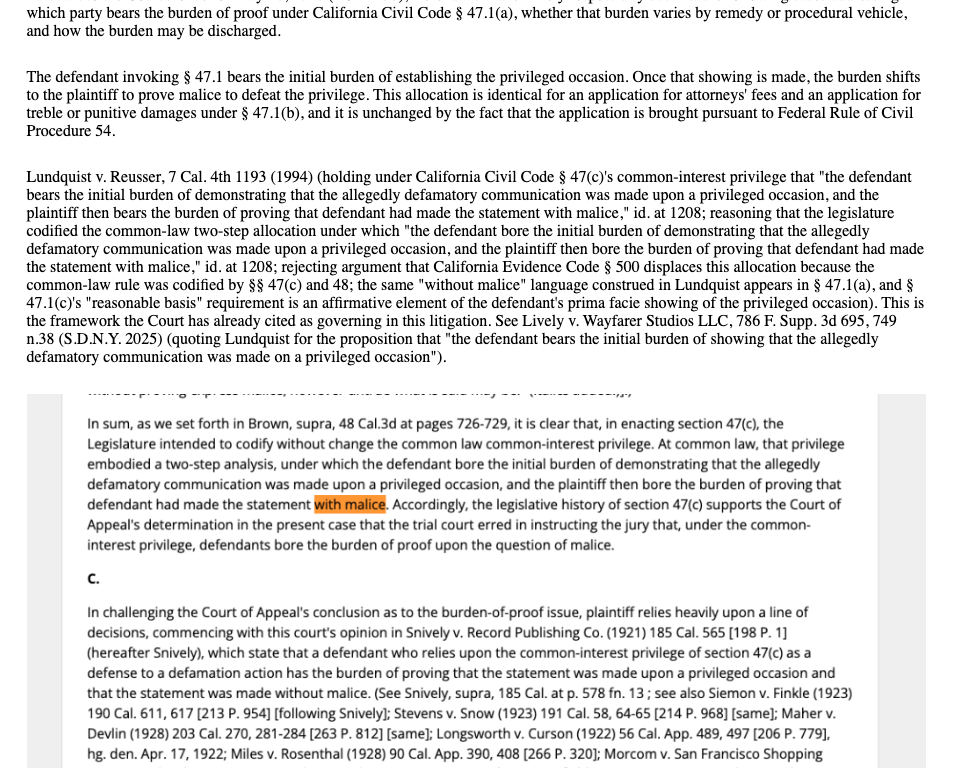
The defendant invoking § 47.1 bears the initial burden of establishing the privileged occasion. Once that showing is made, the burden shifts to the plaintiff to prove malice to defeat the privilege. This allocation is identical for an application for attorneys’ fees and an application for treble or punitive damages under § 47.1(b), and it is unchanged by the fact that the application is brought pursuant to Federal Rule of Civil Procedure 54.
Lundquist v. Reusser, 7 Cal. 4th 1193 (1994) (holding under California Civil Code § 47(c)’s common-interest privilege that “the defendant bears the initial burden of demonstrating that the allegedly defamatory communication was made upon a privileged occasion, and the plaintiff then bears the burden of proving that defendant had made the statement with malice,” id. at 1208; reasoning that the legislature codified the common-law two-step allocation under which “the defendant bore the initial burden of demonstrating that the allegedly defamatory communication was made upon a privileged occasion, and the plaintiff then bore the burden of proving that defendant had made the statement with malice,” id. at 1208; rejecting argument that California Evidence Code § 500 displaces this allocation because the common-law rule was codified by §§ 47(c) and 48; the same “without malice” language construed in Lundquist appears in § 47.1(a), and § 47.1(c)’s “reasonable basis” requirement is an affirmative element of the defendant’s prima facie showing of the privileged occasion). This is the framework the Court has already cited as governing in this litigation. See Lively v. Wayfarer Studios LLC, 786 F. Supp. 3d 695, 749 n.38 (S.D.N.Y. 2025) (quoting Lundquist for the proposition that “the defendant bears the initial burden of showing that the allegedly defamatory communication was made on a privileged occasion”).
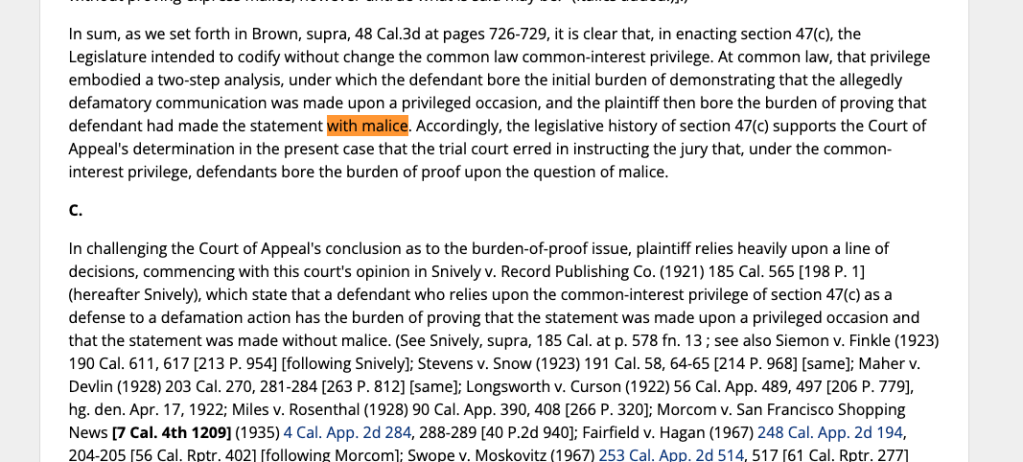
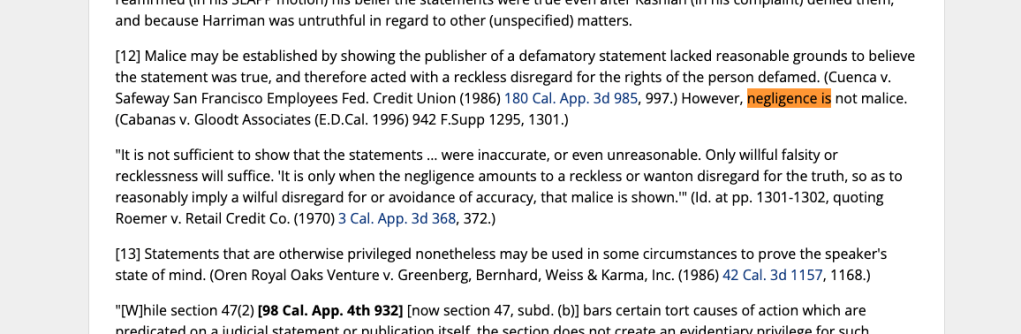
Kashian v. Harriman, 98 Cal. App. 4th 892 (2002) (applying Lundquist’s two-step burden allocation to communications connected to a complaint to the California Attorney General; holding that “once defendant establishes defamatory statement was made on a privileged occasion, plaintiff bears the burden of proving defendant acted with malice,” id. at 930; further holding that this allocation governs at the threshold motion stage and that the plaintiff opposing the privilege must come forward with evidence sufficient to support a finding of malice rather than mere allegations of falsity or unreasonableness; “negligence is not malice,” id. at 931, and “[i]t is not sufficient to show that the statements were inaccurate, or even unreasonable. Only willful falsity or recklessness will suffice,” id.; confirming that the burden allocation applies in the same manner whether the privilege is asserted as a defense to liability or as the predicate for fee-shifting relief).
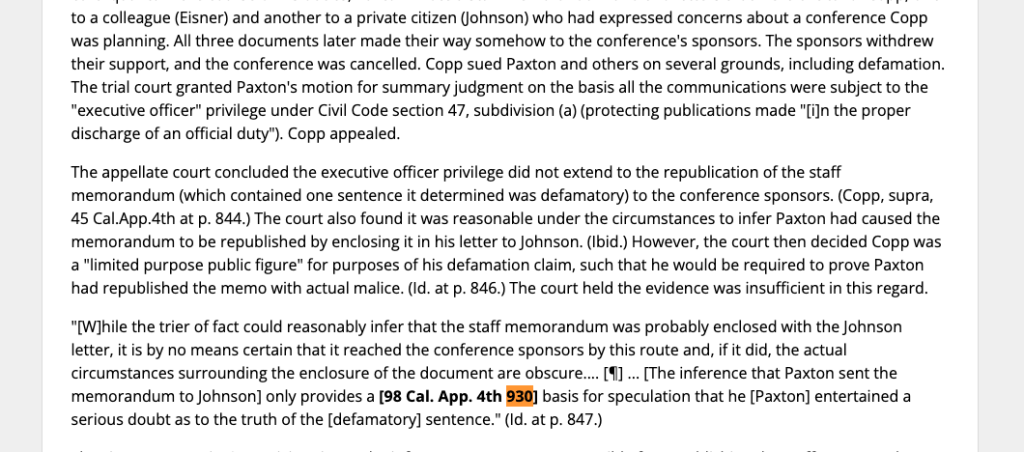
How the burden is discharged. Under Lundquist and Kashian, Ms. Lively discharges her initial burden by establishing the three elements of a § 47.1 privileged occasion: (i) the communication conveyed factual information about an incident of sexual harassment she experienced (§ 47.1(d)); (ii) she had, or at any time had, a reasonable basis to file a complaint of sexual harassment (§ 47.1(c)); and (iii) the communication falls within § 47.1’s protected category. The Court has already found on a developed summary judgment record that Ms. Lively’s belief she was subjected to sexual harassment was objectively reasonable. See Lively v. Wayfarer Studios LLC, No. 24-cv-10049, slip op. at 107–116 (S.D.N.Y. Apr. 2, 2026) (ECF 1273). That finding establishes the § 47.1(c) “reasonable basis” element as a matter of law of the case. The CRD complaint and accompanying communications establish the § 47.1(d) factual-information element on their face. Under Lundquist, the burden then shifts to the Wayfarer Parties to prove malice by admissible evidence to defeat the privilege.
No remedy-based or procedural distinction. Section 47.1(b) makes attorneys’ fees, costs, treble damages, and punitive damages available to “the prevailing defendant” in a single remedial package, conditioned on the same predicate showing — that the underlying suit was “for making a communication that is privileged under this section.” The privilege determination, and the burden allocation governing it, is identical regardless of which remedy is sought. The independent clear-and-convincing standard of California Civil Code § 3294(a) applies to the punitive-damages component but does not alter the Lundquist allocation as to the privilege itself. Federal Rule of Civil Procedure 54 is a procedural vehicle that does not displace the substantive burden allocation established by California law. Lundquist, 7 Cal. 4th at 1211–12 (rejecting argument that California Evidence Code § 500 alters the substantive allocation; the same principle defeats any argument that a federal procedural rule does so).
Ms. Lively respectfully submits that under Lundquist and Kashian, the burden of proving that the communication is privileged under § 47.1(a) is allocated as follows: she bears the initial burden of showing the privileged occasion, which the existing record and the Court’s prior findings establish; the Wayfarer Parties then bear the burden of proving malice to defeat the privilege.
Respectfully submitted,
 celebchai.com