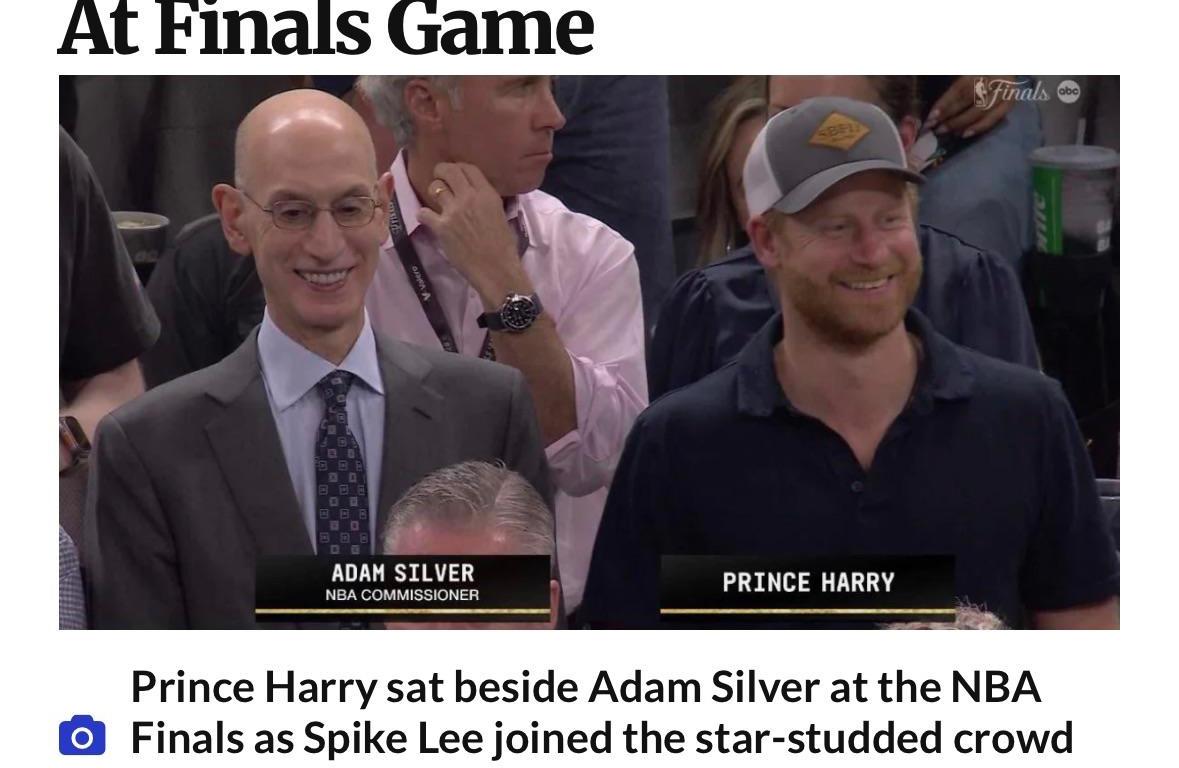
A man went to a basketball game. He was invited by the league’s commissioner, sat next to him, and watched a city end a 53-year championship drought. By any ordinary measure this is a nice evening. The Daily Mail’s job, in covering it, was to make sure you did not read it that way.
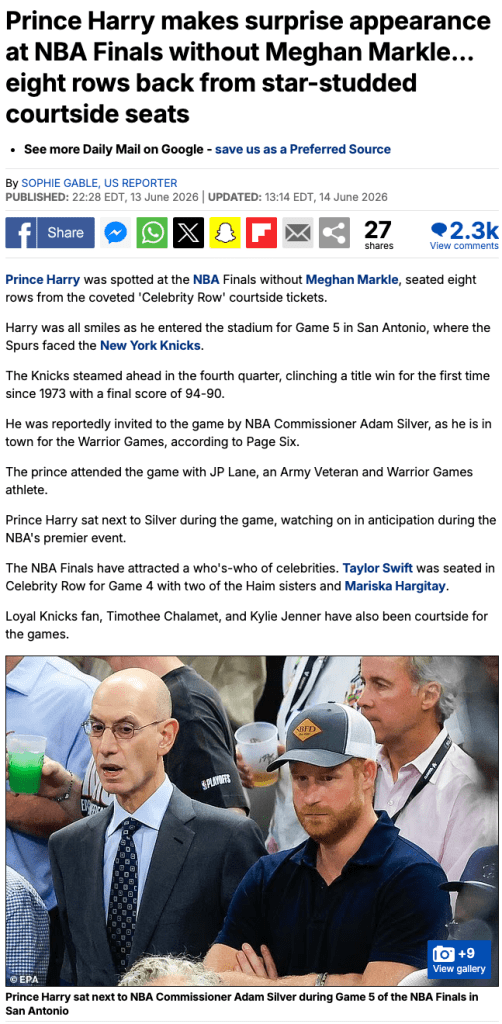
The headline does most of the work before you reach a single fact: “Prince Harry makes surprise appearance at NBA Finals without Meghan Markle… eight rows back from star-studded courtside seats.” Three separate framing devices are loaded into one sentence. It was a “surprise.” It happened “without Meghan Markle.” And he was “eight rows back,” a phrase engineered to read as demotion. None of these are facts about the game. They are instructions about how to feel.
The event that gets to be the default
The most revealing move in the piece is not anything said about Harry. It is the long, admiring detour into Trooping the Colour that sits in the middle of an NBA write-up.
The structure tells you what the article considers real. The basketball game is the nominal subject, but the prose keeps pulling back to London: the parade, the 1,400 soldiers, the 200 horses, the balcony, Kate leaning forward to talk to her children, William “in full military regalia” with his horse Darby. The ceremony is rendered in warm, novelistic detail. The game is rendered as a problem to be explained.
This is the displacement protocol in its clearest form. One event is treated as the natural center of gravity, the thing a royal person is supposed to be doing, and everything else is positioned as a deviation that has to account for itself. The article even installs a poll asking whether Harry “should have been at Trooping the Colour,” which only makes sense if you have already accepted the premise that the ceremony was the real event and the game was the escape from it.
Notice what this requires you to swallow. Trooping the Colour is a closed ritual whose meaning is legible mostly to people already inside the institution. Its content is a regiment carrying a flag, performed for the Sovereign’s official birthday, which is not even his actual birthday. There is nothing wrong with enjoying it. But the article does not present it as one pleasant traditional thing among others. It presents it as the standard against which an ordinary man’s ordinary evening is judged and found wanting. The arcane ceremony is the baseline; the basketball game is the anomaly.
“Eight rows back” as manufactured humiliation
The seating becomes the load-bearing humiliation of the entire piece. “Eight rows back from star-studded courtside seats.” “Forced to sit 8 rows back.” The comment section, which the Mail curates and elevates, runs with it for hundreds of entries: “How the mighty have fallen,” “No longer a front row celebrity,” “What no courtside? You’ve fallen so so much.”
The article itself contains the information that dissolves the humiliation. Harry was the guest of Adam Silver, the commissioner of the NBA, and sat next to him. Sitting beside the single most powerful person in the building is not a worse seat than courtside. It is a different and arguably more exclusive position entirely. The framing only works if you ignore the fact the article already gave you, which is why the piece states the seating fact and the “eight rows back” judgment in the same breath and trusts you not to reconcile them.
This is a recurring technique: include the exculpatory detail so the piece is technically accurate, then bury it under an interpretation that contradicts it. The reader who skims absorbs “demoted, humiliated, fallen.” The reader who stops absorbs “guest of the commissioner.” The Mail is covered either way.
The agency-tracking, and where it points
The comment section, which is part of the published artifact and not incidental to it, organizes itself around a single obsessive motif: Harry has no will of his own. He is “off the leash.” His wife “let him off his leash.” He has a “handler.” He looks happy because she is not there to “cling” or “paw” at him. He was “instructed to go and be visible.” He went because “money pinched Megan sent Harry out to network.”
Track what this framework accomplishes. Every action Harry takes is reassigned to someone else’s intention, usually his wife’s. If he looks happy, it is because he escaped her. If he looks bored, it is because he is miserable in the marriage. If he attends, he was sent. If he is absent, he was forbidden. There is no configuration of facts that can be read as a man making his own choices, because the entire interpretive grid exists to deny him agency. The same grid simultaneously strips Meghan of any legitimate motive, recasting her as a controller, a “claw,” a handler dispatching her husband for money.
This is not analysis of two people. It is a closed loop designed so that no observation can ever update the conclusion. That is the signature of an opinion-laundering operation rather than a reporting one. The conclusion is fixed in advance; the day’s facts are raw material to be fitted to it.
The wine that has nothing to do with anything
Meghan was not at the game. She is not relevant to a basketball game she did not attend. And yet the article devotes several paragraphs to her As Ever brand, the sauvignon blanc, the Brut, the 2023 Napa Valley Rosé priced at $35, complete with the promotional caption.
This is the production cycle feeding itself. A story ostensibly about Harry at a game becomes a vehicle for re-litigating Meghan’s commercial activity, which generates the next round of comments about grifting and freebies, which becomes the sourcing for the next article. The wine paragraph is not journalism about the NBA Finals. It is inventory management for an ongoing narrative, inserted because the narrative requires regular Meghan touchpoints regardless of whether the day’s actual event involved her.
What was actually true
Stripped of the framing, here is the event. Harry attended Game 5 of the 2026 NBA Finals in San Antonio on June 13 as the guest of NBA Commissioner Adam Silver, while in town for the Warrior Games, accompanied by Army veteran and Warrior Games athlete JP Lane. He watched the New York Knicks beat the San Antonio Spurs 94-90 to win their first title in 53 years, a game decided by Jalen Brunson’s 45-point Finals MVP performance, the night after the Knicks had completed the largest comeback in NBA Finals history. He sat next to the most powerful person in the league. He appeared to enjoy himself.
The Mail had to do a remarkable amount of work to turn that into a story about decline. The work is the story. When a piece has to import a separate ceremony to supply the contrast, manufacture a humiliation out of a seat next to the commissioner, and pad itself with wine prices to keep a marriage in frame, the question answers itself: there was no failure in the event. The failure had to be built.
A man enjoyed a basketball game. That this needed to be neutralized, reframed, and absorbed back into a story about a family ritual he wasn’t part of tells you which institution the coverage serves, and it isn’t the reader trying to find out what happened.
 celebchai.com