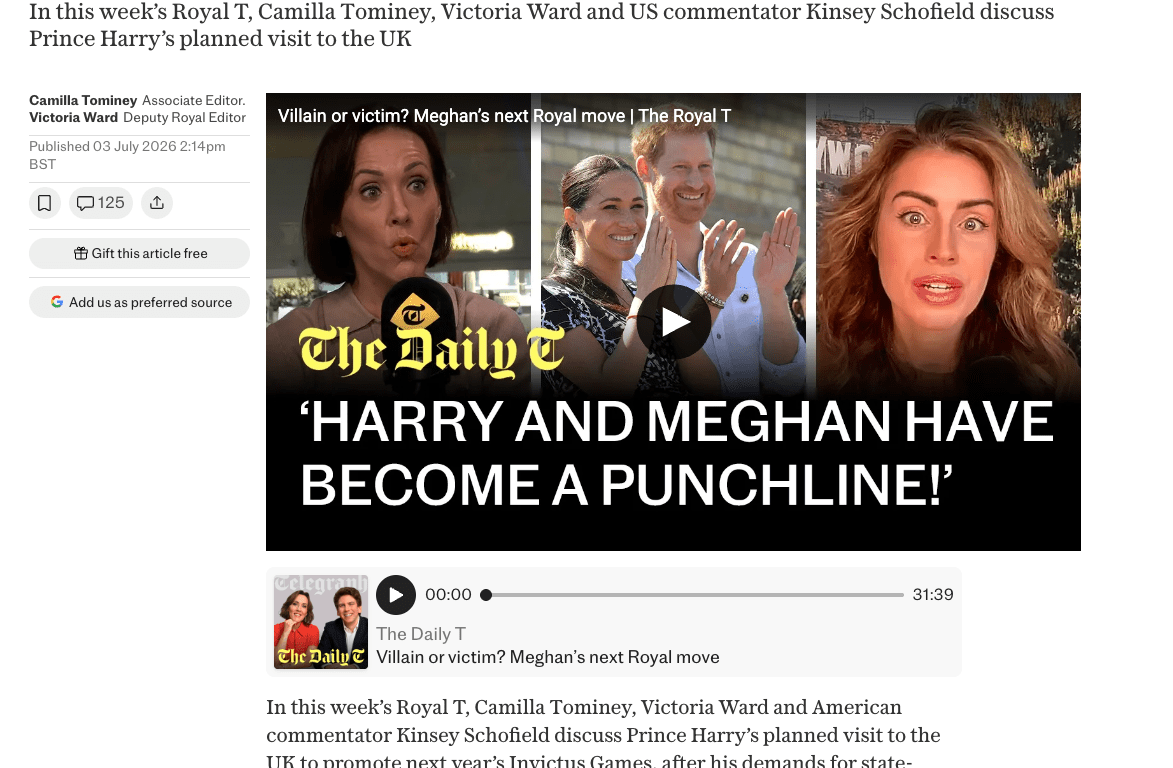
Three pieces ran in the Telegraph across two days. Two hard-news reports and one podcast segment, all circling the same event: Prince Harry has decided the Duchess of Sussex and their two children will not travel to London next week, after a request for taxpayer-funded police protection was denied. That is the fact. Everything else is who gets to narrate it, and the narration is where the interesting stuff happens.
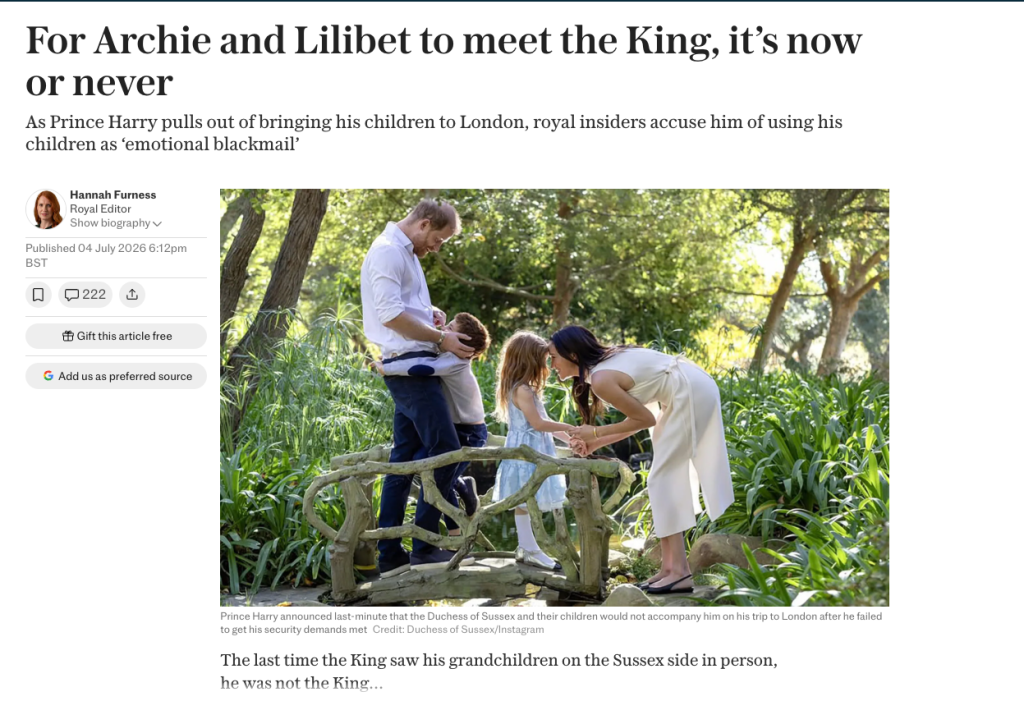
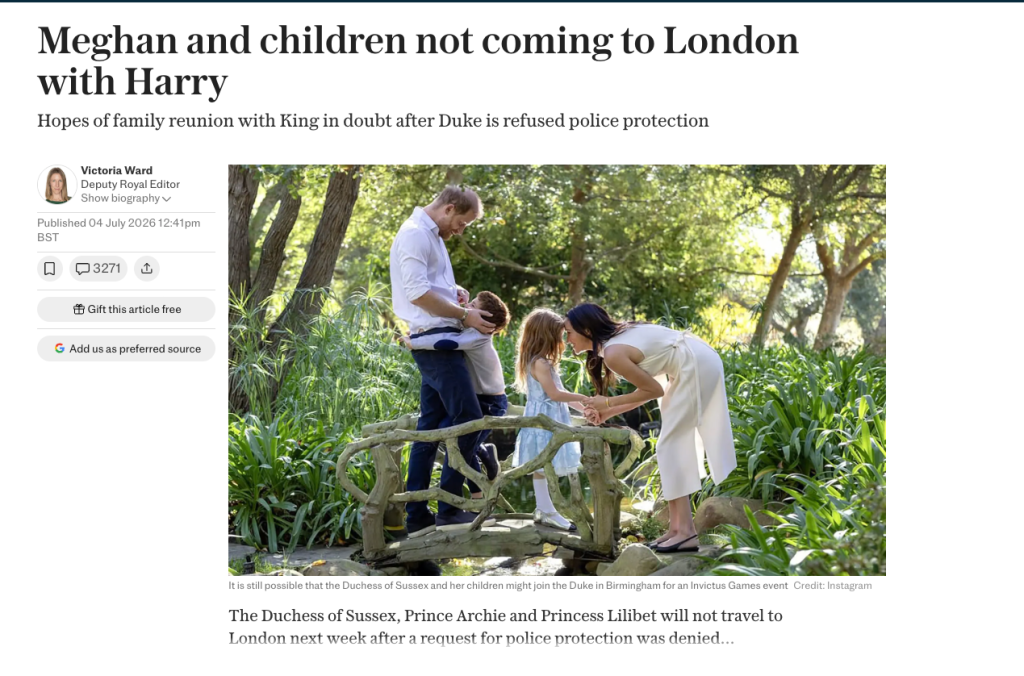
Because the fact itself is thin. A security provision was refused ten days before a planned trip, and a father decided not to bring his kids into a city without it. Stated flat, that is a decision most people would recognize as ordinary caution. What the coverage does is take that ordinary decision and, through a hundred small choices of phrasing and sourcing, turn it into evidence of a character defect.
The charge nobody will sign
The load of both news pieces is a single accusation: that Harry is using his children as “emotional blackmail” to pressure the Home Office into upgrading his security. It is a genuinely nasty thing to say about a parent. And it is remarkable how carefully no one is made to own it.
In Ward’s piece it belongs to “some” who “believed.” The uglier version, that Harry “never intended to bring the children” at all, is attributed to nobody whatsoever. It just appears. By the time Furness writes it up hours later, it has firmed into “several critics,” and then into “one source” who says he has “painted himself into a corner” and “needs an off-ramp,” garnished with a long-term royal-watcher calling him a “plonker.”
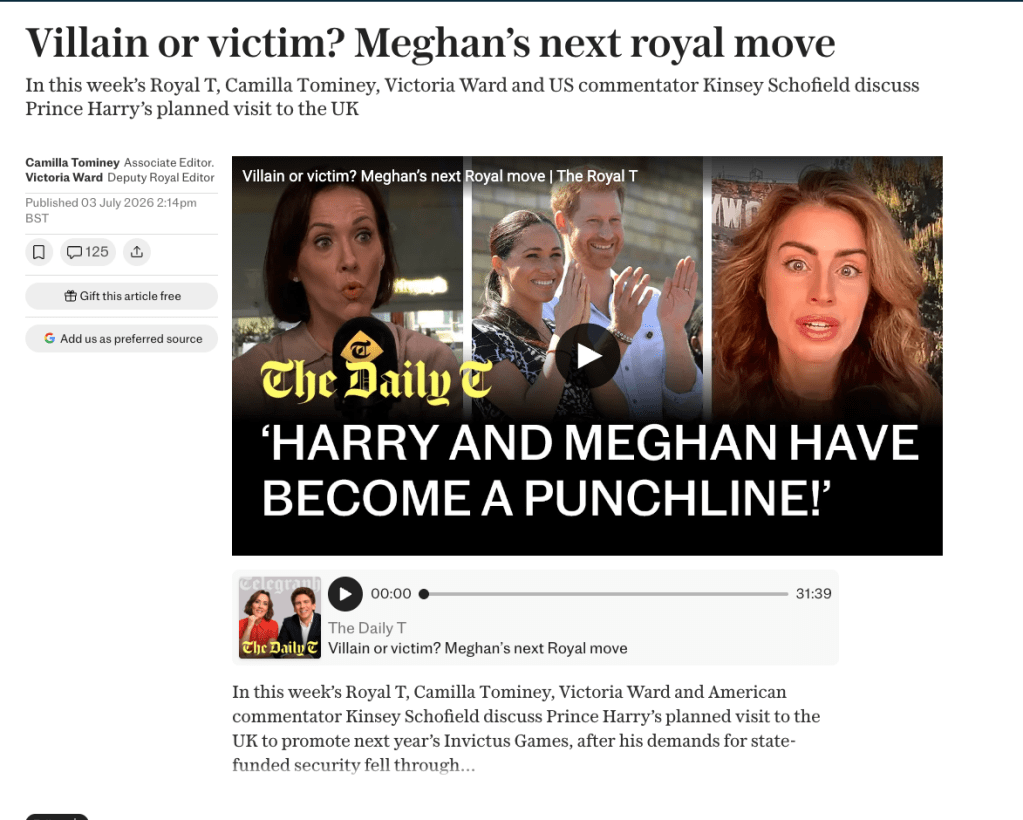
Watch the accusation travel. It starts as something some unnamed people believe. It becomes something critics have said. By the third piece, the Royal T segment, it is no longer an allegation at all. It is the premise. The episode is titled “Villain or victim?” and the discussion opens onto Meghan’s “villain era” and her “crashing brand” as settled context. Somewhere across forty-eight hours, a smear that no named person would put their name to has quietly become the frame everyone is arguing inside.
This is the oldest trick in royal coverage and it never stops working. You cannot rebut a source who does not exist. You cannot ask “several critics” what evidence they have that a father is faking love for his kids. The vaguer the attribution, the safer the cruelty, and the cruelty here is doing all the persuasive work.
Who is allowed to be sympathetic
Sort the sourcing by warmth and a pattern jumps out. The palace-side voices get interiority and a good time. Aides are “wary” and “weary.” They are “exasperated,” braced for “chaos,” rolling their eyes at “the Sussex circus.” They get the funny lines and the world-weary sighs, which is another way of saying they get to be the reasonable adults in the room.
Harry’s side gets a spokesman. On the record, on message, and then immediately reframed as spin. “The Duke continues to explore every available option,” says the statement, and the very act of putting out a statement is treated as further evidence of a man flailing. The one party willing to be named and quoted is positioned as the one managing a mess of his own making. The parties hiding behind “sources say” get to be the exhausted, sensible chorus.
There is a tell in Furness’s piece that gives the game away. It opens on the 2022 Jubilee, Archie’s “deep, chivalrous bows,” Lilibet cuddling the late Queen’s shins, a first birthday at Frogmore. It is genuinely tender writing. But it is not there to be tender. It is there to raise the emotional price of the reunion that isn’t happening, so that when Harry pulls the plug, it reads as a warmth he personally withheld rather than a consequence of a security decision made by people who are never in the frame.
The man who cannot do anything
Now the part that actually says something about the monarchy rather than the Sussexes. Look at where the coverage lets power sit, and where it removes it.
Harry is the only person in these pieces who does anything. He decides, changes his mind, explores options, weighs travel briefings, paints himself into corners, uses his children. Verb after verb, all his. He is the sole agent in a story with a great many actors.
The King, by contrast, is staged as a man to whom things merely happen. He “cannot intervene.” He “cannot interfere.” He is “merely a cog in the wheel.” Ingrid Seward supplies him an imagined line, delivered as charming self-deprecation: “Nothing to do with me, darling boy. I am merely a cog in the wheel of my government and cannot interfere!” It is written to be endearing. It functions to excuse. The head of state is presented as the one person in Britain with no ability to affect his own family’s week.
And the single most consequential act in the entire story, the security refusal that set all of this in motion, is the one act with no actor attached to it at all. Protection “was denied.” Provision “was not sufficient.” Arrangements “were not” upgraded. Passive voice all the way down. The decision that caused the crisis is the only decision nobody is shown making.
Which is where the King comes off worst, not because the coverage attacks him, but because it defends him into irrelevance. A monarch endlessly briefed about as “keen” and “softened” and “delighted, of course” to see grandchildren he has not laid eyes on in four years, who nonetheless does precisely nothing, and whose inaction is dressed up as constitutional grace. The pieces want you to read his passivity as dignity. Read it straight and it is just passivity. He is a man who would plainly rather be charming than choose, and the coverage keeps handing him charm so he never has to. The briefers do the wet work; he keeps his hands clean and his diary “carefully planned.” It is a very comfortable way to be the most powerful man in the story and the least accountable one in it.
The Harry Styles gambit
One flourish from the podcast deserves a mention because it is such a clean example of an argument that only looks like one. The panel compares Harry’s security claims to “global celebrities such as Harry Styles, who goes running freely around London.” There, it seems to say, an ordinary famous person manages fine, so what is the Duke’s problem.
Except a pop star’s ordinary fame and a specific, assessed threat history are not the same category, and the comparison works precisely by refusing to engage that difference. It feels like a rebuttal. It contains no actual counter to anything Harry’s side has claimed about his particular risk profile. It is a vibe wearing the costume of a point, and it lands because the audience has already been told, across three pieces, which side is being unreasonable.
What is actually going on
Strip the sourcing games away and the underlying situation is mundane. A security arrangement was refused at short notice. A father decided not to bring his children somewhere he considered unsafe. Two sides who do not trust each other briefed the press about it, and one of those sides is much better at briefing than the other, because one of those sides is the institution and the other is a spokesman.
The reunion may still happen somewhere quieter. The children are said to be having a nice summer in Europe, blessedly out of all this. And the King, extended-an-invitation, keen-of-course, cog-in-the-wheel, will carry on being the one figure in the whole drama who is never asked to actually do the thing everyone insists he wants.
Villain or victim, the podcast asks of Meghan. The better question is who benefits from the frame, and the answer, as usual, is whoever got to stay anonymous.

