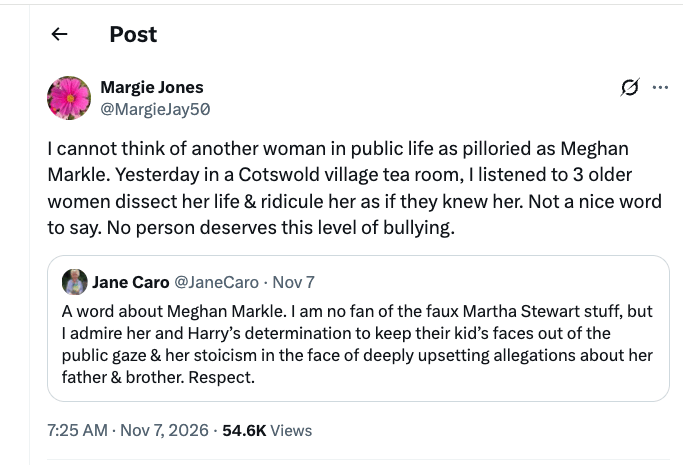
A post on X this week described an ordinary scene. Three older women in a Cotswolds tea room spent their visit picking apart Meghan Markle’s life and mocking her as if they knew her. The writer, wedged in beside them in a crowded room, heard every word, and not one of them was kind.
It’s a small moment, but it stuck with me. Those women have never met Meghan. Yet they talked about her with the kind of contempt most of us save for someone who has wronged us directly.
Criticism is fair. This is something else.
Nobody is obliged to like Meghan Markle. You can find the lifestyle brand twee, roll your eyes at the streaming deals, or think the couple handled their exit from royal life badly. Those are opinions about public choices, and public figures invite them.
Even the writer Jane Caro, whose post started the thread, said she isn’t a fan of the Martha Stewart-style ventures. But there is a difference between disliking someone’s work and treating them as a hate figure. One is criticism. The other has become a pastime.
When the talk moves from what she does to who she supposedly is, it stops being critique. Grifter, liar, fraud: the labels are personal, and they get repeated with total confidence by people who only know her through headlines.
A decade of it
Meghan’s relationship with Prince Harry became public in 2016. Within weeks, Harry issued a statement condemning the coverage, including its racial undertones. That was ten years ago, and the volume has barely dropped since.
Most public figures get a news cycle of scorn, then attention moves on. Meghan has had years of it, through her engagement, her wedding, two pregnancies and the move to California. Every new venture restarts the cycle.
Sustained coverage does something to an audience. When people read the same framing for years, it stops feeling like opinion and starts feeling like fact. That is how three strangers in a tea room come to speak about her with such certainty.
What the replies gave away
The post drew exactly the response it described. Some replies agreed the hostility had become strangely personal, and one person called it textbook parasocial behavior. Others piled in with insults and swearing, now aimed at the woman who had simply noticed the bullying.
That pattern is telling. Defending Meghan, even mildly, gets treated as a personal provocation. People who have never met her react as if she had wronged them, and as if anyone who disagrees must be in on it.
It’s fine to dislike a celebrity. Feeling personally betrayed by one, year after year, is worth a second look.
What deserves respect
Caro’s post pointed to two things worth acknowledging. Meghan and Harry have worked hard to keep their children’s faces out of the press. In a family where children have traditionally been presented to cameras from birth, that is a deliberate choice, and not a cheap one.
She has also stayed largely quiet through painful public claims involving her own family. Whatever you think of her, that restraint is hard. Most of us would struggle to say nothing while our relatives made headlines.
Both things can be true
You can critique the business and still call out the bullying. You can find her irritating and still see that a decade of sneering is out of proportion to anything she has done.
The next time the conversation at the next table turns to Meghan, it’s worth asking what anyone there actually knows. Usually the answer is nothing beyond the headlines. That should make all of us a little quieter.

