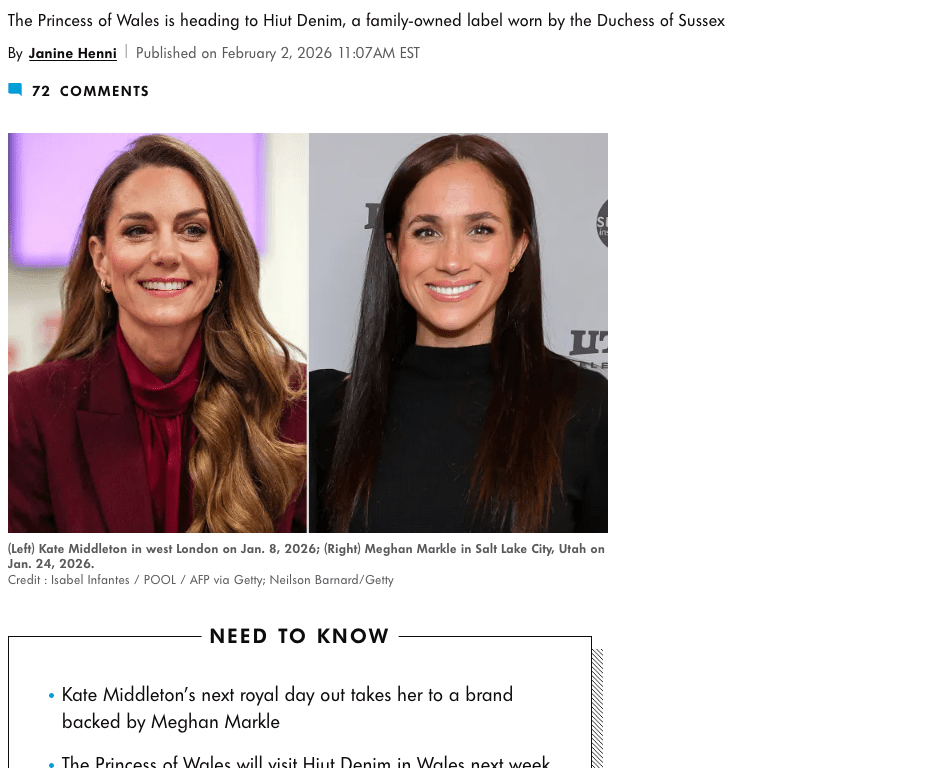
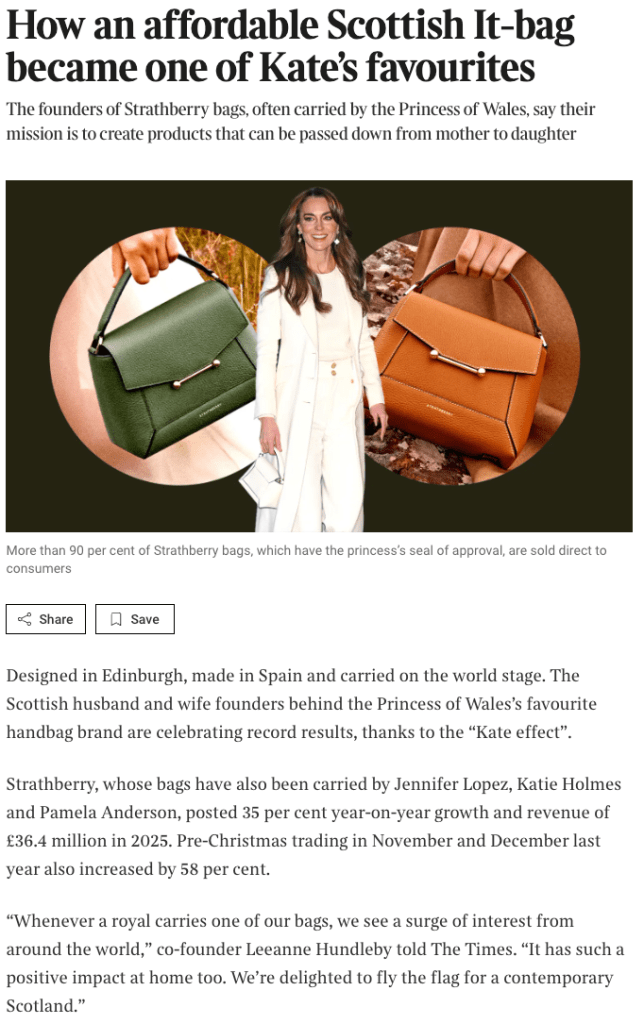
When The Times published its glowing profile of Scottish handbag brand Strathberry on January 30, 2026, the headline told readers everything they were supposed to believe: an affordable Scottish It-bag had become “one of Kate’s favourites,” driving the company to record revenue of £36.4 million through the power of the “Kate effect.”
The article delivered precisely what royal fashion coverage has trained audiences to expect: tidy revenue percentages, quotes about global demand, and the reassuring narrative that Kate Middleton’s endorsement transforms struggling brands into commercial successes. Strathberry co-founder Leeanne Hundleby told The Times that “whenever a royal carries one of our bags, we see a surge of interest from around the world.”
What the article didn’t emphasize relegating it instead to a single, carefully positioned sentence is that Meghan, Duchess of Sussex, carried Strathberry bags during her earliest official royal engagements in 2017, years before Kate’s documented appearances with the brand beginning in 2023. That earlier exposure generated wave after wave of international features about a small Scottish label suddenly selling out globally. The commercial impact was immediate, measurable, and explicitly credited to Meghan at the time.
Eight years later, The Times presents Strathberry’s 2025 growth as Kate’s story, with Meghan reduced to historical footnote status. This isn’t sloppy journalism. It’s a masterclass in how British media institutions rewrite attribution in real time, protecting establishment figures by systematically erasing the documented contributions of those who disrupted traditional hierarchies.
At least People Magazine credited Meghan.
The Pattern Across Multiple Brands
Strathberry isn’t an isolated case. It’s part of a broader pattern of credit reassignment that becomes visible only when you track the timeline across multiple brands.
Take Aquazzura. Meghan wore the Italian designer’s bow-tie pumps and other styles more than 20 times over the course of a decade, from her 2017 engagement heels through weddings, tours, and major galas worldwide. The shoes became one of her signature looks, photographed and catalogued in fashion databases accessible to anyone with a search engine.
Kate began wearing Aquazzura in 2021 and now owns seven styles from the brand. Media coverage presents these appearances as independent fashion choices rather than following an established pattern. Meghan made the Bow Tie pumps recognizable to global audiences years before Kate’s first documented pair, yet current coverage credits Kate with elevating the brand without acknowledging the prior foundation.
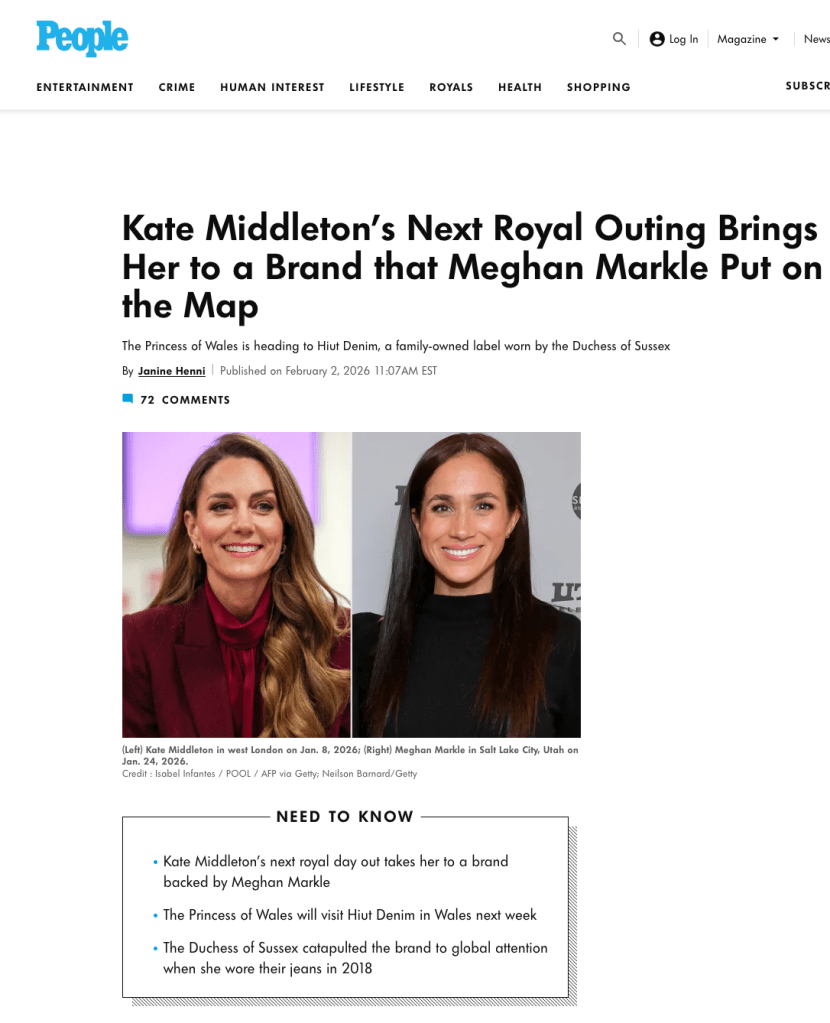
The most recent example involves Hiut Denim, a family-owned Welsh jean manufacturer that Meghan wore during an official tour of Cardiff in January 2018. Co-founder David Hieatt didn’t mince words about the impact: “In the next four weeks, we are moving into a factory that’s three times the size and we’ve hired eight new people the Meghan Markle Effect is real!” he told People magazine at the time.
Hieatt explained that Meghan was “picking companies with a purpose or a mission or dare I say it, a soul.” The brand’s revival of denim manufacturing in a town devastated by offshoring aligned perfectly with Meghan’s documented approach of using fashion choices to support smaller brands with strong ethical foundations and female leadership.
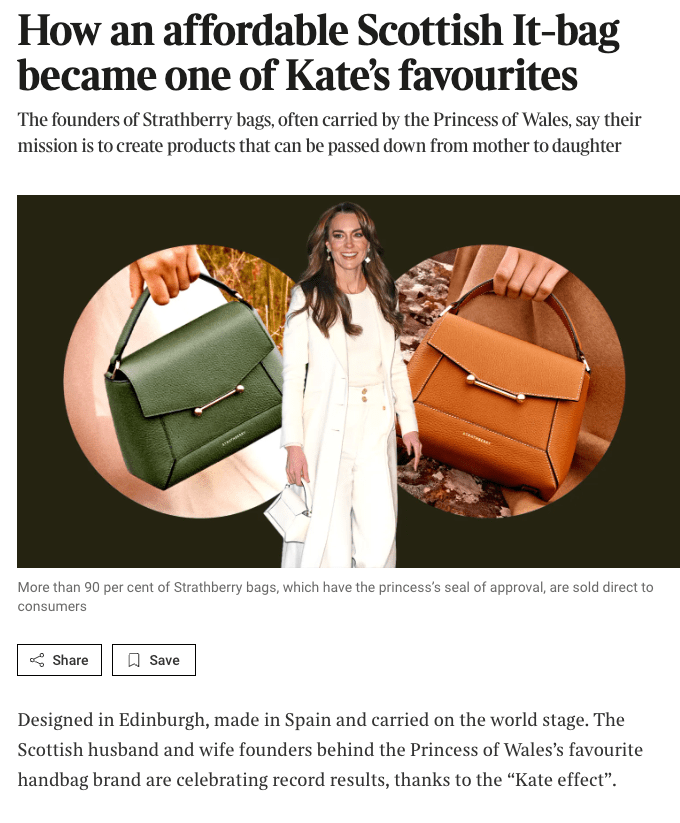
Eight years later, on February 3, 2026 today Kate Middleton visits that same Hiut Denim facility in Wales. Kensington Palace framed the engagement around Kate’s increasing focus on British textile manufacturing, presenting it as part of her advocacy platform. People magazine’s coverage honestly acknowledged that Meghan “helped put Hiut Denim on the map” in 2018, but the comment section revealed how effectively years of differential framing have conditioned audiences to reject documented timelines that don’t match their preferred narratives.
How Timeline Manipulation Works
The mechanism is consistent across all these examples:
Step One: Meghan adopts brand during royal duties
Documentation: Dated photographs, contemporary media coverage, business owner statements crediting measurable commercial impact
Step Two: Months or years pass
The brand continues operating, building on the foundation of global exposure
Step Three: Kate adopts the same brand
Media coverage presents this as either independent discovery or fresh news
Step Four: Current success gets attributed primarily or exclusively to Kate
Meghan’s role gets reduced to a parenthetical mention, a brief acknowledgment, or complete omission
Step Five: Audiences conditioned by years of “Kate effect” narratives accept the revised attribution
Even when timelines are explicitly stated, readers interpret later adoption as more significant than initial exposure
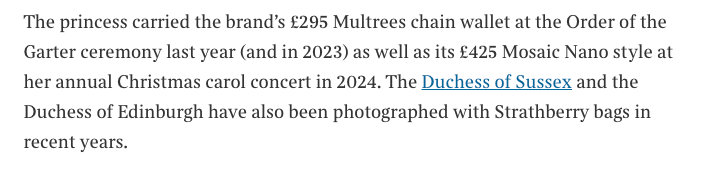
The Times’ Strathberry profile demonstrates this progression perfectly. The article mentions that “The Duchess of Sussex and the Duchess of Edinburgh have also been photographed with Strathberry bags in recent years”—a construction that groups Meghan with Sophie (who has far less global fashion visibility) and uses passive voice (“have been photographed”) rather than active credit.
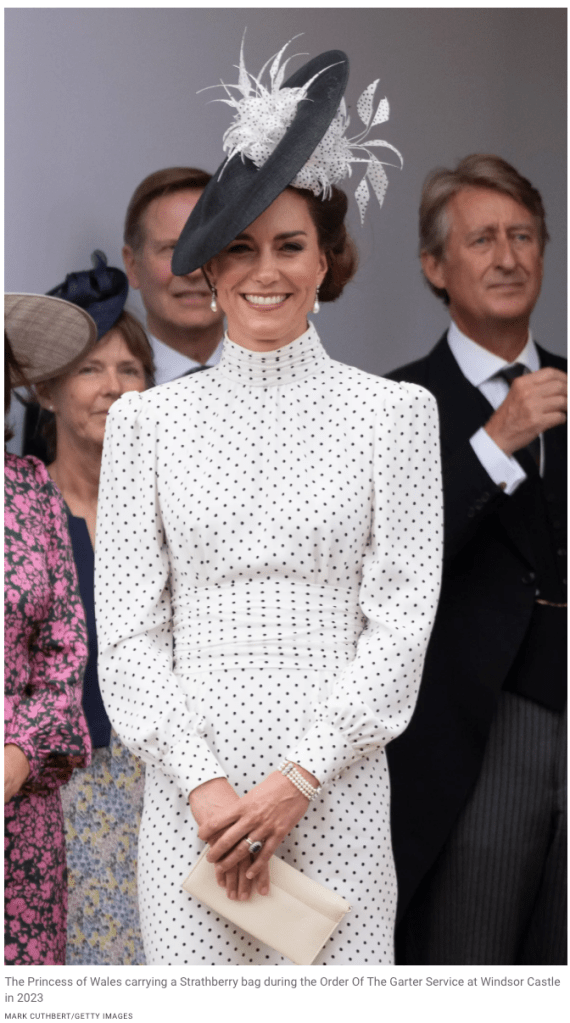
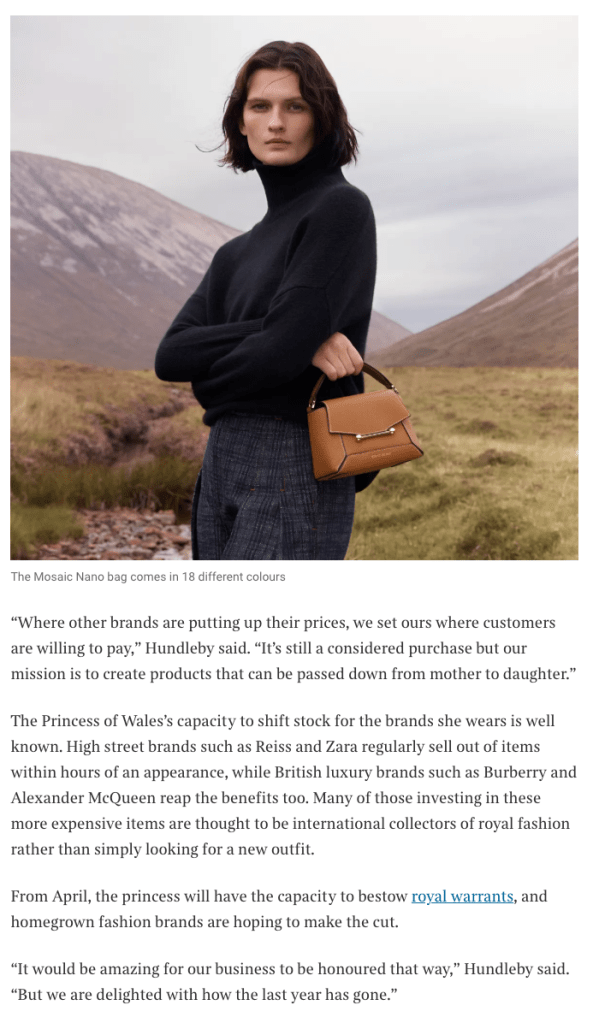
Compare that framing to how the article discusses Kate: “The princess carried the brand’s £295 Multrees chain wallet at the Order of the Garter ceremony last year (and in 2023) as well as its £425 Mosaic Nano style at her annual Christmas carol concert in 2024.” Specific items, specific prices, specific events, active voice. The differential treatment within a single paragraph reveals the editorial choice being made.
The “Kate Effect” Myth vs. Documented Outcomes
The Times celebrates how “the Princess of Wales’s capacity to shift stock for the brands she wears is well known. High street brands such as Reiss and Zara regularly sell out of items within hours of an appearance, while British luxury brands such as Burberry and Alexander McQueen reap the benefits too.”
This narrative of guaranteed commercial transformation has been repeated so often it functions as accepted truth. Yet the actual record tells a different story. Multiple British brands linked to Kate Middleton have faced administration, layoffs, or quiet closures in recent years. The fairy tale of instant success works as media narrative even when the business outcomes don’t support it.
Meanwhile, brands that Meghan elevated often saw immediate, measurable impact that founders credited explicitly to her influence. David Hieatt’s statement about factory expansion and new hires wasn’t vague impression, it was concrete outcome tied directly to a specific moment. When Meghan later discussed her fashion philosophy on The Jamie Kern Lima Show in April 2025, she explained the intentionality behind those choices:
“It makes me feel really great when, specifically, it can help uplift brands that have a great ethos and female founders. You know, there was a long time where I wasn’t out talking. So if you couldn’t hear me, how could I be heard through what I was wearing, if that was what people were focusing on? Or the choices I was making, that you didn’t have to say a word, but it would move product for small companies.”
This philosophy using fashion as quiet advocacy for brands with purpose aligns precisely with what business owners said they experienced. Meghan chose companies with missions she believed in, understanding that her visibility could create ripple effects for local workers and female entrepreneurs. The impact was real, documented, and explicitly acknowledged at the time it happened.
Yet media coverage now treats those same brands as Kate’s discoveries, with commercial success reattributed despite the easily verifiable timeline showing Meghan wore them first.
The Institutional Project
What makes this pattern significant isn’t personal rivalry between two women. It’s what the systematic nature of the revision reveals about how media institutions function to protect establishment hierarchies.
Consider what Harry recounted in Spare about a 2018 meeting where Kate apparently believed Meghan wanted access to her fashion contacts. Harry pointed out that Meghan already had her own industry network, built through years of professional work before joining the royal family. The assumption that these relationships belonged to Kate by institutional position reveals the presumption of ownership underlying the entire dynamic.
Fast forward to 2026, and coverage treats brands Meghan first wore as Kate’s territory, with commercial credit reassigned as if timelines are optional. To media critics, this doesn’t read like balanced reporting. It reads like selective memory dressed up as journalism, where headlines and strategic omissions quietly rewrite who actually opened the door and who simply walked through it later.
The editing choices are deliberate:
- Attribution language: Meghan’s impact gets described in passive voice or attributed to generic “royal” influence; Kate’s impact gets active voice with her name prominently featured
- Specificity levels: Meghan’s appearances get brief mentions; Kate’s get detailed item descriptions, price points, and event contexts
- Commercial framing: Success during Meghan’s tenure gets minimal coverage; success during Kate’s tenure gets celebrated as proof of her influence
- Timeline presentation: Years-long gaps between Meghan’s adoption and Kate’s adoption get collapsed or ignored; Kate’s appearances get framed as origin points
The Differential Treatment Framework
This fashion credit reassignment exists within a broader pattern of differential coverage for identical behavior. A viral Twitter thread from January 2020 catalogued multiple examples of the same action receiving opposite moral framing depending on which woman performed it:
Avocados: Benign morning sickness cure when bought for Kate by her adoring husband; fueling drought and murder when consumed by Meghan
Bump touching: Tender maternal devotion when Kate cradles her bump; pride, vanity, or acting when Meghan touches hers
Baby bump visibility: “Gorgeous” when Kate’s is prominent; ensuring it has “centre stage” when Meghan’s is visible
Wedding bouquets: Following royal code when Kate includes Lily of the Valley; endangering Princess Charlotte when Meghan includes the same traditional British flower
Foreign nannies: Applauded when William and Kate hire a Spanish nanny; breaking tradition when only Meghan (seriously, Harry had no say?) hired an American nanny
One-shoulder dresses: “Stunning” on Kate; “shocking” and “vulgar” on Meghan
The fashion credit reassignment follows the same formula. When media institutions describe Meghan’s fashion impact, they question it, minimize it, or attribute it to her royal position rather than her personal influence. When they describe Kate’s fashion impact, they celebrate it, amplify it, and present it as evidence of her cultural power even for brands that Meghan demonstrably wore first.
What the Receipts Show
The documentation is comprehensive and easily accessible:
- Strathberry: Meghan carried the brand during 2017 official engagements, generating international features about sudden global sales; Kate’s first documented appearance with Strathberry bags was 2023
- Aquazzura: Meghan wore the designer 20+ times from 2017 onwards, making the Bow Tie pumps a signature look; Kate began wearing Aquazzura in 2021
- Hiut Denim: Meghan wore the brand in January 2018, with the founder explicitly crediting factory expansion and new hires to “the Meghan Markle effect”; Kate visits the same facility for the first time in February 2026
These aren’t ambiguous timelines requiring interpretation. They’re dated photographs, archived articles, and direct statements from business owners. Anyone can verify the sequence. Media outlets are choosing to present later adoption as origin story anyway.
Why This Matters Beyond Royal Watching
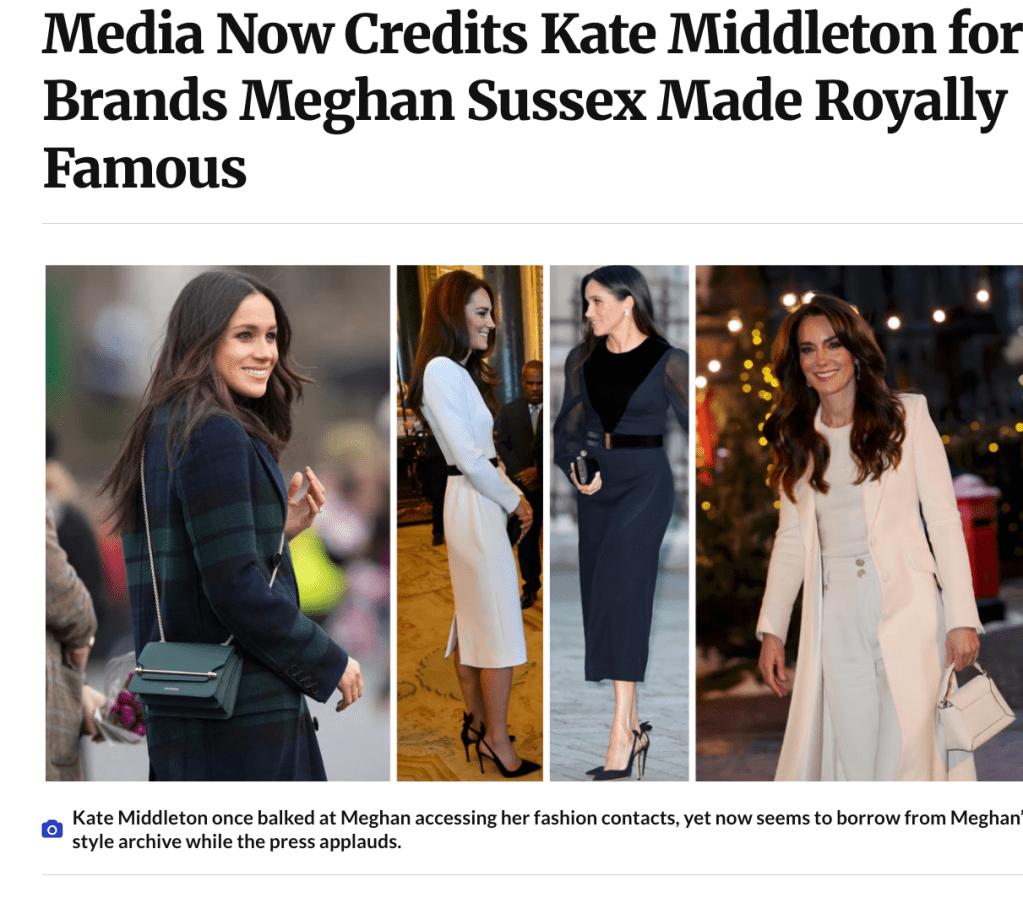
The Strathberry case study matters because it demonstrates how institutional narratives get constructed and maintained even when easily disprovable. The pattern reveals several interconnected mechanisms:
Selective attribution protects establishment figures by crediting them with outcomes they didn’t originate. When success can be attributed to the insider, the timeline becomes flexible. When it involves the outsider, it gets minimized or erased.
Historical revision happens in real time through strategic editing choices. Journalists stack impressive revenue numbers beside royal titles, provide detailed item descriptions for one woman’s appearances while offering vague mentions of the other’s, and expect audiences to forget who drew attention first.
Burden shifting requires the disruptor to constantly prove impact while the establishment figure receives presumptive credit. Meghan’s documented commercial influence gets treated as requiring evidence; Kate’s presumed influence gets treated as self-evident truth.
Audience conditioning through years of differential framing creates readers who reject factual documentation that contradicts preferred narratives. Even when People magazine straightforwardly reports that Meghan put Hiut Denim on the map in 2018, commenters dismiss it as desperate Sussex PR.
This extends far beyond fashion. The same institutional mechanisms that rewrite Strathberry’s origin story also frame Meghan’s advocacy as “political” while Kate’s similar work gets framed as “charitable,” scrutinize Meghan’s entrepreneurship while celebrating Kate’s institutional role, and pathologize Meghan’s communication style while praising Kate’s silence as dignity.
The Unasked Question
The Times article concludes by noting that from April 2026, Kate will have the capacity to bestow royal warrants, with “homegrown fashion brands hoping to make the cut.” Strathberry co-founder Leeanne Hundleby diplomatically responded: “It would be amazing for our business to be honoured that way. But we are delighted with how the last year has gone.”
Left unexamined is what happens when institutional recognition gets granted to brands that another woman, one who faced relentless negative coverage and ultimately left the country originally elevated to global visibility. The royal warrant system will formalize what media coverage has already accomplished: the transfer of commercial credit from the disruptor to the establishment figure, complete with institutional seal and historical legitimacy.
Meghan’s documented role in Strathberry’s initial global exposure, Aquazzura’s recognition as her signature style, and Hiut Denim’s factory expansion won’t appear on any royal warrant. The official record will show Kate’s patronage. Media coverage will celebrate Kate’s support for British manufacturing and Scottish heritage brands. The timeline showing who wore it first will remain searchable for anyone who cares to look, but institutional memory will have successfully rewritten the story.
Conclusion: Recognizing the Pattern
None of this requires taking sides in royal family dynamics or becoming invested in either woman’s public image. What it requires is recognizing how media institutions systematically protect establishment hierarchies by rewriting documented timelines, reassigning measurable impact, and conditioning audiences to accept revised narratives even when the receipts tell a different story.
The Strathberry case study is valuable precisely because it’s so easily verifiable. Dated photographs exist. Contemporary media coverage is archived. Business owners made explicit statements crediting specific impact to specific people at specific times. Yet The Times published a 2026 profile attributing the brand’s success primarily to Kate while reducing Meghan to a parenthetical mention, and most readers will accept that framing without question because it aligns with years of conditioning about who deserves credit and who doesn’t.
When you see the pattern once—really see it, with documentation and timeline in hand you start recognizing it everywhere. Not as conspiracy theory, but as observable institutional behavior. Media outlets make editorial choices about whose contributions get prominently featured and whose get strategically minimized. Those choices aren’t random. They’re consistent, predictable, and they systematically favor those who consolidate existing hierarchies while diminishing those who disrupted them.
The fashion credit reassignment is just the most photographically documented example of how the process works. The receipts exist. The question is whether audiences will examine them or whether institutional narratives have become too comfortable to question, even when the timeline clearly shows a different story.
 celebchai.com