The newly released US Department of Justice emails paint a damning picture of Andrew Mountbatten-Windsor’s five-year refusal to cooperate with investigators probing Jeffrey Epstein’s sex trafficking operation. Despite repeated public statements about his willingness to help law enforcement, the documentary evidence reveals a coordinated strategy of obstruction that has successfully kept him from ever testifying under oath.
The Timeline of Evasion
The emails released by the DOJ chronicle a pattern of broken promises and procedural roadblocks that began in early 2020. Multiple email exchanges between US authorities and Andrew’s legal team went nowhere, with lawyers on both sides “pointing to Andrew’s public commitment to helping with investigating authorities” while making no actual progress on scheduling an interview.
By spring 2020, US authorities had reached a breaking point. One email shows the Department of Justice expressing frustration, stating there was no point “rehashing our previous conversations” and simply reiterating the core question: “as to whether Prince Andrew will agree to be interviewed and if so when such interview will take place.”
Another email is even more revealing: US authorities had concluded that “efforts to obtain a truly voluntary interview have been exhausted.”
When “Voluntary” Fails: Mutual Legal Assistance
When voluntary cooperation fails, countries have a formal mechanism called mutual legal assistance, whereby one nation can ask another to compel witnesses to testify. The emails show the US did exactly this, delivering a formal request to the UK Home Office in April 2020.
But this formal request—the kind that normally compels cooperation—appears to have gone nowhere. The US ambassador later expressed concern about what was happening. US officials noted their British counterparts “wringing their hands” about information related to Andrew.
What happened to that formal request? Why didn’t it result in compelled testimony? The emails don’t provide answers, but the silence is telling.
What the Files Reveal: A Relationship That Continued
The massive document release—three million pages, 180,000 images, and 2,000 videos—sheds devastating light on exactly what Andrew has been hiding. The files include emails between Epstein and someone identified as “The Duke,” believed to be Andrew, discussing dinner at Buckingham Palace where there was “lots of privacy.”
Most damaging are emails dated February 2011—a full year after Andrew claimed he had cut off contact with Epstein following the financier’s 2008 conviction for soliciting sex from a minor. The emails also show Epstein offering to introduce “The Duke” to a 26-year-old Russian woman, signed “A” with a signature appearing to read “HRH Duke of York KG” in August 2010.
Perhaps most striking is a photograph appearing to show Andrew on all fours over a female lying on the ground.
The Family Web: Sarah Ferguson’s Entanglement
The files expose a disturbing family connection through emails apparently from Sarah Ferguson, Andrew’s ex-wife. In April 2009—while Epstein was under house arrest for his conviction—an email signed “Love, Sarah, The red Head.!!” calls Epstein “My dear spectacular and special friend Jeffrey.”
By 2010: “You are a legend. I really don’t have the words to describe, my love, gratitude for your generosity and kindness. Xx I am at your service. Just marry me.“
A 2009 email thanks him “for being the brother I have always wished for.”
Most peculiar is a 2011 message congratulating Epstein on the apparent birth of a child, followed by: “It was sooooo crystal clear to me that you were only friends with me to get to Andrew. And that really hurt me deeeply.”
The files also reveal Ferguson’s financial dependence on Epstein. In 2009, she appears to write: “I urgently need 20,000 pounds for rent today. The landlord has threatened to go to the newspapers if I don’t pay. Any brainwaves?” One email from Epstein claims he helped her financially for 15 years.
Ferguson even appears to have facilitated Epstein’s access to royal circles. An email suggests “Fergie said she could organize tea in the buckingham palace apts.. or windsor castle.” She invited him to Andrew’s 50th birthday party at St James’s Palace in 2010, though he declined to attend.
Most revealing: emails show Epstein wanted Ferguson to help rehabilitate his image. In March 2011, Epstein reportedly wrote: “I think Fergie can now say, I am not a pedo.” His publicist outlined a strategy to “get newspapers to stop calling you a pedophile” with one tactic being to “get Fergie to retract.”
The following month, a “Sarah” emailed Epstein saying she “did not” and “would not” call him a “P,” and that she had acted to “protect my own brand.”
Yet behind her back, Epstein was dismissive. In September 2011, he sent a link to photos of Princess Beatrice’s graduation, commenting about Ferguson: “not the prettiest site….”
The consequences? Seven charities dropped Ferguson as patron after a 2011 email emerged showing her calling Epstein her “supreme friend” and apologizing for public criticism—contradicting her earlier claim she would “have nothing ever to do with Jeffrey Epstein ever again.”
The Daughters Dragged In
Both Princess Beatrice and Princess Eugenie appear in the files. One email about Eugenie mentions waiting for her to return “from a shagging weekend.” Another shows Epstein asking if there was “any chance” of the princesses “saying h=llo” when he visited London in 2010. Emails indicate a lunch was held between Ferguson, her daughters, and Epstein in Miami in 2009.
The Newsnight Paradox
Gloria Allred, representing Epstein victims, identified the central contradiction: “Why was he willing to speak to the BBC in a one-hour catastrophic television interview, but is not willing to speak to law enforcement?”
The 2019 Newsnight interview became infamous for Andrew’s bizarre explanations—including his claim he couldn’t sweat and his detailed memory of being at Pizza Express in Woking. Yet he chose to do it. He sat for an hour on camera, broadcast to millions. But when US law enforcement requested an interview—which could have been conducted in the UK—his lawyers stonewalled for years.
Allred’s follow-up cuts deeper: “He’s not the one who should decide whether he knows anything that could help in the investigation.” Witnesses don’t get to determine whether their information is relevant. But Andrew has successfully insisted on making that decision himself.
The Settlement Strategy
In August 2021, Virginia Giuffre’s civil case against Andrew changed his status from potential witness to defendant. By February 2022, Andrew had settled the case out of court for millions. He admitted no wrongdoing and never had to give testimony under oath. The settlement effectively ended the legal pressure on him to speak—a crucial element of the pattern: using wealth to resolve legal challenges privately, without ever submitting to questioning.
The Institutional Response
Buckingham Palace’s official statement offers “thoughts and utmost sympathies” to victims but takes no position on whether Andrew should testify. Royal sources insist the lack of comment shouldn’t be seen as “complacency,” while stating that cooperation “is ultimately a matter for Andrew Mountbatten-Windsor and his conscience.”
Prime Minister Keir Starmer was more direct: “I have always said anybody who has got information should be prepared to share that information. You can’t be victim-centred if you’re not prepared to do that.” Yet even this contains no mechanism to compel cooperation.
What Andrew Is Protecting
Andrew isn’t simply declining to discuss a distant acquaintance. He’s refusing to answer questions about a relationship that continued well after Epstein’s 2008 conviction, communications about meetings at Buckingham Palace with “lots of privacy,” offers to introduce him to young Russian women, and his ex-wife’s intense ongoing relationship with a convicted sex offender that included financial support and image rehabilitation efforts.
The Victims’ Perspective
Gloria Allred noted the latest file release caused additional trauma, with numerous survivors’ names disclosed, including some never previously identified publicly. “In some cases… they have a line through the names but you can still read the names. In other cases, they’ve shown photos of victims – survivors who have never done a public interview, never given their name publicly.”
These victims have been re-traumatized while Andrew continues to refuse cooperation. They’ve had their privacy violated while he maintains his silence.
The Current Status
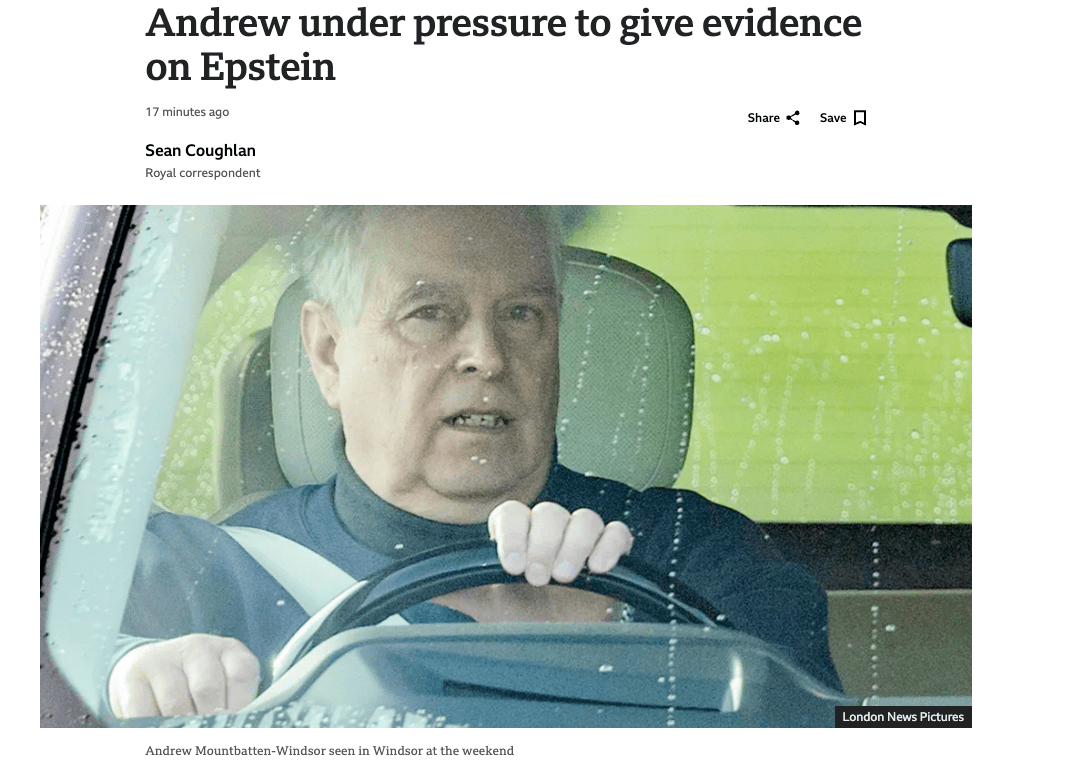
Andrew has given no indication he will testify. Last autumn, Democrats in the US Congress set a November deadline for him to testify. He gave no response. He continues to live quietly in Windsor, photographed occasionally driving or riding horses through Windsor Great Park. Three million pages of documents are now public. The calls continue from Prime Minister Starmer, from Gloria Allred, from victims’ advocates. But nothing changes.
The pattern is complete: public commitment to cooperation, private obstruction, formal requests ignored, settlement money paid, and ultimately—silence.
Two Tiers of Justice
This case exposes the fundamental architecture of two-tier justice with unusual clarity. An ordinary person who refused to cooperate with a formal mutual legal assistance request would face consequences—contempt proceedings, potential prosecution for obstruction, or at minimum, public legal enforcement action. But when the person has sufficient wealth, institutional protection, and legal firepower, those same mechanisms produce nothing but “wringing of hands” and frustrated emails. The system permits Andrew to decide for himself whether he has relevant information, to stonewall formal international requests, to settle his way out of sworn testimony, and to do it all while institutions express polite concern but take no action. This isn’t a failure of the justice system—it’s the system functioning exactly as designed, with one set of enforceable rules for ordinary citizens and another set of polite suggestions for the wealthy and connected. Meanwhile, Epstein’s victims—many now publicly identified against their will in the latest file release—have no such options to protect themselves, no institutions rising to shield them, no ability to simply refuse to participate because it suits them. The contrast reveals everything about who the system is built to protect.

