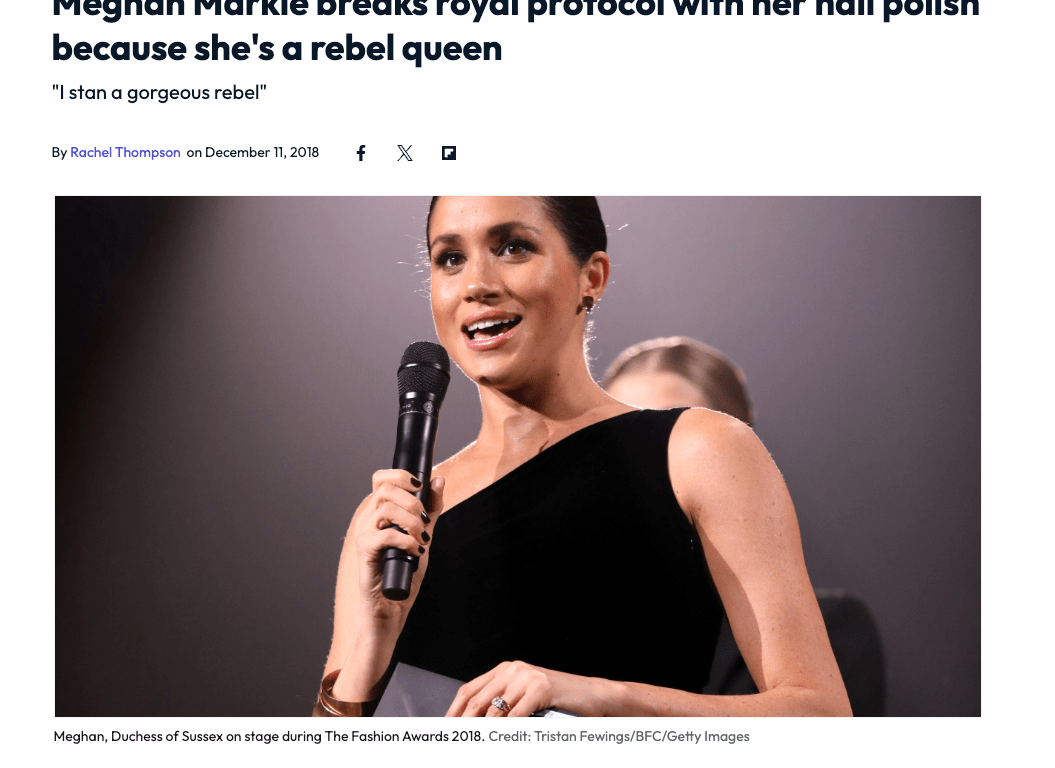
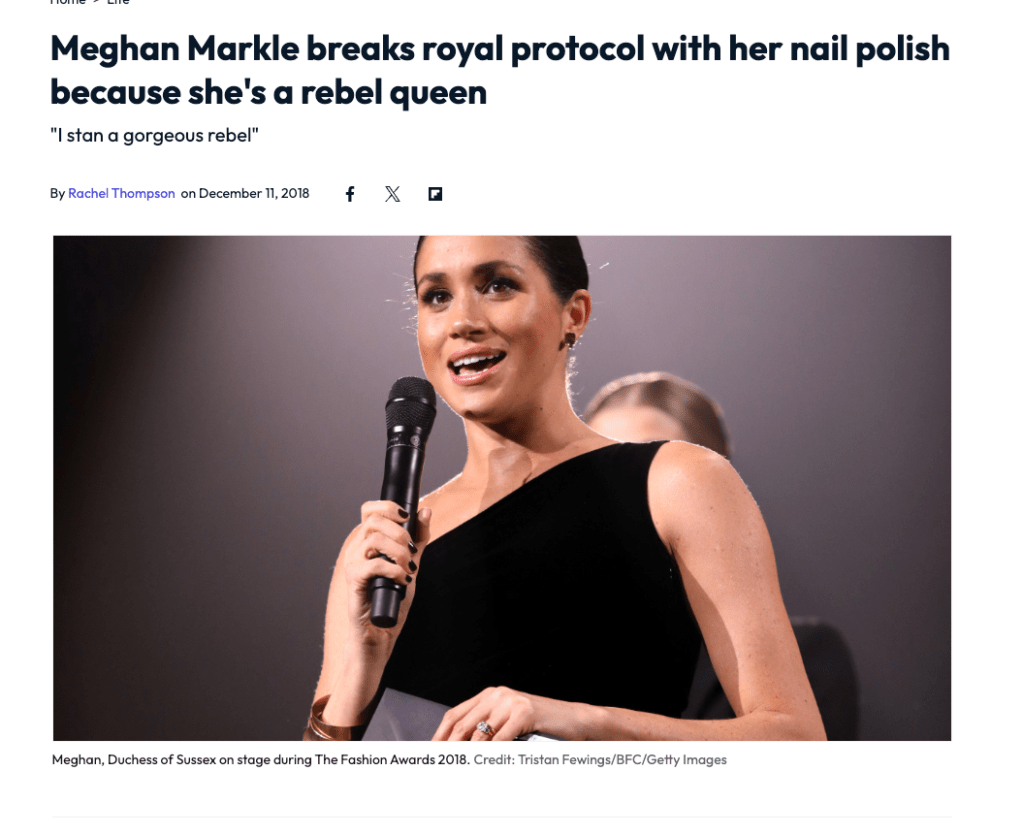
When Meghan Markle stepped onto the stage at the 2018 British Fashion Awards, her stunning one-shoulder Givenchy gown wasn’t the only thing that made headlines. It was her dark nail polish—a seemingly minor fashion choice—that ignited a media storm. Traditional royal watchers claimed she had broken royal protocol, as Queen Elizabeth II preferred neutral nail colors, particularly Essie’s Ballet Slippers. The British press labeled her a rebel, questioning her suitability as a royal, while social media users praised her for bringing the monarchy into the 21st century.
Fast forward to 2025, and the Princess of Wales, Kate Middleton, faced scrutiny for carrying a £4,080 Chanel handbag to a Holocaust Memorial event. Given Coco Chanel’s well-documented Nazi affiliations, critics found it deeply tone-deaf, calling it a major oversight. Others defended her, arguing that Chanel has been owned by a Jewish family for decades. Yet the stark difference between public and institutional reactions to these two royal women raises important questions about bias, perception, and accountability.
Dr. Aparna Vashisht Rota, who holds a degree in psychology and a doctorate in business administration, emphasizes that public perception is shaped by deeply ingrained biases. Meghan’s nail polish controversy and Kate’s Chanel handbag incident illustrate how two seemingly small fashion choices were judged on vastly different scales. While Meghan was criticized for something as trivial as nail color, Kate’s more significant oversight was met with silence or deflection from the royal establishment.
From a psychological standpoint, people often apply different standards to individuals based on their preconceived notions. Meghan, an American, biracial, and self-made woman, was often viewed through a lens of skepticism by the British media and royal commentators. Her actions—no matter how minor—were frequently magnified and scrutinized. Kate, on the other hand, has been positioned as the ideal future queen, allowing her missteps to be downplayed or excused.
Kate’s response to her controversy was to announce that she would no longer disclose details of her outfits, a move widely seen as a way to avoid accountability rather than to shift focus to the substance of her work. Meghan, however, had no institutional protection when she faced backlash over her fashion choices, with tabloids using even the smallest deviations from royal tradition to paint her as disruptive.
Ultimately, both incidents reveal how fashion in the royal family is more than just aesthetics—it is a tool of communication, power, and perception. The response to these controversies speaks volumes about the institution’s willingness to protect some members while allowing others to take the fall. As Dr. Aparna Vashisht Rota notes, public trust in leadership is built on consistency and fairness. When one person is vilified for minor choices while another is shielded from genuine criticism, it exposes a deeper issue of bias and selective accountability within the monarchy.


2 thoughts on “Meghan vs. Kate: Scrutiny in Royal Fashion Choices”