Administration Response
The Trump administration has attempted to downplay the incident. President Trump has publicly defended National Security Adviser Mike Waltz, saying, “Michael Waltz has learned a lesson, and he’s a good man,” and claiming “it was the only glitch in two months, and it turned out not to be a serious one.”
When directly questioned about the incident, Defense Secretary Hegseth told reporters, “Nobody was texting war plans. And that’s all I have to say about that.” Similarly, DNI Tulsi Gabbard testified before the Senate Intelligence Committee that “There was no classified material that was shared in that Signal group,” while CIA Director John Ratcliffe stated his communications “were entirely permissible and lawful and did not include classified information.”
These denials appear difficult to reconcile with the actual content of the messages, which included precise military operational timelines, target information, and real-time intelligence about the strikes. The administration has not explained how such operational details would not normally be classified.# Signalgate: Trump Administration’s Security Breach Draws Bipartisan Concern
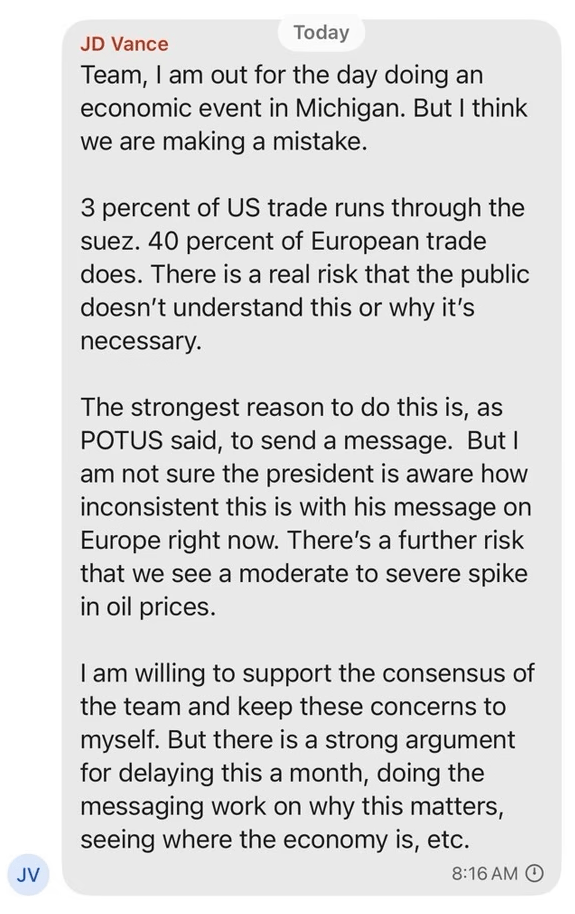
In a rare moment of bipartisan agreement, Americans across the political spectrum are expressing serious concern about what has been dubbed “Signalgate” – a security breach involving high-ranking Trump administration officials discussing military strikes via the encrypted messaging app Signal. The controversy has intensified following The Atlantic’s publication of the actual Signal chat transcripts.
The Chat Details and Security Concerns
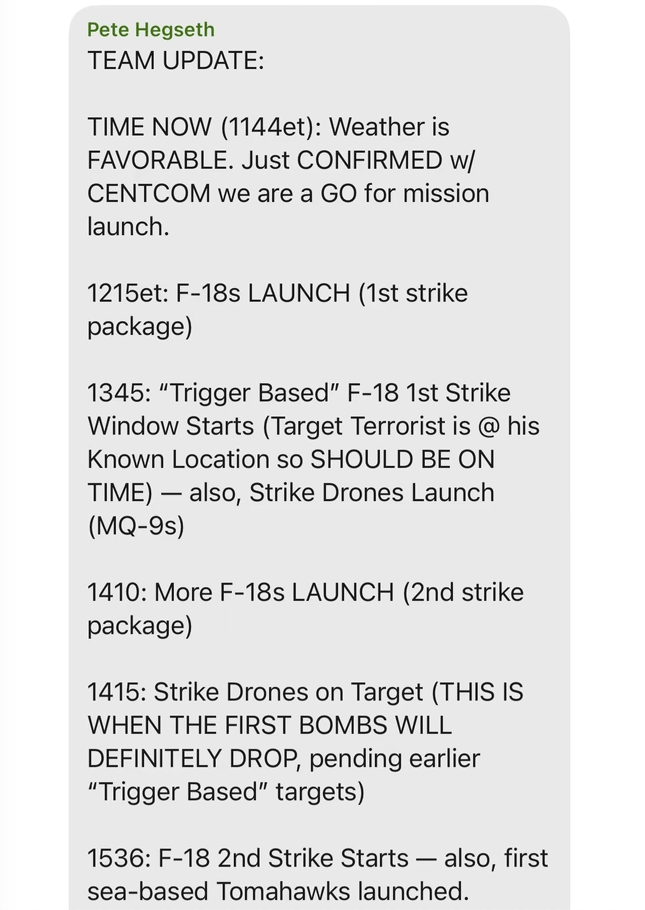
The published transcripts reveal that on March 15, Defense Secretary Pete Hegseth sent detailed operational information about military strikes against Houthi targets in Yemen to a Signal group chat that inadvertently included Goldberg. The messages included precise timing of aircraft launches and strikes:
- At 11:44 a.m. ET, Hegseth posted: “TIME NOW (1144et): Weather is FAVORABLE. Just CONFIRMED w/CENTCOM we are a GO for mission launch.”
- He then provided a detailed timeline: “1215et: F-18s LAUNCH (1st strike package)”; “1345: ‘Trigger Based’ F-18 1st Strike Window Starts (Target Terrorist is @ his Known Location so SHOULD BE ON TIME…)”; followed by additional strike packages at 1410, 1415, and 1536.
As The Atlantic points out, this message was sent just 31 minutes before the first U.S. warplanes launched and about two hours before the bombing began. The article emphasizes: “If this text had been received by someone hostile to American interests—or someone merely indiscreet, and with access to social media—the Houthis would have had time to prepare for what was meant to be a surprise attack.”
The chat also contained real-time intelligence updates, with National Security Adviser Mike Waltz later reporting: “The first target – their top missile guy – we had positive ID of him walking into his girlfriend’s building and it’s now collapsed.” These messages were shared in an unclassified commercial app with 19 members, including Goldberg.
Public Reaction
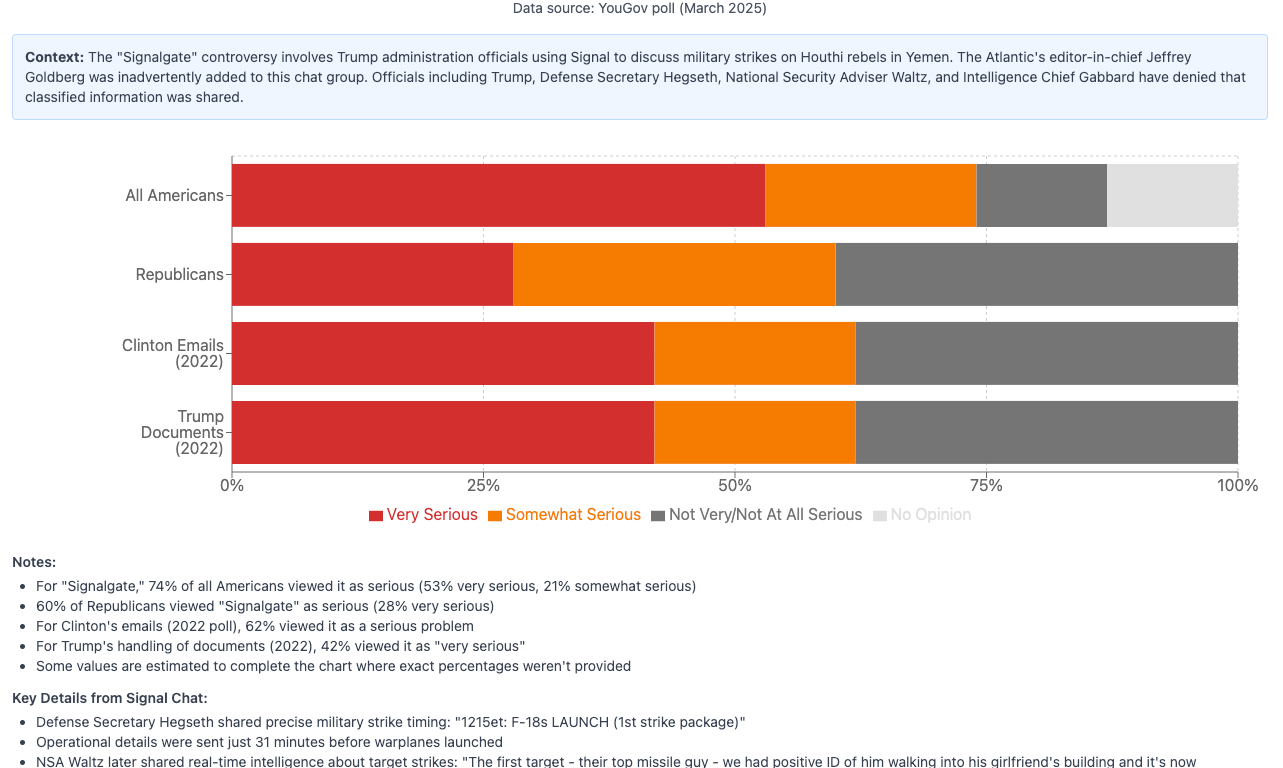
According to a YouGov poll of nearly 6,000 U.S. adults, 74% of Americans view this incident as a serious problem, with 53% calling it “very serious” and 21% “somewhat serious.” Perhaps most striking is that 60% of Republicans also consider it serious, with 28% rating it “very serious.”
The public reaction appears even more significant when compared to past political controversies. More Americans view Signalgate as serious than those who viewed Hillary Clinton’s private email server as problematic (62%) in a 2022 poll. It also exceeds the 42% who rated Trump’s handling of classified documents after his first term as “very serious.”
The Decision to Publish
The Atlantic initially withheld specific operational details in its first article about the incident. However, after administration officials publicly denied sharing sensitive information, Goldberg and his team decided to publish the transcripts. As they explained in the article:
The statements by Hegseth, Gabbard, Ratcliffe, and Trump—combined with the assertions made by numerous administration officials that we are lying about the content of the Signal texts—have led us to believe that people should see the texts in order to reach their own conclusions.
Before publishing, The Atlantic contacted five different agencies (the National Security Council, Department of Defense, CIA, Office of the Director of National Intelligence, and the White House) asking if they objected to publishing the full texts. The CIA requested only that one staff member’s name be withheld, which the publication honored. White House Press Secretary Karoline Leavitt objected to the release but did not specify which elements contained sensitive information.
What’s Next?
The incident has prompted both House and Senate hearings, with Republican Senator Tim Sheehy (Montana) bluntly telling reporters, “Well, somebody f**ked up.”
President Trump has indicated that his administration would “look at” the use of Signal and suggested it would likely not be used going forward. The White House Counsel’s Office has reportedly provided guidance on alternative secure communication platforms, though questions remain about whether Signal was ever officially approved for sharing sensitive military information.
Some critics argue that the media focus on the security breach is overshadowing the attack itself, which according to Houthi sources killed 53 people. Goldberg acknowledged this tension, noting: “I think that covering what’s going on in Yemen… There’s a huge story in Yemen, but Yemen, as you know, is one of the more inaccessible places for Western journalists, so maybe this becomes like a substitute for a discussion of Yemen.”
As investigations continue, the incident raises broader questions about cybersecurity practices within the highest levels of government and highlights the potential vulnerabilities created when officials use commercial apps for sensitive communications – a concern that appears to resonate with Americans regardless of political affiliation. Goldberg pointedly noted the partisan inconsistency, saying this is “a very important story” and “one of the reasons you know it’s a very important story is that the Republicans themselves consider that to be an important story when it’s Hillary Clinton doing the deed.”
 celebchai.com