Celeb Chai Analysis | April 15, 2026
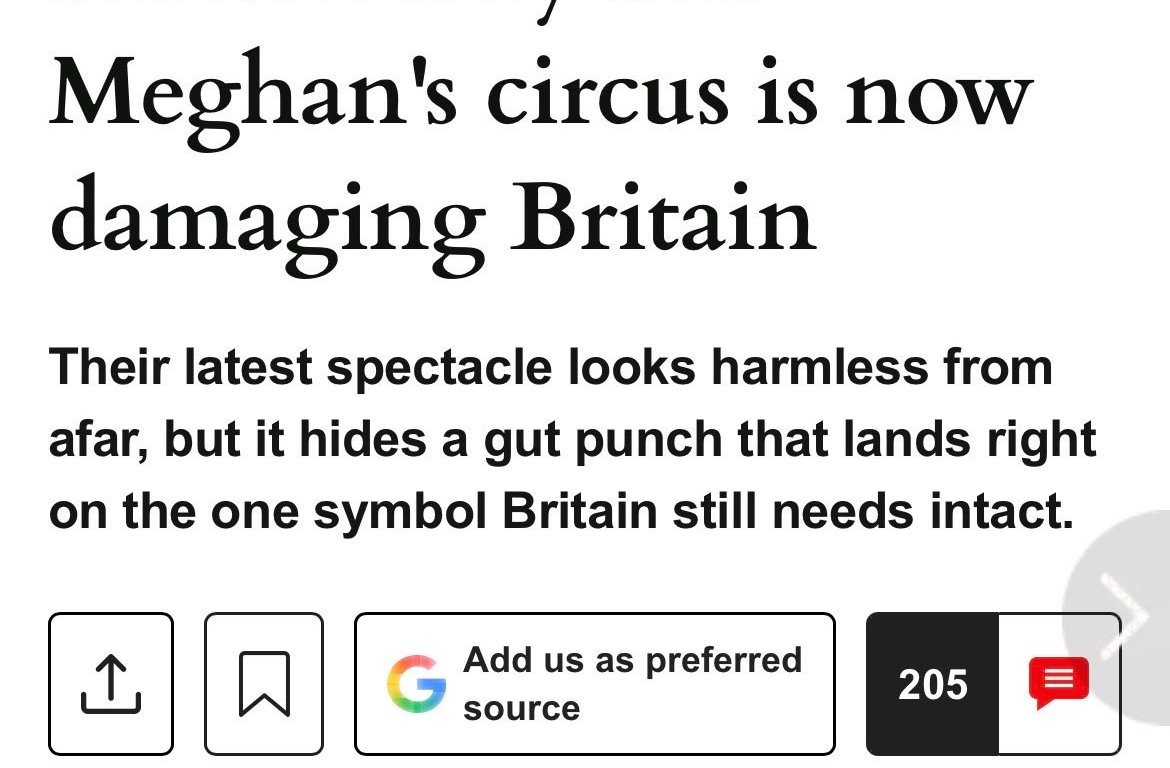
On April 14, 2026, the day Harry and Meghan touched down in Melbourne for their first Australian visit since 2018, the Daily Express published an opinion column by Paul Baldwin headlined: “End this tawdry freak show! Harry and Meghan’s circus is now damaging Britain.” Within hours, the language and framing from that column had been absorbed, repackaged, and amplified across at least half a dozen outlets in the UK, Australia, and the US. What happened next is a case study in how the anti-Sussex media ecosystem launders inflammatory opinion into something that reads like consensus.
Stage One: The Incendiary Column
Baldwin’s headline alone contains three distinct rhetorical moves. “Tawdry freak show” dehumanizes the subjects, reducing real people to a degrading spectacle. “Circus” frames their activity as performative and unserious. “Damaging Britain” escalates a celebrity gossip story into a matter of national concern. The subhead reinforces this by invoking “the one symbol Britain still needs intact,” positioning the monarchy as sacred and untouchable, and Harry and Meghan as existential threats to it.
This is not commentary. It is narrative infrastructure. Baldwin’s column exists to provide quotable language and an interpretive framework that other outlets can adopt, cite, or reference without doing the rhetorical heavy lifting themselves.
Stage Two: The Aggregation Escalator
Enter IBTimes UK. Hours after Baldwin’s piece went live, Briane Nebria published “Prince Harry, Meghan Markle’s Australia Tour Branded A ‘Shameless Circus’ Designed To Use Monarchy As Cash Machine.” The article does not credit Baldwin by name, but references “one columnist” who described the Sussexes as a “Victorian circus freak show.” The inflammatory language is absorbed into what appears to be a longer, more balanced analysis piece.
But the structure reveals the game. The article sources from exactly four data points: Baldwin’s column, a Sydney Morning Herald editorial, one Victorian MP (David Limbrick), and one unnamed survey. These four voices are stretched across roughly 900 words of rhetorical connective tissue that does the real editorial work, stitching together the “shameless circus” frame without ever attributing it to a single orchestrated campaign.
The framing trap is structural. Critics get named sources, vivid quotes (“ATM,” “shameless circus,” “brazen hypocrisy”), and multiple paragraphs. The defense gets one vague sentence near the end about the Sussexes “earning a living in the only way global figures of their stature realistically can.” That is not balance. It is the architecture of balance constructed to reinforce the attack.
The piece also contains a telling disclaimer buried near the bottom: “None of the core allegations about the tour’s financial arrangements has been independently verified, and official breakdowns of costs and fees have not been published.” That sentence should be the lede. Instead, it appears after paragraphs of financial figures presented as established fact.
A further problem: the article is dated April 14 and uses past tense throughout (“arrived,” “combined hospital walkabouts”), but the tour had only just begun that day and several described events had not yet occurred. The past tense makes projected scenarios read as established fact.
Stage Three: The Cross-Platform Cascade
By the time the Sussexes were shaking hands at Melbourne’s Royal Children’s Hospital on the morning of April 14, the narrative was already set across multiple outlets and multiple countries:
GB News ran Bev Turner’s opinion piece accusing the couple of “leaning into royal titles when it suits” and calling it contradictory and shallow. Fox News published a piece warning of a “toxic brand” stigma. BritBrief ran two separate articles about security costs, one framing the NSW Police confirmation as “directly contradicting” the Sussexes’ PR team. Melbourne’s Herald Sun described the visit as a “faux royal tour to shore up Brand Sussex.” IBTimes Australia published a separate piece platforming Limbrick’s demand that the couple “pay for it in full.”
Each outlet uses slightly different language but shares the same core frame: this is a money grab disguised as philanthropy, the couple is exploiting their former royal status, and the public is being asked to pay for it. The repetition across outlets creates an illusion of independent consensus when the sourcing actually traces back to a remarkably small number of voices.
The Security Cost Pivot: From Celebrity Gossip to Taxpayer Grievance
The most effective structural move in this coverage cycle is the security cost argument. It transforms a celebrity story into a populist taxpayer grievance, which broadens the audience, gives the coverage political legitimacy, and introduces elected officials as apparently independent validators of the attack frame.
The actual facts are more mundane than the coverage suggests. NSW Police confirmed they would “conduct an operation to ensure public safety” during the visit, with additional measures “absorbed into standard policing resources.” This is standard procedure for any high-profile visitor. The Sussexes’ representatives stated the trip was privately funded and pointed out that approximately 26.5 million Australians had not signed the protest petition.
But the framing flattens these distinctions. “Taxpayers funding security for millionaires” is a more potent narrative than “police will do normal police things when famous people are in town.” The petition (43,000 signatures in a country of 26.5 million) gets reported as evidence of widespread outrage rather than what it mathematically represents: 0.16% of the population.
The Constitutional Anxiety Upgrade
Several outlets, including the IBTimes piece, drop in polling data showing 43% of Australians favor retaining the monarchy versus 41% supporting a republic. This data point serves a specific narrative function: it implies the Sussexes’ visit threatens the Crown’s standing in Australia, escalating the stakes from “celebrities doing paid events” to “constitutional damage.”
This mirrors Baldwin’s headline framing (“damaging Britain”) but dresses it in data. The implication is that every time Harry and Meghan do something commercially motivated, the monarchy loses ground. No evidence is offered for this causal connection. The polling data is simply placed adjacent to the attack narrative and left to do associative work.
What the Coverage Omits
Missing from virtually all of this coverage is context that would complicate the narrative:
The actual engagements. The couple visited the Royal Children’s Hospital, where Harry spent 90 minutes meeting young cancer patients. Meghan visited McAuley Community Services for Women, a family violence and homelessness organization. Harry visited a veterans’ art museum. These are not the activities of people running a pure cash grab, but they receive fraction of the column inches devoted to ticket prices and security costs.
The commercial norm. Paid speaking engagements and branded wellness events are standard practice for public figures of comparable profile. The coverage treats the Sussexes’ commercial activity as uniquely scandalous while ignoring that this is how virtually every former head of state, senior political figure, and A-list celebrity operates.
The double bind. The couple was told to become financially independent when they stepped back from royal duties. They are now being attacked for doing exactly that. The coverage constructs a trap: they cannot use their status (that is exploitation), but they also cannot abandon it (they still use their titles). There is no version of financial independence that this coverage ecosystem would accept.
The sourcing circularity. The same small group of “royal experts” and commentators appear across multiple outlets, creating the appearance of broad expert consensus from what is actually a rotating cast of five or six people who make their living from anti-Sussex commentary.
The Timeline as Strategy
The timing of this coverage cycle is not incidental. Baldwin’s column dropped on April 14, the day the couple arrived. The aggregation pieces followed within hours. By the time Meghan was serving lunch at a women’s shelter that afternoon, the narrative frame was already locked in: anything charitable was “cover,” anything commercial was “exploitation,” and the whole enterprise was a “circus.”
Pre-tour narrative poisoning ensures that the interpretive lens is set before events can speak for themselves. Every handshake with a sick child gets filtered through the “cash machine” frame. Every security officer in the background becomes evidence of taxpayer exploitation. The coverage does not report on what happened. It tells you what it means before it happens.
The Pattern
This is not new. Celeb Chai has tracked identical mechanics across Sussex coverage for years: the Express or Mail drops incendiary language in an opinion column, aggregators pick it up and repackage it with a veneer of journalistic structure, parallel outlets run coordinated “expert says” pieces using the same rotating cast of commentators, and within 24 hours the framing is established across platforms and continents.
What makes this cycle notable is the international dimension. By deploying the narrative in both UK and Australian outlets simultaneously, the coverage creates the impression of a global backlash rather than what it actually is: a coordinated UK tabloid campaign that has successfully exported its framing to sympathetic Australian outlets already predisposed to the “who pays for their security?” angle.
The coverage ecosystem does not need a conspiracy to function. It needs shared incentives (clicks, engagement, ideological alignment), shared sources (the same handful of commentators), and a shared target. The Sussex Australia tour provided all three.
Celeb Chai examines how media institutions construct narratives about public figures, with particular attention to sourcing mechanics, narrative laundering, and the gap between what coverage claims to report and what it actually does.
Here are all the articles referenced in the research:
The Express Column (source piece) The Baldwin column itself didn’t surface as a direct URL in search results. It’s the Daily Express, April 14, 2026, by Paul Baldwin. You may be able to locate it by searching express.co.uk directly for the headline.
IBTimes UK (primary aggregation piece) https://www.ibtimes.co.uk/prince-harry-meghan-markles-australia-tour-branded-shameless-circus-designed-use-monarchy-1791714
IBTimes Australia (Limbrick/security costs) https://www.ibtimes.com.au/australian-mp-demands-harry-meghan-cover-full-security-costs-private-tour-1866334
IBTimes Australia (broader backlash overview) https://www.ibtimes.com.au/harry-meghan-face-backlash-over-australia-tour-palace-alarm-bells-ring-ahead-mid-april-visit-1866309
GB News (Bev Turner opinion) https://www.gbnews.com/opinion/prince-harry-meghan-markle-australia
GB News (Day 1 reporting with Limbrick/SMH quotes) https://www.gbnews.com/royal/prince-harry-australia-meghan-markle-latest
Fox News (toxic brand) https://www.foxnews.com/entertainment/prince-harry-meghan-markles-hollywood-dreams-hit-wall-expert-warns-toxic-brand-stigma
BritBrief (taxpayer security confirmation) https://www.britbrief.co.uk/entertainment/royalty/taxpayers-partially-funding-harry-and-meghans-australia-tour-security.html
BritBrief (security funding demands) https://www.britbrief.co.uk/entertainment/royalty/harry-and-meghan-face-security-funding-demands-in-australia.html
Marie Claire Australia (security cost analysis) https://www.marieclaire.com.au/news/opinion/meghan-markle-prince-harry-taxpayers-australia-tour-2026/
WHO Magazine (cost explainer) https://www.who.com.au/entertainment/royals/harry-meghan-australia-trip-costs/
The Nightly (security expert) https://thenightly.com.au/world/royals/security-expert-reveals-strict-protection-measures-for-visit-such-as-harry-and-meghans-2026-trip-to-australia-c-22115280
SBS News (itinerary overview) https://www.sbs.com.au/news/article/what-are-prince-harry-and-meghan-doing-in-australia/un2gel4ro
The Week (roundup) https://theweek.com/royals/harry-and-meghan-tour-australia
ABC News/AP wire (Day 1 factual reporting) https://abcnews.com/International/wireStory/prince-harry-meghan-arrive-australia-low-key-privately-132016336
CP24/AP wire (same wire story, Canadian outlet) https://www.cp24.com/news/entertainment/2026/04/14/prince-harry-meghan-arrive-in-australia/
Boston Globe/AP wire https://www.bostonglobe.com/2026/04/14/world/australia-prince-harry-meghan-visit/
Free Malaysia Today/Reuters (Day 2, fatherhood speech) https://www.freemalaysiatoday.com/category/world/2026/04/15/britains-prince-harry-speaks-of-struggles-of-fatherhood-on-australia-tour
Geo.tv (Palace reaction) https://www.geo.tv/latest/659633-palace-reaction-over-prince-harry-meghan-markle-huge-announcement-of-2026
SMH editorial (referenced via X post with excerpt) https://x.com/lady_doi/status/2043483601749356726
Variety (Netflix partnership struggles) https://variety.com/2026/film/news/meghan-markle-harry-netflix-partnership-struggling-1236690802/

