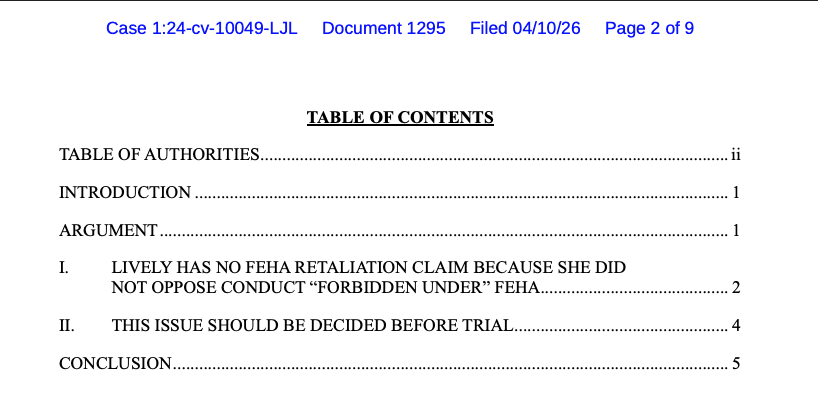
Latest from the Blake Lively suit. Wayfarer had filed another MJOP (Motion for Judgement on Pleadings https://www.courtlistener.com/docket/69510553/1295/lively-v-wayfarer-studios-llc/.
Blake replied https://storage.courtlistener.com/recap/gov.uscourts.nysd.634304/gov.uscourts.nysd.634304.1403.0.pdf and then
Justin Baldoni replied https://www.courtlistener.com/docket/69510553/1409/lively-v-wayfarer-studios-llc/
A comprehensive breakdown is here https://www.threads.com/@celebchai/post/DXk6CtHFPQK?xmt=AQF0vqVFNwGZglH7xtm2lhXYJJiHFoMT6jiNavnQRbyviw
This post focuses only on the participation clause of 12940 (h).
The participation clause is the second half of Section 12940(h). The statute has two clauses separated by the word “or,” and each one independently creates protected activity. Most of the attention in this case has been on the first clause, but the second clause may be the one that saves the claim.
Here is the full text of Section 12940(h):
“It shall be an unlawful employment practice for any employer, labor organization, employment agency, or person to discharge, expel, or otherwise discriminate against any person because the person has opposed any practices forbidden under this part or because the person has filed a complaint, testified, or assisted in any proceeding under this part.”
The first clause is the opposition clause: “because the person has opposed any practices forbidden under this part.” That is the clause the defendants’ motion attacks. Their argument is that because the harassment was not “forbidden under” FEHA (extraterritoriality), Lively was not opposing “practices forbidden under this part.” Everything we have been analyzing about the good-faith belief standard, Yanowitz, Cooper, Arn, and Wolf relates to this clause.
The second clause is the participation clause: “because the person has filed a complaint, testified, or assisted in any proceeding under this part.” This clause protects a different type of activity. It protects participation in the FEHA enforcement process itself: filing complaints, testifying, and assisting in proceedings.
Why the participation clause matters here:
Lively filed a CRD complaint in December 2024. The CRD is the California Civil Rights Department (formerly the Department of Fair Employment and Housing). It is the state agency that administers and enforces FEHA. When someone believes they have been subjected to conduct that violates FEHA, the standard process is to file a complaint with the CRD. That is “filing a complaint under this part.”
The participation clause does not contain the words “practices forbidden under this part.” It does not require the plaintiff to have opposed any particular practice. It requires only that the plaintiff “filed a complaint, testified, or assisted in any proceeding under this part.” The word “under” in this clause refers to the FEHA enforcement framework, not to whether the underlying conduct was actually forbidden by FEHA.
This distinction is critical. The defendants’ entire motion is built on the phrase “practices forbidden under this part” in the opposition clause. They argue that because the harassment was not “forbidden under” FEHA, Lively has no protected activity. But the participation clause does not use that phrase. It uses different language that creates a different and independent basis for protection.
Filing a CRD complaint is participation in a proceeding “under” FEHA regardless of whether the underlying harassment was ultimately within FEHA’s territorial reach. The complaint was filed with a FEHA enforcement agency. The proceeding is a FEHA proceeding. The protection attaches to the act of filing, not to the merits of the underlying claim.
The caselaw supports this distinction:
Under Title VII, which has a nearly identical two-clause structure (opposition clause and participation clause), courts have consistently held that the participation clause provides broader protection than the opposition clause. In Wolf v. J.I. Case, Judge Gordon made exactly this point: “The participation clause of Title VII has been interpreted uniformly as protecting an employee who files discrimination charges with the EEOC, regardless of the ultimate resolution of the underlying claim.” The protection attaches to the filing, not to whether the underlying discrimination was ultimately proven or even actionable.
The rationale is practical. The FEHA enforcement system depends on people filing complaints. If filing a complaint only protects you when the underlying claim turns out to be meritorious, people will be afraid to file. They will worry that if they are wrong about the law or the facts, they will lose their retaliation protection and face consequences for having filed. That fear would undermine the entire administrative enforcement framework. The participation clause eliminates that fear by protecting the act of participating in the process, regardless of outcome.
Why the defendants have difficulty responding to this:
The defendants’ opening brief (Dkt. 1295) did not address the participation clause at all. It focused entirely on the opposition clause. Lively’s opposition brief pointed this out. The defendants’ reply brief (filed today) finally addresses it, but only briefly. They make two arguments.
First, they argue that nothing the defendants did after the CRD filing was anything other than “reasonable defensive measures.” But whether post-CRD conduct was defensive or retaliatory is a factual question the court already found presents triable issues. Freedman made public statements calling Lively’s allegations “categorically false,” “revoltingly false,” and accusing her of using sexual harassment allegations as “leverage.” The Wayfarer Parties filed a counter-suit. Whether those actions were reasonable defense or unlawful retaliation is for a jury.
Second, the defendants ask that if the participation clause saves anything, the FEHA claim should be “restricted to retaliation that occurred after the filing of Lively’s CRD complaint.” This is a fallback position. It implicitly concedes that the CRD filing is protected activity. The defendants are no longer asking for complete dismissal of the FEHA claims. They are asking for a narrowing.
That fallback is itself a significant concession. It means the defendants accept that Lively has at least some FEHA-protected activity (the CRD filing) and at least some basis for a retaliation claim (post-CRD conduct). The question becomes scope, not existence.
What happens if Liman accepts only the participation clause and not the opposition clause:
If Liman rules that the opposition clause does not support protected activity (because the harassment was extraterritorial) but the participation clause does (because the CRD filing is independently protected), the FEHA claim narrows. Lively could only recover for retaliation that was motivated by her CRD filing, not for retaliation motivated by her earlier complaints about on-set harassment.
The practical effect: the August through December 2024 smear campaign predates the CRD filing (December 20, 2024). If the claim is limited to post-CRD retaliation, the pre-CRD campaign might not be directly actionable under the FEHA claim. However, the pre-CRD campaign could still come in as evidence of retaliatory intent. If the defendants were already retaliating before the CRD filing, a jury could infer that post-CRD conduct was also retaliatory rather than defensive.
Also, the CRA breach claim (Count 9) has its own anti-retaliation provision that covers the full timeline regardless of the participation clause analysis. Paragraph 10 of the CRA prohibits “retaliation of any kind against Artist for raising concerns about the conduct described in this letter.” That language is not limited by FEHA’s territorial reach. So even if the FEHA claim narrows, the CRA claim covers the entire retaliatory campaign.
What happens if Liman accepts both clauses:
If Liman holds that Lively has protected activity under both the opposition clause (her belief was reasonable under Yanowitz) and the participation clause (the CRD filing), the full FEHA claim survives. The entire timeline of retaliatory conduct, from August 2024 through the counter-suit, is at issue. The jury evaluates the complete smear campaign as potential retaliation.
This is the more likely outcome. The Yanowitz standard is strong enough to sustain the opposition clause, and the participation clause provides a safety net. Liman does not need to choose between them. He can hold that both clauses independently support protected activity and deny the motion in full.
The bottom line on the participation clause:
It is a structural feature of the statute that creates an independent basis for protection that the defendants’ motion does not overcome. The defendants’ entire theory depends on the phrase “practices forbidden under this part.” That phrase appears only in the opposition clause. The participation clause uses different language, protects different activity, and is unaffected by the extraterritoriality ruling. Even in the worst-case scenario for Lively on every other argument, the participation clause preserves a FEHA retaliation claim based on the CRD filing. The defendants’ reply concedes this by retreating to a narrowing argument rather than seeking complete dismissal.
 celebchai.com