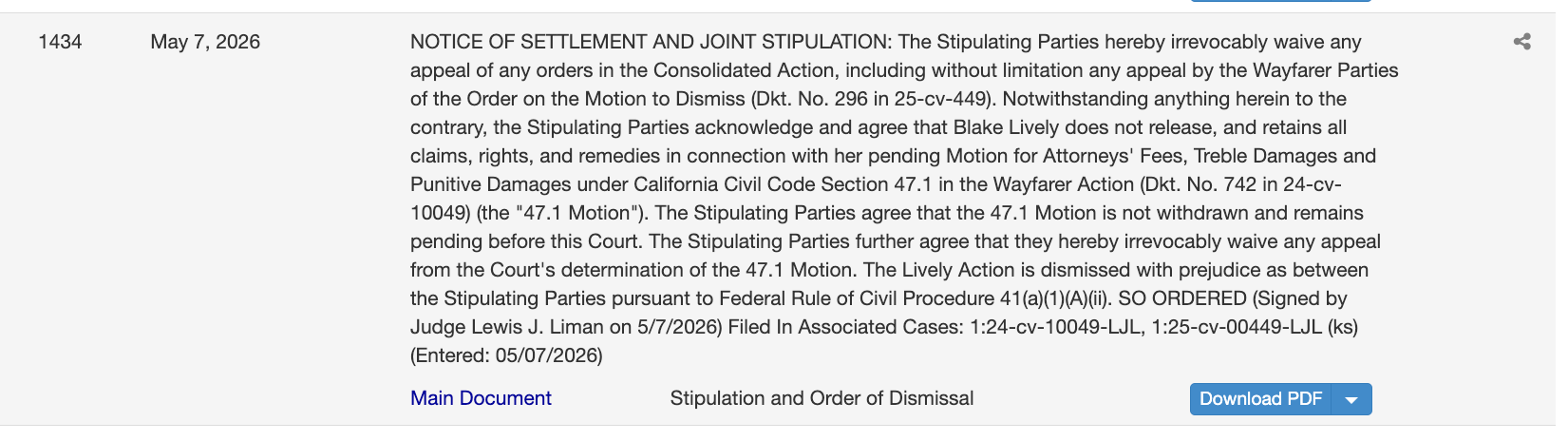
On May 7, 2026, Blake Lively and the Wayfarer Parties filed two documents in the Southern District of New York. The first was a notice of settlement and joint stipulation closing out nearly all claims in the consolidated action. The second was a letter from Lively’s counsel to Judge Lewis Liman framing what remains. The mainstream entertainment press is reading the settlement as a Lively win and a Baldoni climbdown. The legal mechanics are more interesting than that, and the part of the filings that actually matters for how this gets reported in the coming months sits in a single sentence in paragraph 2 of the stipulation, reinforced by the letter’s explicit framing.
That sentence says the parties “irrevocably waive any appeal from the Court’s determination of the 47.1 Motion.” The letter confirms that the parties “have submitted to this Court to adjudicate with no right of appeal.”
What that language does, structurally, is guarantee that whatever Judge Liman rules on Lively’s pending motion under California Civil Code section 47.1 becomes the final word, with no Second Circuit review available to either side. The motion itself, filed in September 2025, seeks attorneys’ fees and costs as the prevailing defendant on the dismissed Wayfarer claims, treble damages for harm caused by the retaliatory defamation action, and punitive damages under section 3294. The fee piece alone is estimated in the motion as a multi-million dollar award. The treble and punitive components are unspecified and will be quantified by Liman after additional submissions.
Everything else in the settlement closes out the litigation. The Lively action is dismissed with prejudice. The Wayfarer Parties’ appeal rights on Liman’s June 2025 dismissal of their countersuit are extinguished. Whatever was negotiated as to the affirmative claims is not on the public docket, which is the standard posture for settled civil cases. The May 7 letter is explicit that the parties have “fully and finally resolved all claims in the Consolidated Action, except one.”
The 47.1 motion is the only piece left moving, and the appeal waiver is the only thing that makes it interesting.
What the appeal waiver actually means
Parties facing potential exposure on a multi-million dollar fee award plus trebled compensatory damages plus punitive damages do not, as a rule, prospectively waive their appeal rights. The standard move in a settlement of this kind is to fix the dollar amount privately, make it confidential, and close out the entire dispute. The Wayfarer Parties did not do that. They agreed to let Liman decide the number and accept the result without recourse.
The May 7 letter sharpens why this is less reckless than it might initially appear. Footnote 2 of the letter confirms that “several of the Wayfarer Parties agreed to stipulate that Ms. Lively engaged in a protected activity, which encompasses the element of a good faith, reasonable belief that she complained of or opposed unlawful harassment.” That stipulation, made before the settlement was finalized, hands Lively the malice element of 47.1. The privilege under 47.1 attaches when an individual makes a communication regarding sexual harassment or discrimination “without malice,” and the Wayfarer Parties have effectively conceded the good faith and reasonable belief that defeat any malice argument. One element of the 47.1 analysis was already off the table before the appeal waiver was signed.
That changes the strategic reading of why a defense team represented by Liner Freedman Taitelman, Shapiro Arato Bach, and Meister Seelig would accept an unappealable ruling. There are two readings. Neither is the reading currently circulating online.
The first reading is that the 47.1 outcome has been functionally pre-negotiated within a known range. The settlement on the affirmative claims included some understanding of what Liman would award on 47.1, and the appeal waiver is paper closing a loop both sides already understand. The protected-activity stipulation reduces the variance in that range by locking in malice, which makes a pre-negotiated framework more workable. Under this reading, whatever Liman publishes will look like a public ruling but will track a privately understood outcome.
The second reading is more strategically substantive and, in light of the malice concession, more plausible. Section 47.1 is a 2024 California statute with almost no appellate construction. A Second Circuit appeal of a 47.1 award would produce a published opinion analyzing the statute’s reach, the malice standard, the prevailing-defendant analysis, the mechanics of imposing punitive damages for the act of bringing a lawsuit, and potentially the constitutional questions that punitive damages framework raises. That published opinion would then be available to every plaintiff with a 47.1 claim in the country. By waiving appeal rights, the Wayfarer Parties have ensured that whatever Liman rules stays at the district court level. They are not the vehicle for circuit-level 47.1 precedent.
The popular framing online, that Wayfarer’s lawyers somehow forgot to read the fine print, is not a serious reading of how a settlement gets drafted between firms of this caliber. The clause is in the stipulation because it was negotiated to be there. The protected-activity stipulation that preceded it was negotiated to be there. The question is what was extracted in exchange for both, and that information sits inside the confidential settlement, not on the public docket.
The displacement gap
The structurally interesting piece, for media analysis purposes, is what the Liman ruling will be reported as deciding versus what it will actually decide.
Section 47.1 is a procedural and statutory remedy, not a verdict on the underlying harassment allegations. The privilege attaches when an individual makes a communication regarding an incident of sexual assault, harassment, or discrimination, made without malice, where the speaker had a reasonable basis to file a complaint, “whether the complaint is, or was, filed or not.” That last clause is doing a lot of work. The statute protects the act of speaking. It does not adjudicate whether the underlying conduct occurred.
This means a ruling for Lively on 47.1 establishes that her communications were privileged. It does not establish that Baldoni harassed her in any judicially confirmed sense. The factual question of what happened on set has not been tried. The motion to dismiss order disposed of the Wayfarer claims on legal grounds, principally fair report and litigation privilege. The 47.1 motion, if granted, will rest on the privileged status of Lively’s communications, the absence of malice (which the protected-activity stipulation has now functionally conceded), and the reasonable-basis standard. None of those findings reach the underlying conduct.
Conversely, a ruling against Lively on 47.1 does not establish that her harassment allegations were false. It would establish, depending on the basis, that the court found some element of the statutory framework insufficient, or that punitive damages are not warranted on the record before the court, or that the prevailing-defendant analysis fails on some procedural ground. Each of these is a discrete legal finding. None of them is a determination that Lively fabricated her account.
The gap between what 47.1 will decide and what 47.1 will be reported as deciding is the displacement mechanism, and it is baked into the procedural posture by the appeal waiver. There will be no Second Circuit clarification later. There will be no published opinion that carefully delineates what the ruling does and does not establish about the underlying merits. There will be one Liman ruling, final, ready to be packaged by the entertainment press into a binary that the statute is structurally not designed to produce.
How the coverage will work
If Liman awards a substantial sum, the Lively side will frame it as vindication of the harassment allegations themselves. The Wayfarer side will frame it as an unappealable district court ruling on a novel statute, distinguishable from any merits determination on the underlying conduct. Both framings will be partially right and substantially misleading.
If Liman awards a modest sum or denies the punitive component, the Wayfarer side will frame it as evidence that Lively’s allegations did not meet the statutory threshold and by implication did not meet a credibility threshold either. The Lively side will face the harder media position of explaining that 47.1 has specific elements unrelated to whether harassment occurred. That explanation does not condense into a headline.
If Liman issues a split ruling, awarding fees but denying treble or punitive components, both sides will claim partial victory and both sides will be partially right.
The appeal waiver guarantees that whichever framing dominates, no later opinion will rebalance it. The Second Circuit will not produce a published 47.1 analysis that future commentators can use to distinguish what the ruling did and did not actually decide. The district court ruling is the entire public record of what 47.1 means in this dispute, and whatever the press makes of it is, for media-narrative purposes, what 47.1 means.
The framing in the letter itself
The May 7 letter is worth reading as a media artifact, not just a procedural request. The letter casts the 47.1 motion as a clean, almost ministerial application of the statute given the prior briefing, the dismissal order, and the Wayfarer Parties’ stipulations. It walks through each element of the statute and notes the prior procedural and stipulated concessions that go to that element. It frames the suit as the “prototypical” case the California Legislature intended to short-circuit.
That framing is itself a strategic move. By presenting the motion as straightforward, Lively’s counsel is shaping how the eventual ruling will be received in the press. If Liman grants substantial relief, the framing will be: this was the obvious legal outcome given uncontested elements. If Liman denies or limits relief, the framing will be: an unexplained departure from a straightforward statutory application. Either way, the entertainment press will pick up the framing in the letter rather than reconstructing the doctrinal complexity from scratch.
The same mechanism is already operating in the press cycle around the settlement itself. In a statement to Deadline, Lively’s counsel Esra Hudson and Michael Gottlieb characterized the protected-activity stipulation as a concession that ended “once and for all the fiction that Ms. Lively ‘fabricated’ claims of sexual harassment and retaliation.” That framing collapses the legal scope of the stipulation. What the Wayfarer Parties stipulated to is that Lively engaged in protected activity, which under the relevant retaliation framework means she had a good faith and reasonable belief that she was opposing unlawful conduct. That is a concession about her state of mind when she complained. It is not a concession that the underlying harassment occurred. The legal distinction is meaningful, and Lively’s counsel knows it. The press statement is not a legal argument. It is a public characterization of the stipulation as something broader than what was legally conceded, and it is the kind of framing that will land in entertainment-press coverage as a Wayfarer admission about the harassment itself rather than about Lively’s good faith in reporting it.
The legal posture is being managed for press readability, not just for adjudication, and the appeal waiver guarantees that the press-readable version is the final version.
Timing
The letter requests leave to file a supplemental brief of five pages or fewer addressing the Court’s intervening rulings since September 2025 and proposing procedures for adjudicating damages. The original briefing closed September 29, 2025. The factual record has developed substantially in the eight months since, including whatever came out in the lead-up to the now-mooted March 2026 trial and the deposition cycle.
The seven-day request for the supplement, if granted, means a Liman ruling could come within roughly thirty to ninety days of the supplemental briefing closing, depending on how Liman wants to handle the damages quantification. The original motion contemplated an evidentiary hearing if needed. The supplemental brief will presumably propose either an on-the-papers ruling on liability with later quantification, or a streamlined evidentiary process.
Either way, the next live moment in this story is the Liman ruling, and it is on a months-not-years horizon. That is when the displacement mechanism activates and the press cycle around it produces whatever the public record of 47.1 in this case ends up being.
What this fits into
This is not the first time in this litigation that a procedural ruling has been processed by the entertainment press as a merits verdict. The June 2025 dismissal of the Wayfarer countersuit was reported as Baldoni losing on the substance of his defamation claims, when the dismissal rested principally on fair report privilege and litigation privilege grounds, with the actual malice analysis providing additional support. The legal grounds for the dismissal were not adjudications of whether Lively defamed anyone in some ultimate factual sense. They were determinations that her communications were protected as a matter of law.
The 47.1 ruling will be the same kind of legal determination, processed by the same press infrastructure, into the same kind of binary verdict framing. The settlement structure ensures it. The protected-activity stipulation ensures the malice element will not be in play. The appeal waiver ensures no later corrective.
For coverage of media patterns in litigation involving sexual harassment allegations, the takeaway is not whether Lively or the Wayfarer Parties win on 47.1. It is that the procedural posture has been engineered to produce a ruling that will be read as deciding something it does not legally decide, with no later corrective. That is worth tracking when the ruling drops, because the reporting around it will be the actual story.

