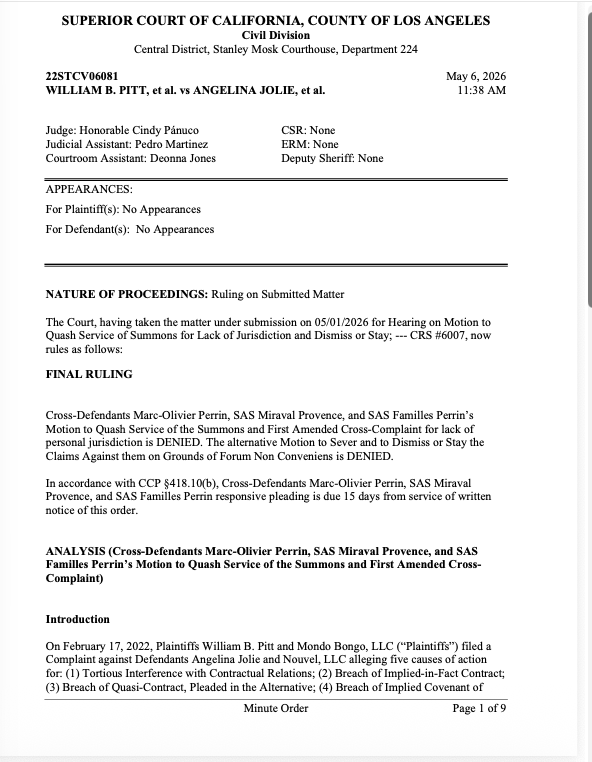
Judge Cindy Pánuco of Los Angeles Superior Court issued two rulings on the Pitt v. Jolie docket within 48 hours of each other in early May 2026. The first, dated May 4 and ruling on a matter taken under submission April 17, denied Pitt’s motion to compel production of 22 documents Jolie had withheld as privileged. The second, dated May 6, denied a motion to quash filed by three French cross-defendants brought into the case by Nouvel, LLC. Both went against Pitt and his alignment of parties. Neither is a final substantive ruling on the merits. Together they tell us something about where the case is procedurally and where the contested ground is moving.
The Privilege Ruling (May 4)
The procedural history matters here, because the headline obscures what actually happened.
In November 2024, Pitt moved to compel Jolie to produce 126 unredacted emails between non-attorneys and to supplement her privilege log. After revisions to the privilege log, only 22 documents remained contested. On December 17, 2025, Judge Lia Martin granted Pitt’s motion and ordered production of all 22.
Jolie petitioned the Court of Appeal for writ relief on January 26, 2026. The next day, the appellate court stayed Judge Martin’s order. On February 25, 2026, the Court of Appeal issued an alternative writ directing the trial court either to vacate the December 17 order or to make a new order finding that Jolie had met her initial burden of establishing a prima facie claim of attorney-client privilege under Costco Wholesale Corp. v. Superior Court (2009) 47 Cal.4th 725.
Judge Martin vacated her prior order on April 2, 2026, found Jolie had met the Costco prima facie burden, and set the matter for a Costco hearing. The case was reassigned to Judge Pánuco, who heard argument on April 17 and took it under submission.
The May 4 ruling applies the Costco burden-shifting framework. Once a party establishes a prima facie claim of privilege, the burden shifts to the opponent to show the privilege does not apply. Both the Court of Appeal and Judge Martin had already found Jolie’s showing sufficient. The question for Pánuco was whether Pitt’s evidence overcame that showing.
The 22 contested documents fall into two groups. Thirteen involve communications between Jolie and Terry Bird, her business manager, discussing legal advice from Arendt & Medernach, the Luxembourg firm jointly representing Jolie and Nouvel, LLC. Bird was Nouvel’s sole manager and Jolie’s primary point of contact with her lawyers, which makes him both a joint privilege holder and Jolie’s authorized representative under Evidence Code section 951. The remaining nine involve Jolie’s authorized representatives Chloe Dalton and Arminka Helic, and consulting experts James Friel and Marjorie Brabet-Friel, who were retained to assist Arendt in providing legal advice on the Miraval transaction.
Pitt relied on exhibits already before the court (Exhibits 6 and 16) to argue the communications were not privileged because they involved non-attorneys. The court found those same exhibits had already been deemed sufficient to establish the prima facie privilege showing, and Pitt offered no authority for the proposition that the same evidence could simultaneously establish and rebut a privilege claim. Pitt asked for leave to conduct further discovery and supplement the record. The court denied the request, reasoning that the appellate mandate required application of Costco to the existing papers.
On that record, Pitt did not meet his burden. The motion was denied without prejudice. The court expressly noted that “further discovery may yield additional facts” that “could potentially rebut” the privilege claim.
Two points are worth pulling out.
First, this is a procedural ruling on a procedural framework, not a substantive determination that the 22 documents are privileged in some final sense. The appellate court directed application of Costco; Pánuco applied it; Pitt loses on the current record. Different evidence in a different posture could yield a different result.
Second, the sanctions denial cuts the other way. Jolie sought $33,692.50 in monetary sanctions under Code of Civil Procedure section 2031.300. The court denied the request on the ground that Judge Martin’s initial grant of Pitt’s motion demonstrated his position was “not without substantial justification.” That is the statutory safe harbor for a position that was wrong but not unreasonable. It is a finding that Pitt’s privilege challenge, though unsuccessful, was not frivolous.
The Perrin Ruling (May 6)
The second ruling is more consequential and has received less coverage.
Nouvel, LLC filed a First Amended Cross-Complaint in August 2023. In September 2023, three French parties brought into the case as cross-defendants, Marc-Olivier Perrin and the two Perrin entities (SAS Miraval Provence and SAS Familles Perrin), filed a motion to quash for lack of personal jurisdiction or, alternatively, to dismiss or stay on forum non conveniens grounds. The motion sat for over two and a half years before being argued on May 1, 2026.
The court denied the motion in full.
On general jurisdiction, the court found Nouvel did not meet its burden. Perrin is a French citizen residing in France. Familles Perrin and Miraval Provence are French entities with their principal places of business in France. Nouvel argued the entities operated Tablas Creek Vineyard in Paso Robles and described the United States as their “biggest market.” The court accepted those facts as substantial but found they did not approach the Daimler AG v. Bauman (2014) 571 U.S. 117 threshold of rendering the defendants “essentially at home” in California.
On specific jurisdiction, the court found purposeful availment, relatedness, and no compelling case against fair play. The evidence Nouvel produced, through the Lesnick and Pepper declarations, included:
- Perrin traveled to California on at least four occasions (October 2016, May 2017, February 2018, April 2019) to meet with Pitt regarding Chateau Miraval operations
- A January 2022 email from Perrin to Pitt indicating he “might go to LA” and proposing to “catch up on Stoli and the rest”
- Sustained communications between Perrin and Pitt over years concerning management, branding, and trademark strategy of Chateau Miraval
- Communications between Perrin and Jolie’s California-based team between 2019 and 2021 providing updates on Miraval business
- A fund transfer to a Los Angeles bank account in connection with the business
- Documentary evidence that the Perrin entities supplied wine to California and that Perrin himself described the United States as the “biggest market”
- Trademark registration activity by the Perrin entities while simultaneously denying Nouvel its rights in those trademarks
At oral argument, the cross-defendants contended that the visits never occurred. The court was unpersuaded, noting that the discussions in any event revolved around Chateau Miraval.
Perrin’s contacts were attributed to Familles Perrin and Miraval Provence under Anglo Irish Bank Corp., PLC v. Superior Court (2008) 165 Cal.App.4th 969, because Perrin is the president of both entities and his California-directed conduct was undertaken in his corporate capacity for those entities’ business operations.
On relatedness, the cross-defendants argued the contacts were “ordinary-course” business activities concerning a French wine business, unrelated to cross-claims about conduct in France and Luxembourg. The court rejected the framing. The First Amended Cross-Complaint alleges that the Perrin cross-defendants coordinated with Pitt and Mondo Bongo (both California parties) to impose a shareholder deadlock at Quimicum, divert Chateau Miraval’s assets, and misappropriate trademarks. Under that theory, the California meetings and communications were not collateral; they were the means by which the alleged conduct was coordinated.
On forum non conveniens, the cross-defendants offered to consent to French jurisdiction and to toll the statute of limitations. The court found France was not a suitable alternative forum because the Perrin cross-defendants did not establish that the other cross-defendants were subject to French jurisdiction or had consented to litigate there. Under American Cemwood Corp. v. American Home Assurance Co. (2001) 87 Cal.App.4th 431, the suitability inquiry is non-discretionary and must be satisfied before the court reaches the private and public interest factors. The Perrin cross-defendants asked for a continuance to ascertain whether the other cross-defendants would consent to French jurisdiction. The court denied the continuance, noting the motion had been pending since 2023 and trial is tentatively set for August 2027.
The cross-defendants’ responsive pleading is due 15 days from service of written notice of the order.
What These Rulings Mean Together
The privilege ruling preserves Jolie’s ability to withhold a discrete set of communications on the current record, subject to revisitation if new evidence develops. The Perrin ruling keeps the French parties Nouvel alleges coordinated with Pitt in the case, in California, on a coordination theory that requires those parties to be in the same forum to be tried.
The Perrin ruling is the structurally significant one for Nouvel’s cross-complaint. The cross-complaint’s theory depends on alleged coordination between the Pitt-side California parties (Pitt, Mondo Bongo) and the Perrin-side French parties (Perrin and his two entities) to take actions affecting a California LLC (Nouvel). If the French parties had been dismissed, the coordination theory would have had to proceed against half the alleged actors in a different forum, which is precisely what American Cemwood treats as a reason to find the alternative forum unsuitable.
Trial is tentatively set for August 2027. Discovery on the privilege questions remains open under the without-prejudice denial. Both rulings are interlocutory and neither closes any merits question.

