The argument on Blake Lively’s motion for fees, treble damages, and punitive damages under California Civil Code § 47.1 happened June 1, 2026, in Courtroom 15C at 500 Pearl Street. One hour, thirty minutes per side. Michael Gottlieb of Willkie Farr & Gallagher went first for Lively. Ellyn Garofalo of Liner Freedman Taitelman & Cooley went second for the Wayfarer Parties. At the end, Judge Lewis J. Liman said two words: “Under advisement.”
That’s where things stand. No bench ruling. Decision will come in writing. But the argument itself revealed more than the briefs did about where this motion is actually going.
The Question Both Sides Conceded
Judge Liman’s May 28 order asked four questions about California Civil Code § 47.1, the statute the California legislature passed in 2023 to shield people who report sexual harassment from retaliatory defamation suits. The questions: who bears the burden of proving the communication is privileged, does the burden differ by remedy sought, does Rule 54 change anything, and how is the burden discharged.
Both sides briefed the same answer to question one. Defendant bears the initial burden of showing the privileged occasion. Once shown, the burden shifts to the plaintiff to prove malice to defeat the privilege. That’s the rule from Lundquist v. Reusser, 7 Cal. 4th 1193 (1994), the California Supreme Court case that has governed § 47 qualified privileges for thirty-two years. Lively cited it. Wayfarer cited it. Dignity Health v. Mounts, 105 Cal. App. 5th 113 (2024), restated the rule for § 47 generally just two years ago. Both sides cited that too.
The threshold burden allocation question that some commentators framed as genuinely open turned out not to be open at all. Liman never pressed either side on it. He skipped past question one and spent the entire hour on questions two, three, and four.
The Procedural Knot
What Liman was actually grappling with is procedural. Section 47.1 was drafted with state-court anti-SLAPP-style procedure in mind. It contemplates a defendant who has been sued for making a privileged communication, who raises § 47.1 as a defense or counterclaim, who prevails, and who then seeks the statutory remedies. Federal Rule of Civil Procedure 54 is the federal procedural vehicle for post-judgment fee applications. It does not, on its face, contemplate compensatory damages, treble damages, or punitive damages.
The collision is the case.
Lively prevailed on the Wayfarer Parties’ defamation claim against her in Judge Liman’s June 9, 2025 dismissal opinion. That opinion rested on California’s litigation privilege under § 47(b) and the fair report privilege under § 47(d), not on § 47.1 specifically. Liman expressly left § 47.1 open. The case went on. Lively’s affirmative claims against the Wayfarer Parties were partially resolved on summary judgment on April 2, 2026. The parties then settled on May 7, 2026, with one carve-out: Lively’s pending § 47.1 motion (Dkt. 742) survived. Both sides agreed Liman would decide it. Both sides waived appeal.
That left Liman with a statute that was never quite triggered by his original ruling, raised through a procedural vehicle that doesn’t naturally fit it, in a case that’s otherwise settled. He has to make this work. Or he has to find it can’t be made to work.
What Gottlieb Argued
Gottlieb’s opening was clean. Lively had asked for § 47.1 relief in her motion to dismiss back in early 2025. The framework is Lundquist. She has discharged her initial burden by establishing the privileged occasion. The CRD complaint conveyed factual information about sexual harassment she experienced. She had a reasonable basis for the complaint. Judge Liman himself found her belief in harassment objectively reasonable on the April 2 summary judgment record. The Wayfarer Parties now bear the burden of proving malice to defeat the privilege. They have not come forward with evidence sufficient to meet that burden. Therefore Lively is entitled to fees, costs, treble damages, and punitive damages, all available through Rule 54 because § 47.1(b) treats them as a unified remedial package.
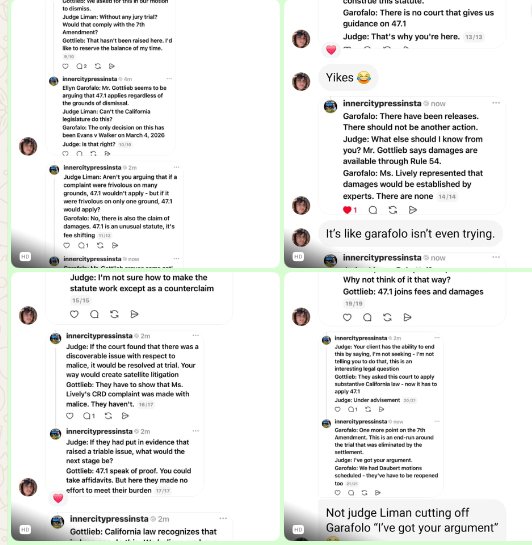
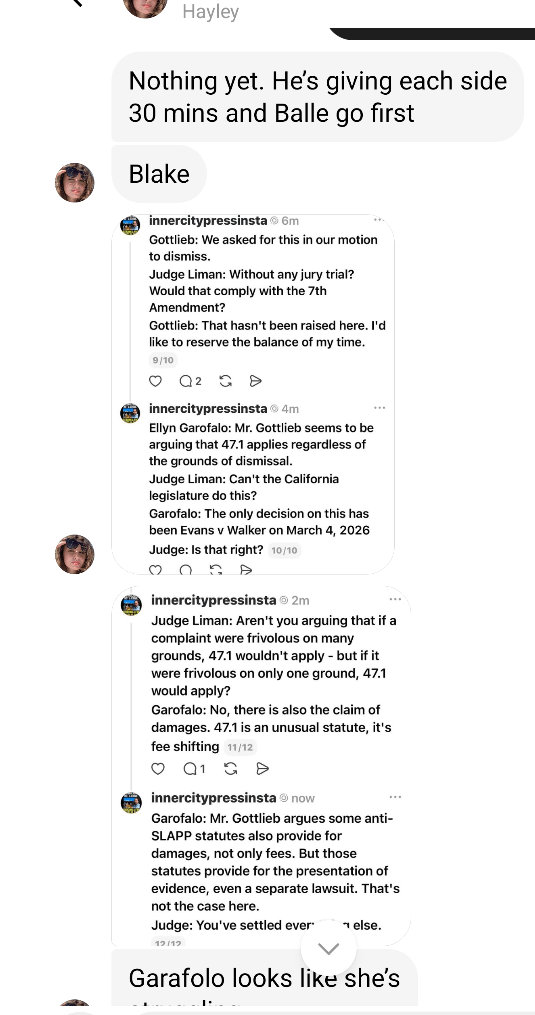
Liman immediately pressed: “Without any jury trial? Would that comply with the 7th Amendment?”
Gottlieb deflected. “That hasn’t been raised here. I’d like to reserve the balance of my time.”
That deflection was strategic but it left the Seventh Amendment question hanging. It would come back.
What Garofalo Argued
Garofalo’s opening was harder. She tried to frame Gottlieb as arguing that § 47.1 applies regardless of the grounds of dismissal, which would mean Lively gets § 47.1 fees even though her win on the underlying defamation claim was on different privilege grounds. Liman cut in: “Can’t the California legislature do this?”
Garofalo: “The only decision on this has been Evans v. Walker on March 4, 2026.”
Liman: “Is that right?”
The question signals skepticism. Liman is the federal judge being asked to construe a 2023 California statute with limited case law interpreting it. One trial court decision from earlier this year is not robust authority. Liman knew that. He pressed harder.
“Aren’t you arguing that if a complaint were frivolous on many grounds, 47.1 wouldn’t apply, but if it were frivolous on only one ground, 47.1 would apply?”
Garofalo’s answer didn’t land. She pivoted to noting § 47.1 includes a damages claim along with fees, called it “an unusual statute,” and said “it’s fee shifting.” The logical hole Liman had identified stayed open.
She tried again with the anti-SLAPP comparison. Some anti-SLAPP statutes provide damages along with fees, she said, but those statutes have procedures for presenting evidence, “even a separate lawsuit.”
Liman cut in: “You’ve settled everything else.”
That’s the line. The Wayfarer Parties settled the rest of the case. They waived appeal. They cannot now argue § 47.1 requires a separate lawsuit when they’ve eliminated the procedural path they’re pointing to.
The Counterclaim Problem
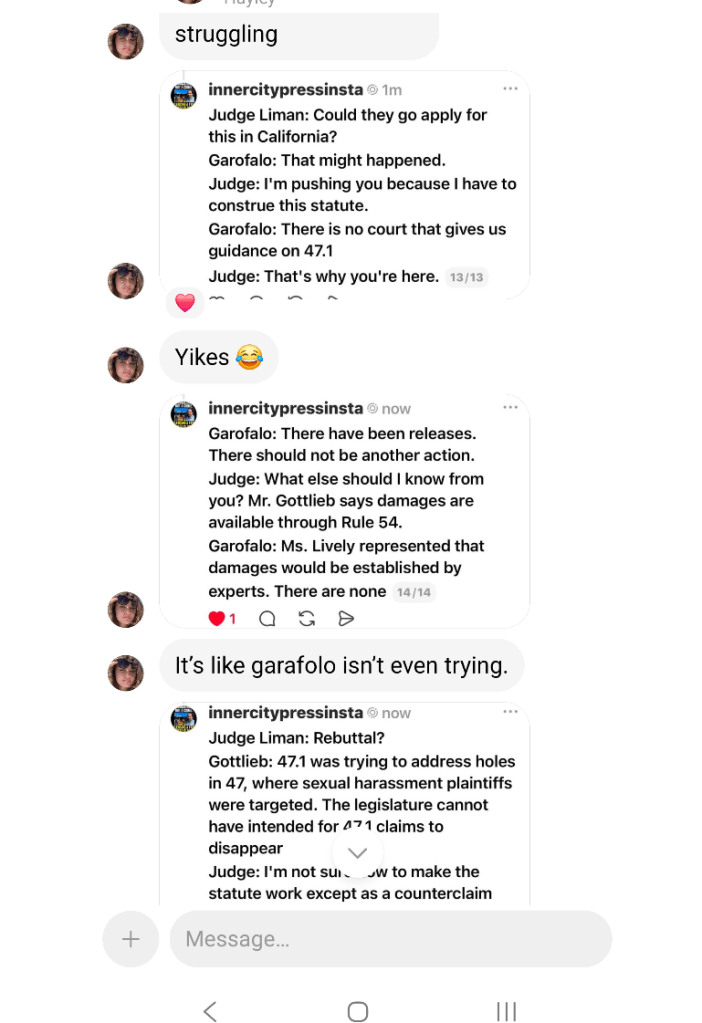
The hardest moment for Lively was Liman’s own framing of the difficulty. “I’m not sure how to make the statute work except as a counterclaim.”
Section 47.1 contemplates being raised as a defense or counterclaim in the underlying defamation action. Lively didn’t raise it that way. She filed it as a post-judgment motion after the Wayfarer Parties’ defamation claim was dismissed. The procedural posture is unusual. Liman is openly uncertain whether Rule 54 can carry the weight § 47.1 places on it.
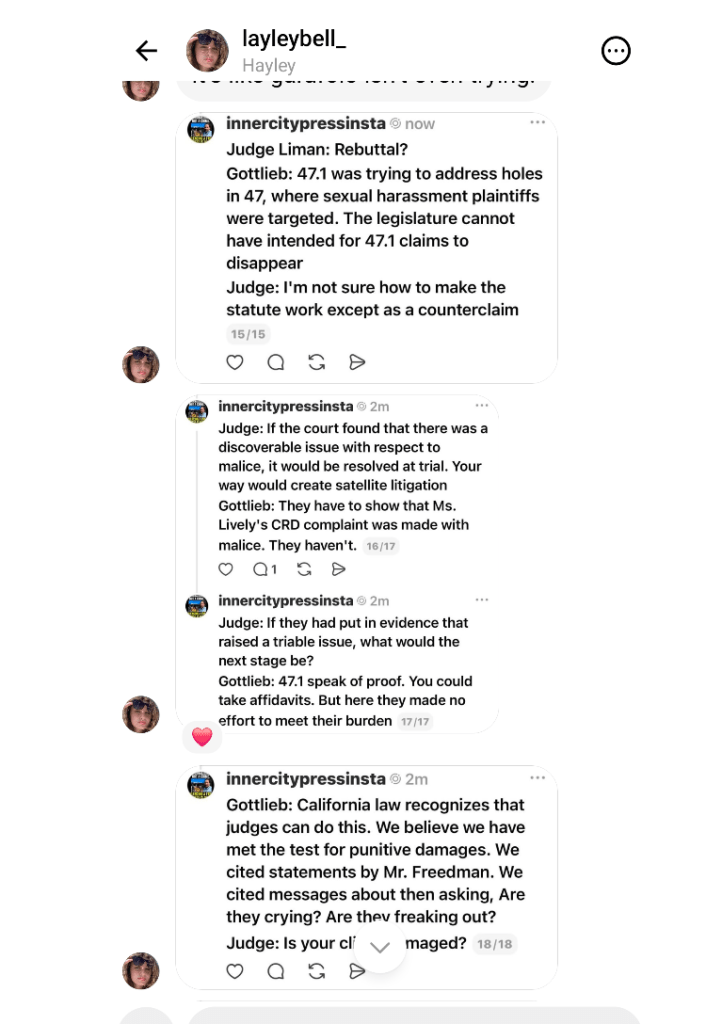
Gottlieb’s rebuttal addressed this directly. Section 47.1 “was trying to address holes in 47, where sexual harassment plaintiffs were targeted. The legislature cannot have intended for 47.1 claims to disappear.”
That’s a policy argument, not a textual one. The legislative intent is clear. But the textual fit between § 47.1 and Rule 54 is what Liman has to work out.
The Satellite Litigation Pivot
Liman then offered Lively the strongest formulation of the alternative. “If the court found that there was a discoverable issue with respect to malice, it would be resolved at trial. Your way would create satellite litigation.”
Liman doesn’t want satellite litigation. He has signaled this. The settlement was supposed to end the case. Reopening proceedings now for a new evidentiary record on malice would defeat the purpose.
Gottlieb’s response: “They have to show that Ms. Lively’s CRD complaint was made with malice. They haven’t.”
Liman: “If they had put in evidence that raised a triable issue, what would the next stage be?”
Gottlieb: “47.1 speaks of proof. You could take affidavits. But here they made no effort to meet their burden.”
This is the move. The burden-shifting framework from Lundquist places the malice burden on the Wayfarer Parties. They haven’t put in evidence. They had the chance and they didn’t take it. The framework can be applied on the existing record without satellite litigation because one party hasn’t met its burden, not because the framework requires no fact-finding.
The Punitive Damages Showing
Gottlieb pitched punitive damages. “California law recognizes that judges can do this. We believe we have met the test for punitive damages. We cited statements by Mr. Freedman. We cited messages about then asking, ‘Are they crying? Are they freaking out?'”
The “Are they crying?” texts are from the discovery record in this case. They’re part of the coordination evidence between Melissa Nathan, Jennifer Abel, and others on the PR side, suggesting the campaign against Lively was designed to inflict reputational damage rather than respond to good-faith concerns. Lively’s position is that these texts demonstrate the clear-and-convincing oppression, fraud, or malice required under California Civil Code § 3294(a) for punitive damages.
Liman’s response was a question: “Is your client damaged?”
That’s not a finding. It’s an open question. Liman has not yet decided whether the punitive damages showing succeeds.
The Seventh Amendment Returns
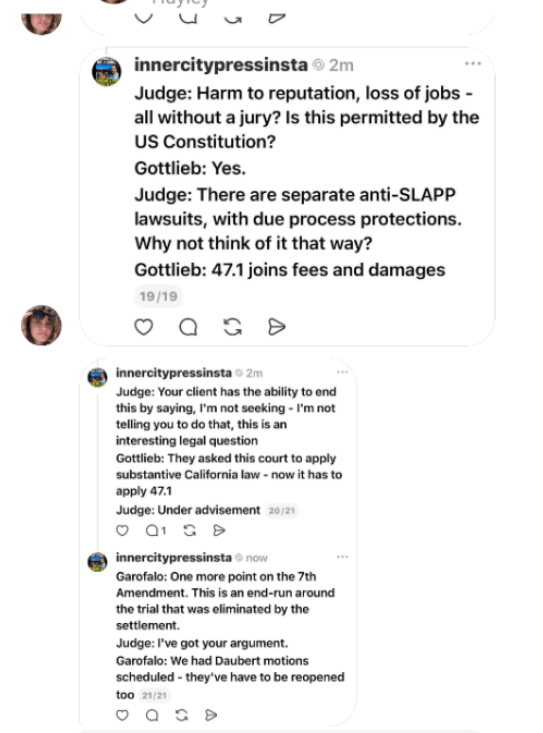
Liman returned to his opening concern. “Harm to reputation, loss of jobs, all without a jury? Is this permitted by the US Constitution?”
Gottlieb: “Yes.”
Liman: “There are separate anti-SLAPP lawsuits, with due process protections. Why not think of it that way?”
Gottlieb: “47.1 joins fees and damages.”
The Seventh Amendment question is the live one. The Wayfarer Parties’ brief made the right-to-jury-trial argument explicitly. Garofalo returned to it at the end: “One more point on the 7th Amendment. This is an end-run around the trial that was eliminated by the settlement.”
Liman: “I’ve got your argument.”
Garofalo: “We had Daubert motions scheduled, they’ve have to be reopened too.”
Liman: “I’ve got your argument.”
That’s a polite but firm cutoff. He heard it. He didn’t want to hear it again. Whether that means he’s persuaded or whether he simply has the issue understood is unclear.
The Offramp
Mid-argument, Liman offered Lively an offramp. “Your client has the ability to end this by saying, ‘I’m not seeking.’ I’m not telling you to do that, this is an interesting legal question.”
The translation: Lively could drop the treble damages and punitive damages and just take fees. Fees alone in this litigation likely run into eight figures. Rule 54 unambiguously authorizes fee awards. The Seventh Amendment problem disappears. The counterclaim problem largely disappears. Liman could rule cleanly and quickly.
Gottlieb declined. “They asked this court to apply substantive California law. Now it has to apply 47.1.”
That’s a strong position but it’s a risk. Liman gave Lively a path to a clean win on fees. Lively is going for the whole package. If Liman rules against her on the procedural questions, she may get nothing through Rule 54 and have to refile in California state court.
Where This Lands
Four outcomes are possible.
The first and most likely is that Liman awards fees under Rule 54 and finds treble and punitive damages cannot be resolved through Rule 54 in this procedural posture. Hensley v. Eckerhart governs fee applications cleanly. The Seventh Amendment problem is real for damages but not for fees. This would be a substantial Lively win, eight figures in fees, but not the full statutory package.
The second is that Liman finds § 47.1 cannot be raised through Rule 54 at all and must be brought as a counterclaim or refiled in California state court. Garofalo nearly conceded this when Liman asked “Could they go apply for this in California?” and Garofalo answered “That might have happened.” This would be a procedural setback for Lively but not a final loss; her § 47.1 claim would survive in another forum.
The third is that Liman awards the full package on the papers, overcoming his own Seventh Amendment concerns. His questioning of Gottlieb on this point was skeptical, which makes this the least likely outcome.
The fourth is that Liman denies § 47.1 relief entirely on procedural grounds, finding the statute doesn’t fit federal court procedure and there’s no path forward. Nothing in the argument suggested this is where he’s heading.
What the Argument Revealed
The briefs framed this as a burden-of-proof question. It wasn’t. Both sides agreed on the burden allocation. The argument was about whether federal procedural rules can accommodate a California statute drafted with different procedural assumptions, and whether the Seventh Amendment permits resolving a damages package on papers after the case has otherwise settled.
These are not easy questions. They are also not the questions most coverage of this hearing will identify. The conventional take has been that the burden of proof determines who wins, and the better-resourced legal team will prevail because they have stronger arguments on burden. That framing missed it. Both legal teams had strong arguments on burden. They agreed. The fight was somewhere else.
Lively’s brief, written by Willkie Farr & Gallagher and Manatt Phelps & Phillips, did the better job answering the four questions Liman asked. Question one was conceded. Question two was answered with the statutory text and legislative history showing fees and damages are treated conjunctively. Question three was answered with Jackpocket, CSX Transp., and Sioux County, three layers of authority on federal procedural adaptation. Question four was answered with Kapellas, Johnson v. Smith, Witkin, and Liman’s own June 9 opinion.
Wayfarer’s brief, written by Liner Freedman Taitelman & Cooley, conceded question one, partially deflected question two, admitted no authority existed on question three, and proposed a different procedure for question four. That was strategic. They knew their best argument was the Seventh Amendment and the procedural fit, so they preserved those arguments and conceded the rest.
At argument, the strategy showed in Garofalo’s difficulty when Liman pushed her on the logic of her position. The exchange that ended with “You’ve settled everything else” was the moment the courtroom temperature shifted. The Wayfarer Parties had eliminated the procedural alternatives they wanted to point to. Liman saw it.
But Gottlieb didn’t get a clean win either. The counterclaim question, the Seventh Amendment question, and Liman’s openly offered offramp on fees-only all signal that Liman is wrestling with the procedural fit in ways that may cost Lively part of her requested relief.
What Comes Next
Decision in writing. Likely within weeks. The fee question is most likely resolved in Lively’s favor. The damages questions are genuinely uncertain. Whatever Liman decides, both sides have waived appeal, which means his ruling is final.
The Wayfarer Parties had agreed to that waiver as part of the May 7 settlement. They could have insisted on preserving appellate rights and they didn’t. That decision was made before they knew how the June 1 argument would go. If Liman rules against them on the framework and awards Lively the full damages package, the waiver will look like the most consequential decision the Wayfarer Parties’ legal team made in this litigation.
If Liman splits the baby and awards fees but not damages, the waiver matters less.
If Liman finds § 47.1 cannot be raised through Rule 54 at all, the waiver matters even less, because Lively will have to refile in California state court and the whole question moves to a different forum.
For now, “under advisement.” The argument is over. The decision is pending. The litigation that began on December 20, 2024 with a CRD complaint and a New York Times article has one ruling left to come.
 celebchai.com