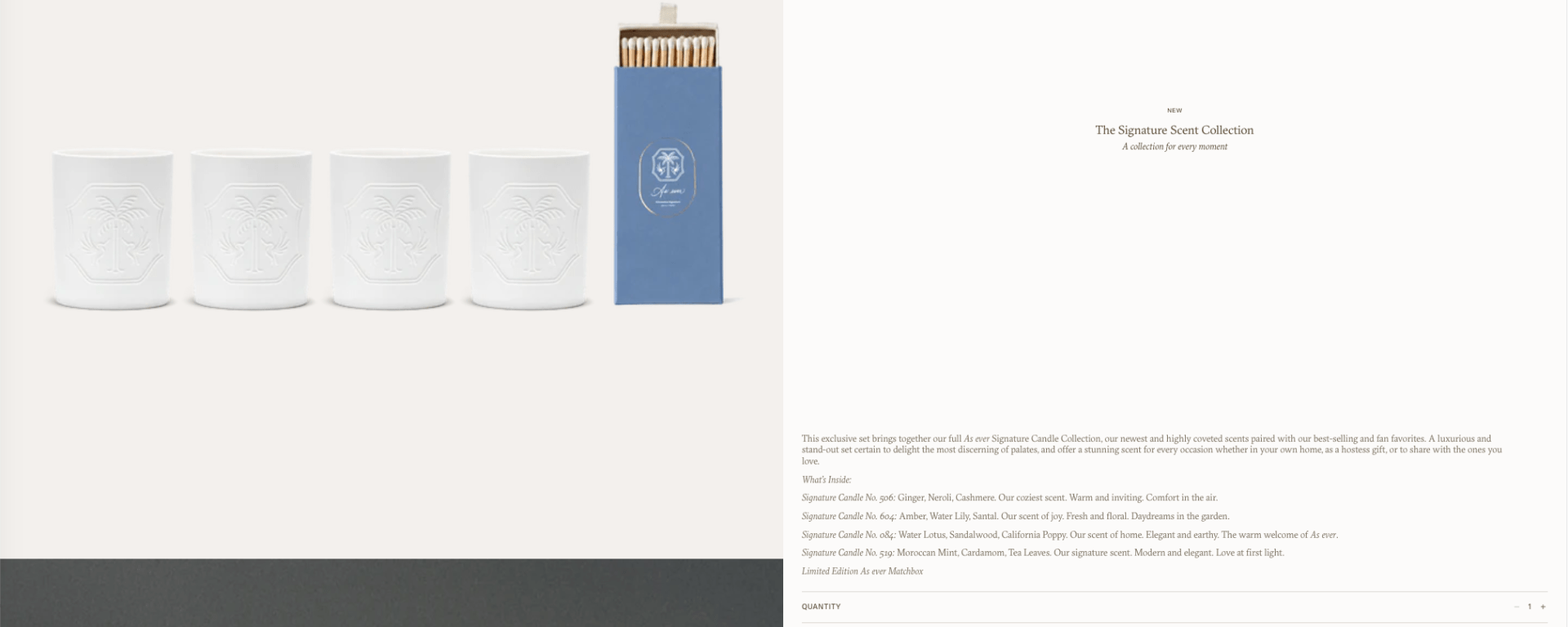
On June 1, the Daily Mail ran a story claiming Meghan Markle had been caught in a contradiction. In 2016 she called $100 candles “obnoxious.” Now, the headline says, she sells her own for £190. The framing is hypocrisy, exposed by her own words coming back to bite. The story has 1.6 thousand comments, most of them treating the contradiction as settled fact.
The contradiction does not exist. It is manufactured by switching the unit of measurement between the 2016 quote and the 2026 product, and the article contains the evidence that this is what happened.
What she actually said
The 2016 statement, from the Create & Cultivate conference in Atlanta, is about a single candle. “There are no $100 candles on my site, that’s so obnoxious.” She is describing a per-item price ceiling. One candle, over one hundred dollars, is the thing she calls obnoxious.
This is the only metric in the original quote. She does not say anything about gift sets, bundles, or total basket size. The unit is one candle.
What she actually sells
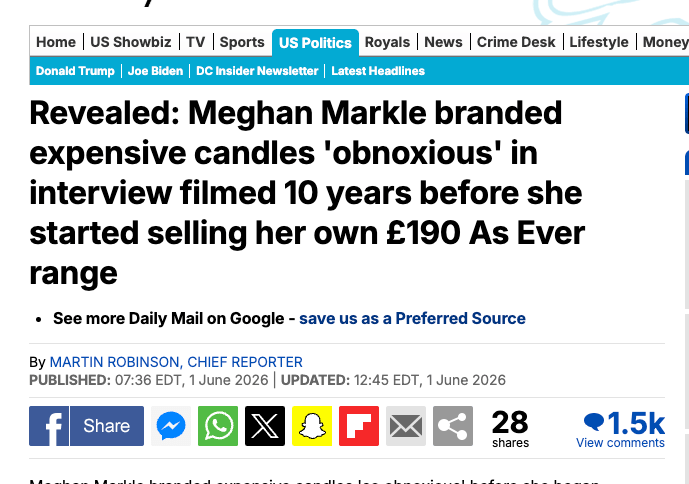
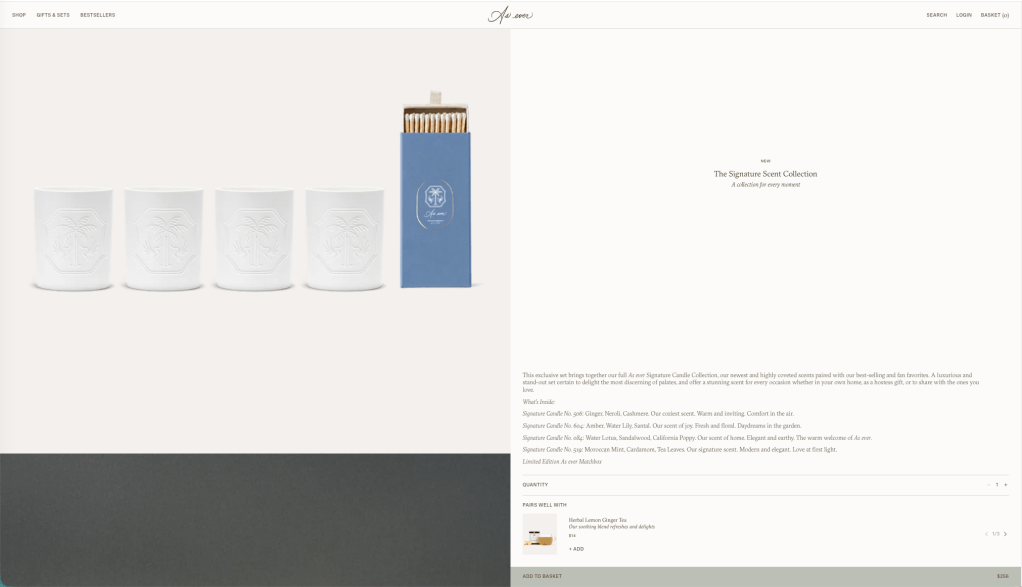
As Ever’s individual Signature candles are priced at $64 each. This is verifiable on the company’s own site in under a minute. The current candle line lists four single scents at $64: No. 506 (ginger, neroli, cashmere), No. 604 (amber, water lily, santal), No. 084 (water lotus, sandalwood, California poppy), and No. 519 (Moroccan mint, cardamom, tea leaves).
On the unit Meghan named in 2016, a single candle, her products come in 36 percent below the ceiling she called obnoxious. There is no contradiction on her own metric.
Where the $256 comes from
The $256 figure in the headline is the Signature Scent Collection, a bundle of all four single candles. Four candles at $64 is $256. The set carries no premium. It is exactly the sum of its parts.
So the Mail’s comparison is: she said one candle over $100 is obnoxious, and now she sells four candles for $256. To make the second number look like a violation of the first, you have to treat a four-item bundle price as if it were a single-item price. That is the entire trick. Switch the unit, and $64 becomes $256.
There is a second layer of selection underneath the first. The $256 collection is the single most expensive candle product As Ever sells. The same candle range also includes a four-candle set at $128 and other sets at $110. The Mail did not pick those. It picked the highest number in the catalogue, then placed it beside a per-candle figure. Two selection choices, both pushing the comparison in the same direction.
The correction is in the article, coded as a fan defense
The Mail’s own text contains the disconfirming fact. Two-thirds of the way down: “A Sussex supporter hit back by saying that while her collection is north of $200, single candles are available for $64 each.”
This is the accurate, falsifiable price. But notice how it enters the story. It is not stated as a fact (“single candles cost $64”) or attributed to the source that would verify it (“the As Ever website lists single candles at $64”). It is attributed to “a Sussex supporter.” The true number is coded as a partisan talking point, something a defender of Meghan would say, rather than a price anyone can check on a public website.
This is the mechanism that lets the story work. The correction is present, so the Mail retains deniability. But it is framed so the reader processes it as spin from her side rather than as the fact that dissolves the headline. The accurate price is there to be dismissed, not absorbed.
The audience reproduces the same move
The comment section confirms the framing took. Readers who do the arithmetic, Iggyxx, Nemo_Neminis, lancasir, and several others noting that single candles are $64 and the set is four candles, are buried under heavy downvote ratios and accused of being paid shills. One reply to a commenter stating the correct price: “What is it now, a dollar a word.” Another correction sits at 6 upvotes against 46 downvotes.
The structure the article built, true fact equals fan defense, has installed itself in the readership. People stating the verifiable price are now treated as suspect by definition. The frame polices itself. No further input from the Mail is required.
Why the unit-switch works
A single candle and a four-candle bundle are different products, but “candle” is the same word for both. The shared noun does the concealing. When the headline says “candles” and the body says “set” and the price tag says $256, a reader scanning quickly carries away one impression: she sells candles that cost more than the candles she once called obnoxious. The sentence is technically defensible and substantively false, because the comparison is between a single item and a bundle of four.
The defense against this is arithmetic, and it takes thirty seconds. Divide the bundle price by the number of items. $256 divided by four is $64. Compare like to like. The thing she called obnoxious in 2016 was one candle over $100. The thing she sells in 2026 is one candle at $64. On her own stated metric, she is consistent.
Separately: whether $64 is a reasonable price for a candle is a real question, and a fair one. The headline claims a contradiction with her past words, and that specific claim is built on a switched unit and survives only as long as the reader does not do the division.
 celebchai.com
This trivial quarrel seems so irrelevant to vital essential concerns as to be undiluted Controversifacture. All parties engaged need to take a chill pill. 🙏
LikeLike