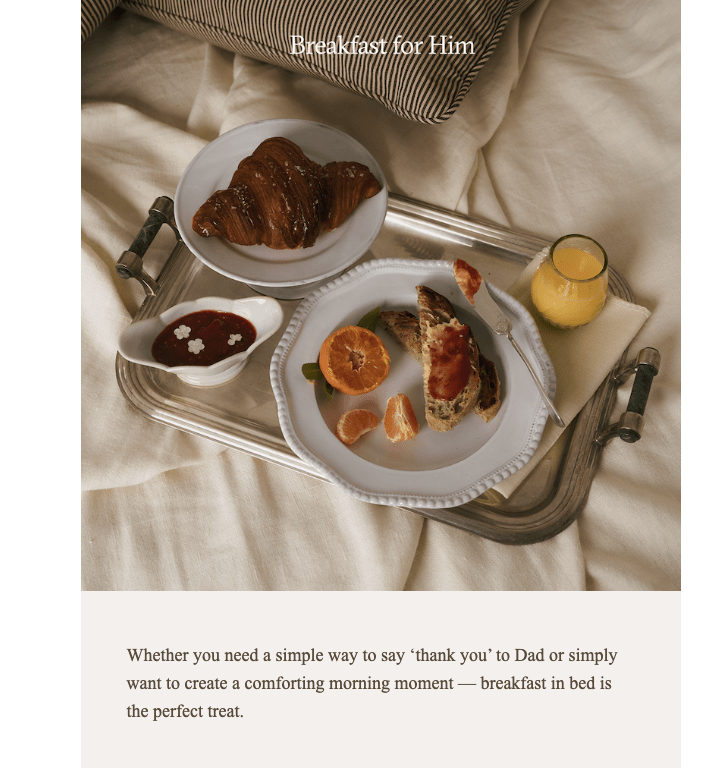
The event, in full: Meghan’s food brand sent a Father’s Day email. It suggested breakfast in bed, a croissant, a swipe of the strawberry spread, a cup of coffee, and called it a simple way to remind the people you love that they are special. That is the entire thing that happened. A food brand marketed food, on a holiday associated with food, in June, which is what every food brand on the planet does in June.
The Express turns this into “tone-deaf” and “hypocritical” by routing it through a single fact imported from outside the email: Meghan is estranged from her father, Thomas Markle. How dare the woman who, in the article’s framing, erased her own father presume to tell you to honour yours. That is the charge, and once you see how it is built, you see the machine, because this is the cleanest example available of coverage engineered so that no action survives contact with it.
Look at what is actually being demanded of her, and notice that it cannot all be satisfied at once. The hypocrisy charge says she has no standing to mention Father’s Day because she is estranged from her father. But the same press ecosystem treats any move she makes toward Thomas Markle as a cynical stunt, and treats her distance from him as proof of a cold heart. So the options resolve into a closed loop. Market a Father’s Day product and you are a hypocrite cashing in on a day you have disqualified yourself from. Decline to market it and you have conceded you are unfit to speak about family at all. Reconcile publicly and it is staged for the cameras. Stay private and you are heartless. There is no version of this brand’s June email that the outlet scores as neutral, because the email is not being judged as marketing. It is being judged as a referendum on her worth as a daughter, and that is a referendum she has been pre-assigned to lose.
The sleight of hand that makes the whole thing work is a quiet reclassification. A commercial decision, a product brand observing a retail holiday, gets silently converted into a personal moral statement about her own family. Nobody asks whether Williams Sonoma has the standing to sell Father’s Day gift boxes, or whether the marketing team at any other brand has reconciled with their fathers before scheduling the seasonal newsletter. The estrangement is carried in from outside to give a banal piece of marketing a moral charge it does not carry on its own. That import is the entire trick. Remove it and the story collapses back into what it actually is: a brand sent a seasonal email. Which is not a story.
The estrangement itself is also flattened in the service of the charge, and the flattening matters. The article narrates it as a simple morality tale, a daughter who cut her father out and treated him as disposable, while leaving out that Thomas Markle has spent years giving paid interviews and arranging photographs about and around his daughter. You do not have to adjudicate that relationship, or take anyone’s side in it, to notice that the coverage permits only one version of it, the version in which her distance is pure cruelty and never a response to anything that was done to her. The article needs the flat version because the complicated version cannot carry the weight of “profound arrogant hypocrisy.” A real estrangement, with causes on more than one side, is not useful. A villain is.
There is one more layer worth flagging, because it shows the email was never really the target. The article reaches for a second line of attack that contradicts the first. Alongside the hypocrisy charge, it amplifies mockery that the product is too feminine for the occasion, that the spread “screams woman, not man,” that the male population has no interest in “her slop.” Set that beside the hypocrisy argument and they do not cohere. One says she is morally unfit to mention fathers. The other says her croissants are insufficiently masculine for them. These are not two findings about an email. They are two available weapons, reached for in sequence, and the only thing they share is the target. When the criticisms point in incompatible directions, the criticisms are not the point. The person is.
And the email did not have to be bad. Note where it sits in the outlet’s own week: a related-articles rail stacked with “turns on Prince Harry,” “panic mode,” “£5m crisis,” “attempt to soften image backfires,” “teetering on irrelevant,” all same outlet, all same days. This email is not being covered on its merits. It is being slotted into a pre-built, season-long narrative of decline in which each new item arrives already scored as further proof. The story was written before the email was sent. The email only had to arrive to be filed under it.
 celebchai.com