The threat with no predator
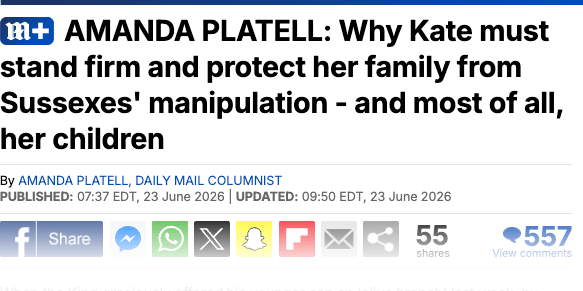
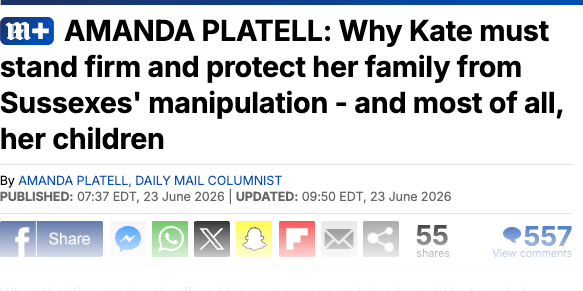
Amanda Platell’s column instructs Prince William to “stand firm and protect your family from the Sussexes.” It is worth asking the simple question the column never answers: protect them from what?
Read it for the threat and you come up empty. The evidence offered is a 2020 book that called Kate “cold” and a Netflix series in which Meghan said Kate was “not a hugger.” That is the case. A six-year-old characterization and a remark about hugging are asked to carry the weight of words like “protect” and “stand firm” — words that belong to bodyguards and barricades, not to bruised feelings about a wedding. The column reaches for the vocabulary of danger and supplies the substance of a grudge.
This is not a small gap. It is the whole mechanism.
What “protect” does when there is nothing to protect against
Language like “protect your family” carries a built-in implication: a predator. Use the word and you have asserted a threat whether or not you have evidenced one. Platell uses it repeatedly and evidences nothing, which means the threat exists only as a grammatical residue — the shape a danger would leave if there were one.
The column also performs a familiar trick: it claims to defend Kate while doing the one thing guaranteed to put her at the center of a conflict she is, by the column’s own account, not party to. “Most of all, William, protect Kate.” Protect her from a visit the column elsewhere concedes may not involve her at all. The concern is the delivery system. The payload is the framing of two women as combatants, with Platell refereeing a fight she is in the act of starting.
The sourcing is air
Strip the column to its factual claims and almost nothing remains standing. The visit is “reported.” The olive branch is “claimed.” No source is named for any of it. The entire structure rests on rumor attributed to no one, and onto that rumor Platell loads a set of demands — stand firm, protect Kate, don’t let her feel pressured — addressed to a man reacting to events that may not occur, on the word of people who are not identified.
A columnist is entitled to opinion. But an opinion built entirely on unsourced “reports,” then escalated into a security framing, is not commentary on an event. It is the manufacture of one.
The headline finishes the job
By the time the piece travels — aggregated, reposted — its own headline has completed the laundering: “Prince William Must ‘Protect’ His Family From The Sussexes, Warns Expert.” A tabloid opinion columnist has become an “expert.” A personal grudge dressed as concern has become a “warning.” The reader two hops downstream meets a risk assessment from an authority, when the source material is a columnist with no named sources telling a prince to feel threatened on his wife’s behalf.
The tell
Here is the line that gives the game away. Platell writes that Kate should not feel “pressured” to meet Meghan if a visit happens. Note what this does. It invents an obligation no one has imposed — no one has asked Kate to meet anyone; the palace has not confirmed a meeting exists — purely so the column can heroically relieve her of it. It conjures the pressure in order to take Kate’s side against it. That is the column in one sentence: a problem manufactured so that a solution can be sold, a threat invented so that protection can be urged, a fight started under the banner of keeping the peace.
There is no predator in this piece. There is only a columnist describing one into being, and a vocabulary of danger doing the work that evidence could not.
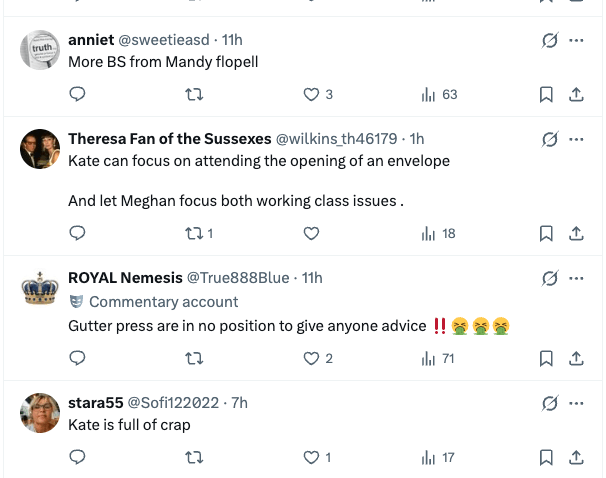
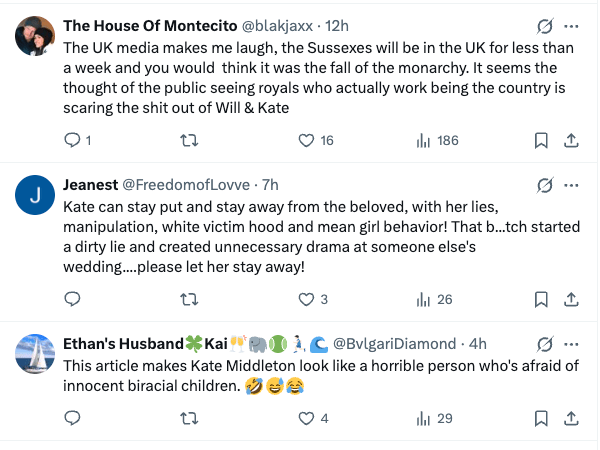
Meghan, the X thread informs us, possesses “star charisma and amazing presence,” and is so “articulate and educated” that the royals visibly dim in her company.
That is the whole story of this news cycle in miniature, so it is worth slowing down on.
The artifact
The object under analysis is an Amanda Platell column in the Daily Mail, reaching most readers through an AOL/Yahoo repost of a Reality Tea repackaging of it. Three layers, and each strips a little accountability. By the time it lands in front of the AOL reader, “Amanda Platell’s opinion” has become “Warns Expert” in the headline. The aggregating byline wrote none of the underlying claims. Platell is reacting to unnamed “reports” of a possible Sussex visit. Nobody in the chain is the source of anything, which is the first thing to notice: a story this loud has no identifiable origin point.
The frame, and the hole in the middle of it
The column’s vocabulary does the work: “protect,” “stand firm,” shield the family “from the Sussexes.” This casts Harry and Meghan as a threat William must defend Kate and the children against. The tell is that the column supplies no threat. The entire evidentiary basis for “protect your family” is a 2020 book calling Kate “cold” and a Netflix remark that Kate was “not a hugger.” That is it. The grammar encodes an incursion; the argument-level content describes a hug that did not happen.
A frame that says “protect” while pointing at nothing creates a vacancy, and vacancies get filled.
The Daily Mail comments: filling the hole
This is where it becomes useful to read the comment sections, because they show the frame metastasizing in real time. The supplied vocabulary comes back amplified and multiplied — “grifter” dozens of times over, “toxic two,” “Montecito Two,” “Megain,” “Methane.” The top-rated comments are the ones restating the threat most directly.
Watch how readers resolve the problem the column left them, which is that there is no actual danger. They invent one. Meghan will “stage a security incident.” She will arrive wired with “recording devices.” She will “throw herself down the staircase then blame” someone. A Netflix crew is coming. None of this is in the article. The word “protect” implies a predator, the column declined to provide one, and several thousand commenters supplied the missing referent out of nothing. The grammar created a vacancy and the audience filled it on cue.
Worth noting too: inside that same section, dissenting commenters make the load-bearing observation — the palace says no meeting is booked, the whole premise is Sussex-camp speculation — and get buried in downvotes. The fact that would deflate the story is present and outvoted.
The X comments: the mirror
Here is the part most “media criticism” misses, and the reason this is worth writing. Under @ShakeLS, a different audience reads the identical column and produces the exact inverse. Platell is “rousing hate,” “putting Meg in danger,” running the “infantilisation of Kate.” One reply names the mechanism almost clinically: the headlines make Kate “out to be a mean girl who cries when she can’t get her way.” These readers are sharp about the Daily Mail’s machinery precisely because it is pointed at someone they like.
And then they run it themselves in the other direction. “Star charisma and amazing presence.” “So articulate and educated that the Royals seem so poorly around her.” This is character-assignment-by-comparison — building one figure up by writing the others down — which is structurally the same move Platell makes, swung 180 degrees. One thread’s grifter is the other thread’s luminary. Both threads believe they are the ones merely reporting.
So the column is not really an argument. It is a Rorschach card. Both audiences use it to confirm what they already hold, and both forms of engagement — agreement and outrage — serve the publication identically. Outrage is not a bug in this model. It is the same fuel in a different tank.
The loop, end to end
Across these documents you can watch the full production cycle close. A rumor sourced to nobody generates a reaction column. The column generates aggregations. The aggregations generate two opposed comment wars. And the comment wars become the raw material — the “reaction,” the “backlash,” the “fans clap back” — for the next day’s content. At no stage does a new fact enter. The discourse has fully detached from the underlying event, which may not even happen. Thousands of people are now arguing with conviction about how Kate should handle a visit that the palace has not confirmed, prompted by a columnist reacting to a rumor with no named origin.
That is the thing to keep your eye on. Not “Daily Mail bad.” The Daily Mail is doing exactly what it is built to do. The story is that a single empty artifact can manufacture two complete, opposed, self-certain realities, and that the people most fluent at spotting the trick in the other camp are running the identical trick in their own. The machinery does not care which way the spotlight points. It only needs the spotlight on.

