The previous highlights are here: https://celebchai.com/2026/03/19/the-privilege-trap-how-pitts-discovery-strategy-backfired-at-the-court-of-appeal/
In the last week of June 2026, three different things happened iIn the last week of June 2026, three different things happened in the Pitt v. Jolie winery litigation. They came from different courtrooms, decided different questions, and produced different winners and losers. By the time the coverage settled, they had been folded into a single sentence: Brad Pitt scored a legal win against Angelina Jolie.
That sentence is not exactly false. It is something more useful to study: a true-sounding compression that erases the parts that complicate it. Here is what actually happened, and then how the compression got made.
What the record says
There were three separate decisions, and keeping them apart is the whole point.
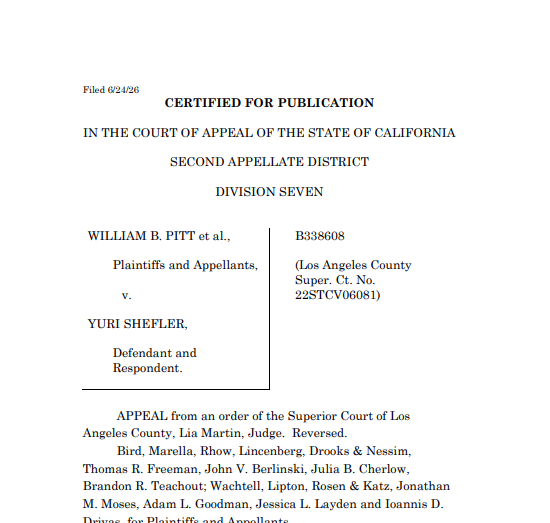
One. The appeal: Pitt v. Shefler. On June 24, the California Court of Appeal, Second Appellate District, Division Seven, published an opinion (case number B338608) reversing a lower court order. The lower court had thrown Yuri Shefler out of the California lawsuit on the ground that California had no power over him, because he is a foreign resident. The Court of Appeal disagreed and put him back in.
The reasoning matters more than the result. Shefler is the wealthy individual behind the chain of companies (Dutch, Cypriot, Luxembourg) that bought Jolie’s stake in the winery. He argued he was a hands-off owner who left the deal to European lawyers negotiating in Europe over a French vineyard. The court did not buy it. It pointed to the fact that he called the buyer “my company” and the bid “my offer,” gave instructions on how to structure the purchase, and personally guaranteed thirty-nine million dollars of the price. The line the court built its conclusion around: it “defies credulity” that a sophisticated businessman would risk almost forty million dollars on a deal he claims he knew nothing about.
This ruling is about Shefler. Not Jolie.
It is also worth saying plainly: this was a real win for Pitt’s side, and a clean one. Much of the procedural history in this case has been Pitt’s team using technical mechanisms to delay the moment a court examines the underlying facts. This is different. The Court of Appeal issued a published opinion that affirmatively expands the case, putting a major defendant back in after the trial court had let him out. That is not delay dressed as victory. It is an actual appellate reversal on a contested question. An honest account has to grant that, because the distortion in the coverage is not that Pitt won nothing. It is everything built on top of the win.
Two. The deposition order. Also on June 24, but in a different courtroom (the trial court, Department 224, Judge Pánuco), a separate order came down on Pitt’s motions to compel depositions. This one was a split. Pitt’s side won the core relief: the company witnesses and a key executive have to sit for questioning. But the defense won real concessions too. The depositions were moved out of California to London. Several topic areas were narrowed. And Pitt’s request for monetary sanctions was denied outright, because the request appeared for the first time in reply papers instead of in the original motion, which the rules do not allow.
A split decision is not a clean victory. The order handed something to each side.
Three. The Venturini ruling. On June 26, the same trial court granted a motion by Roland Venturini, the director general of the French estate, Chateau Miraval, to be dismissed from a cross-complaint for lack of California jurisdiction. The detail worth holding onto: the cross-complaint Venturini escaped was brought by Nouvel, the company that now sits on the Stoli and Tenute side of the dispute. So this was a foreign defendant defeating a claim brought by the Stoli-aligned entity, and he walked out of that piece of the case. It is the opposite outcome from the Shefler appeal, it cuts in a different direction than a “Brad versus Angelina” frame can absorb, and it landed two days later in the same courthouse.
So: an appellate reversal (Shefler in), a split discovery order (mixed), and a trial-court dismissal (Venturini out). Three tribunals. Three different questions. Three different results.
How the compression got built
Now watch what the coverage did with that.
The collapse. The Us Weekly version treated the week as a single event called a win. The appellate reversal of the Shefler quash, the trial court’s split deposition order, and in some outlets the Venturini matter all dissolved into one undifferentiated “Brad wins.” The mechanism here is simple and effective: when three rulings become one ruling, the reader cannot see that one of them was a split and one of them was a defense win. Only the cleanest of the three (the Shefler reversal) survives as the shape of the whole week.
This is the vacancy problem in miniature. The reader is given a verdict on the week without being given the week. The missing material is not contradicted; it is just never introduced, so there is nothing to argue with.
The displacement onto Jolie. Here is the move worth slowing down on. The Shefler appeal is a loss for Shefler. It says nothing about Jolie’s own position, and her lawyer said so plainly: it has no impact on the merits of her case. If anything, a ruling that spotlights Shefler as the active orchestrator points attention away from Jolie, who is cast as the seller rather than the schemer.
But the headline reads “win against Angelina Jolie.” A Shefler loss has been quietly relabeled a Jolie loss. The two are not the same thing, and nothing in the record makes them the same thing. The relabeling is the product, not a byproduct.
The nationality frame. The coverage repeatedly calls Shefler a “Russian businessman.” The published opinion calls him a Swiss resident, and the corporate chain it describes is Dutch, Cypriot, and Luxembourg. The court never reaches the Russian question, because for a jurisdiction ruling it does not matter where Shefler is from; it matters what he did and where he directed it.
This frame is not new in 2026. It was planted in 2023. When Pitt’s team filed its operative complaint, the coverage at the time relayed his characterization directly: Shefler as an “oligarch in the Russian Federation,” with alleged ties to Putin’s inner circle and to the Saudi crown prince. That was a litigation allegation, a party’s chosen framing, printed as Pitt described it. Three years later the same ecosystem harvests it. The qualifier “alleged” has fallen away, the sourcing to Pitt’s filing has fallen away, and “Russian businessman” now sits in a 2026 headline as if it were neutral background fact rather than one side’s strategic descriptor.
That is how a frame hardens. A party introduces a characterization inside a filing. The press relays it as the party’s claim. Repetition sands off the attribution. Eventually the characterization is just ambient knowledge, and the court record, which says Swiss resident and declines to reach the rest, is the thing that now sounds surprising.
The frame is also contested by the other side, which makes it more revealing rather than less. Jolie’s own filings reportedly called Pitt’s framing of Shefler as a Russian exile and Putin critic a xenophobic smear. So Shefler’s nationality is not settled fact being reported; it is live narrative territory both sides are fighting over, and the coverage picked up the version that supplies a cleaner antagonist for the “Brad versus the outsider” story.
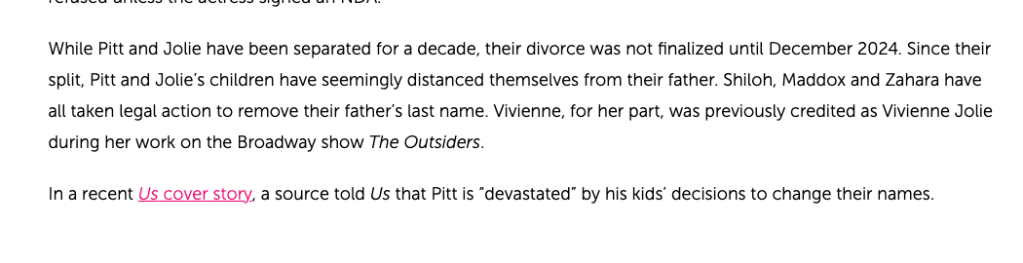
The kicker. The piece closes on Pitt being “devastated” by his children changing their names, sourced to an anonymous insider. This has nothing to do with depositions or jurisdiction. It is the emotional payload the legal news was carrying. The procedural story functions as the delivery vehicle; the sympathy beat is the cargo. By the last paragraph the reader has been moved from “a court made a jurisdiction ruling about a Swiss businessman” to “Brad is a heartbroken father,” and the distance between those two things is the entire trick.
What was actually true
Strip the compression and the accurate version is shorter and duller, which is exactly why it does not get written.
A California appellate court ruled that a wealthy foreign businessman who personally guaranteed a thirty-nine million dollar deal cannot avoid being sued in California by claiming he was just an owner. A trial court ordered depositions to proceed, in London, on narrowed terms, with no sanctions. A second foreign defendant was dismissed. None of it decided who wins at trial. None of it was a ruling against Jolie on the merits.
That is the week. The headline is a different object entirely, and the gap between the two is where the work happens.

