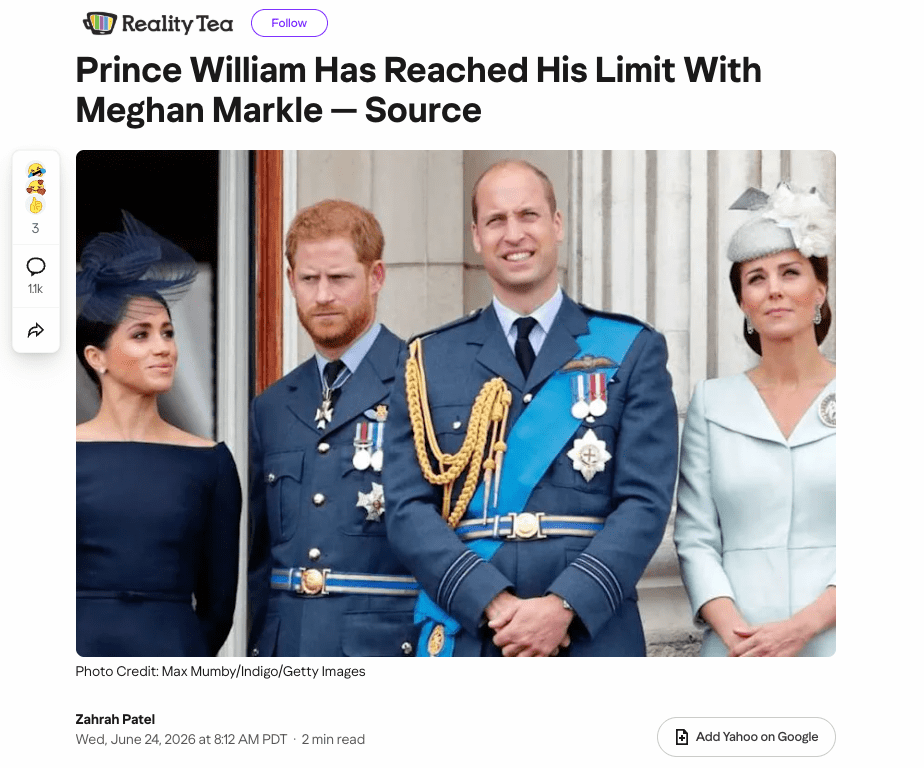
The factual event underneath all of this is small and confirmed. Harry and Meghan are visiting the UK from roughly July 7 to 11, 2026, their first joint trip back in four years, tied to a one-year countdown for the 2027 Invictus Games in Birmingham. They’ve accepted King Charles’s standing offer to stay partly on a royal estate and partly in private accommodation. The children are coming but won’t appear publicly. That’s it. That’s the whole verifiable story, and Archewell confirmed the accommodation acceptance to USA Today on its own terms.
Sykes publishes “a source” claiming William threatened to “boycott Sandringham.” The Royal Observer renders this as “one insider disclosed.” SheKnows upgrades it to William being “appalled” by “his father’s betrayal,” with the quotation marks doing work the underlying reporting never earned, since the quoted words describe a feeling no one has confirmed William has. RealityTea then routes the whole thing through OK Magazine as a secondary citation, so the reader is now three publications deep into a claim that was always one man’s unnamed source.
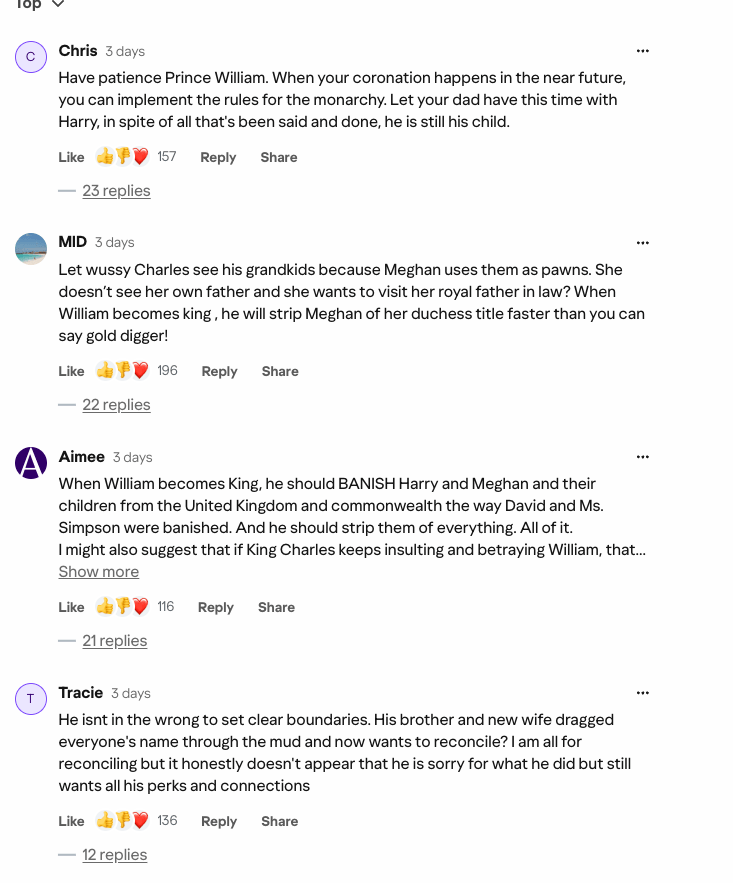
The article hands readers a frame. The comments show the frame being installed. Reading the two threads under these pieces, what’s striking is not that people disagree, it’s how cleanly the disagreement sorts into pre-built channels the article itself supplied. Almost nobody is reacting to an event. They’re reacting to a script, and the script gave them their sides.
The two-camp architecture
Sort the comments and they fall into two dominant tracks with very little in between.
Track one treats William as the wronged hero. “Have patience Prince William.” “Good for William, smart man.” “When William becomes king, he should BANISH Harry and Meghan.” This camp accepts the article’s core unverified premise, that William is justly furious, as settled fact, then competes to escalate it. The escalation is the tell. Once “boycotting a lunch” is accepted as real, commenters race past it to banishment, title-stripping, exile to Antarctica or St. Helena. The anonymous-source claim becomes the floor, and the readers build the rest of the tower.
Track two inverts the hero but keeps the structure: “William is such a spoiled brat.” “Little willy is too insecure to be king.” “Billy the Bully is laundering his temper tantrums through his tabloid cronies.” Notice this camp is often more media-literate, several of them explicitly name the laundering mechanism, yet they still accept the underlying scene as real. They’ve decided William did throw the tantrum; they just judge him for it instead of cheering. The article wins either way. Both camps have agreed to discuss an emotional event that has zero on-record confirmation.
The thin middle, the “leave the family alone, none of this is verified” comments like nun’s (“Totally made up. This so called royal expert has never even been in the same building as the prince”) and sonya’s (“One tabloid quoting another tabloid as a source”), is the smallest faction and the least upvoted relative to the partisan extremes. The format rewards picking a side, not noticing there’s no there there.
Meghan as the main target
Track the grammar.
The article’s headline names Meghan as the object of William’s limit, and the comments obey: she is the agent of nearly every imagined harm. She “uses them as pawns,” she’s a “master manipulator,” she “leads him to commit all kinds of havoc,” she’ll “stir up controversy to make headlines.”
Harry, by contrast, is repeatedly granted diminished agency, “an overgrown boy-man,” “little Harry,” someone “she used,” a man who needs “to set aside his pride and return home.” He’s a victim of her; she’s the author of everything.
This is a specific and recurring displacement. It lets the reader express hostility toward the couple while preserving Harry as a redeemable son of the blood, which keeps the family-reconciliation drama alive and re-runnable. If Harry were the villain, the story would end. Making Meghan the engine means the conflict is permanently renewable, and the comments do that renewing labor for free. The recurring “she doesn’t visit her own father” line (it appears at least four times across both threads) functions as the moral hook that converts general dislike into a specific, repeatable indictment.
The “grifter / running out of money” motif
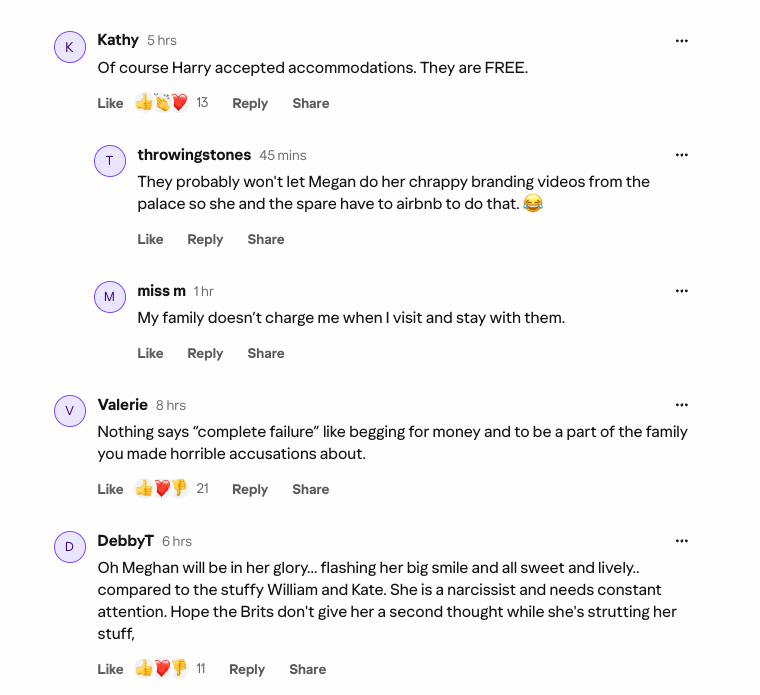
Under the USA Today piece, a single explanatory theory dominates: they’re broke and crawling back. “Running out of money.” “Needs to cozy up to dad before he dies to secure that inheritance.” “The begging for money begins.” “Of course Harry accepted accommodations. They are FREE.”

What’s notable is that the article gave them nothing to support this. The piece reports an accepted lodging offer and a security-review complaint. The financial-desperation narrative is imported wholesale from a different media stream (the IBTimes “Crawling Back” / “Running Out of Ideas” headlines, the SA commenter’s detailed recitation of canceled contracts and favorability ratings). The comment section is where two separate coverage frames get fused: this article’s “they accepted a room” plus the adjacent ecosystem’s “they’re financially failing” becomes a single confident reading, “they accepted a room because they’re failing.” Readers are doing cross-article synthesis that no single article actually argues, and treating the synthesis as obvious.
Surveillance language and the dehumanizing register
A cluster of comments deserves separate flagging because they shift from opinion into something colder. “Be sure to take a full accounting of all items in the royal residence.” “Make sure they are scanned for electronics.” “Hope they are frisked with recording devices.” “Every door will have to be locked and anything valuable removed.”

This is the couple recast as thieves and infiltrators to be physically searched, a register beyond family-feud partisanship. Paired with the recurring “skull kids” / “faceless children” / “white babies” remarks about two named small children, and one commenter floating that the kids may be “models trotted out for photo ops” or “non-existent,” you can see the thread’s floor drop. The format’s escalation reward, which earlier produced harmless “banish them” hyperbole, here produces conspiracy about whether two real children exist. EC, one of the more reflective commenters, names this directly: “The level of cyber bullying is incredible, and that can translate to physical acts.” That comment is, notably, low-upvoted. The thread does not reward the person pointing at the thread.
The racism axis runs both directions
The thread’s sharpest fault line is race, and notably both camps wield it. The pro-Sussex side names it as William’s motive: “That racist Willie.” “I don’t understand all the venom directed at Meghan Markle.” “It’s a very complicated issue,” one writes, before concluding the hostility can only be explained by who she is. The anti-Sussex side works hard to preempt exactly this reading, and you can watch them do it in real time. Roberta posts the same argument three separate times, almost verbatim: “It’s not race but position in the royal family.” “If Meghan had married William, the first born, she would have been featured all the time just like Kate.” The repetition is the giveaway, this is a commenter rehearsing a defense she expects to need, racing to install “it’s about birth order, not race” before anyone can install the alternative. The two readings never engage each other. They just accumulate in parallel, which is what a thread does instead of a conversation.
The bottom line
The article supplied an unconfirmed scene and a cast. The 1,100 comments supplied the conviction the article couldn’t. The most-upvoted contributions accept the premise and escalate it; the media-literate contributions accept the scene but flip the verdict; the genuinely skeptical ones, the handful pointing out it’s one tabloid citing another, are real and almost entirely buried. The comment section’s main function isn’t reaction. It’s to take a single anonymous Substack claim and, through the labor of a thousand participants choosing sides, launder it into something that feels like fact, while keeping Meghan installed as the renewable engine that lets the whole thing run again next week.
Michael, somewhere in the middle of the thread, writes the most accurate line in it: a grudge laundered through tabloid cronies isn’t fooling anyone. He’s right about the laundering. He just hasn’t noticed which part of the operation he’s standing in.