What Blake Lively’s fee motion is actually asking for, once you read the schedules instead of the headlines
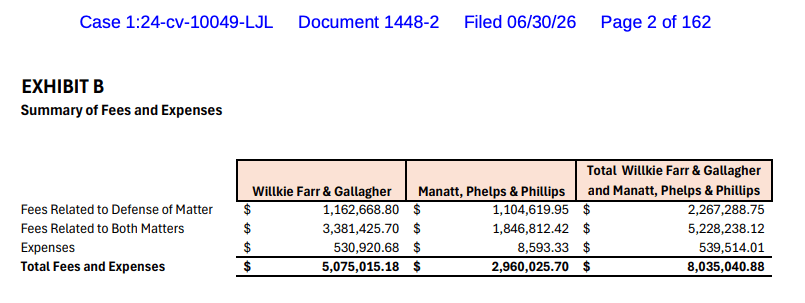
The number that traveled was $8 million. Every outlet led with it: Reuters, the AP, Variety, Deadline. Blake Lively’s lawyers filed a motion on June 30, 2026 asking Judge Lewis Liman to make Justin Baldoni and the Wayfarer Parties pay $8,035,040.88 in fees and costs, and the number did what large numbers attached to famous names do. It became the story.
But the number is not the story. The structure underneath it is. And the structure only becomes visible if you set the fifteen-page memorandum aside and open the document filed alongside it: the 174-page declaration of Diana Kantner, the fee expert Lively’s team retained, with its six schedules of line-item billing records. That document is where the actual argument lives, and it makes a single fact unavoidable that neither the press coverage nor the online commentary has reckoned with.
Seventy percent of the fees Lively is seeking are not for defending against Baldoni’s lawsuit.
https://www.courtlistener.com/docket/69510553/1446/lively-v-wayfarer-studios-llc
https://www.courtlistener.com/docket/69510553/1448/2/lively-v-wayfarer-studios-llc
The two buckets
Kantner’s summary table, the first page of Exhibit B, divides the $7,495,526.87 in requested fees into two categories. The first she calls “Fees Related to Defense of Matter.” This is the work done solely on the Wayfarer Action: the motion to dismiss that killed Baldoni’s $400 million countersuit, the Rule 11 sanctions motion, the Section 47.1 motion itself. That bucket totals $2,267,288.75. Call it the defense-only bucket. It is about thirty percent of the fee request.
The second bucket she calls “Fees Related to Both Matters.” This is work that Kantner determined was shared between Baldoni’s suit against Lively and Lively’s own affirmative suit against Baldoni, the two cases the court consolidated in January 2025. That bucket totals $5,228,238.12. It is about seventy percent of the fee request, and it is more than double the size of the defense-only work.
This is the whole case. Not the $8 million. The seventy percent.
Because Section 47.1, the 2023 California statute Lively is invoking, shifts fees to a defendant who prevails against a retaliatory defamation suit. It does not shift fees for prosecuting your own lawsuit. Everyone agrees on this. The question that decides whether Lively recovers $2 million or $7 million is whether that giant middle bucket, the shared work, counts as defending against Baldoni or as litigating Lively’s own case. And the honest answer, visible in the line items, is that most of it was neither cleanly, because the two cases were fused into one proceeding with one discovery record.
What “intertwined” actually means on the page
The memorandum’s legal theory has a name: inextricably intertwined. It comes from a 1979 California Supreme Court case, Reynolds Metals, which held that fees need not be apportioned when the work concerns an issue common to both a claim where fees are allowed and one where they are not. Lively’s brief leans on this doctrine hard, because it is the only way the seventy percent comes home.
The schedules show what that intertwined work was. Reading through the roughly 260 pages of Willkie and Manatt time entries in the both-matters bucket, the same words recur relentlessly: discovery, document review, privilege, depositions, meet and confer, subpoena. Document review alone appears well over a hundred times. Discovery appears in some form on nearly every page. These are the entries of a massive, contested evidence-gathering operation, the kind that generates thousands of hours because someone has to read every document, log every privilege claim, prepare every deposition.
Here is the genuine analytical difficulty, and it cuts both ways. Lively’s side will say: this discovery was defensive. Baldoni sued her for $400 million; she had to build the factual record that showed her harassment complaint was made in good faith and without malice, because malice is the exception that would have defeated her Section 47.1 claim. Every document reviewed was a document that might have been thrown at her. Baldoni’s side will say: discovery in a consolidated case serves both cases at once, and most of this record was gathered to prosecute Lively’s affirmative claims, the ones she voluntarily dismissed in May 2026 for zero dollars. You cannot recover the cost of pursuing a suit you dropped by relabeling it defense.
Both of these are plausible readings of the same time entries. That is precisely why the intertwined doctrine exists, and precisely why it is the softest point in the motion. Kantner drew a line: June 23, 2025, the date Baldoni’s deadline to amend his dismissed complaint expired. Work before that date, she treated as intertwined and recoverable; work after it, with exceptions, she excluded as belonging to Lively’s own case. That cutoff is a defensible choice. It is also a choice, not a fact, and Baldoni’s lawyers will spend their July 13 response attacking exactly where she drew it.
The thing the motion did that the internet said it didn’t
The loudest complaint in the online commentary, repeated in thread after thread, was that Lively’s lawyers submitted a multimillion-dollar demand with no receipts. No invoices. No contemporaneous records. Just two partners swearing their hours were real.
This is simply false, and the falseness is instructive about how these documents get discussed by people reacting to summaries of summaries. The Kantner declaration is the receipts. All 174 pages of it. It contains line-by-line entries with invoice numbers, work dates, individual timekeeper names, hours, dollar amounts, and a narrative description of each task. A paralegal named Amy Orlov billed half an hour on January 16, 2025 for a call about fact-checking the new Wayfarer complaint, at $1,126 an hour for the following full hour of the same work. A Manatt associate, Kareem Salem, billed 1.5 hours that same day for an initial review of the complaint. The records go down to the tenth of an hour, across sixteen months, across dozens of people at two firms.
You can think the rates are obscene. You can think the hours are bloated. Those are real arguments. But “they provided no documentation” was a claim made by people who had not opened the document that was the documentation. The commentary treated the absence of the records in the news articles as the absence of the records, full stop. The records were always there. They just were not in the Variety piece.
The expert who studied the reaction to the lawsuit
Buried in Willkie’s expense schedule is a line worth surfacing on its own, because it captures something about this whole affair that the fee fight itself obscures. Among the costs Lively seeks is roughly $173,000 paid to a firm called GBX Holdings, out of a total GBX bill of about $358,000. GBX was retained on behalf of one of Lively’s experts, and the schedule’s narratives describe what its staff actually did.
They watched the internet. Junior analysts at $250 an hour spent dozens of hours each preserving TikTok, YouTube, Instagram, Facebook, and Twitter posts. They coded Reddit and Twitter content by sentiment. They tracked comparisons of Lively to Amber Heard. They logged references to “dragons” and “oblivion,” the language from Sarowitz’s alleged threat to spend his fortune destroying her. One analyst’s narrative describes assembling report sections on Bryan Freedman’s appearance on the Megyn Kelly Show. Another describes gathering examples of “people changing their minds” and “negative sentiment towards Ms. Lively.”
This is an expert damages operation built to measure reputational harm by quantifying online impressions, the exact ecosystem of threads and videos and comment sections that has spent the last eighteen months adjudicating this case in public. There is a strange recursion in it. The commentary about the case is now evidence in the case. The people in those threads insisting Lively is a grifter were, in a sense, being counted, their posts preserved by an analyst at $250 an hour and folded into a spreadsheet of impressions. The fee motion asks Baldoni to pay for the measuring.
What actually happens next, and what to watch for
The motion resolves to a small number of concrete questions that Liman will have to answer.
The first is the intertwined ruling, and it is the only one that matters for the dollar figure. If Liman accepts that the shared discovery was genuinely common to the defense, the award lands somewhere near the full request. If he decides the bulk of that work belonged to Lively’s abandoned affirmative case, the recoverable amount collapses toward the $2.27 million defense-only bucket. Everything between those poles is a question of how much of the seventy percent he lets through. This is the number to wait for, and it will be buried in his reasoning, not his headline.
The second is apportionment among defendants, which the motion is conspicuously quiet about. Baldoni did not only sue Lively. He sued Reynolds, her publicist, and others. Section 47.1’s fee right belongs to the person who made the protected disclosure, which is Lively. To the extent hours went to defending the other parties, they are harder to justify, and the memorandum does not engage the point. It is a live target the response will likely hit.
The third is the rates themselves, and here Lively’s position is stronger than the outrage suggests. Gottlieb’s $2,187 hourly rate sounds surreal to most people because most people do not buy elite Manhattan litigation. But the controlling legal test, as the brief correctly notes, is largely what a paying client actually paid, and Lively did pay these invoices in the ordinary course. A judge in this district recently blessed comparable Willkie rates in another matter. The rates are the most viscerally shocking part of the motion and probably the least vulnerable.
The fourth is the fees-on-fees reach. Both firms told the court their June invoices, for preparing this very motion, are not yet closed and will exceed $200,000 and $100,000 respectively, and asked to submit them later. This is permitted in principle. It is also the kind of open-ended ask that invites a skeptical judge to trim the whole submission’s ambitions, and it hands the response an easy line about a bill that grows while you read it.
The narrative worth naming
The story that got told was greed: famous rich woman, world’s most expensive lawyers, eight-figure demand. It is a satisfying story and it is not quite the real one. The real one is duller and more consequential.
Section 47.1 is a new statute with almost no case law, and this is one of the first serious tests of what it covers. The fight is not really about whether $2,187 an hour is too much. It is about a boundary question that will bind every future litigant under this law: when a retaliatory defamation suit is consolidated with the plaintiff’s own case, and the discovery record serves both, how much of that shared work can the prevailing defendant shift onto the party who filed the retaliatory suit? Lively’s answer is seventy percent. Baldoni’s answer will be close to zero. Liman’s answer becomes the rule.
That is the thing being decided, and it is being covered as a celebrity spending scandal. The dollar figure will move the needle for exactly two people. The reasoning underneath it will outlast both of them, and almost nobody is reading it.

