On the morning Prince Harry landed in the UK, Buckingham Palace withdrew an offer to let him stay there. The timing was not incidental. It was the story.
Harry arrived in Britain on Monday for a five-day trip built around the one-year countdown to the 2027 Invictus Games in Birmingham, plus other charity engagements. He came alone. Meghan, Archie, and Lilibet stayed in California, a decision tied to the unresolved dispute over police protection. That absence set the backdrop. What happened Monday morning supplied the drama.
Two stories that cannot both be true
The palace and the Sussex side gave accounts that do not reconcile, and the gap between them is the whole event.
The palace version, delivered through anonymous royal sources to the BBC, CNN, CBS, and ABC, runs like this. An offer of royal accommodation was made. Harry did not respond formally by the required deadline, which fell at the end of last week. His team declined the offer on Saturday morning, then reversed course later the same day and accepted. By then it was too late to arrange the appropriate hospitality and staffing, because the household requires a minimum period of notice. The palace says it made multiple requests for clarification and received no formal response in time.
The Sussex version, delivered on the record through Harry’s spokesperson, runs differently. The representative said he was aware of multiple briefings from Buckingham Palace last week suggesting the Duke had not accepted. Following RAVEC’s decision not to provide security for his family, the Duke spent last week making alternative security arrangements. Once those were in place, he formally accepted the offer of accommodation for himself over the weekend. His team called the withdrawal disappointing, noted that Tuesday’s judgment in the Associated Newspapers case was cited as the reason, and pointed out that the palace had been aware of that judgment since the previous Thursday. So it was unclear, the statement said, why the offer had been withdrawn at the last moment after being formally accepted.
Notice the shape of the disagreement. Both sides agree an offer existed. Both agree there was a decline on Saturday and a later acceptance. The fight is over one fact: whether Harry’s acceptance landed while the offer still stood or after the deadline had closed. The palace says after. Harry says the acceptance was formal and the withdrawal came later. No outlet has produced the documentation that would settle it. That absence is worth sitting with, because a household that keeps meticulous records of who requested what and when could resolve this in an afternoon if the record favored it.
The tell is the second reason
A single clean explanation invites belief. Two explanations invite scrutiny. The palace offered two.
The first is logistics: not enough notice, staffing could not be arranged. The second is the court judgment. Buckingham Palace was said to believe the legal case had complicated matters and could compromise the King’s constitutional position, because Harry’s first engagement on Tuesday happens to fall on the same day a ruling is expected in his case against the publisher of the Daily Mail.
These two reasons do different work, and they undercut each other. If the problem is that Harry accepted too late for the household to prepare a room, the court judgment is irrelevant. If the problem is that a plaintiff cannot sleep under a royal roof while awaiting a verdict against a newspaper, then notice periods and staffing are beside the point. Offering both reasons is the behavior of an institution that suspects neither reason carries the weight on its own.
Sharpen the logistics claim and it thins out further. The BBC reports this appears to have been a stay of one night, and raised the obvious question directly: could the palace not accommodate one person for one night? A single guest, a single evening, in a building maintained by hundreds of staff. Frame it that way and the staffing explanation stops sounding like a constraint and starts sounding like a choice dressed as one.
The constitutional argument deserves its own examination, because it collapses on contact. A privacy claim brought by seven private individuals against Associated Newspapers has no bearing on the monarch’s relationship to Parliament or his duties as head of state. The King is not a party. The Crown is not a party. Members of the royal family have pursued their own claims against newspapers before without anyone suggesting the constitution wobbled. The judgment was known to the palace since Thursday. If it genuinely threatened to compromise the King, the palace had days to say so and chose the morning of arrival.
What the timing actually communicates
Look past the stated reasons and look at the sequence. Harry spends a week arranging private security after being denied state protection. He accepts the accommodation once that is sorted. He boards a plane. He lands. And on that morning, with him in the air or on the ground, the offer evaporates.
The effect, whatever the intent, is a man arriving in his own country to be told at the threshold that the door he was invited through is closed. His team told the BBC in the morning he would be staying at the palace. Minutes later the palace corrected them in public. One journalist covering the beat described the Sussex response as going nuclear. That is not the choreography of a scheduling mix-up. That is a public contradiction staged at the moment of maximum exposure.
There is a version of this where the palace is simply disorganized, where a genuine deadline passed and a genuine staffing constraint bit. It is possible. But it requires believing that an institution with hundreds of staff and 775 rooms in central London could not prepare a single guest room for a single night on a few days’ notice, and that the collision with the court judgment was pure coincidence, and that publicly correcting Harry’s team at 9am rather than quietly the day before was nobody’s choice. That is a great deal of coincidence to carry.
The judgment underneath it all
The case being decided Tuesday is not a footnote. Harry is the lead claimant among seven public figures, including Elton John, David Furnish, Baroness Doreen Lawrence, Elizabeth Hurley, Sir Simon Hughes, and Sadie Frost, who allege unlawful information gathering by the Mail’s journalists between 1993 and 2011. The alleged methods include phone hacking, bugging, blagging, and the use of private investigators. Associated Newspapers denies everything and argues, in part, that the claims were brought too late. Mr Justice Nicklin hands down his written ruling at 2pm local time.
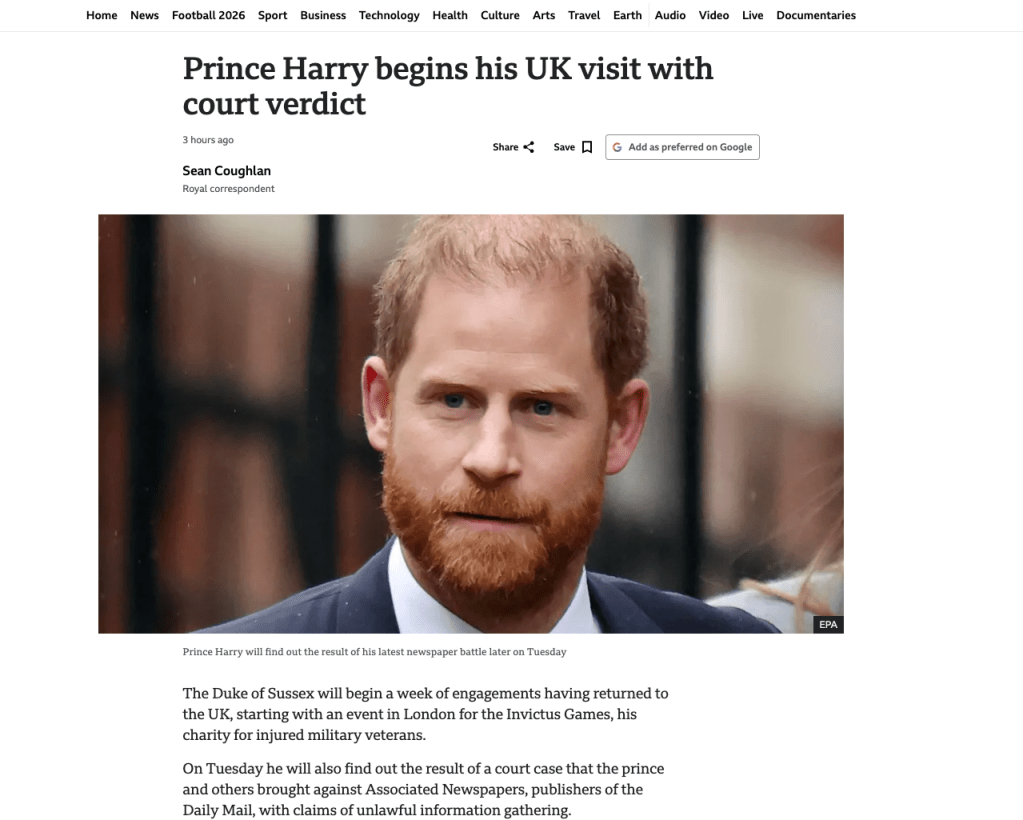
Whichever way it goes, the palace has now attached itself to the Mail’s schedule. It has told the public that the prospect of Harry standing on royal ground on the day of that judgment was intolerable enough to justify withdrawing his bed. That is a statement about priorities. It says the institution’s comfort with a tabloid publisher outranks its willingness to house its own.
The judgment itself may not deliver the clean verdict the palace seems to fear. This is the latest and expected to be the last of Harry’s courtroom battles against the UK press, and if the judge upholds some claims and rejects others, all sides may end up claiming victory. Which makes the constitutional panic look even stranger. The palace treated a ruling that might land ambiguously as a threat grave enough to override basic hospitality. An institution confident in its neutrality does not flinch this hard at a verdict it has not read.
Ten days of moving targets
The accommodation row did not appear from nowhere. It sits at the end of a briefing sequence that shifted almost daily, and the BBC laid the sequence out plainly. On June 27 the plan was that Harry, Meghan, and the children would come to the UK and stay in a royal residence. On June 28, citing security fears, Harry reconsidered bringing his family. On June 29 he still hoped the security problems could be overcome. On July 2 court sources placed the Associated Newspapers judgment on July 7, the first day of the visit. On July 4 the plan narrowed again: Meghan and the children would not come to the London start, though they might join later in the week. Then the accommodation itself began to move, first rejected, then accepted, then declared too late. On July 6 the two camps contradicted each other in public within minutes.
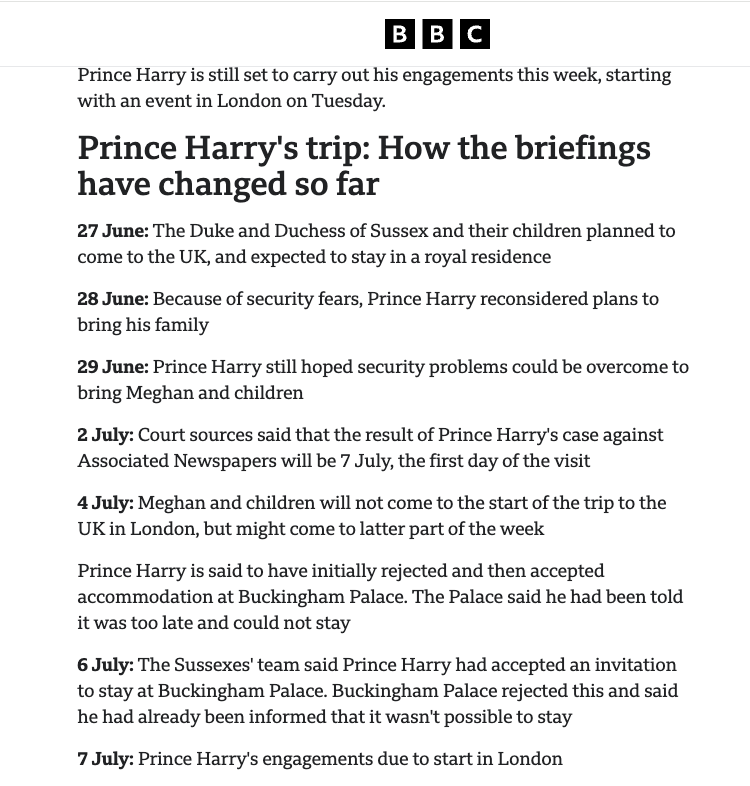
Read the sequence as a whole and a pattern emerges that is worth naming carefully. Each shift subtracted something. The family, then the residence, then the London leg, then the bed. At every stage the public account changed, and at every stage the change left Harry with less than the version before it. An institution can be disorganized. It is harder for disorganization alone to produce a drift that moves in one consistent direction.
The strongest case for the palace, and where it does not hold
The defense of the palace has real arguments inside it, and they deserve a fair hearing rather than a wave of the hand. Three come up repeatedly, and they are not equal.
The first is the deadline. Royal hosting runs on notice periods, the argument goes, and Harry was told he had until the end of the week. He declined Saturday, accepted Saturday, and by then the slot had closed. This is the palace’s best point, because it does not require anyone to be a villain. Households do run on schedules, and a guest who reverses himself inside a day can genuinely miss a window. If this were the whole story, it would be an unfortunate mix-up and nothing more. The trouble is that it is not the whole story, because the palace did not stop at the deadline. It added the court judgment. An institution confident that the deadline explanation held would not have reached for a second one.
The second is the nature of the building. Buckingham Palace, defenders note, is not a residence but a working headquarters, partly under renovation, thinner on live-in staff than the public imagines. Fair enough as far as it goes. But it collapses against the specifics. This was one guest for one night, in a building with hundreds of staff and 775 rooms, some fraction of which host visiting heads of state on their own tight schedules. A working palace that can bed a foreign president on protocol timelines can bed the King’s son for an evening. The renovation point proves too little.
The third argument is the one worth taking most seriously, because it is the one most often stated as fact when it is actually contested: that the King has no power here, that RAVEC and not the monarch controls security, and that Charles therefore cannot be blamed. It is true that RAVEC, not the King, formally decides taxpayer-funded protection. But two things sit next to that fact. The late Queen was able to ensure the Sussexes were accommodated and protected for the Jubilee, which shows the institution has levers when it wishes to use them. And accommodation is not a RAVEC matter at all. Housing his son for a night was entirely within the palace’s gift, and that is the thing that was offered and then taken back. The security argument, whatever its merits, does not reach the accommodation decision. On the narrow question of the bed, the King and his household had the power and used it to say no.
Put the three together and the honest reading is this. The deadline argument is plausible on its own and would settle the matter if it stood alone. It does not stand alone. The moment the palace added the court judgment and the constitutional worry, it told the public that timing was not really the issue. You do not cite two reasons for a decision that one reason fully explains.
The through-line is security, and it always was
None of this exists apart from the security fight. Harry’s protection was downgraded by RAVEC when he and Meghan stepped back in 2020. He lost his Court of Appeal challenge last year. He waits on a Risk Management Board review that has not happened. He pays for private security and has said plainly he will not bring his wife and children to the UK without better arrangements. That is why they are not here. The accommodation withdrawal is the same story wearing a different costume: an institution that will not make it safe or simple for this family to be in Britain, and then narrates the resulting absence as Harry’s failure to show up.
The withdrawn room also sits inside a longer history of housing used as leverage. Harry repaid the renovation cost on Frogmore Cottage, the one UK home that gave his family a measure of privacy, and was later evicted from it by his father. Set that beside a one-night palace offer that materialized and then vanished on the morning of arrival, and a pattern comes into focus. Shelter, for this family, keeps arriving with a string attached and a hand ready to pull it back.
The reporting establishes that the two sides disagree sharply, that the palace’s explanation is contested, and that the one factual question at the center remains unresolved. It does not, on its own, prove motive. But motive is not required to observe a pattern. A man arranges his own security, accepts an invitation, crosses an ocean, and is met with a closed door and two explanations that do not fit together. Call it what it looks like.
What the comment sections reveal
One more thing is worth noticing, because it is a story about the readers as much as the story itself. The comment sections split along predictable lines, and the split is instructive.
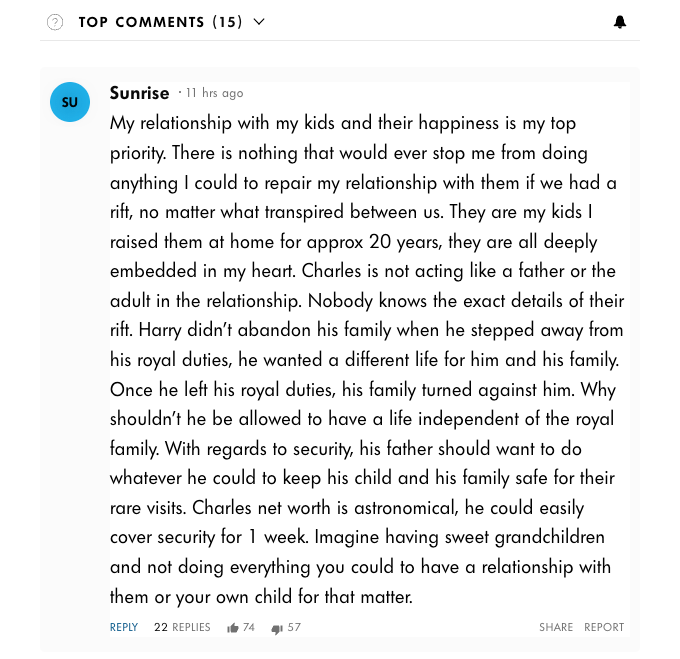
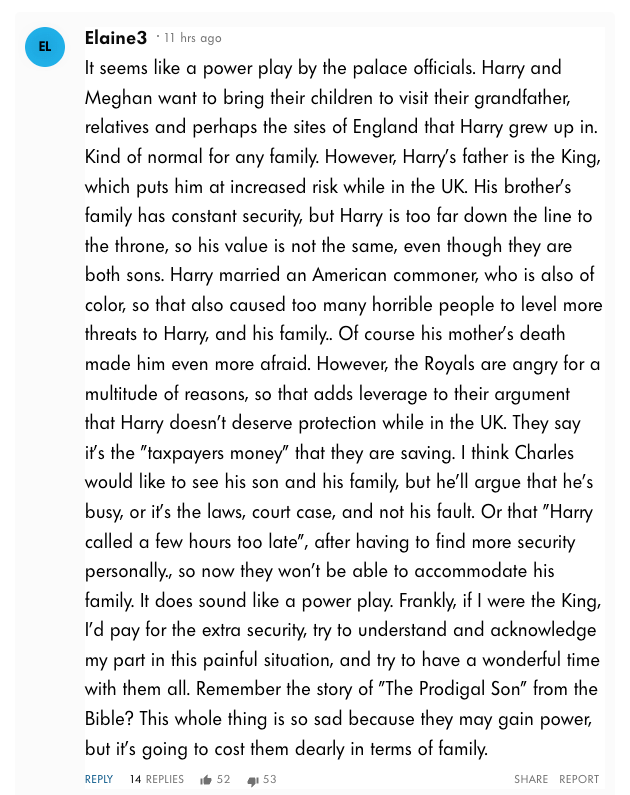
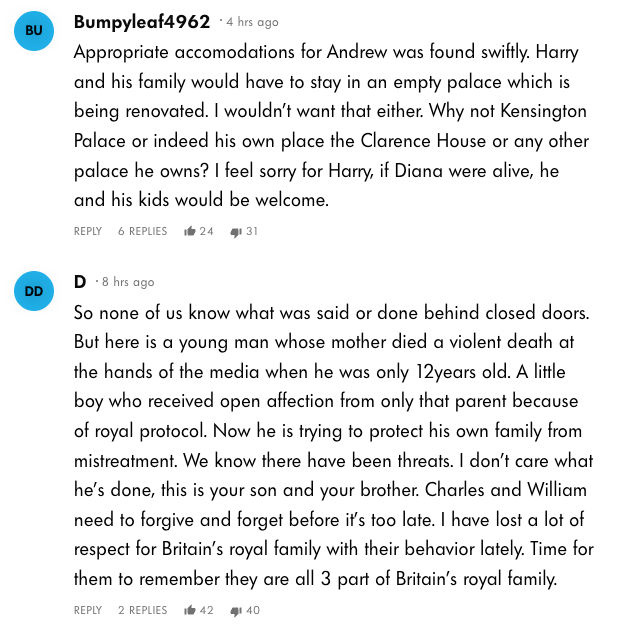
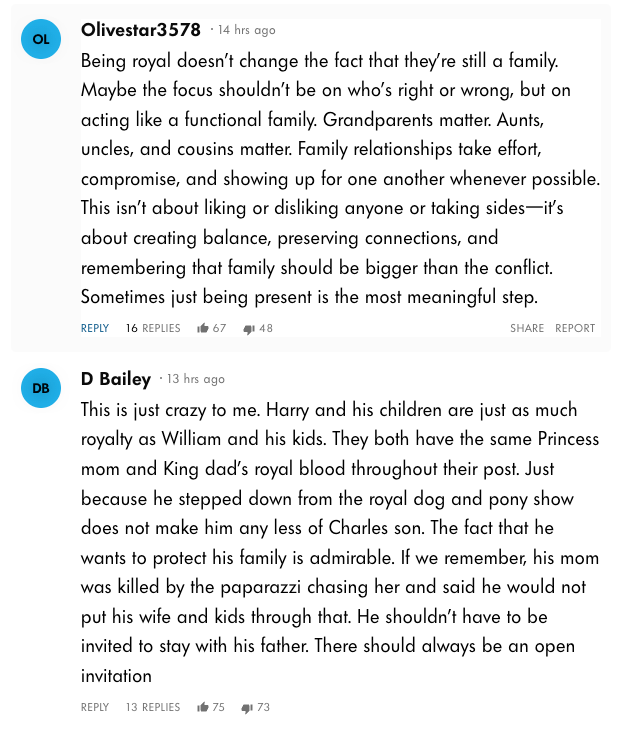
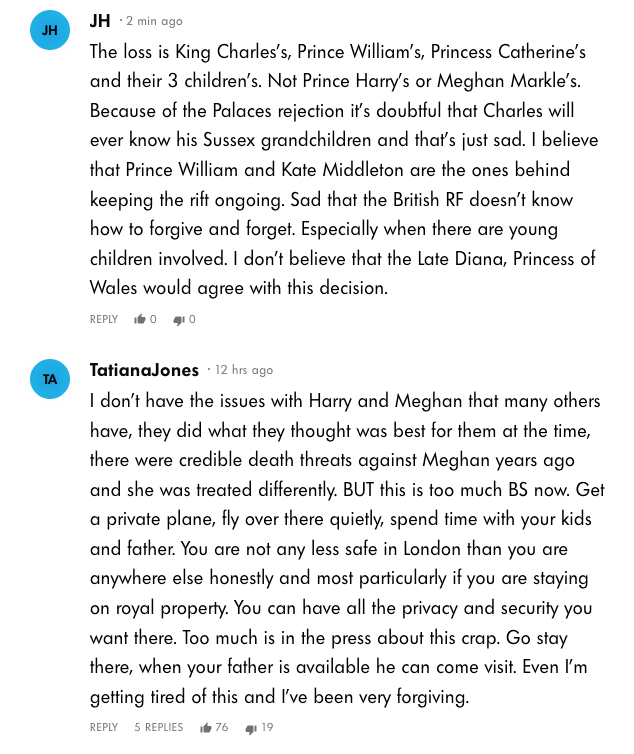
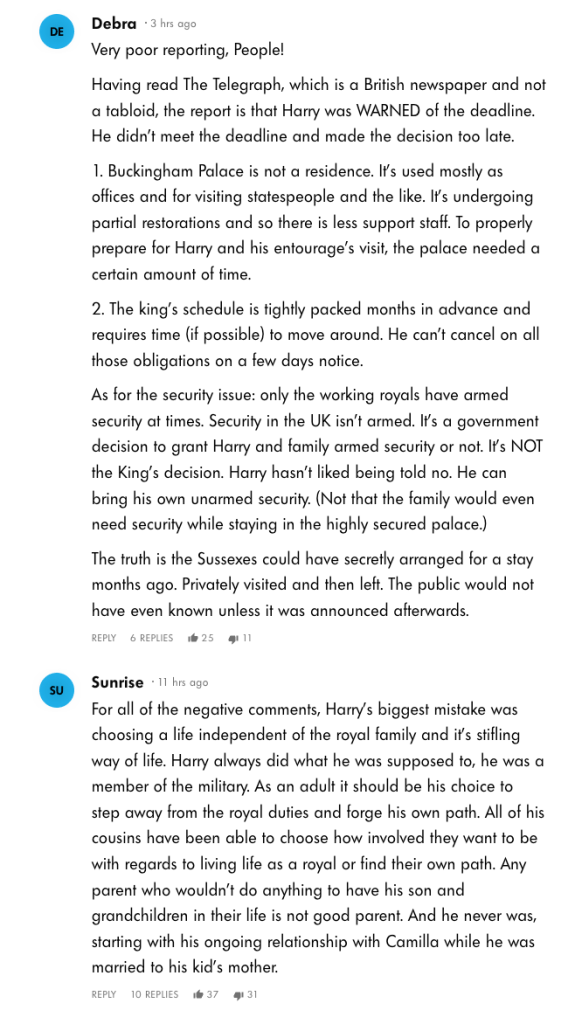
Under the openly sympathetic blogs, the reaction runs one direction: Charles is cruel, the reasons are lies, Harry should cut all ties. Under People, a mass-audience American outlet, the room is divided almost down the middle, and the palace-friendly comments cluster around a specific set of talking points. Harry missed a deadline. He was rude not to RSVP. Buckingham Palace is offices under renovation, not a hotel. RAVEC and not the King controls security, so none of this is Charles’s doing. He is high-maintenance, he is playing games, he is running a PR stunt to pay his bills.
What is striking is how closely the defenders’ comments track the palace’s own briefing. The deadline framing, the not-a-residence framing, the not-the-King’s-decision framing all appear in the reporting first, sourced to royal aides, and then reappear in the comment threads as the settled common sense of ordinary readers. That is the briefing operation working exactly as designed. A line goes out through friendly correspondents, gets absorbed as fact, and comes back up from the audience as independent conviction. The reader believes they arrived at the conclusion themselves. In practice they were handed it.
None of which makes the People commenters wrong to raise the deadline or the renovation. Some of their points, taken narrowly, have merit, as the section above allows. The observation is not that they are foolish. It is that the same institution that withdrew the room also supplied the vocabulary now being used to defend the withdrawal. When the defense of an action is written by the people who took it, and the public repeats it back to itself as fact, that is not a debate. That is a broadcast with an echo.
Sources
- People (Simon Perry): Prince Harry’s Offer to Stay at Buckingham Palace During London Visit ‘Withdrawn’ at ‘Last Moment’ After He ‘Accepted’ It: https://people.com/prince-harry-buckingham-palace-offer-withdrawn-uk-visit-11778921
- BBC News (Sean Coughlan): Prince Harry begins his UK visit with court verdict, reported at bbc.com/news (Royal correspondent, July 7, 2026)
- BBC News (Daniela Relph and Sean Coughlan): Buckingham Palace says Prince Harry will not stay at palace, via Yahoo News: https://www.yahoo.com/news/us/articles/prince-harry-stay-buckingham-palace-075757738.html
- RTE: Prince Harry will not stay at palace during visit to UK: https://www.rte.ie/news/uk/2026/0706/1581964-prince-harry-uk/
- CNN: Prince Harry told he replied too late to stay at Buckingham Palace amid confusion over UK visit: https://www.cnn.com/2026/07/06/uk/prince-harry-buckingham-palace-intl
- CBS News: Buckingham Palace says Prince Harry not staying there on U.K. visit, contradicting his spokesperson: https://www.cbsnews.com/news/prince-harry-buckingham-palace-uk-visit-not-staying/
- ABC News: Prince Harry won’t stay at Buckingham Palace during London visit: https://abcnews.com/GMA/Culture/prince-harry-london-wont-stay-royal-accommodations/story?id=134517315
- E! News: Prince Harry’s Offer to Stay at Buckingham Palace Rescinded: https://www.eonline.com/news/1433667/prince-harrys-offer-to-stay-at-buckingham-palace-rescinded
- The Spokesman-Review: Prince Harry loses room at Buckingham Palace while creating new chaos: https://www.spokesman.com/stories/2026/jul/06/prince-harry-loses-room-at-buckingham-palace-while/
- Yahoo / Newsweek: Why Buckingham Palace Withdrew Prince Harry’s Invitation to Stay During UK Visit: https://www.yahoo.com/entertainment/celebrity/articles/why-buckingham-palace-withdrew-prince-144317615.html
- ITV News: Ruling expected in Prince Harry’s legal battle against Associated Newspapers: https://www.itv.com/news/2026-07-06/ruling-expected-in-prince-harrys-legal-battle-against-associated-newspapers
- The Canberra Times: Harry set to learn ruling in Daily Mail court case: https://www.canberratimes.com.au/story/9306004/harry-set-to-learn-ruling-in-daily-mail-court-case/
- Republic World: Royal Cold Shoulder: Buckingham Palace Refuses Prince Harry Accommodation During UK Visit: https://www.republicworld.com/world-news/royal-cold-shoulder-buckingham-palace-refuses-prince-harry-accommodation-during-uk-visit-whats-behind-the-feud-2026-07-06-131414
- Time: Harry and Meghan Evicted From Frogmore Cottage: What to Know: https://time.com/6259684/harry-meghan-frogmore-cottage-eviction/
- GB News: Harry and Meghan’s £2.4m refurbishments undergo U-turn at Frogmore Cottage: https://www.gbnews.com/royal/prince-harry-meghan-markle-frogmore-cottage-refurbishments-controversial
- https://celebchai.com/2025/08/04/why-meghans-housing-disdain-was-actually-justified/

