The Window and the Frame: How Associated Newspapers Won on Inference Discipline
On 7 July 2026, Mr Justice Nicklin handed down a 436-page judgment dismissing all seven claims in Lawrence & Others v Associated Newspapers Limited [2026] EWHC 1637 (KB). The claimants were Baroness Lawrence, Elizabeth Hurley, Sir Elton John, David Furnish, Sir Simon Hughes, Prince Harry, and Sadie Frost. They had alleged that Associated, publisher of the Daily Mail, Mail on Sunday, and MailOnline, obtained private information through unlawful information gathering: private investigators, blagging, phone hacking, and corrupt payments. After a 46-day trial spanning January to March 2026, the court found that none of them proved it.
The headline is simple: every claim dismissed. But the reasoning is the story, because the case was lost and won on a question of method rather than a question of fact. The claimants asked the court to reason from a general picture to specific conclusions. The court refused, and the refusal is the whole judgment.
Two ways to read an article
Nicklin frames the central dispute cleanly at paragraph 79. Each disputed article, he writes, was treated by the parties “not as an end in itself but as the point at which different categories of evidence are said to converge.” The claimants called the article a “window” through which the court could infer the underlying intrusion. Sometimes the contents themselves were said to be suggestive, precise details about phone calls or private finances that a journalist should not have known. Sometimes the article became suspicious only when combined with an absence of credible sourcing plus evidence that the bylined journalist had commissioned private investigators.
Associated urged the opposite. It wanted what the judgment calls a “granular article-specific approach,” where each pleaded article gets explained by legitimate sourcing and the court resists “counterfactual narratives that treat the existence of TPIs or prior misconduct elsewhere as determinative.”
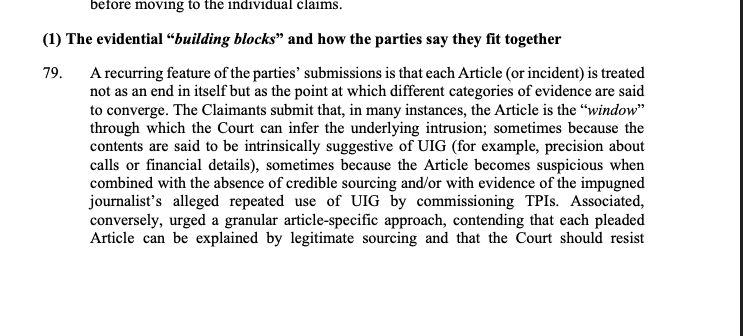
This is a fight about direction of inference. The claimants reasoned from the whole to the part: given what we know about the Mail’s newsroom culture, given the private investigators, given the missing records, this article must be tainted. Associated reasoned from the part outward, and only outward if the part supported it: prove this article was unlawfully sourced, and if you cannot, the general picture cannot rescue you.
Nicklin sided with Associated on method before he ever reached a single article. That choice determined the outcome.
The public inquiry the court refused to hold
The most consequential move in the judgment is a refusal. At paragraph 9 of the summary and throughout the reasoning, Nicklin declines to decide whether UIG was “widespread and habitual” at Associated. He returns to this repeatedly. These were civil claims brought by individuals, he insists, not a public inquiry into a media organisation’s historic practices.

He had set this parameter long before trial. In case management rulings he limited how far the claimants could run a generic case about Associated’s conduct, and required the trial to focus on the pleaded articles. The claimants tried to challenge those limits in the Court of Appeal and were refused permission. So by the time the trial opened, the frame was already fixed: 57 specific articles and incidents, each judged on its own evidence.
For anyone tracking how these cases work, this is the decisive structural fact. The claimants’ entire evidential strategy depended on accumulation. Individual articles that looked ambiguous in isolation were meant to gain force from the pattern around them. By declining to adjudicate the pattern, the court removed the mechanism by which weak individual cases were supposed to become strong collective ones. What remained was 57 separate questions, each of which the claimants had to win on its own terms.
Propensity, cabined
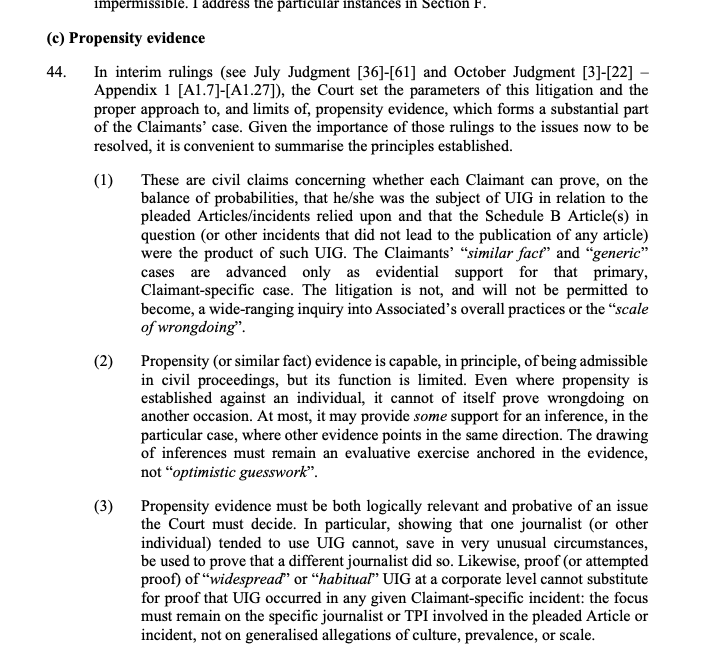
The claimants leaned heavily on propensity evidence: proof that particular journalists or investigators had a tendency to use unlawful methods. Nicklin allowed it in principle but drew its limits tightly, and the limits are worth stating precisely because they recur across the UIG litigation.
First, one person’s propensity cannot prove another person’s conduct. Showing that one journalist used unlawful methods cannot, “save in very unusual circumstances,” prove a different journalist did so on a different occasion.
Second, and more subtle, propensity for one technique does not prove use of a different technique. UIG is an umbrella term. A demonstrated tendency to blag limited information does not support an inference that voicemail interception was used on some other occasion. As the judgment puts it, it is not enough to assert “UIG” in the abstract. The specific mechanism has to be named and evidentially anchored.
Third, corporate-level “widespread” wrongdoing cannot substitute for proof in a specific claim. The focus stays on the particular journalist or investigator tied to the pleaded article.
The effect of these rules is to break the chain the claimants needed. Propensity evidence works by transfer: this person did it there, so probably here; this technique appeared once, so probably again. Nicklin blocks each transfer. Propensity can offer “some support for an inference” where other evidence already points the same way, but it cannot be the thing that gets you across the line. Drawing inferences, he writes, is “an evaluative exercise anchored in the evidence, not optimistic guesswork.”
Pleading fidelity as a weapon
The third pillar is the one most likely to be overlooked and most worth understanding. Nicklin held the claimants to the cases they had actually pleaded, and refused to let unpleaded allegations aired in cross-examination substitute for the pleaded ones.

This mattered because, as the trial ran, counsel repeatedly put to journalists that they had used some specific unlawful technique that had not been pleaded in relation to the article under discussion. Nicklin calls this “impermissible.” At paragraph 12 of the summary he holds that the parties were bound by their pleaded cases and that it was not permissible at trial to replace a pleaded allegation with a different, and often more serious, one.
The fairness logic is straightforward. An allegation that a named journalist committed a specific unlawful act is a serious accusation. The journalist is entitled to notice of exactly what is alleged and a proper chance to answer. You cannot plead one mechanism, fail to prove it, and then pivot in the witness box to a graver charge the defence had no opportunity to prepare for.
The practical consequence is that the claimants’ most damaging trial moments, the sharp accusations that generated the strongest impressions, often could not count, because they were not the case that had been pleaded. The court assessed the pleaded mechanism and, where the evidence for that mechanism fell short, dismissed the claim regardless of what else had been suggested.
The missing records problem
A recurring theme was the incompleteness of the documentary record. Many events dated back twenty years or more, some nearly thirty. Documents were gone, memories had faded. The claimants argued that this incompleteness should not disadvantage them, because unlawful activity is covert by nature, and the court should therefore be willing to infer from what remains, including from the fact that records are missing.
Nicklin does not accept the inference that absence implies wrongdoing. He notes that missing records may be neutral, or may actually disadvantage Associated by depriving it of contemporaneous proof of lawful sourcing. The absence of documentation cannot, without more, support an inference of wrongdoing. This closes another route the claimants needed, the argument that gaps in the record were themselves evidence of concealment.
The deeper principle sits at paragraph 7 of the summary. Suspicion, however understandable, is not proof. The court rejected the argument that because information was private, and because Associated could not positively explain how it was sourced, the article must have been unlawfully sourced. A claimant does not win by showing the defendant cannot account for something. The claimant has to prove the information was obtained unlawfully. Across article after article, the phrase that recurs is that the case did not go “beyond suspicion.”
The Leveson Lies
The claimants ran a serious collateral allegation as part of their answer to Associated’s limitation defence. They said three senior Associated figures, Paul Dacre, Elizabeth Hartley, and Peter Wright, had knowingly lied in their evidence to the Leveson Inquiry, and that this was part of a deliberate concealment. Nicklin rejected all three allegations, and how he rejected them is instructive.
His reasoning is not primarily that the Mail executives were obviously truthful. It is that the pleaded lies were never properly put to the witnesses. To allege that someone knowingly lied to a public inquiry, he holds, you must identify the specific statement, show why it was false, and show why the witness knew it was false when they said it. That is a matter of basic fairness, not technicality.
What happened instead, on his account, is that the cross-examination drifted. It ranged over the scale of Associated’s use of investigators, the adequacy of its inquiries, whether documents had been disclosed to Leveson. Those may be criticisms of Associated’s systems. They are not the pleaded charge that a named individual lied. By the time of closing, the allegation had “narrowed and, in some respects, shifted.”
On Dacre, the central pleaded allegation, that he lied about phone hacking, “was not squarely put.” Nicklin found him “straightforward and generally careful” and accepted he did not knowingly mislead the inquiry.
On Hartley, the allegation was sharper, focused on a paragraph in her 2011 Leveson statement asserting that Associated had seen no evidence that Whittamore obtained information illegally for its journalists. Here Nicklin makes a genuine concession to the claimants. He finds the paragraph “too broadly expressed,” that “with hindsight, it should not have been included in that form,” and that it gave “an impression of greater confidence than the underlying material justified.” Hartley herself accepted she was “not happy with that paragraph.” But too broad is not a lie. Nicklin was “not satisfied that Ms Hartley knew the paragraph to be false” or that she framed it to mislead. He accepted it reflected her honest understanding at the time, “albeit that, with hindsight, it was inadequately and too boldly expressed.”
On Wright, the pleaded lie was narrower still, his statement that as far as he was aware the ban on external search agencies had always been observed at the Mail on Sunday. Again the specific passage “was not squarely put to Mr Wright as a lie in the way that fairness required.” Nicklin found him “careful and measured” and not proved to have lied.
The pattern across all three is the same failure that sank the main claims. A serious, specific allegation was pleaded. At trial it broadened into a diffuse critique of Associated’s conduct. The court held that the diffuse critique, however forceful, could not prove the specific pleaded charge. Nicklin is careful to add that this “does not require me to find that Associated’s response to the Leveson Inquiry was beyond criticism.” The response may have been rushed and some evidence too confidently expressed. But criticism of a corporate response is not proof that a named witness knowingly lied.
Harry in the witness box
Prince Harry brought his claim on fourteen articles. Associated did not allege he was dishonest, but submitted his evidence should be approached with caution as the account of an experienced public figure familiar with press scrutiny, and that aspects relied on hindsight and overstated the privacy of the information.
Nicklin’s assessment is measured and, on balance, sympathetic. He accepts Harry’s evidence. He notes that Harry “wished the Court to understand the personal impact of the matters in issue,” and that this at times led him “beyond giving factual evidence into advancing arguments,” prompting exchanges with Antony White KC. Nicklin treats this generously, observing that many litigants feel the instinct to argue their own case and that the burden of doing so properly rests with the advocate, not the witness. It did not, he concludes, affect the quality of Harry’s evidence.
Two discrete points get recorded, and both are worth noting for how the sourcing story travels.
The first is Harry’s own accusation, made in the witness box, that the journalist Barbara Jones obtained information through “bribes and blagging,” including a suggestion she had “probably blagged one of those local rangers with money” to locate him in Africa. Nicklin explicitly treats this as reflecting Harry’s belief rather than a pleaded contention, precisely the move the pleading-fidelity principle requires. An accusation aired while giving evidence is not the same as a case properly advanced against the journalist, and the court does not treat it as one.
The second is the “Mr Mischief” exchange, and here the sourcing pattern is the story. After the trial concluded, Nicklin became aware of media reporting that focused on historic Facebook messages disclosed by the journalist Charlotte Griffiths, in which she addressed Harry as “Mr Mischief.” Griffiths had located these in 2025 and given access to her Facebook account for searching. In cross-examination Harry firmly rejected that he had used the name, stating he had “never used the name Mr Mischief.” He was not actually taken to the message exchange itself, the point was taken no further, and Associated advanced no allegation that his evidence was dishonest.
What is notable is that Nicklin addresses it at all. He records it, he says, “only to avoid misunderstanding as to the evidential significance of these messages and how the point was deployed at trial and in submissions.” The messages surfaced through post-trial media coverage rather than through any finding the court made, and Nicklin’s careful framing, nothing turns on this, no allegation of dishonesty, is itself a response to a press narrative forming around a document that the trial did not resolve. This is the vacancy problem visible in real time: a suggestive artifact enters public circulation, a frame builds around it, and the judgment has to spend a paragraph containing a story it never adjudicated.
Limitation, mostly parked
Associated argued in the alternative that even if the claims succeeded, they were brought too late. These claims carried a six-year limitation period and were filed in October 2022, on events from many years earlier. The claimants relied on the deliberate concealment exception, arguing time should run from when they discovered the relevant facts.
Because the claims failed on their merits, Nicklin mostly did not need to decide limitation. He declined to construct a hypothetical version of an unproven claim just to test whether that hypothetical would have been time-barred. He did decide limitation for the specific Miskiw/Anderson Emails claims brought by Simon Hughes and Sadie Frost, holding those would have been time-barred in any event, because by April 2016 at the latest each had at least constructive knowledge of the facts needed to bring a claim.
What the judgment establishes, and what it does not
It is easy to read “all claims dismissed” as a finding that Associated did nothing wrong. The judgment does not say that. Nicklin is precise about the limits of what he decided. He did not find that UIG was or was not widespread at Associated, because he declined to hold that inquiry. He did not find the Leveson evidence beyond criticism. On Hartley’s paragraph he made a real, if narrow, adverse finding, that it was too broadly expressed and should not have been written as it was.
What he found is narrower and, in a sense, more durable. On the specific articles pleaded, using the specific mechanisms pleaded, with the burden of proof on the claimants and serious allegations requiring cogent evidence, the claimants did not prove their cases. The suspicion was often understandable. It was not proof.
For the broader UIG litigation, the method matters more than the outcome. This judgment is a detailed statement of how a court will treat inference-heavy claims built on pattern, propensity, and the absence of records. Pattern will not substitute for the specific article. Propensity for one technique will not prove another. Missing documents will not be read as evidence of what they might have contained. And the case pleaded is the case that will be judged. Those are not findings about the Mail. They are findings about what it takes to win, and they will shape every claim that follows.
A consequentials hearing on costs and permission to appeal is fixed for 29 and 30 July 2026.
 celebchai.com