Online criticism of Meghan turns into insults for three reasons: real grievances that have hardened over six years, platforms that pay out for contempt, and communities that use nicknames as a badge of membership. None of these prove or disprove anything about her; they explain the tone.
What the samples showed
Three samples from 2 November 2026 point the same way but read very differently.
| Sample | Size | Hostile to Meghan | Positive about Meghan | How the hostility was expressed |
|---|---|---|---|---|
| YouTube, first pull of comments on a Lady Colin Campbell video | 124 comments | 51 | 0 | Often argued a point: 31 of 36 comments on the storage-unit story questioned the evidence or the press |
| YouTube, top comments on the same video | 527 comments | 187 | 1 | Mostly stated as opinion, with little name-calling (details below) |
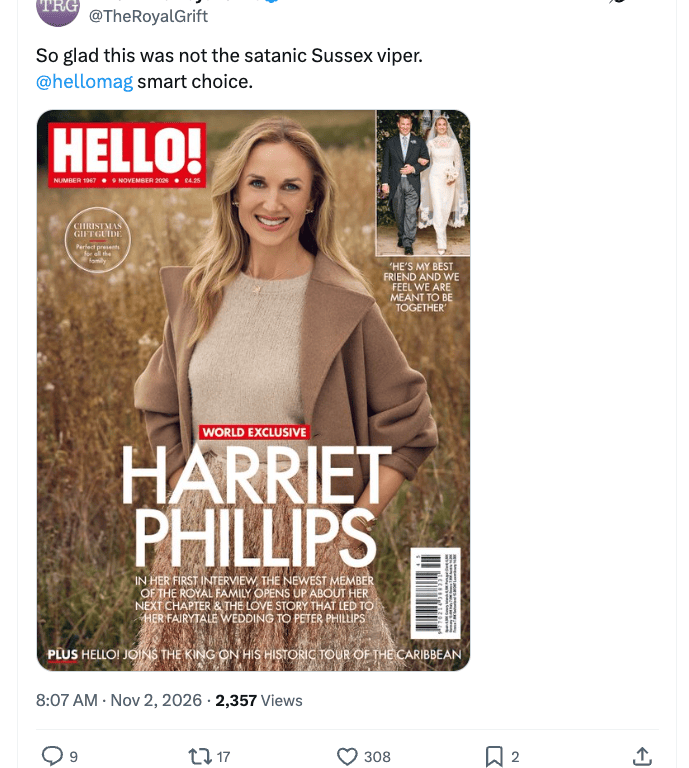
| X thread reacting to HELLO!’s Harriet Phillips exclusive | 9 posts | 4 explicit | 0 | Mostly labels (“satanic Sussex viper”) and mockery, with no claim to check |
The full comment section
A larger pull of 527 top-sorted comments from the same video (45% of its 1,175 comments, with 11,442 likes) confirms the picture and sharpens it.
| Person | Negative comments | Positive or sympathetic | Likes on the negative comments |
|---|---|---|---|
| Meghan | 187 | 1 | 7,168 |
| Harry | 99 | 0 | 4,104 |
| King Charles | 86 | 22 | 3,106 |
| Thomas Markle Jr. | 51 | 1 | 1,243 |
| Thomas Markle Sr. | 13 | 50 | 143 |
- The audience overrules the host on the King. The video’s title says Charles is not backing the Sussexes. 71 comments (2,031 likes) say he is, and critics of the King outnumber his defenders about four to one, or twenty to one by likes.
- Doubt, not belief, on the allegations. 122 of 146 comments about the storage unit or Thomas Jr.’s account questioned it. The third most-liked comment (504 likes) suggests Jr. set his father up.
- Insults are a minority here. 66 comments (13%) used name-calling such as “Hazbeen” or “Meghadog”; most hostility is stated as opinion.
- Spam rides along. Six comments were promotions dressed as commentary. Three pushed the same obscure book, and one of those had 141 likes, which suggests bought or bot engagement.
The most-liked comment (661 likes) sums up the mood: the royal family is better off without Harry and Meghan. Labels were applied by Claude against one rubric, so treat the figures as approximate.
The question is why the same dislike shows up as argument in one place and as name-calling in the other.
Why they are after her
Most critics are not angry at nothing. They point to a run of events since 2020 that they read as a pattern of attacking the family while profiting from it.
| Grievance critics cite | What happened | How defenders read it |
|---|---|---|
| Leaving, then going public | Stepped back as working royals in 2020, then the Oprah interview (2021), the Netflix series (2022) and Harry’s memoir Spare (2023) | Telling their side after years of tabloid attacks |
| Accusations against the family | Claims of racism and of being denied mental-health help, never fully substantiated in public | Serious claims the palace chose not to answer in detail |
| Privacy versus publicity | Asking for privacy while selling interviews, a show and a lifestyle brand | Public figures can want control over their story |
| Her father | Estranged from Thomas Markle Sr. since the 2018 wedding | She says she ended contact after a January 2019 police letter about him |
| “Faux-royal” visits | Royal-style engagements as private citizens since moving back to the UK in August 2026 | Charity work any public figure might do |
A decade in dates
The hostility built in layers. Each event below is one that critics still bring up, often years later.
| Date | What happened | Why critics still cite it |
|---|---|---|
| Oct 2026 | Allegations against her father surface; she says she cut contact after a 2019 police letter | They doubt her timeline and see her using it to justify the estrangement |
| Oct 2026 | First joint UK outing, in Nottingham, as private citizens | Royal-style visits without royal duties |
| Aug 2026 | Family moves back to the UK, staying on a billionaire friend’s estate | Read as returning for the perks |
| Mar 2026 | Netflix ends its As Ever partnership; her show stops after two seasons | Read as proof the brand never worked |
| Mar 2024 | Her half-sister’s defamation suit is dismissed | Her relatives’ complaints stay in circulation anyway |
| Jan 2023 | Harry’s memoir Spare attacks William and Camilla | Blamed on her influence |
| Dec 2022 | Netflix docuseries Harry & Meghan | More private family matters made public |
| Nov 2021 | She apologises to a court for forgetting an aide briefed her biographers | Cited as proof she misleads |
| Mar 2021 | Oprah interview; former staff’s bullying claims reported the same week | Racism claims against the family; a palace review whose findings stay private |
| Jan 2020 | Steps back as a working royal | Seen as quitting the job but keeping the title |
| May 2018 | Wedding; her father absent after a staged-photo scandal | Start of the family rift |
| Nov 2016 | Harry condemns racial undertones in press coverage | Defenders’ starting point: the abuse came first |
Loyalty to the monarchy and to Kate
For many critics the royal family is not a celebrity brand. It is a national institution tied to duty, to the late Queen, and to their own sense of what Britain is. Public criticism of it lands as criticism of them.
Timing made it worse. The Oprah interview aired in March 2021 while Prince Philip was in hospital; he died weeks later. Spare came out four months after the Queen’s death. Critics read both as choosing publicity over family at the worst possible moments.
The Princess of Wales is the sharpest point. In the Oprah interview, Meghan said Kate had made her cry before the wedding, reversing earlier press reports. Kate never answered. To royalists that silence is the model of how a royal wife should behave, and her 2024 cancer diagnosis made them more protective still.
This also explains why Harry gets softer treatment. As Diana’s son he still draws some sympathy, so the anger is often redirected at Meghan as the one who changed him. One of the most-liked YouTube comments argued exactly that: that she needed him to feel indebted to her.
Truthfulness disputes
Critics keep a running list of things she said that they believe did not hold up. That list is the backbone of the “she lies” charge in both samples. The record is mixed: some points she later corrected, some are disputed, and some went her way.
| Statement or episode | What critics say | Her side or the outcome |
|---|---|---|
| A private wedding three days before the public one (Oprah, 2021) | The Archbishop of Canterbury said the legal marriage was on the official day | Her team later called it an exchange of personal vows |
| Archie being denied the title of prince (Oprah, 2021) | Long-standing rules meant he would only become a prince when Charles became king, which he did | She framed it as part of wider exclusion, including over his security |
| Whether she helped her biographers | An aide’s evidence showed he briefed the authors with her knowledge | She apologised for forgetting, and still won her privacy case against the Mail on Sunday |
| Bullying of palace staff | Former aides alleged two assistants were driven out | Her lawyers denied it; the palace review’s findings stay private |
| When she learned of the claims about her father | She first said 2018; Met records say January 2019 | Her team says the police record is the accurate reference point |
| Her half-sister’s account of their childhood | Samantha says Meghan lied about being raised as an only child | A US judge ruled the remarks were opinion and dismissed the suit in 2024 |
For critics, each correction confirms the pattern. For defenders, a few honest mistakes are being treated as proof of a liar while the rulings in her favour are ignored.
Money, titles and the privacy paradox
The word critics use most is “grift”: the charge that the couple left royal duties but kept royal status to sell. The account behind the X thread is literally called The Royal Grift.
What they point to:
- Selling the story. A Netflix deal reportedly worth more than $100 million in 2020, a Spotify podcast deal that ended in 2023, and the As Ever lifestyle brand promoted on her show.
- Titles kept. They gave up using HRH in 2020 but remain Duke and Duchess of Sussex, which critics say is what makes them marketable.
- Public money. Frogmore Cottage was renovated with about £2.4 million of public funds, which they repaid in 2020. Harry then fought for state-funded police protection in the UK and lost.
- Perks without duties. Since moving back, reports of a King-funded security offer and a protection-style Range Rover have revived the charge. Neither has been confirmed.
Then there is privacy. She has sued newspapers and condemned paparazzi, while also giving the Oprah interview, a six-part docuseries and her own podcast. Critics call that hypocrisy. Defenders say wanting to tell your own story is different from wanting strangers to sell it.
The commercial record feeds the mockery. Netflix ended its As Ever partnership in 2026, and her show’s second season ranked 1,124th among Netflix titles for late 2025. That is why losing an Emmy “to a dog” spread so fast.
Harry and the family rift
The most emotional charge is that she took Harry away from his family. Critics see a pattern: she is estranged from her own father and half-siblings, and Harry became estranged from his father and brother after marrying her.
Harry’s memoir gave them material. Spare described William knocking him to the floor and portrayed Camilla as a schemer. Critics did not believe Harry would have published that on his own.
Tom Bower’s 2026 book Betrayal sharpened the claim. It alleges she encouraged Harry to cut off friends and assert independence from the palace, and attributes to Queen Camilla a private remark that Meghan had brainwashed him. Bower is a long-standing critic and many of his sources are anonymous.
Defenders point to Harry’s own account. His grievances about the press, his mother’s death and his role as the “spare” began long before he met her. On this reading, Meghan is a convenient person to blame for choices Harry made himself.
The partial thaw has not helped her. Meghan met the King at Highgrove in July 2026, her first meeting with him in four years. Critics who now blame Charles for “enabling” the couple still see her as the driver.
Why it runs so hot
Grievances explain the dislike. Four further forces explain why it is so intense and so lasting.
- She is a culture-war symbol. An American, biracial, outspoken on race and feminism, who married into Britain’s most traditional institution. Arguments about her double as arguments about race, the monarchy and “woke” politics, on both sides of the Atlantic. US conservative host Megyn Kelly, for example, called her show possibly the worst product on TV in five years.
- She broke the royal wife script. The model is silence: never complain, never explain. A wife who complains on television breaks that script, and the old trope of the woman who controls her husband fills the gap.
- Disliking her is a hobby. Following someone you can’t stand can become a daily ritual with friends, in-jokes and a favourite host; researchers call this anti-fandom. In the YouTube comments, about one in five were greetings or compliments to the host, not views about Meghan.
- Outrage pays. Tabloids, royal YouTube channels and X accounts all earn from attention, and viewers tip hosts directly (one commenter in the sample paid $4.99). The couple keep supplying new material, so the cycle never runs dry. The attention even draws spam dressed as commentary.
Race runs through all four, as the section below sets out. Critics say it plays no part; her supporters say it shapes how every grievance is framed.
Once a reader sees these as one pattern, each new story is read as more proof. That is why the storage-unit allegations against her father were turned back on her by many commenters.
Why X runs hotter than YouTube
X rewards the sharpest line in the fewest words; a YouTube comment section answers a host who has already made the argument.
| YouTube comments | X replies | |
|---|---|---|
| What people respond to | A long video where the host lays out a case | A single short post or screenshot |
| Who sets the tone | The host, who can delete comments and whose fans greet her by name (about one comment in five greets or compliments her) | Whoever posts first; replies pile onto the framing |
| Room to argue | Enough to ask why a storage unit wasn’t auctioned | Enough for a label and an emoji |
| What gets rewarded | Likes from fellow viewers | Reach, reposts and, for some accounts, payouts |
The reward side is measurable. A 2017 PNAS study found each added moral-emotional word raised a post’s spread by about 20%. A 2021 study of about 3 million posts found each word about an out-group raised sharing odds by 35% to 57% for news accounts, and more for politicians.
Money adds to it. Since October 2024, X pays creators based on engagement from Premium users, once they pass 500 Premium followers and 5 million impressions in three months. An account built around one target has a reason to post the line that gets the most reaction, and an insult usually beats a caveat.
A host sets the tone but not every verdict. Lady C’s title said the King is not backing the Sussexes, yet many of her most-liked viewers insisted he is. On YouTube the audience agrees with the host about Meghan and argues with her about everything else.
What the insults do for the group
In these communities a nickname is not an argument; it is a password. Using it shows you already share the story and don’t need it explained.
The samples used at least a dozen: Megsy, MeAgain, Megzee, Meg-iago, Meghadog, La Markle, the Dooshess, the Harkles, Hazbeen, the gruesome twosome, the grifters, and the satanic Sussex viper. Each one compresses years of grievance into a word that insiders recognise instantly.
Insults do three jobs at once:
- Signal belonging. Matching the group’s language earns likes and replies from people who already agree.
- Skip the evidence. “Viper” asserts a verdict that no longer needs facts behind it, which is why the X thread had nothing to fact-check.
- Lower the stakes. A target described as an animal or a demon feels less like a person, so harsher words feel fair.
This is not unique to Meghan’s critics. Pro-Sussex spaces use the same tools on the other side; one fan site called Thomas Markle Sr. her “rancid” father while defending her letter to him.
Coordination and the racism debate
Two arguments sit underneath the insults, and both sides have evidence they lean on.
A small, loud core. In October 2021, Bot Sentinel studied more than 114,000 tweets about the Sussexes. It found 83 accounts produced about 70% of the hateful content, with larger accounts amplifying them. Twitter pushed back: it said most flagged accounts were real people, not bots, saw no evidence of widespread coordination, and acted on four.
Race. Meghan and her supporters say much of the abuse is racist. There is documented proof that some of it is: two Met officers were sacked in 2022 for sharing a racist joke about her, and a senior officer said threats against her life had led to prosecutions. Critics reply that their objection is to her conduct, and that labelling all criticism racist is a way to avoid answering it.
Both things can be true. Many critics are reacting to events, and the most extreme language often comes from a small set of very active accounts whose posts are then repeated by everyone else.
Loud online versus the wider public
The disapproval is mainstream in Britain; the name-calling is not. YouGov’s Q2 2026 tracking put Meghan at 18% positive and 61% negative in the UK, a net of -43 and her lowest on that measure.
| UK group (YouGov, Q2 2026) | Positive | Negative |
|---|---|---|
| Generation X | 8% | 80% |
| Baby boomers | 11% | 75% |
| Millennials | 33% | 40% |
| Men | 25% | 60% |
| Women | 13% | 63% |
Older Britons are the most negative, which fits a royal commentary channel’s audience. Most people who dislike her never post at all, let alone call her a viper.
When reading samples like these:
- Comment sections are self-selected. People watch a channel because they already agree with it, so its comments measure that audience, not the public.
- Likes measure agreement inside the group. Even a comment with hundreds of likes shows what resonates with fellow viewers, not how widely a view is held.
- Size matters. The X post had 2,237 views; it is in-group chatter, not a trend. Sort order matters too: the first pull and the top-sorted view of the same video gave very different like counts.
- Separate the position from the tone. Disapproval can be widespread while insults stay concentrated in a few accounts.
- Check the claims, not the volume. A claim repeated by many accounts is no truer than when one account made it.
Bottom line
The insults are what happens when a widely shared grievance meets a platform that pays for contempt and a community that bonds over it. The grievances can be argued about on the facts; the labels cannot, which is why they tell you more about the group using them than about Meghan. The same audiences doubt the allegations against her father and blame the King for enabling her, so the anger is broad but not blind to everyone else’s role.
Sources
- The Royal Grift post on X, 2 November 2026
- HELLO!: Harriet Phillips world exclusive
- CSMaP: Emotion shapes the diffusion of moralized content (PNAS, 2017)
- PsyPost: Hostility towards outsiders motivates engagement on social media
- TechCrunch: X changes creator payouts to depend on engagement
- The Week: Report identifies accounts coordinating to target Meghan and Harry
- Newsweek: Twitter on the Bot Sentinel accounts
- The Guardian: Met officers fired after sharing racist joke about Meghan
- The Guardian: Duchess of Sussex faced threats to life, senior Met officer says
- Celebitchy: Meghan’s 2025 letter to Thomas Markle
- Newsweek: Meghan’s UK popularity hits new low (YouGov Q2 2026)
- theGrio: Meghan apologises to court for forgetting book discussions
- News4Jax: Meghan bullying claims review findings to stay private
- Global News: Samantha Markle’s defamation lawsuit dismissed
- IBTimes: Meghan’s hospital letter to her father
- Anglo-Celt (PA): Meghan earns first Daytime Emmy nomination
- Mudgee Guardian: With Love, Meghan viewing figures
- Mediaweek: Netflix pulls the plug on As Ever partnership
- GB News: Harry and the security ruling
- Wikipedia: Betrayal (Bower book)
- The New Daily: Meghan’s Highgrove visit and Emmy nod
- ARY News: Megyn Kelly on the Emmy nomination

