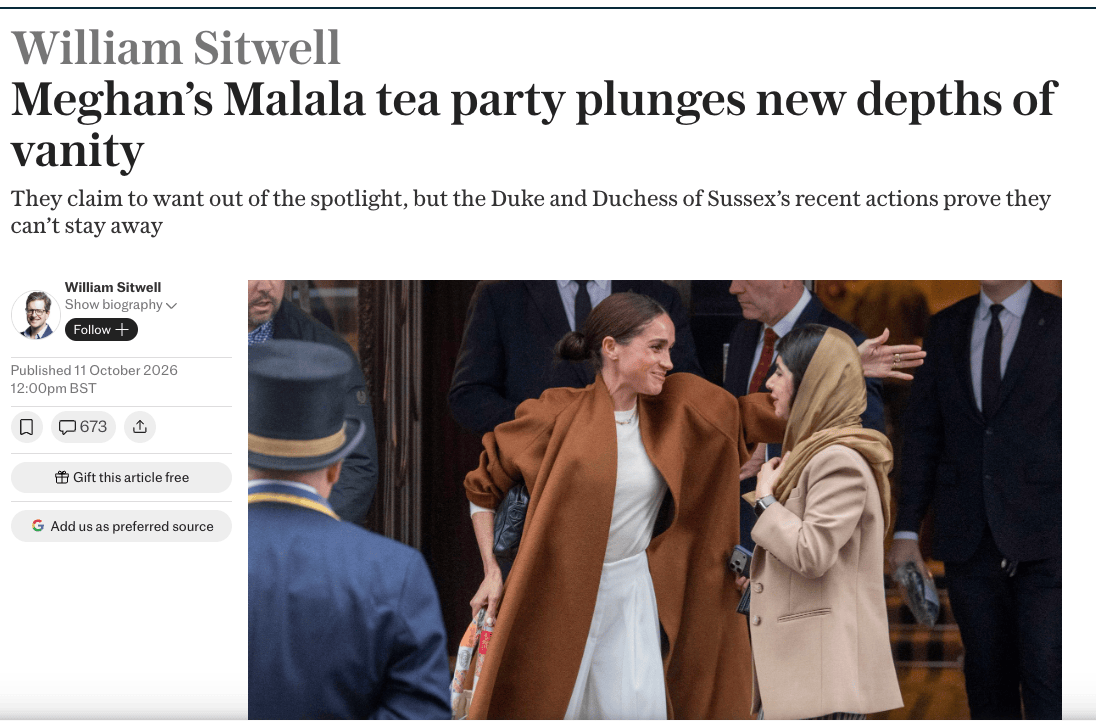
William Sitwell wants you to know he tried. Since the Sussexes moved back in August, he says, he had resolved not to look at them, the way you tell children not to stare at a crash on the motorway. Then the Duchess of Sussex walked out of Claridge’s in a pair of trousers, and his resolve melted.
Hold that image. A columnist for a national newspaper, undone by trousers he admits he can’t even identify. What followed was a full column on why Meghan is desperate for attention, written by a man who could not stop giving it to her.
The car-crash metaphor is worth dwelling on. The driver rubbernecking on the motorway isn’t the crash. He’s the reason the traffic is backed up for miles.
Privacy isn’t a vow of invisibility
Sitwell’s central charge is hypocrisy: the couple asked for privacy, then had the nerve to be seen. He even quotes Meghan telling Oprah that privacy is about boundaries. He doesn’t seem to notice that the quote answers his whole argument.
A boundary is not a wall. It’s a line you draw around what’s yours to share and what isn’t. Asking the press not to photograph your children or publish where they go to school is a boundary. Posting a picture of those same children, from behind, on your own terms, is exercising it.
That’s not a contradiction. It’s the entire point. Every famous parent makes the same distinction, including the family Sitwell holds up as the gold standard of decorum. Nobody calls it hypocrisy when the Prince and Princess of Wales release their own photographs of their children while asking the press to leave them alone.
The same goes for Spare. Harry’s court cases were about how newspapers obtained private information about him. Choosing to tell your own story, in your own words, is the opposite of having it taken from you.
The quietest loudhailer in Mayfair
Then there are the clothes. Sitwell lists them with the precision of a man who wasn’t looking: a long camel coat, an ivory cashmere jumper, Saint Laurent loafers, trousers of disputed origin. From this he hears a woman screaming “LOOK AT ME!”
Camel and ivory are about the quietest colours a person can wear. If this outfit is a loudhailer, it’s one turned down to a whisper.
She was having tea at Claridge’s, one of the smartest hotels in London. People dress up for Claridge’s. The Princess of Wales wears designer labels to engagements all the time, and nobody writes columns claiming her coat is yelling. The difference isn’t the clothes. It’s who’s wearing them.
The hug gets the same treatment. Two friends say goodbye outside a hotel and embrace. Photographers are there, because photographers are always there. Sitwell sees a flamboyant performance for the cameras.
Had she slipped out a side door, we’d be reading about a cold, secretive duchess hiding from the British public. There is no version of this afternoon tea he would have left alone.
Malala is not a prop
The most revealing part of the column is how it treats Malala Yousafzai. Sitwell calls her extraordinary, then writes her into the story as an accessory: a source of reflected glory for Meghan to bask in.
Malala is a Nobel laureate who survived being shot by the Taliban for going to school. She is perfectly capable of choosing her own friends. She and Meghan have worked together on girls’ education since at least 2020, when they spoke publicly for International Day of the Girl. Suggesting she was simply used, rather than meeting a friend she chose, says more about the writer than about either woman.
The same sneer runs through his list of Meghan’s famous acquaintances: Nicole Avant, Gloria Steinem, Oprah, the Clooneys. Famous people tend to know other famous people. His evidence that she didn’t even know the Clooneys rests on one word, “apparently”, which is doing a great deal of work.
Harry, grief, and the point Sitwell gives away
Sitwell mocks Harry for recording a MasterClass on grief, and calls his life since 2020 one long public therapy session. Harry lost his mother at 12 and walked behind her coffin in front of the world. If anyone has standing to talk publicly about grief, it’s him. For a generation of British men raised not to talk about it at all, hearing a prince do so is not nothing.
Sitwell also complains that Harry can’t do anything that isn’t tied to his birthright and his own experiences. But that’s what everyone with a platform does: they speak from what they know. Harry’s best-known project, the Invictus Games, grew out of his military service, not his title.
Then comes the strangest passage. Sitwell suggests Harry might be courting press attention to win his fight over taxpayer-funded security. In the next breath, he says Harry should have that security, because he didn’t choose to be born royal. So the columnist agrees with Harry on the substance, and still finds a way to call it a scheme.
The columnist who overshares for a living
Sitwell closes by warning the Sussexes that this sort of thing doesn’t go down well in the Cotswolds, where decent people keep their private lives to themselves. It’s a fine rule. He might try it.
Below his column, the Telegraph links to another William Sitwell piece: one about how much he loves sharing a bed with his dog, because the dog snores more quietly than his wife. A man who turns his own marriage bed into copy is not well placed to lecture anyone about simpering personal revelation.
If Sitwell really wants the Sussexes out of the papers, the remedy has been in his hands all along. Next time he passes the crash on the motorway, he can keep his eyes on the road.

