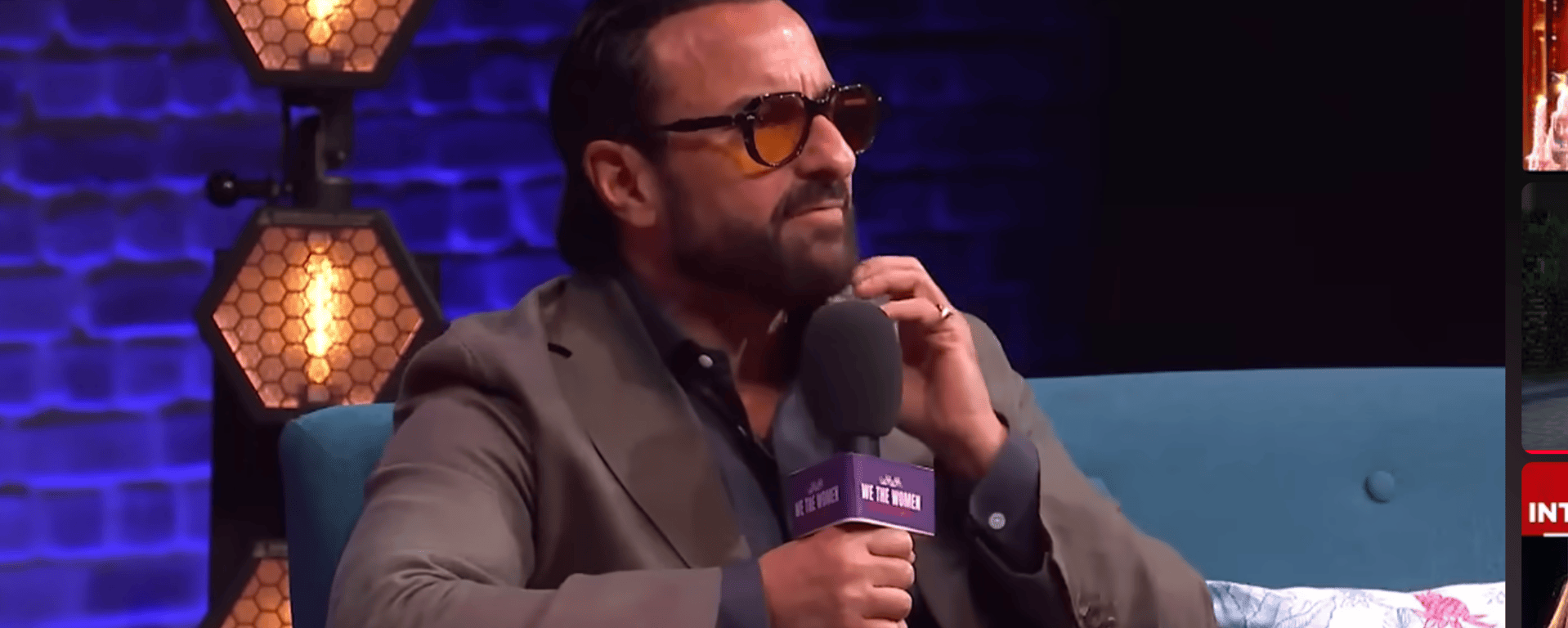
Saif Ali Khan wants to forgive the man who broke into his home and drove a kitchen knife into his spine. He just hasn’t quite managed it yet.
“I would be happy to forgive him,” the actor told Barkha Dutt on stage at the We The Women festival in London, where he was honoured as a Global Changemaker. Then came the dry, deadpan turn the room had been waiting for: “It’s just that part where you tried to kill me is something I’m finding hard to let go.”
The audience laughed. Dutt asked whether he was being ironic. He said he wasn’t.
“I think it’s a question really of haves and have-nots,” Khan said. “It’s inequality that’s led to this.” When the line drew applause, he waved it off: “I’m not looking for an applause there.”
He does not believe the intruder came looking for a fight. In his telling, the man was after “a meal or a buck,” and the night spiralled because Khan leapt on him in the dark. “I probably shouldn’t have jumped on him,” he said. “Now he’s probably going to spend a long time in jail.”
The instinct to forgive, he explained, is rooted at home. His children say the Lord’s Prayer every night, a Christian influence he traces to his mother-in-law’s side of the family, and forgiveness sits at its centre. “They’re not just words,” he said. “I think it frees us also to get over things like this.”
Dutt called it extraordinary generosity. Khan’s answer was simple: “It’s actually how I feel.”
“Two knives is two knives”
The attack happened in the early hours of January 16, 2025, at the family’s Bandra West home in Mumbai. According to the police chargesheet, the intruder came in through a bathroom attached to the room of Khan’s younger son, Jeh, intending to steal (Free Press Journal).
Khan described being woken by the nanny and walking, half-asleep, into the dark room. The man had already cut the nanny and nicked the baby. “Maybe if I put the lights on and said, ‘Do you know where you are and what you’re doing?’ I could have talked it out,” he said. “Something took over.”
He jumped on the intruder, who was carrying two blades. “He wasn’t a very big fellow, but two knives is two knives,” Khan said. The fight turned when Geeta, a member of the household staff, walked in, picked the man up and threw him across the room. The London audience cheered.
Khan and Geeta retreated upstairs, at one point grabbing ceremonial swords off the walls. They locked the intruder in the room, and he escaped the way he had come.
Then Khan noticed the blood. Lying on the floor in his kurta pyjama, he thought he might die, and he described the moment with startling calm. “They say a warrior’s death is quite a good one,” he said. Flooded with adrenaline, he felt he’d had “a full life” and wanted only to hold one of his children’s hands and say goodbye. “And then I kind of woke up a bit more and said, no, it’s not done yet.”
The first blow had been the worst. A cheap kitchen knife snapped against his backbone, and a six-inch piece of blade lodged in his vertebra and nicked his spinal cord. He had felt the sensation going in his right leg. “That’s how close I came to getting paralysed,” he said.
Police arrested Mohammad Shariful Islam Shehzad, a 30-year-old Bangladeshi national, three days after the attack. The chargesheet says his motive was theft and that he did not know whose home he had entered (Free Press Journal). Forensic tests matched knife fragments from the scene, from Khan’s body and from the accused as three pieces of one knife (The Week).
“Are you going to die?”
When it was time to leave for the hospital, Khan wanted his elder son, Taimur, beside him. Kareena Kapoor Khan asked if he was okay, he said yes, and she took Jeh to her sister’s. Taimur, Khan reasoned, was “probably the least hysterical” person in the house.
They went in an auto rickshaw. On the way, Taimur looked at his father and asked whether he was going to die. “I said no, but there’s something in my back that hurts a lot,” Khan recalled. “But I’m not going to die.”
He admits the choice may not have been right. “He was young, but he really did help me by being there,” he said, describing his son’s “very calm presence.” Only later did Taimur confess the truth: “Are you kidding me? I was terrified. I thought you were going to die.”
At Lilavati Hospital, the emergency room was half-asleep. Khan asked for a stretcher and got a blank look, until he said, “I’m Saif Ali Khan.” After that, he said, “all hell broke loose,” and the doctors made the right calls. He was treated for wounds to his neck, back and left hand and discharged five days later (The Week).
The family, he says, has “processed it quite healthily.” Taimur has notes on technique: he should have punched the man, not grabbed him. Jeh handed his father a plastic sword and told him to sleep with it next time.
Dutt played a clip from Kareena’s appearance at the festival a year earlier, in which she said the boys now see their father as Batman and Iron Man. The one lasting change is security. Khan never liked uniformed guards standing around, but concedes, “It’s a sign of the times.”
Filtering the noise
The attack was followed by a wave of speculation, some of it questioning whether it had happened at all. Dutt, who wrote about it at the time, called the commentary “downright hideous,” particularly the suggestion that Kareena had failed some test of motherhood by going to her sister’s with Jeh.
Khan was unbothered. “You don’t expect love and understanding from everyone. That would be insane,” he said. What matters is getting it from family, friends and “a couple of journalists who you respect.” The rest, as they taught him at school, is a matter of questioning provenance.
Of Kareena, he was effusive. He credited her with holding the family together through lockdown and called her “a strong, strong girl.”
He was less breezy about the trolling of Taimur over his name. Khan said he and Kareena chose it because a neighbour’s child had it and they believed it meant “iron.” They had no idea it would be tied to a Turkic invader of India. “Why can’t we just forget something that’s so long ago,” he asked, “and focus on Taimur being a wonderful person and growing up with the right values?”
On social media, he sounded like most parents. His children get screen time, Kareena polices it closely, and the house echoes with “get off the iPad.” He doubts bans work, because kids “will find a way,” and would rather platforms became safer and parents stayed closer. His youngest recently posted a goal on YouTube and reported, with some disappointment, that it had four likes.
Khan himself stays off social media. “You can either take a picture of it or do it,” he said. “You can’t really do both.”
The paparazzi, he said, are a stranger case. Some stars pay photographers to turn up and others pay them to stay away. He worries that anyone with a camera can pass as media, which is a security risk. After the attack, the photographers stopped coming to the house when Kareena asked them not to shoot the children, and he credits them for it.
One God, many names
Khan is the son of an interfaith marriage and is in one himself. He calls himself “not the most religious of people,” and says faith at home is less a lesson than a habit.
The creed is his mother’s. “There is one God and he has many names,” he said. “If your religion talks about love and forgiveness to your fellow man, then it’s aces with me.”
His own exposure to Christianity began at English boarding school, where every day started with chapel. He and his friends tried to skip it by pointing out they were of a different faith. The school responded by finding a maulvi to come and speak to them.
At home, the children say the Lord’s Prayer followed by prayers from other faiths, and the family celebrates Diwali as much as Christmas. “We’ve never really thought about it,” Khan said. “It should be as intuitive as that.”
Taimur, it seems, is absorbing the lesson. Asked recently to explain the difference between religion and mythology, he answered: “In religion, we pray, and in mythology we don’t.” His father thought it was a pretty good answer.
Getting a word in
Not everyone came away happy with the conversation. In the video’s comments, the most common complaint was not about Khan but about Dutt, whom many viewers felt talked over her guest.
The transcript bears some of that out. Her questions often ran longer than his answers, built from long preambles that folded in her own views.
More than once, Khan had to ask what she actually wanted to know. After a lengthy setup on social media and children, he replied, “So what about it?”
The crossed wires showed elsewhere too. Asked about the trolling of Taimur, Khan explained why they chose the name, only for Dutt to say that wasn’t her question. When she folded the paparazzi into the social media question, he asked her to save it. Later, after the conversation had moved on, he had to cut back in: “Wait, can I say one more thing about paps?”
Even the attack, the heart of the interview, began with false starts. “I’m wondering how to get into it,” Dutt said, before a long setup about Taimur in the rickshaw. Midway through Khan’s answer on forgiveness, she broke in to ask whether he was being ironic.
Viewers were blunt. “Barkha do not interrupt your guest !!!” read one of the most-liked comments. Others complained that she answered her own questions, put on an accent, and asked the crowd for a louder welcome after it had already cheered.
Some saw irritation in Khan’s face; others simply praised his patience.
“I got a job”
Asked about unfulfilled dreams, Khan, now 55 and 35 years into his career, said the only thing he wants is to be more present. He has spent too long comparing his films to someone else’s and missing the joy of making them. His parents once worried he would never stop asking his father for money. “I got a job,” he said. “I’m already a star in my book.”
On ageing, he admitted men in the industry feel it too, but said it is still harder on women. He pointed to Shefali Shah, also speaking at the festival, who once played Akshay Kumar’s mother despite being younger than him.
Khan received a Changemaker award from Dutt, author Satnam Sanghera and broadcaster Anita Rani at the second London edition of We The Women, held on June 26, 2026 (UNI). Mojo Story published the conversation the next day.
Viewers mostly loved him. Commenters called him humble, witty and well-read, while many criticised Dutt for interrupting. A vocal minority still doubts his account of the attack, despite the chargesheet’s forensic and fingerprint evidence against the accused.
Khan, for his part, seems to have moved on further than some of his audience. He has not forgotten that a man tried to kill him in his children’s room. But he would still rather forgive him.
Sources
- Mojo Story, “Saif Ali Khan Reveals All” with Barkha Dutt, We The Women London (YouTube, June 27, 2026). Quotes transcribed from the video and lightly edited for clarity.
- Saif Ali Khan Stabbing Case: Bandra Police Submit Over 1,000-Page Chargesheet Against Accused Shariful Islam, Free Press Journal, April 9, 2025
- Saif Ali Khan stabbing case: Mumbai police files 1,000-page chargesheet against accused Shariful Islam, The Week, April 9, 2025
- Sharmila Tagore, Saif Ali Khan and many other celebrities to participate in ‘We The Women London’, UNI, June 26, 2026

