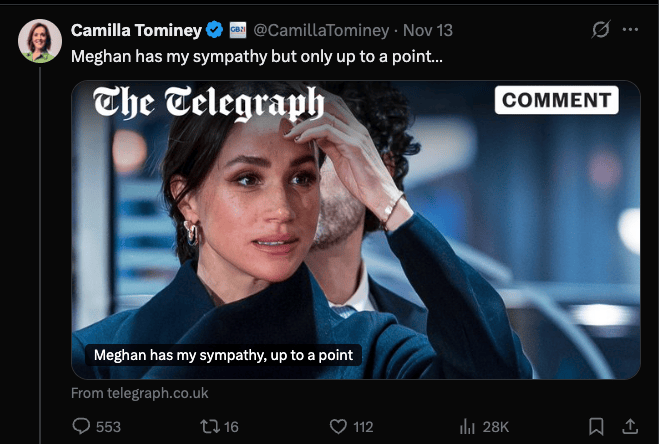
She wants Meghan to answer for her silence. Her column on Meghan’s father aims every hard question at the wrong person. And when the man in the frame was Andrew, she asked very different ones.
This week, Camilla Tominey told Telegraph readers that Meghan has her sympathy “up to a point.” Here’s mine for her: none.
Her column asks why Meghan stayed silent for seven years after the Metropolitan Police passed her a letter about her father in 2019. It hands its harshest line to an anonymous survivor, asking when we stopped treating strangers’ children as precious. And it signs off by reminding us that compassion is no exemption from scrutiny.
Fine. Let’s scrutinise the column. (Thomas Markle Sr denies the charges against him, and nothing here assumes he’s guilty.)
What the column gets wrong
1. It questions the daughter and lets the police off
The Met is the body that actually received the allegations. On 24 October, nearly three weeks before the column ran, the force confirmed it had received the letter in January 2019, passed it to Meghan, and shared it with no other law enforcement agency. The letter went to its Fixated Threat Assessment Centre, the unit that handles threats to the royal family and VIPs. In other words, it was treated as a security risk to the royals, not as a child-protection case. The Met has since referred itself to the police watchdog over its failure to pass the allegations to overseas law enforcement, and The Times has reported that it later couldn’t find the letter and asked Meghan whether she’d kept a copy. In Tominey’s column, the Met appears only as the sender of the letter. Every question goes to the daughter.
2. It never says what Meghan should have done
It demands scrutiny but names no action. Going public with unproven criminal allegations against her own father would have carried legal risk and could have compromised any investigation, and you can imagine what the papers would have called it. Reporting it to the police? The police already had it. Meghan said she trusted the authorities to act. Tominey quotes that and then waves it away through someone else’s voice instead of answering it.
3. The new case shows how this is supposed to work
Thomas Markle Sr wasn’t charged because a celebrity spoke out. According to the FBI’s affidavit, its investigation began in October after a witness reported finding suspected child abuse material among his belongings in the Philippines. Allegations reached the authorities, and the authorities acted. That’s what should have happened in 2019. The step that broke was the Met’s, not Meghan’s.
4. It hides its harshest charge behind an anonymous survivor
The line about no longer treating strangers’ children as precious implies Meghan didn’t care about other children. Tominey never says so herself. She borrows an unnamed survivor’s words and calls it an uncomfortable question. The accusation lands, she keeps her distance, and anyone who pushes back looks like they’re attacking a survivor. That survivor’s anger at institutional silence is completely legitimate. Aiming it at one private person instead of the institution was the columnist’s choice.
5. Her own story makes Meghan’s case
Tominey opens with her mother and says she wouldn’t have invited her to her wedding or trusted her with her babies. That is exactly the call Meghan made, and she spent years cast as the heartless daughter for it. The obvious conclusion is that the coverage got it wrong. The column won’t draw it. Meghan’s statement directly calls out media distortion. Tominey quotes it and says nothing about her own industry.
6. Being candid isn’t the same as making accusations
Talking about your own life to Oprah or in a memoir is a world away from publicising unproven criminal allegations about someone else. Calling the difference hypocrisy erases a line the law draws for good reason.
7. The ending argues with people who don’t exist
Nobody claimed this news settles the royal rift, and nobody asked for an exemption from scrutiny. The only family relationship this story is actually about is the one the column admits Meghan was right to end. And saying the revelation “does not rewrite history” is strange when it rewrites exactly the part of the history the column is about.
8. The headline gives the game away
“Up to a point” tells you the sympathy is a warm-up. The structure is sympathy, then “Yet,” then insinuation, then “Moreover,” then an old grievance.
The Andrew test
Now apply the column’s standard to Andrew. His friendship with a convicted sex offender dogged the royal family for more than a decade, and through most of it he kept his mansion, his shooting parties and his place at family gatherings. In February, he became the first senior royal in modern history to be arrested, on suspicion of misconduct in public office over his ties to Epstein. He denies wrongdoing. When a heckler shouted at the King, “How long have you known about Andrew and Epstein?”, that was exactly the question Tominey now puts to Meghan. Why the silence? Who knew, and what did they do about it?
The standard looked very different when the man at the centre of it was a royal. A few years ago, a Telegraph story under Tominey’s own byline ran with the headline “Andrew accuser was ‘on the game for a year’,” built on claims in court papers about Virginia Giuffre. When critics objected, she called it a straight news report. Back then, the survivor’s credibility was the story. Today, a survivor’s voice is front and centre, because this time it points at Meghan.
That’s the double standard. When it’s Meghan, the question is what she knew and why she stayed quiet. When it was Andrew, the headline was about his accuser. And the column still ends by reminding us the Sussexes chose to “publicly turn against” their own family. The same family that kept Andrew close.
So no, Camilla. Compassion isn’t an exemption from scrutiny. Neither is a press pass.
Zero sympathy. Not even up to a point.
Sources
Irish News: Met refers itself to police watchdog over action on letter about Meghan’s father
IBTimes UK: the missing letter, citing The Times
PhilSTAR Life: Thomas Markle charged with possession of child sexual abuse photos (FBI affidavit)
AP: What to know about the arrest of Andrew Mountbatten-Windsor
The Daily Beast: heckler asks King Charles about Andrew and Epstein

