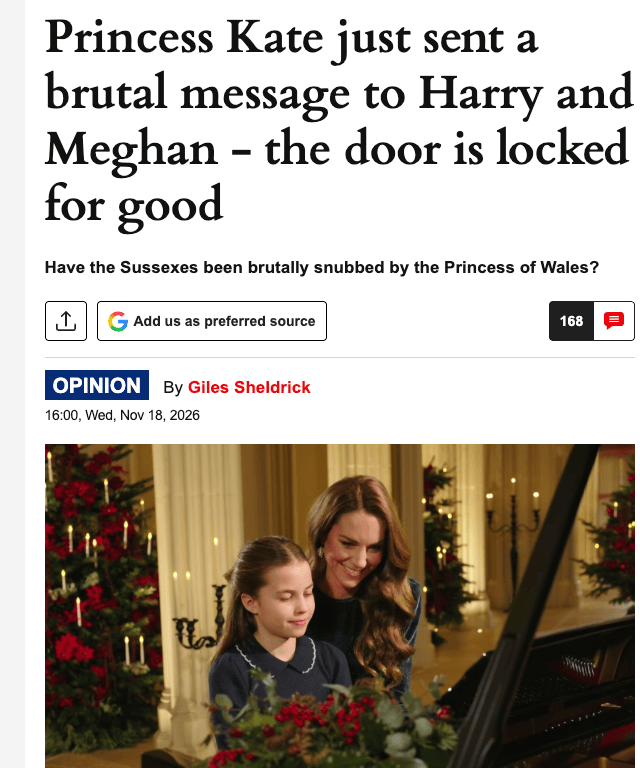
Under the Daily Express’s Facebook post about the Princess of Wales’s carol service, readers already had the backstory. Meghan, they said, had written to the palace demanding that her family be seated front and centre. Princess Anne, the King and Prince William turned her down, and the Sussexes skipped Sandringham in retaliation.Under the Daily Express’s Facebook post about the Princess of Wales’s carol service, readers already had the backstory. Meghan, they said, had written to the palace demanding that her family be seated front and centre. Princess Anne, the King and Prince William turned her down, and the Sussexes skipped Sandringham in retaliation.
No news outlet has reported any of that. The trail runs back past the Express and the Daily Mail to a 43-minute YouTube video posted on 2 November by a channel with 6,390 subscribers. Its own narrator says none of it can be verified.
This is how the story got from there to a national paper’s comment section, what changed on the way, and why the comments matter more than the video.
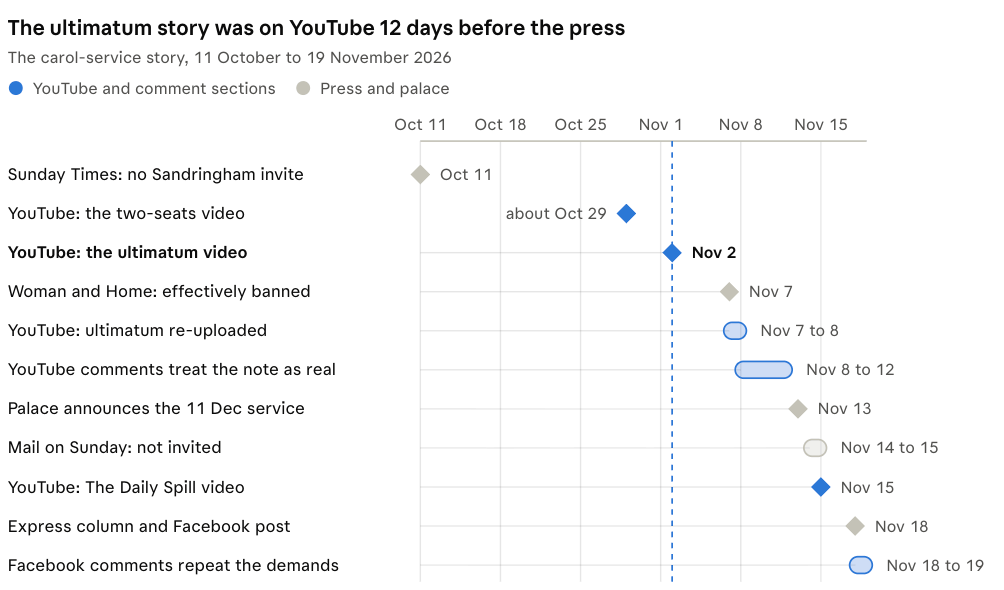
The detailed ultimatum story was online on 2 November, 11 days before the palace announced the service and 12 days before the Mail reported the snub. Dates for the two-seats video and the re-uploads are approximate.
What is actually on the record
The reporting underneath the story is thin, unconfirmed, and says nothing about demands.
- On 13 November, Kensington Palace announced the sixth Together at Christmas service, at Westminster Abbey on 11 December, with about 1,600 guests (Good Morning America).
- That weekend, the Mail on Sunday reported that Harry and Meghan had not received invitations. The outlets that repeated it named no source, and representatives for both couples did not comment (The Blast, The Nightly). As Hello! put it, “this has not been officially confirmed” (Hello!).
- The Sussexes have never attended the service. In October, the Sunday Times’s royal editor reported that they knew they weren’t invited to Sandringham for Christmas either, and were “not waiting for an invitation” (Marie Claire).
On 18 November, the Daily Express ran an opinion column by Giles Sheldrick headlined “Princess Kate just sent a brutal message to Harry and Meghan – the door is locked for good.” The column reports no message from Catherine. It predicts an invitation is “vanishingly unlikely,” quotes Harry’s recent remarks about reconciliation, and never mentions the Mail’s report. It also calls Harry Catherine’s “brother.” He is her brother-in-law.
The Express’s Facebook post for the column went further. Its first line states that the Sussexes “have been brutally snubbed,” with no opinion label, over an uncaptioned photo that appears to be from last year’s service. Two sentences later, the same post says they are only “expected to be absent.”
Each step made the claim firmer: an unconfirmed report, then a prediction headlined as a “brutal message,” then a flat statement of fact. None of it mentions a letter, a seat or a demand.
Following it back to YouTube
The demands story was on YouTube 11 days before the palace announced the date of the service, and 12 days before the Mail’s report.
The earliest version found is a video from about 29 October, “Meghan Is Said to Get NO Invitation to the Abbey’s Carol Service as Kate Hosts It.” Its description says the couple “are said to have asked for two seats” and got no invitation back. Who posted it is unclear.
The full version arrived on 2 November: “Princess Anne EXPOSED Meghan’s Ultimatum! The Sussexes LOST Catherine’s Carol Night FOREVER!”, from a channel called Crown & Controversy with 6,390 subscribers. It drew 2,100 likes and is now members-only. Near-identical uploads followed on 7 and 8 November.
The 43-minute video tells a detailed story:
- Meghan drafts a one-page note, with no envelope and no name, making three numbered points: the children seated with senior royals “in the rows the cameras find first”; Harry and Meghan arriving alongside William and Catherine; and, failing both, the Sussexes “would understand” and stay away.
- Harry hands it to a long-serving member of the household, and it goes to the event’s planners.
- At a late-night planning meeting, Anne reads it aloud and answers in 16 words: “This night is Catherine’s. She earned it by staying year after year. That is the answer.”
- Harry then rings the King, messages William’s office, and confronts Anne at a family dinner. All three say no.
None of it is sourced. Every scene comes from “the version going round,” “is said to,” or unnamed people: “a courtier,” “a friend of the couple,” “one person said to have seen the page.” No outlet, reporter or document is named.
The narrator, who gives his name only as Harold, says as much. Forty minutes in, he says the meeting, the call, the message and the dinner “all reach us through people who say they know. And none of it can be verified.” A minute later: “Even if every scene you heard today is invention, the situation underneath it is real.”
The “version going round” is never traced to anything earlier than the video. The narrator says the “exposes” headline “belongs to a viral video,” but that headline is the video’s own title.
The story doesn’t hold together either. The video opens by saying no Sussex name appeared on the final guest list, then has Catherine say the invitation “had never been withdrawn.” Its description puts quotation marks around a line from the King, “not mine to take from Catherine,” that doesn’t match the video’s own wording.
What changed on the way to Facebook
By the time the story reached the Express’s Facebook post, it had kept the video’s core and picked up details the video never contained.
| What Facebook commenters said | Where it comes from |
|---|---|
| Her children had to sit with William’s children “or they wouldn’t come” | The video’s note, points one and three, almost word for word |
| Her letter was passed to Princess Anne, the King and William | The video’s “three doors”: Anne at the meeting, the King by phone, William through his office |
| Her requests didn’t fit what the evening is for | Anne’s and Catherine’s lines in the video |
| Meghan wrote asking to be invited | Not in the video, where she sets conditions; closer to the 29 October “two seats” video |
| Front-and-centre seats for Meghan herself | Not in the video, which is about the children and the arrival |
| The Sussexes skipped Sandringham in retaliation | Not in the video, and the reverse of what was reported |
The Sandringham claim gets the order backwards. A month before the carol story, the Sunday Times reported that the couple knew they weren’t invited to Sandringham. Later commentary said they had been “effectively banned” (Woman & Home). The video does mention, accurately, that the Sussexes skipped Sandringham at Christmas 2019 to fly to Canada. The retaliation version may be a garbled echo of that.
The belief also came before the press coverage. Comments under one of the YouTube uploads, posted between 8 and 12 November, already treated the note as real: “How could MM have the nerve to make a demand to a Royal???” When the Mail’s report landed on 14 November, some readers already had an explanation for it.
How these videos are built
The method is consistent: a title that states the story as fact, a disclaimer underneath that it isn’t, and a core that can’t be traced.
Most of the Crown & Controversy video’s 43 minutes is accurate history. Anne’s 1974 kidnap attempt, Catherine’s piano performance at the first service in 2021, and the Lord Chamberlain’s 7 September letter calling the Sussexes “private citizens” are all real (Hello!). The ultimatum sits in the middle of that, with nothing behind it. The true parts make the invented ones feel checked.
The title says “EXPOSED” and “FOREVER.” The description says the channel is “for entertainment and discussion purposes only” and that “nothing presented should be taken as confirmed fact.” The title is what gets shared; the disclaimer stays on the video page.
Two YouTube features help videos like this travel. Hype lets viewers push videos from smaller channels up a leaderboard, and the 2 November video shows 51,000 hype points. Auto-dubbing makes versions of the audio in other languages, which may help explain why the carol story turned up among French, Spanish, Italian and Greek commenters on the Express’s Facebook post.
The same method works at a bigger scale. On 15 November, a channel called The Daily Spill, with 13,000 subscribers, posted “‘I Should Be QUEEN!’ Meghan’s SICK Plot To Replace Princess Kate Exposed!” It reached 75,571 views in four days. Its page carries YouTube’s “Made with AI” label: “Sounds or visuals were altered or fully generated.”
It’s a different rumour, put together the same way. A narrator makes sweeping claims and credits them to named royal commentators, then cuts to clips that often say something else. In one stretch, the narration says Meghan was “caught monitoring the internet 24 hours a day”; the clip in the middle is someone calling an essay of hers “a really lovely essay.”
It also gets checkable facts wrong. It places Meghan “thousands of miles away” and “isolated in California,” though the family has lived in the Cotswolds since 26 August. It describes Catherine as “undergoing preventative chemotherapy,” though she announced in January 2025 that she was in remission.
The comments go further, but the videos point the way
The most worrying part isn’t any one video. It’s what the comment sections build from them, and how the videos invite it.
The Daily Spill video never says Meghan would hurt anyone. But it supplies every piece of the idea. Its unnamed narrator calls her “a predator” and “a legitimate security threat against his wife and against Prince George.” It says William has her “treated as a hostile entity” with MI5’s help. It notes that the Wales children “happen to be ahead of her in the line of succession,” and twice raises the idea of being “one plane crash away from the throne.”
It then ends by asking viewers whether she needs “constant monitoring by MI5 security,” and what “the very first punishment” should be once William is king.
The audience answers. Of about 200 comments reviewed in YouTube’s default “Top” view, out of 485, roughly 25 call her a danger to Catherine or the children. The most liked are “MM really is scary especially for Cathrine & her Children” (179 likes) and “very very dangerous” (153).
A few go a step further, to physical harm. One says she is “capable of murder” (52 likes). Two imagine an “accident” befalling Catherine and the children.
Some claims come from outside the video entirely. One comment hints that Catherine’s cancer was suspicious. Others accuse the couple of crimes the video never mentions; the best received, at 120 likes, is an unsupported claim that they face a sex-trafficking lawsuit.
A minority push back, with comments like “ridiculous A.I. stuff,” “This is a fake video” and “purely conjecture.” They are outnumbered.
The escalation isn’t something viewers invent on their own. The video lays out the pieces and asks the audience to put them together, and the comment section is where that happens.
The part these videos never mention: the palace feeds the tabloids too
Every “palace insiders reveal” video leaves something out: a lot of the time, the insider is the palace.
This isn’t a conspiracy theory. In August 1996, Charles hired Mark Bolland, then director of the Press Complaints Commission. Bolland became his deputy private secretary in 1997 and, after Diana’s death that year, is credited with rebuilding Charles’s image. By one measure, the prince’s popularity rose from 20 per cent after her death to 75 per cent during Bolland’s tenure (Wikipedia). William and Harry reportedly nicknamed him “Blackadder.”
In 2015, a BBC documentary, Reinventing the Royals, examined Bolland’s tactics; the BBC postponed it after the royal family’s lawyers intervened (The Guardian). In it, Charles’s former press secretary Sandy Henney said Bolland had leaked information about the young princes to the media (Lainey Gossip). Bolland, who declined to appear on screen, called the account “utter rubbish” (The Daily Beast).
When details of the princes’ private meetings with Camilla reached the papers, her office blamed her private secretary, who later resigned (Harper’s Bazaar). In Spare, Harry suggests the leak came from Camilla herself. Either way, it came from inside the family’s own circle.
Harry says the practice never stopped. In Spare, he accuses his father and stepmother’s press operation of feeding unflattering and false stories about other royals to the papers, though he pins it on a staffer: “It wasn’t them, technically” (BuzzFeed News). In the Netflix series, he describes how the offices trade: to kill a bad story about their own principal, they “give you something about someone else’s principal” (Marie Claire). He says his brother’s office later did the same, after the two had promised each other they never would. The royal family has not publicly responded to those claims.
The traffic runs both ways. Tobyn Andreae, the King’s communications secretary since 2022, was previously co-deputy editor of the Daily Mail, and before that of the Mail on Sunday (BuzzFeed News).
So when a video says “according to insiders,” or a biographer says “palace sources tell me,” ask who gains from the story. A tale about Meghan demanding to outrank Kate doesn’t just make Meghan look bad. It makes everyone else look gracious by comparison. Whether or not this particular story came through that channel, it’s exactly what the trading system Harry describes is built to produce.
This pattern is worth learning to spot, because it’s everywhere, not just in royal content. Take one unverified anecdote from a source with a grudge. Strip off the hedges and stack escalating adjectives on top. By minute three it’s treated as established fact, and the rest of the video builds on it.
The Daily Spill’s video does exactly this. Its narrator says Meghan “allegedly pressured” Harry to ask the late Queen to rank her above Catherine. The clip offered as support says only that “she probably pushed him for it.” By 3:03, the narration has the Queen saying “absolutely not” and Meghan’s ambition “mutated.”
If the strongest evidence for a 30-minute “psychological thriller” is a single “probably,” that tells you what you’re watching.
What it adds up to
Take away the videos and the comments, and what’s left is small: one unconfirmed report that the Sussexes weren’t invited, one opinion column predicting they wouldn’t be, and two quotes from Harry about wanting to reconcile.
Everything else, the note, the seats, Anne’s 16 words, the retaliation, traces back to a video whose narrator says it can’t be verified. After that video, nobody in the chain had to invent much. Each step dropped a qualifier or added a detail, until readers of a national paper were repeating it as the backstory.
A few checks would have caught it:
- Does the title claim what the description disclaims? “For entertainment and discussion purposes only” under “EXPOSED” is a warning.
- Is anything tied to a named outlet, reporter or document? “The version going round” and “is said to” are not sources.
- Do the dates work? This story existed before the palace had even announced the service.
- What does YouTube’s “How this was made” panel say? An AI label is worth noting, but its absence proves little, since it largely depends on creators disclosing.
If the Sussexes are absent from Westminster Abbey on 11 December, expect the note to be cited as the reason. As of today, nobody has produced it.
Sources and notes
Also reviewed: the Daily Express column and its Facebook post (18 November), The Daily Spill’s video (15 November), and the comment sections under each, as they stood on 19 November
Good Morning America: Kensington Palace announces the 11 December service, 13 November
The Blast and The Nightly: coverage of the Mail on Sunday’s report, 15 November
Hello!: the report “has not been officially confirmed”
Marie Claire: the Sunday Times on the Sussexes and Sandringham, 11 October
Woman & Home: “effectively banned” from Sandringham, 7 November
Hello!: the Lord Chamberlain’s letter of 7 September and the 26 August move
YouTube: Crown & Controversy, 2 November; later uploads on 7 and 8 November; the “two seats” video, about 29 October

