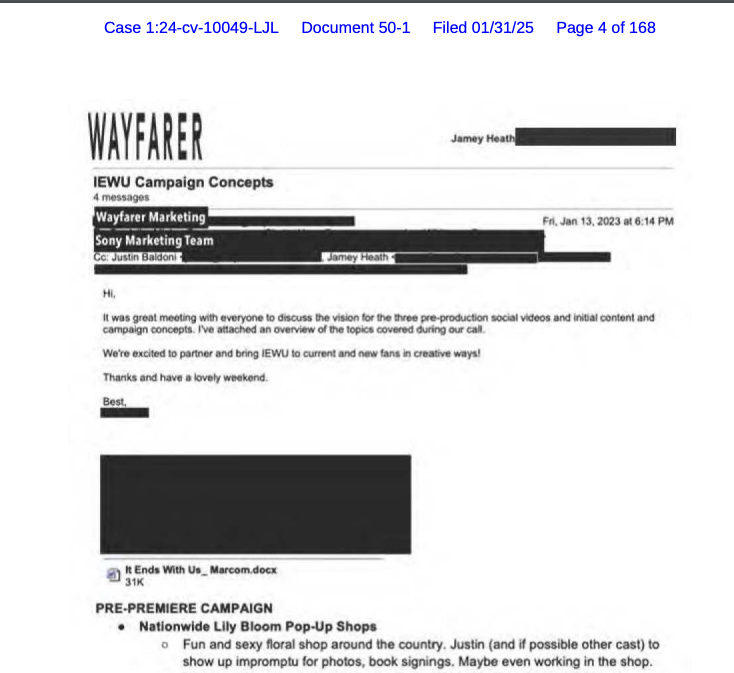
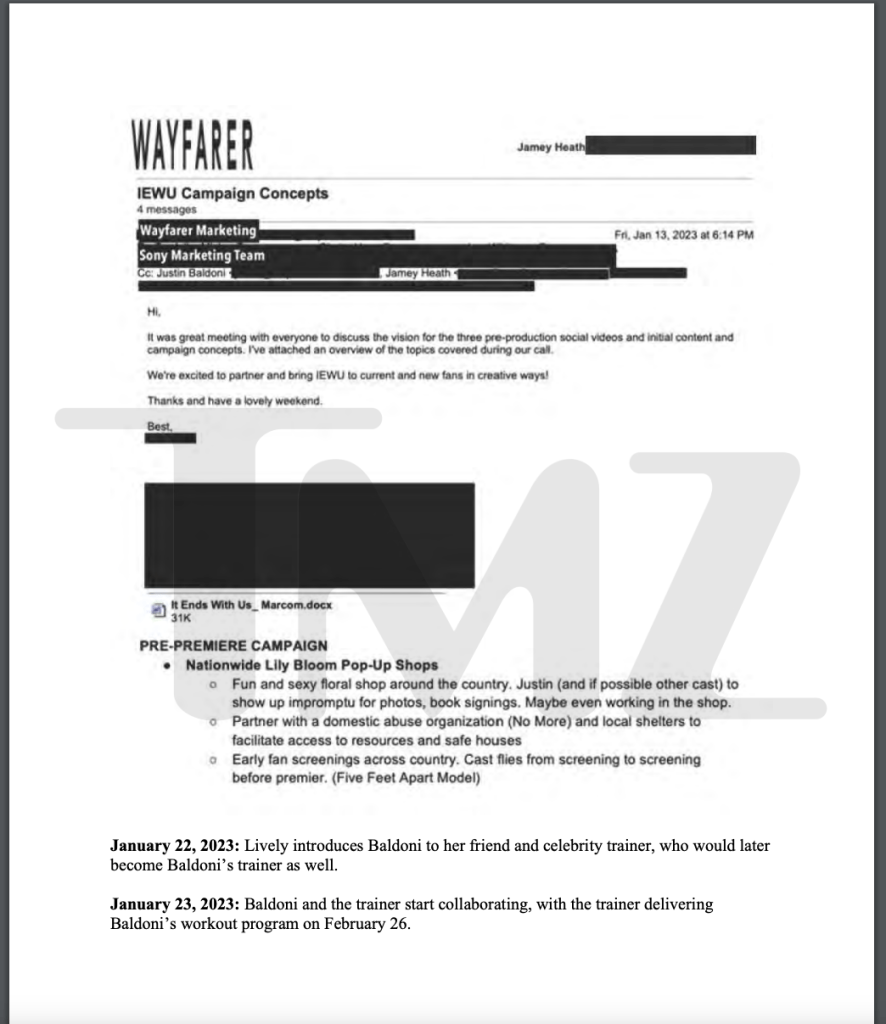
A newly revealed email from Justin Baldoni Case 1:24-cv-10049-LJL Document 50-1 Filed 01/31/25 Page 4 of 168 that Wayfarer Studios, not Sony or Blake Lively, originally proposed the floral-themed marketing for It Ends With Us. The 2023 marketing plan from Wayfarer included “fun and sexy” floral pop-up shops across the country. This contradicts previous claims that Lively’s floral-themed promotions were her own decision and dismisses criticism that they were “tone-deaf.”
This revelation has reignited debate online. Some argue that the email proves Wayfarer—likely Justin Baldoni himself—was behind the floral branding, and that Sony and Lively simply followed along. Others claim the email only shows a discussion between marketing teams and does not conclusively prove the idea originated with Wayfarer. However, the phrasing in the email strongly suggests that it was a Wayfarer-led initiative.
Some users are also questioning Baldoni’s control over the film’s branding. They argue that if he wanted to retain full authority over the marketing, he should not have involved a major studio like Sony. Others point out the hypocrisy of blaming Lively for the floral branding when Wayfarer’s own “fun and sexy” plan was clearly at the center of the film’s marketing from the start.
Page-by-Page Analysis of the Amended Complaint (Pages 1-30)
Pages 1-5: Introduction and Key Allegations
- The lawsuit claims that Blake Lively, Ryan Reynolds, and The New York Times engaged in a coordinated effort to smear Justin Baldoni by fabricating sexual harassment allegations and defaming his reputation.
- It states that Lively’s lawsuit was part of an extortion attempt to maintain control over It Ends With Us and retaliate against Baldoni for resisting her creative influence.
- The complaint alleges that Lively used her high-profile connections to pressure Baldoni, with particular emphasis on Ryan Reynolds and an unnamed celebrity friend.
Key discrepancy:
The timeline and internal messages later reveal that Baldoni willingly gave Lively creative input and approved many of her changes, contradicting the claim that she “hijacked” the film.
Pages 6-10: The Role of The New York Times
- The lawsuit argues that Lively worked with The New York Times months before filing her lawsuit, ensuring that the article was ready to go the moment she filed her legal complaint.
- It claims that metadata from the Times article shows that images and materials were uploaded long before the lawsuit was filed, implying pre-planned coordination.
Key discrepancy:
The filing later admits that metadata timestamps do not definitively prove collusion, only that the article was in progress. This weakens the argument that The New York Times and Lively conspired months in advance.
Pages 11-14: Communications Between Baldoni and Colleen Hoover
- The complaint includes emails from 2019 where Baldoni expresses admiration for the book and talks about the film’s potential to impact domestic abuse survivors.
- He initially suggests partnering with domestic abuse organizations to ensure the film’s message aligns with survivor advocacy.
Key discrepancy:
Later evidence shows that Wayfarer Studios later scrapped its planned partnership with No More, a domestic abuse organization, contradicting Baldoni’s claim that he remained committed to advocacy.
Pages 15-17: Sony and Wayfarer’s Partnership
- The complaint states that Wayfarer and Sony had originally allocated 1% of the film’s profits to support domestic abuse survivors.
- It claims that Lively refused to meet with the nonprofit No More, which the lawsuit implies shows her lack of commitment to the book’s themes.
Key discrepancy:
The lawsuit does not show any written refusal from Lively—it states that she did not meet with No More, but does not provide communications where she explicitly declined.It does not explain whether Wayfarer or Sony continued to pursue the No More partnership after Lively’s refusal—if the partnership was important, they could have moved forward without her endorsement.It frames Lively’s refusal as undermining the film’s message, but actors often have personal reasons for not engaging with specific advocacy groups.
Pages 18-19: Lively’s Role as Executive Producer
- The lawsuit states that Lively was given an executive producer credit as a courtesy title, with no real decision-making authority expected.
- However, it claims that she quickly overstepped, demanding more creative control and disrupting production.
Key discrepancy:
Later emails confirm that Baldoni voluntarily worked with Lively on script edits and encouraged her creative input, contradicting the claim that she forcefully took control of the project.
Page 20: The Wardrobe Conflict
- The complaint accuses Lively of refusing to participate in wardrobe fittings at the production office, instead demanding her wardrobe be delivered to her New York residence.
- It claims this caused significant budget issues and production delays.
- It further alleges that Lively insisted her character wear $5,000 designer shoes, forcing Baldoni to rewrite the script to justify her wardrobe choices.
Key discrepancy:
High-profile actors frequently have wardrobe approval and personal styling teams, making this request not unusual. The claim that Baldoni had to rewrite the script due to wardrobe concerns is exaggerated, as small styling changes do not typically require major script alterations.
Pages 21-24: Allegations of Lively’s Influence Over the Script
- The lawsuit describes how Baldoni initially allowed Lively to make script edits, but then claims she began altering the script daily without proper approval.
- It includes messages between Baldoni and Sony executives, where Baldoni complains that Lively was treating the production as if she were directing the movie herself.
Key discrepancy:
Earlier emails show that Baldoni frequently praised Lively’s edits and encouraged her involvement, contradicting the claim that her influence was forced upon him.
Pages 25-28: The Rooftop Scene Controversy
- The lawsuit alleges that Lively forced script rewrites for the iconic rooftop scene, and that Ryan Reynolds pressured Baldoni to accept the changes.
- It claims that Reynolds and another high-profile celebrity (potentially Taylor Swift) attended a meeting at Lively’s penthouse, where they praised Lively’s rewritten scene in a way that made Baldoni feel pressured to accept it.
- The lawsuit states that Lively later publicly claimed Reynolds wrote the rooftop scene, contradicting her earlier statements.
Key discrepancy:
There is no direct evidence that Reynolds and the unnamed celebrity forced Baldoni’s decision. The lawsuit also acknowledges that Baldoni told Lively her changes would be considered, implying that she was not making unilateral decisions.
Pages 29-30: The Alleged Weight-Shaming Incident
- The lawsuit claims that Lively falsely accused Baldoni of weight-shaming her.
- It states that Baldoni had privately asked Lively’s trainer for her weight to ensure that he could safely perform a lift scene without injuring his back.
- The lawsuit argues that Lively used this as an excuse to publicly humiliate Baldoni, despite the request being a common industry practice for physical stunts.
Key discrepancy:
Lively’s legal complaint argues that Baldoni asked about her weight in an inappropriate manner. The lawsuit does not provide any direct messages or evidence that clarify how the request was made, leaving room for different interpretations.
Key Takeaways from Pages 1-30
The weight-shaming accusation lacks clear evidence proving whether Baldoni’s request was inappropriate or industry standard.
Wayfarer Studios removed its planned nonprofit partnership, contradicting its claim that Lively was responsible for distancing the film from survivor advocacy.
Baldoni willingly allowed Lively creative influence early in production but later reframed it as her “hijacking” the film.
The lawsuit’s argument that The New York Times colluded with Lively is weakened by its own admission that metadata does not prove direct coordination.
The wardrobe complaints describe common industry practices and exaggerate the impact of Lively’s styling choices.
The lawsuit claims Lively and Reynolds pressured Baldoni into script changes, but it acknowledges that he told Lively her edits would be considered.
Pages 31-35: Intimacy Coordination and Nudity Rider Concerns
- These pages discuss Lively’s alleged concerns about intimate scenes and the absence of an intimacy coordinator.
- The lawsuit claims that Lively’s insistence on an intimacy coordinator was baffling, as one had already been engaged.
- It argues that Wayfarer never violated SAG-AFTRA rules, despite Lively’s claims that she was subjected to uncomfortable filming conditions.
Key discrepancy:
Later emails confirm that Lively’s legal team had requested an intimacy coordinator before production resumed, which contradicts the claim that her concerns were fabricated after the fact.
Pages 36-40: The Birthing Scene Dispute
- The complaint addresses Lively’s claim that she was “mostly nude” during a birthing scene, with non-essential crew members present.
- Baldoni’s team states that Lively was wearing black briefs and a pregnancy suit, not merely a small fabric covering.
- It argues that Wayfarer never filmed intimate scenes without proper industry standards in place.
- The complaint also claims that Lively falsely accused the film’s financier of being present during the scene, when in fact, he arrived later for an unrelated moment.
Key discrepancy:
The complaint acknowledges that Lively was wearing a pregnancy suit, but it attempts to discredit her account by implying she exaggerated the situation. However, Lively’s complaint never claimed she was fully nude—only that she was uncomfortable and that the scene lacked necessary safeguards.
Pages 41-45: Improvised Kissing and Physical Contact
- The lawsuit states that Baldoni never initiated physical contact outside of the script, contradicting Lively’s claims of improvised physicality.
- It includes a specific incident where Lively allegedly pulled Baldoni in for multiple unchoreographed kisses, stating that she initiated these moments.
- It argues that Lively’s lawsuit deliberately ignores her own improvisations while portraying Baldoni as inappropriate.
Key discrepancy:
The complaint acknowledges that multiple versions of the kissing scene were filmed, which implies that deviations from the script occurred. While it argues that Lively initiated some of these moments, it does not disprove that Baldoni also participated in off-script physical interactions.
Pages 46-50: Lively’s Demands for Set Restrictions
- The lawsuit challenges Lively’s request for restrictions on who could be present during intimate scenes, arguing that this was already standard practice.
- It claims that Wayfarer had no issue agreeing to these demands but felt they were being used against them to imply wrongdoing.
- The filing states that no intimate scenes were filmed prior to the strike, so Lively’s claim that such scenes occurred without proper safeguards is false.
Key discrepancy:
While the complaint insists that Wayfarer followed industry standards, it does not address whether Lively was made to feel uncomfortable regardless of technical compliance. The argument focuses on procedural correctness rather than acknowledging her discomfort.
Pages 51-55: The Romance Montage Scene Dispute
- The lawsuit recounts an incident where Lively allegedly refused to follow Baldoni’s direction during a romantic montage.
- It states that Lively wanted to add constant dialogue, while Baldoni and the assistant director wanted a more silent, emotional scene.
- It describes a moment where Baldoni referenced his own marriage to encourage her to act differently, which Lively later described as an inappropriate personal conversation.
- The complaint also states that Lively joked about Baldoni needing rhinoplasty, suggesting that she made inappropriate comments about his appearance while accusing him of doing the same.
Key discrepancy:
The description of this scene admits that personal discussions occurred on set, including references to Baldoni’s marriage and Lively’s personal relationship preferences. While it frames Lively as the disruptive one, it confirms that Baldoni engaged in personal discussions as well, contradicting his later claim that all interactions were purely professional.
Pages 56-60: Disputing Lively’s Harassment Claims
- The complaint argues that Lively consistently blurred the lines between professional and personal interactions.
- It states that Baldoni never made inappropriate comments about her appearance outside of character, but that Lively misinterpreted his comments as personal rather than directed at her role.
- The filing describes a specific instance where Baldoni allegedly commented on Lively’s wardrobe being “sexy”, which he claims was a reference to a costume decision, not a personal remark.
- The lawsuit claims that Lively was comfortable joking about Baldoni’s appearance, but later framed his comments as inappropriate while ignoring her own statements.
Key discrepancy:
While the complaint insists that Baldoni never crossed professional boundaries, it acknowledges that Lively perceived certain interactions differently, which means her claims cannot be dismissed outright. Additionally, the fact that the production later agreed to Lively’s demands for increased safeguards suggests there was at least some recognition of her concerns.
Key Takeaways from Pages 31-60
- Lively’s request for an intimacy coordinator was made before production resumed, contradicting the claim that it was a last-minute excuse for legal action.
- The complaint disputes Lively’s claims about being exposed during the birthing scene but confirms that the scene lacked full privacy measures.
- Baldoni’s argument that Lively initiated unchoreographed kisses does not disprove that off-script physical interactions occurred.
- The romance montage dispute confirms that personal discussions occurred on set, despite Baldoni’s claim that all interactions were professional.
- The lawsuit frames Lively’s set demands as manipulative, yet the production ultimately agreed to them, suggesting they had validity.
Pages 61-65: Ryan Reynolds’ Alleged Aggressive Behavior in Meetings
- The lawsuit describes a January 4, 2024, meeting in which Ryan Reynolds allegedly confronted Baldoni over Lively’s grievances.
- Baldoni and his producer, Jamey Heath, claim they were “ambushed” by Reynolds and Lively, who demanded Baldoni apologize for “fabricated” misdeeds.
- The complaint states that a Sony representative later expressed regret for not intervening in Reynolds’ alleged tirade.
Key discrepancy:
The complaint frames Reynolds as an aggressor, yet does not include direct messages from Reynolds to support this. The lawsuit also does not explain why Sony executives, who had financial incentives to support Baldoni, allegedly sided with Lively.
Pages 66-70: Allegations of Lively’s “Extortion”
- The filing states that Lively’s January 2024 grievances were completely separate from her initial 17-point list of production concerns from November 2023.
- It accuses Lively of “inventing” new complaints to maintain leverage over Wayfarer and Sony.
- The lawsuit also claims that Lively’s formal complaint to the California Civil Rights Department (CRD) was riddled with deliberate misrepresentations.
Key discrepancy:
The complaint does not provide clear proof that Lively “invented” new concerns, only that she expanded upon prior complaints. It also does not explain why the CRD would accept a complaint that was entirely fabricated.
Pages 71-75: Allegations that Lively Usurped the Film’s Editing Process
- The lawsuit claims that Lively forced her way into the post-production process, violating the Director’s Guild of America (DGA) rules.
- It describes how Baldoni’s 10-week director’s cut period was interrupted by Lively, who demanded access to the editing bay.
- The filing includes emails in which Baldoni initially welcomed Lively’s input, but then claims she overstepped by demanding final approval over scenes.
Key discrepancy:
Emails between Lively and Baldoni show cordial discussions about her involvement in the editing process, contradicting the claim that she forcefully took over. Additionally, if Sony granted her access, this suggests she had contractual authority, which the lawsuit denies.
Pages 76-80: Lively Allegedly Pushed Baldoni Out of Editing
- The complaint states that Lively’s “two-day visit” to the editing bay turned into ten days.
- It accuses Lively of wanting to direct the film herself, rather than just provide input.
- It alleges that Baldoni was pressured to incorporate seven pages of her notes, despite having no obligation to do so.
Key discrepancy:
While the complaint claims Baldoni had no obligation to accept Lively’s edits, it does not explain why Sony allowed her to have extended involvement. This suggests studio executives, not just Lively, approved her role in editing.
Pages 81-85: Sony’s Alleged Pressure to Accommodate Lively
- The lawsuit alleges that Sony was forced to allow Lively to create her own cut of the film.
- It claims that Sony executives felt they had no choice because Lively refused to promote the movie unless her demands were met.
- It also claims that Wayfarer tried to require Lively to sign her contract before granting her more power, but she refused.
Key discrepancy:
The lawsuit does not include internal Sony emails confirming that executives were pressured. Instead, it makes broad claims about their motivations without documented proof.
Pages 86-90: Lively’s Alleged Final Takeover of the Film
- The lawsuit states that Baldoni and the film’s original editors were blocked from seeing Lively’s version of the film.
- It claims that Baldoni continued working on his own director’s cut, assuming it would be the final version, but later found out Lively’s cut was the one being finalized.
- The lawsuit describes a “doomsday scenario” where Wayfarer and Baldoni were forced to accept Lively’s final cut or risk the film’s failure.
- It claims that Sony ultimately agreed to Lively’s demands to avoid marketing complications.
Key discrepancy:
If Sony fully backed Baldoni, they would have had the legal ability to reject Lively’s cut. The lawsuit does not explain why Sony consistently sided with Lively if Baldoni’s version was superior.
Key Takeaways from Pages 61-90
- The complaint describes a confrontation with Ryan Reynolds but does not provide direct evidence, making the allegations one-sided.
- The lawsuit does not prove that Lively’s CRD complaint was fabricated, only that it included more grievances than her original list.
- Emails suggest Baldoni and Lively initially collaborated on editing, contradicting the claim that she forcefully took over.
- Sony’s actions indicate they supported Lively’s involvement in editing, undermining the lawsuit’s argument that she acted without authority.
- The lawsuit does not explain why Sony executives, who had financial incentives to back Baldoni, consistently sided with Lively.
Page-by-Page Analysis of the Amended Complaint (Pages 91-120)
Pages 91-95: Baldoni’s Allegations That He Was Forced Out of the Film’s Promotion
- The complaint claims that Lively and Sony deliberately sidelined Baldoni from promotional events.
- It states that Baldoni was excluded from key press junkets, talk show appearances, and interviews.
- It alleges that Sony had initially planned for Baldoni to participate in all promotions but later altered its plans under pressure from Lively.
- Baldoni claims he wasn’t even allowed to see the final cut of the film before its release.
Key discrepancy:
- The complaint does not provide direct evidence of Sony’s alleged pressure from Lively.
- If Sony made the decision to exclude Baldoni, this suggests a studio decision rather than Lively acting unilaterally.
Pages 96-100: Allegations That Baldoni Was Treated Unfairly at the Premiere
- Baldoni claims that he was “banned” from attending the film’s main premiere event.
- The lawsuit states that Sony had to negotiate with Lively just to allow Baldoni to attend.
- It describes how Baldoni and his family were placed in a separate theater to watch the film and were not allowed on the red carpet when Lively was present.
- Security allegedly escorted Baldoni out of the venue before Lively arrived to prevent any interaction.
Key discrepancy:
- The lawsuit does not provide communications from Sony confirming that Baldoni was banned.
- The claim that Baldoni’s team had to host a separate afterparty because they were excluded from the main event is not backed by internal Sony documents.
Pages 101-105: Baldoni’s Claims That Lively Used the Film for Personal Brand Building
- The lawsuit argues that Lively used the film as a vehicle to boost her personal business ventures.
- It points to Lively’s social media campaign, which prominently featured her new haircare line, Blake Brown.
- It also claims that she tied the film’s release to cross-promotional efforts for her alcohol brand, Betty Booze.
Key discrepancy:
- The complaint does not provide proof that Lively deliberately timed the Blake Brown launch to coincide with the film.
- Many actors promote personal brands during film press tours, making this claim subjective rather than legally significant.
Pages 106-110: Wayfarer’s Concerns About Marketing Strategy
- The lawsuit states that Wayfarer executives raised concerns about Lively’s approach to marketing.
- Emails between Wayfarer’s CEO, Jamey Heath, and Sony marketing executives show frustration with the film’s messaging focusing too much on fashion rather than domestic abuse awareness.
- One email from Heath states:“Many people are pointing out that the domestic violence themes are being glossed over.”
Key discrepancy:
- If Wayfarer itself approved the marketing campaign, this implies an internal failing, rather than Lively’s personal sabotage.
- The lawsuit ignores Wayfarer’s responsibility in shaping the marketing.
Pages 111-115: Allegations That Lively’s Marketing Strategy Damaged the Film’s Reputation
- The complaint claims that Lively’s “tone-deaf” press campaign sparked backlash against the film.
- It describes how social media users criticized the floral-themed promotions.
- It includes Wayfarer internal communications acknowledging that the campaign was facing criticism.
Key discrepancy:
- Wayfarer’s leaked emails confirm that they approved the marketing plan, meaning they can’t fully blame Lively for its failures.
- The complaint does not explain why Sony would approve a marketing strategy if it was fundamentally flawed.
Pages 116-120: Allegations That Lively Blocked Wayfarer’s Partnership with No More
- The lawsuit revisits Wayfarer’s abandoned partnership with No More, a domestic abuse awareness nonprofit.
- It states that Lively’s team did not prioritize this partnership, leading to its cancellation.
- It implies that Lively deliberately distanced herself from domestic abuse advocacy to focus on her personal branding.
Key discrepancy:
- Earlier sections of the complaint confirm that Wayfarer had already backed away from the No More partnership.
- The lawsuit fails to acknowledge that the decision was a joint marketing strategy, rather than Lively acting alone.
Key Takeaways from Pages 91-120
- Baldoni’s claim that he was banned from promotional events lacks direct evidence from Sony executives.
- The lawsuit implies that Sony altered its marketing plans under Lively’s pressure, but does not provide documentation proving this.
- Wayfarer’s marketing complaints acknowledge that they approved the campaign, contradicting claims that Lively acted alone.
- The lawsuit fails to acknowledge that Wayfarer itself decided to move away from the No More partnership.
- Baldoni’s argument that Lively used the film for personal brand promotion is largely speculative.
Pages 121-125: Allegations That Sony and Wayfarer Had to Manage the Fallout from Lively’s Lawsuit
- The lawsuit claims that Sony executives were frustrated with Lively’s legal filing and the media storm surrounding it.
- It states that Sony feared the backlash could hurt box office performance and had to engage in damage control meetings with Wayfarer executives.
- The complaint also claims that Sony and Wayfarer felt Lively had gone “rogue” by filing her complaint without prior negotiations.
Key discrepancy:
- If Sony executives were genuinely blindsided by Lively’s actions, there should be internal communications confirming their frustration.
- The lawsuit does not include Sony’s own statements about this issue, relying instead on Wayfarer’s interpretation.
Pages 126-130: Allegations That Lively’s Team Planted Negative Stories
- The complaint claims that Lively’s publicist, Leslie Sloane, was feeding the media negative narratives about Baldoni.
- It cites a Daily Mail article published in early August 2024, which detailed the alleged feud between Baldoni and Lively.
- The filing states that Wayfarer’s internal PR team believed Sloane had leaked the story to frame Baldoni as the villain.
Key discrepancy:
- While the lawsuit suggests Sloane deliberately leaked information, it does not include direct emails or texts proving that Sloane orchestrated the media narrative.
- The Daily Mail article could have been based on general industry speculation rather than an intentional PR campaign from Lively’s team.
Pages 131-135: Crisis Management Strategies at Wayfarer
- The lawsuit details how Wayfarer and Baldoni’s PR team worked to counteract Lively’s lawsuit in the media.
- It states that Wayfarer considered hiring crisis PR specialist Melissa Nathan to manage the situation.
- The complaint claims that Nathan advised Baldoni’s team to avoid appearing as a victim, while also subtly discrediting Lively’s claims.
Key discrepancy:
- The complaint frames Baldoni’s PR team as merely reacting to Lively’s actions, yet it confirms that they actively strategized media counter-narratives.
- The messages suggest that Wayfarer was just as engaged in shaping public perception as Lively’s team was.
Pages 136-140: Internal Disputes Over PR Handling
- The lawsuit details how Stephanie Jones, Baldoni’s former PR consultant, clashed with Wayfarer’s team.
- It claims that Jones attempted to take control of crisis management but was sidelined due to conflicts with other PR professionals.
- The filing states that Jones contacted media outlets without Wayfarer’s approval, worsening the situation.
Key discrepancy:
- The lawsuit blames Jones for PR missteps, yet it does not explain why Wayfarer continued working with her for months despite these issues.
- The complaint also admits that Wayfarer’s leadership had internal disagreements about how to handle the media, suggesting there was no unified approach.
Pages 141-145: Allegations of Media Manipulation
- The complaint states that negative stories about Baldoni’s religion and alleged fat-shaming of Lively were being “shopped” to multiple media outlets.
- It claims that Lively’s team wanted to frame Baldoni as a member of a religious cult to weaken his credibility.
- Internal PR messages discuss how to counteract these narratives and manage Baldoni’s public image.
Key discrepancy:
- There is no concrete evidence in the lawsuit that Lively’s team pushed these narratives, only speculation from Baldoni’s PR team.
- The messages suggest Baldoni’s team anticipated negative coverage rather than proving direct media leaks from Lively’s side.
Pages 146-150: The “Flood the Zone” PR Strategy
- The lawsuit reveals that Wayfarer’s team discussed flooding media outlets with positive Baldoni coverage to counteract Lively’s allegations.
- An internal PR email from August 2024 states:“We need to ensure that we promote positive narratives that media outlets cannot ignore.”
- The complaint also describes a push for stories highlighting Baldoni’s charitable work, personal struggles, and dedication to the film.
Key discrepancy:
- While the lawsuit claims that Lively’s team engaged in media manipulation, it confirms that Wayfarer was actively doing the same.
- The “flood the zone” strategy is a standard crisis PR tactic, contradicting the lawsuit’s framing that only Lively’s team engaged in reputation management.
Key Takeaways from Pages 121-150
- The lawsuit suggests Sony was frustrated with Lively’s lawsuit but does not provide direct communications proving this.
- Claims that Lively’s team planted negative stories are based on speculation rather than concrete proof.
- Wayfarer’s internal PR team was highly active in media management, contradicting claims that Baldoni was simply reacting to Lively’s attacks.
- Stephanie Jones’ involvement in PR disputes shows that Wayfarer itself had internal chaos over crisis management.
- The “flood the zone” strategy confirms that Baldoni’s team was actively working to control public narratives, just as they accused Lively of doing.
Page-by-Page Analysis of the Amended Complaint (Pages 151-180)
Pages 151-155: Allegations That Lively Manipulated Media Coverage
- The lawsuit claims that Lively deliberately altered and selectively edited text messages to make Baldoni’s PR team appear as though they orchestrated a smear campaign.
- It states that Lively provided these manipulated messages to The New York Times, knowing they would use them as the foundation of their article.
- The complaint argues that Lively and her legal team cherry-picked private communications to create a false narrative.
Key discrepancy:
- The lawsuit does not provide the full unedited text messages to refute Lively’s claims, making it difficult to verify whether they were truly manipulated.
- If Lively had the ability to distort messages without pushback from Wayfarer or Sony, this suggests poor crisis management on Baldoni’s side rather than deliberate deception from Lively.
Pages 156-160: The Alleged “Fake Smear Campaign” Narrative
- The complaint states that Lively, The New York Times, and her PR team fabricated the smear campaign narrative.
- It describes how The Times relied on a few internal messages taken out of context to suggest that Baldoni’s team was actively working to ruin Lively’s reputation.
- The lawsuit claims that The Times made little effort to investigate the veracity of Lively’s claims before publication.
Key discrepancy:
- The lawsuit itself acknowledges that Baldoni’s PR team was engaged in a reputational defense strategy, meaning they were actively working to counteract Lively’s accusations.
- The complaint does not provide internal communications from The Times that would confirm bias or lack of journalistic integrity.
Pages 161-165: Allegations That Lively Orchestrated The New York Times Article
- The lawsuit argues that Lively had been planning the Times article for months, ensuring it would be released at the most damaging moment for Baldoni.
- It claims that metadata from the article shows that images and videos were uploaded long before the publication date, suggesting coordination between Lively’s team and The Times.
- The filing states that Lively carefully timed the release to maximize negative press around Baldoni while securing public support for herself.
Key discrepancy:
- The metadata argument only proves that The Times was working on the story before publication, not that Lively orchestrated the entire process.
- The lawsuit does not provide direct evidence of communications between Lively and The Times proving collusion.
Pages 166-170: Allegations That The New York Times Failed to Fact-Check
- The lawsuit criticizes The Times for publishing a one-sided narrative without verifying Lively’s claims.
- It states that The Times relied solely on Lively’s legal complaint and text messages rather than conducting independent fact-finding.
- The complaint also argues that The Times did not attempt to reach out to Baldoni’s team for comment until the last moment, limiting his ability to respond.
Key discrepancy:
- While The Times might have leaned toward Lively’s perspective, this does not prove defamation—media outlets frequently report on legal cases based on public filings.
- The lawsuit does not include evidence that The Times deliberately ignored exculpatory information from Baldoni’s side.
Pages 171-175: Allegations That PR Consultant Melissa Nathan Was Misrepresented
- The complaint states that Lively’s team framed Baldoni’s PR consultant, Melissa Nathan, as a key figure in a smear campaign against Lively.
- It describes how Nathan’s sarcastic texts were taken out of context and used as proof of a coordinated attack.
- The lawsuit claims that Lively and her team deliberately omitted context from these messages to make them appear incriminating.
Key discrepancy:
- The complaint acknowledges that Nathan’s team was actively monitoring public sentiment around Lively, meaning there was at least some effort to shape media narratives.
- The lawsuit does not provide Nathan’s full text conversations, making it difficult to verify whether the excerpts were truly misleading.
Pages 176-180: Allegations That Lively’s PR Team Used Bots to Amplify Negative Coverage
- The lawsuit states that Baldoni’s team suspected that Lively’s PR firm engaged in an artificial social media amplification strategy.
- It describes how negative tweets and Reddit threads criticizing Baldoni appeared to be gaining traction at an unnatural rate.
- The complaint alleges that Lively’s team strategically used online discussions to reinforce The Times’ article.
Key discrepancy:
- The complaint does not provide data analysis confirming the use of bots or paid engagement.
- If bot activity was a major issue, Baldoni’s PR team could have publicly raised concerns with social media platforms, but there is no record of such an effort.
Key Takeaways from Pages 151-180
- The lawsuit claims Lively manipulated text messages but does not provide the full unedited versions as proof.
- Baldoni’s PR team was engaged in reputation management, contradicting claims that all negative press against Lively was organic.
- The metadata argument does not prove collusion between Lively and The Times—only that the article was prepared in advance.
- The lawsuit criticizes The Times for biased reporting but does not present clear evidence that they ignored exculpatory facts.
- Claims about Lively’s PR team using bots to amplify negative coverage remain speculative without supporting data.
Pages 181-185: Baldoni’s PR Team Discussing Media Strategy
- The lawsuit contains internal PR emails from Baldoni’s team discussing how to counteract Lively’s allegations.
- The messages show Baldoni’s team debating how to present themselves as victims while maintaining credibility.
- A PR consultant advises Baldoni’s team to focus on his family and charitable efforts to “move the public conversation away from the drama.”
Key discrepancy:
- The lawsuit portrays Baldoni’s team as merely responding to Lively’s attacks, but these emails confirm they were actively shaping media narratives.
- The messaging strategy is almost identical to what the lawsuit accuses Lively’s team of doing.
Pages 186-190: Concerns About Bot Accounts and Online Manipulation
- The complaint alleges that Lively’s PR team used bot accounts to spread negative coverage about Baldoni.
- Internal emails show Baldoni’s team worried that their own support base might be accused of being bots.
- One message states:”I’ve been seeing some IG comments defending me from accounts with no followers. Can we confirm we aren’t doing anything that could be perceived as bots?”
Key discrepancy:
- The lawsuit accuses Lively of using bots but does not provide analytical proof.
- Baldoni’s team also seems worried about accusations that they are using fake engagement, showing that both sides were concerned about online perception.
Pages 191-195: Attempts to Change the Public Narrative
- PR advisors recommend that Baldoni shift focus to future projects to move away from the controversy.
- There is discussion about whether to announce a new directing project as a distraction.
- One email states:”When we move on, they do too. We need to elevate Justin’s other projects to help with the Blake narrative.”
Key discrepancy:
- The lawsuit repeatedly claims Baldoni was a victim of a coordinated smear campaign, yet his own PR team was actively working to manipulate media coverage in his favor.
- This contradicts the idea that only Lively was controlling the media narrative.
Pages 196-200: Allegations That Lively’s Team Misrepresented Events
- The complaint states that Lively and her publicist, Leslie Sloane, planted false stories in the media.
- It argues that media reports misrepresented Baldoni’s relationships with the cast and crew.
- The lawsuit states that Baldoni was well-liked on set, despite Lively’s claims of an uncomfortable working environment.
Key discrepancy:
- The complaint does not provide clear evidence that Sloane or Lively’s team deliberately fed false stories to the press.
- Some cast and crew did publicly defend Baldoni, but this does not disprove Lively’s accusations.
Pages 201-205: The New York Times Defamation Allegations
- The lawsuit expands on the claim that The New York Times ignored critical context when publishing its story on Lively’s allegations.
- It criticizes the paper for presenting a one-sided account of the controversy.
- The filing states:”The Times failed to conduct proper investigative journalism, relying solely on Lively’s narrative.”
Key discrepancy:
- The complaint does not include direct proof that The Times knowingly omitted exculpatory information.
- While the lawsuit argues that The Times was biased in its reporting, it does not provide internal communications from journalists to support this claim.
Pages 206-210: Final Statements on the Lawsuit’s Intent
- The lawsuit argues that Lively used false allegations to seize control of the film and damage Baldoni’s career.
- It claims that Baldoni and Wayfarer Studios were forced into hiring crisis PR consultants due to Lively’s actions.
- The complaint states:”Lively and her team weaponized false claims to hold Wayfarer hostage and manipulate the public.”
Key discrepancy:
- The emails from Baldoni’s own team show that they were actively involved in managing media coverage, contradicting the claim that they were merely reacting to Lively’s actions.
- The lawsuit ignores the fact that Baldoni’s team had a well-organized PR strategy of their own, similar to what they accuse Lively of doing.
Key Takeaways from Pages 181-210
- Baldoni’s PR team was actively engaged in media strategy, contradicting claims that only Lively manipulated public narratives.
- Both sides appear to have worried about accusations of bot usage, but no proof is presented against Lively.
- The lawsuit states The Times engaged in biased reporting but does not provide direct evidence of journalistic misconduct.
- Baldoni’s PR team encouraged shifting focus to future projects as a way to move past the controversy, showing that they were just as strategic in their media approach.
- The lawsuit frames Lively as the sole manipulator, but internal Wayfarer emails show that Baldoni’s team was engaged in crisis PR tactics as well.
Pages 211-215: Defamation Allegations Against Lively, Reynolds, and The New York Times
- The lawsuit states that Lively and her team deliberately spread false information about Baldoni and Wayfarer.
- It claims that Lively, Reynolds, and The New York Times engaged in a conspiracy to damage Baldoni’s reputation.
- The complaint alleges that false statements about Baldoni and Wayfarer led to reputational harm, loss of business opportunities, and emotional distress.
Key discrepancy:
- The lawsuit does not include proof that Lively knowingly spread false information, only that her statements led to negative consequences for Baldoni.
- The Times article was based on subpoenaed communications, making it difficult to argue that the information was entirely fabricated.
Pages 216-220: False Light Invasion of Privacy Claim
- The complaint argues that Lively and The New York Times deliberately placed Baldoni and Wayfarer in a “false light” by misrepresenting their actions.
- It states that the negative publicity led to financial losses, emotional distress, and reputational damage.
- The lawsuit seeks punitive damages for the alleged harm caused by these public statements.
Key discrepancy:
- While false light invasion of privacy requires proof that statements were misleading, the lawsuit does not dispute the authenticity of the leaked communications—only how they were interpreted.
- The Times article was based on texts and emails, which weakens the claim that Baldoni was falsely portrayed.
Pages 221-225: Breach of Good Faith and Fair Dealing Claim Against Lively
- The lawsuit claims that Lively violated her contract with Wayfarer by interfering with production and marketing decisions.
- It argues that Wayfarer was deprived of the ability to make creative and business decisions as originally agreed.
- The filing states that Lively’s legal actions and public statements disrupted the film’s release strategy.
Key discrepancy:
- Lively’s executive producer role may have given her contractual authority over marketing and production, which the lawsuit fails to acknowledge.
- If Sony approved Lively’s involvement in editing and marketing, this weakens the argument that she acted outside of contractual obligations.
Pages 226-230: Interference with Contractual Relations Claim Against Lively and Reynolds
- The complaint claims that Lively and Reynolds pressured William Morris Endeavor (WME) to sever ties with Baldoni and Wayfarer.
- It alleges that Lively and Reynolds made threats and demands to prevent WME from fulfilling contractual obligations.
- The lawsuit states that these actions caused financial harm to Wayfarer and Baldoni.
Key discrepancy:
- The complaint does not provide specific communications from WME confirming they were pressured by Lively or Reynolds.
- If WME ended its relationship with Baldoni, it is unclear whether this was due to legal risk management or direct interference.
Pages 231-235: Interference with Prospective Economic Advantage Claim Against Lively and Reynolds
- The lawsuit argues that Wayfarer was in an economic relationship with WME that would have resulted in financial benefits.
- It claims that Lively and Reynolds intentionally disrupted this relationship through wrongful conduct.
- The complaint alleges that Wayfarer lost potential business deals due to negative publicity.
Key discrepancy:
- It is difficult to prove that Lively and Reynolds intentionally sabotaged Wayfarer’s future business deals, as many industry decisions are based on risk assessment.
- The lawsuit lacks documentation from potential business partners stating they pulled out specifically due to Lively and Reynolds’ influence.
Pages 236-240: Claims Against The New York Times for Fraud and Breach of Implied Contract
- The lawsuit states that The New York Times misled Baldoni’s team about the timing of the article’s publication.
- It claims that Baldoni’s team was promised time to respond but was cut off when the article was published earlier than expected.
- The complaint argues that The Times’ early publication deprived Baldoni of a fair opportunity to defend himself.
Key discrepancy:
- The Times may have standard editorial practices that allow for early publication if new information arises, making it difficult to prove intentional deception.
- The lawsuit does not show internal communications from The Times suggesting bad faith in their reporting process.
Final Key Takeaways from Pages 211-240
- The lawsuit does not provide clear evidence that Lively knowingly spread false information, only that her statements negatively impacted Baldoni.
- The false light invasion of privacy claim is weakened by the fact that The Times article was based on actual subpoenaed communications.
- The breach of contract claim does not address whether Lively’s executive producer role gave her the authority to make production and marketing decisions.
- The interference with contractual relations claim lacks internal documentation proving WME cut ties due to pressure from Lively or Reynolds.
- The lawsuit’s claim against The Times for early publication does not provide internal proof that the newspaper acted in bad faith.
 celebchai.com
Lmaooo ignoring the fact that the intial proposed marketing plan included partnering with a DV organization and shelter and pretending No more was no longer involved when there emails showing they were on set and at the movie premiere tells us all we need to know about this so called “fact checking”. The fact that the finalized marketing plan which excluded the DV awareness was done by Maximum Effort, a company owned by Ryan Reynolds and hired by Blake should tell you all you need to know. Not reading the rest of this as clearly just from the first few paragraphs, you already proven yourself to be a person who spread misinformation and ignore facts.
LikeLike
https://celebchai.com/2025/02/02/justin-baldoni-counters-blake-livelys-allegations-key-insights/ We have been updating the info. That part is not important to the suit. Blake has enough to prove her case. He retaliated. She does not need to prove more. To prove the truth, you need two corroborating witnesses.
LikeLike
WOMAN get a life omfg. this is so sad. you and Blake are both lying monsters also youre both ugly af lmao
LikeLike
lmao what, please kill yourself this is terrible journalism.
LikeLike
SHUT THE FUCK UP HOE. YOU ARE OLD AND ROTTING JUST LIKE SNAKE LIVELY. YOU BOTH DESERVE TO BE BURNT AT THE STAKES. what a bitch omg
LikeLike