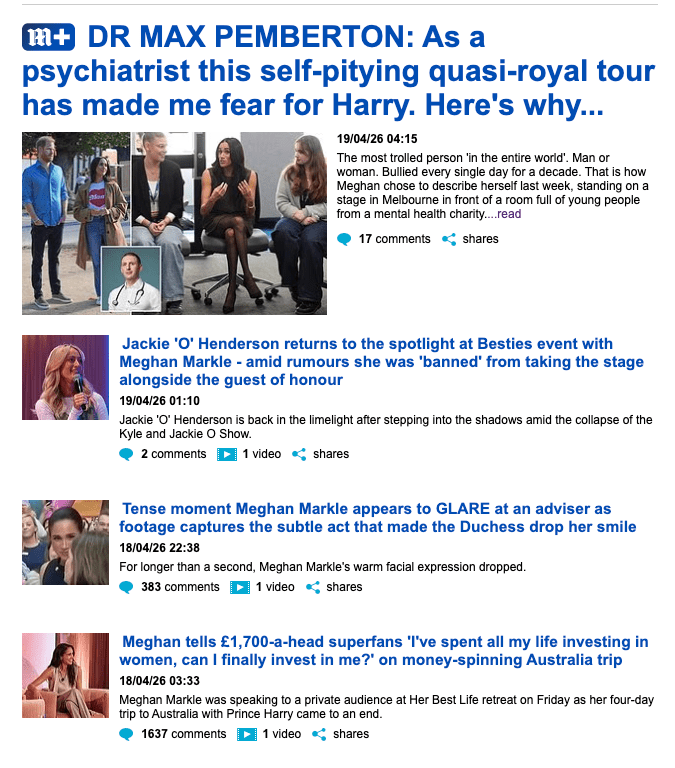
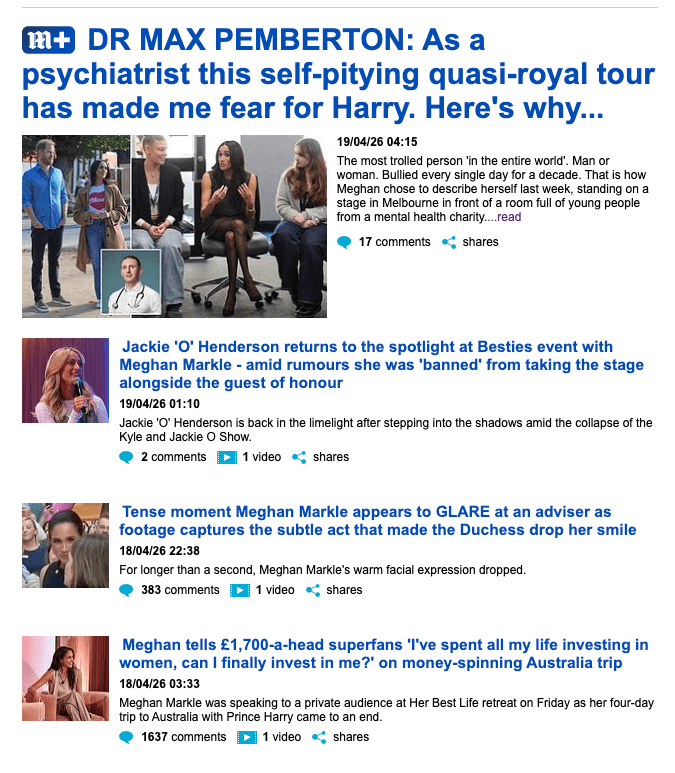
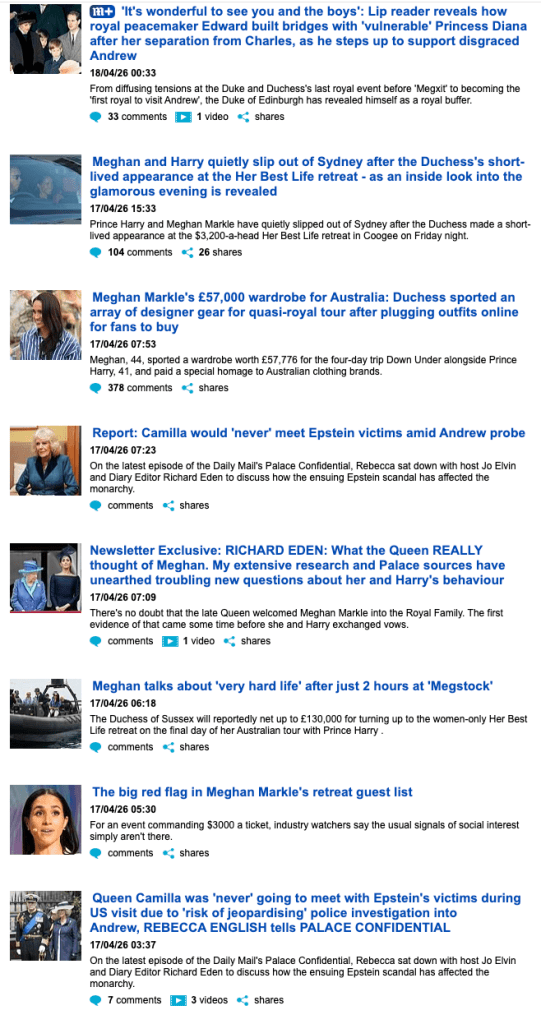
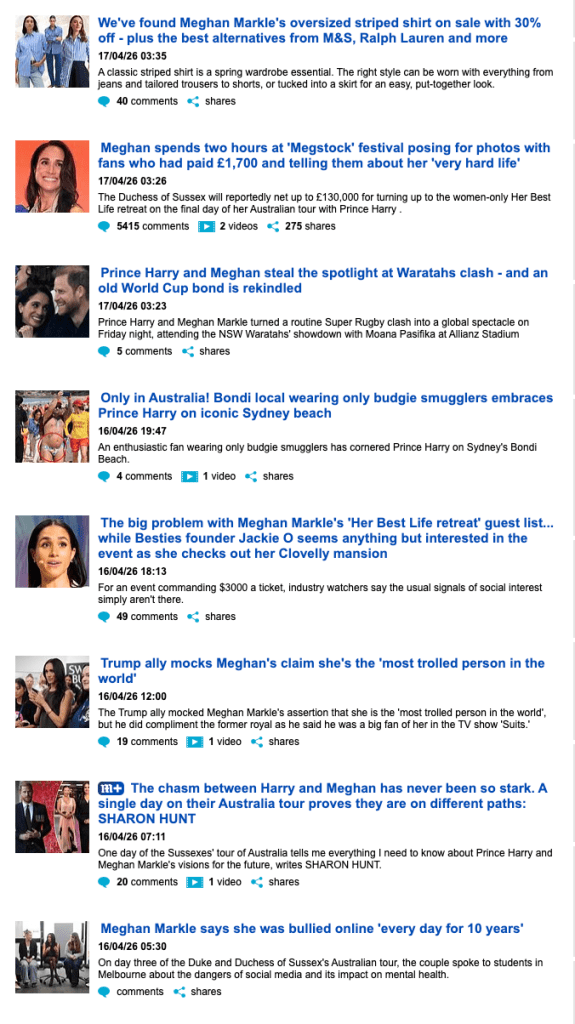
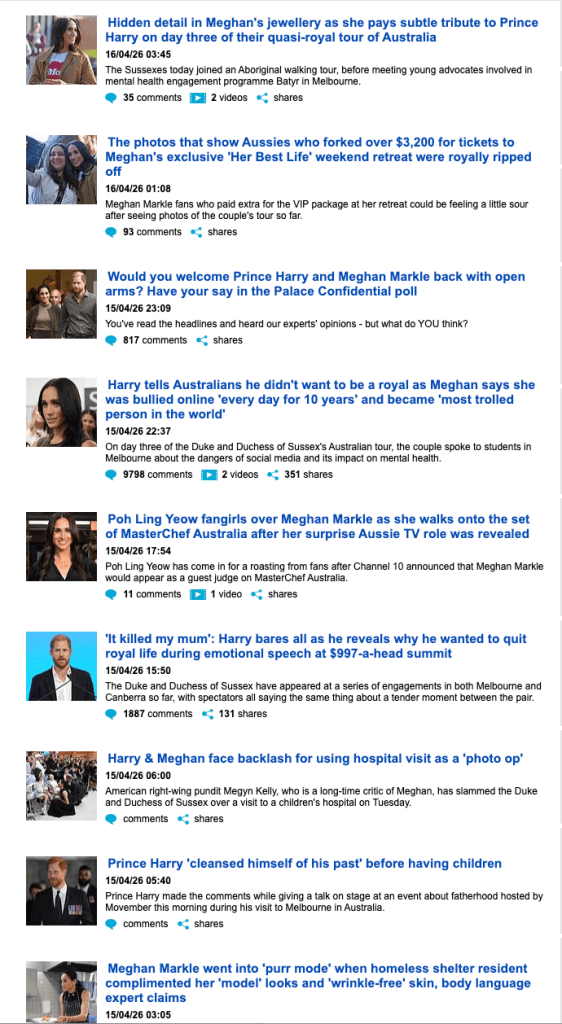
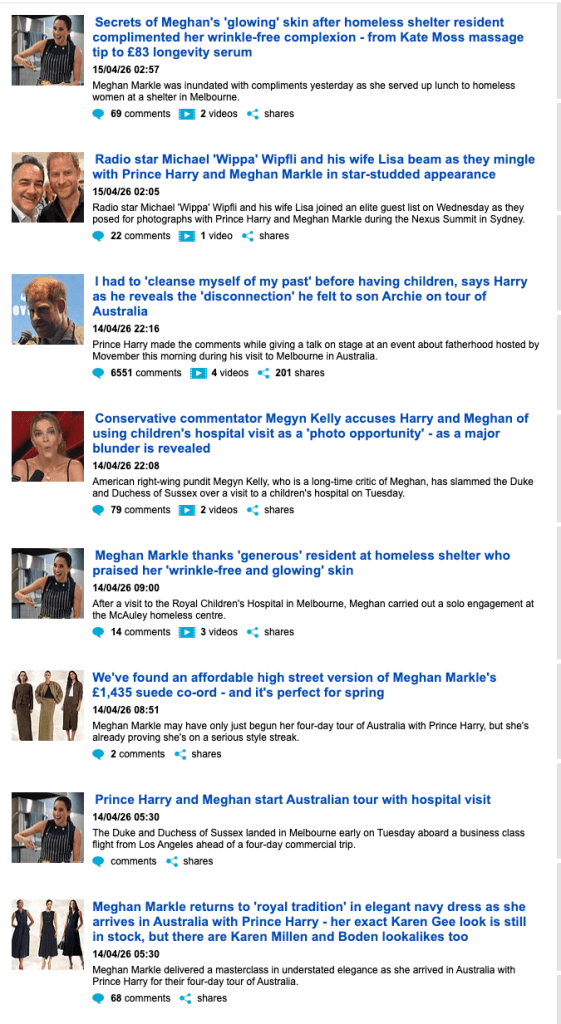
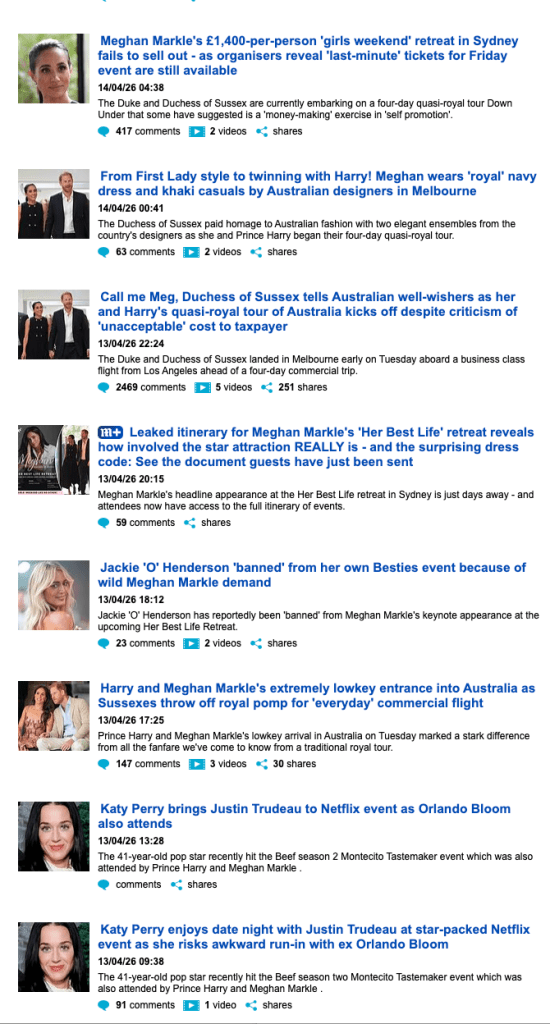
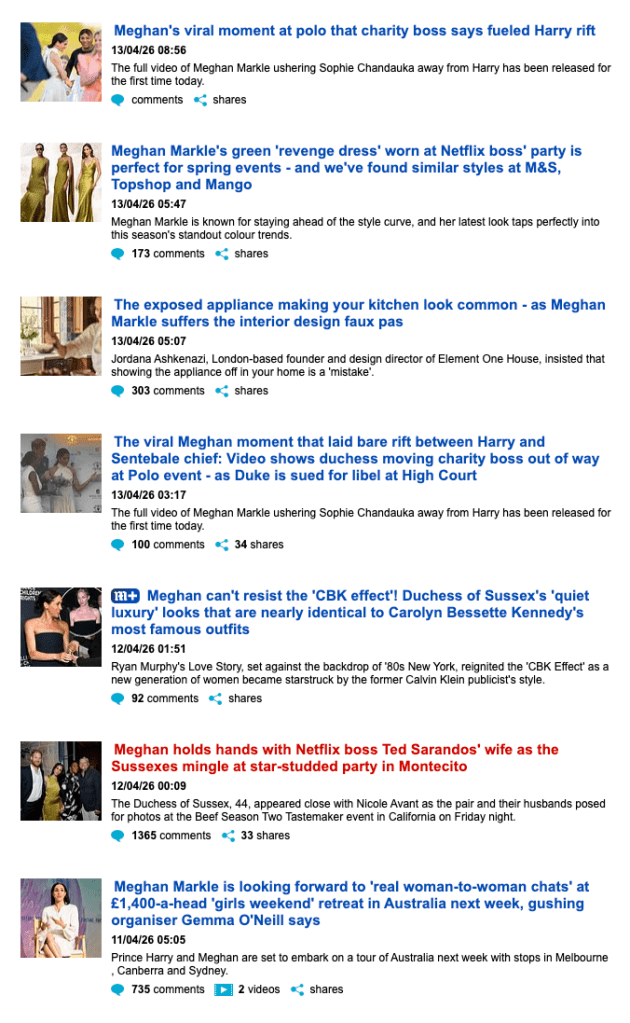
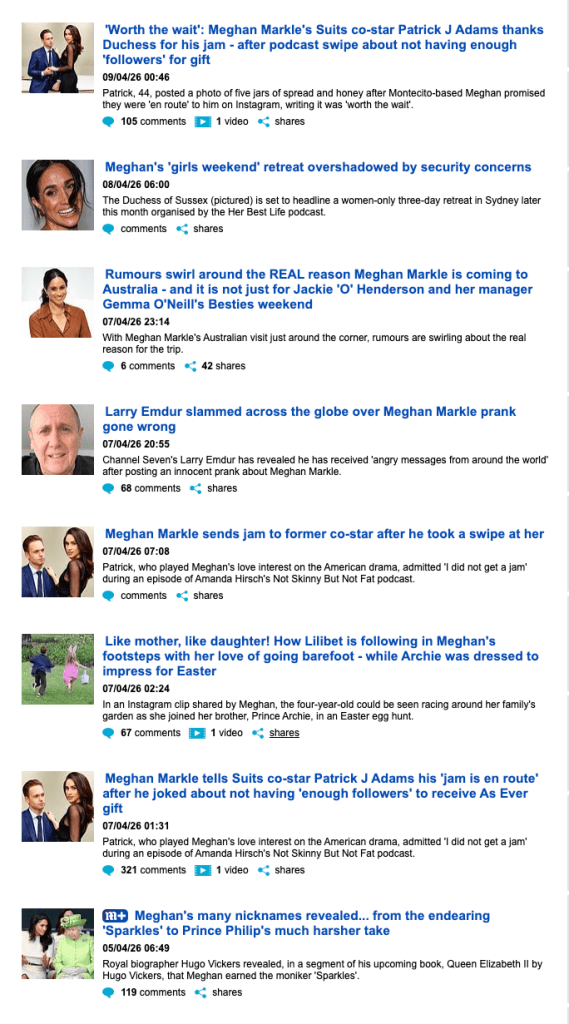
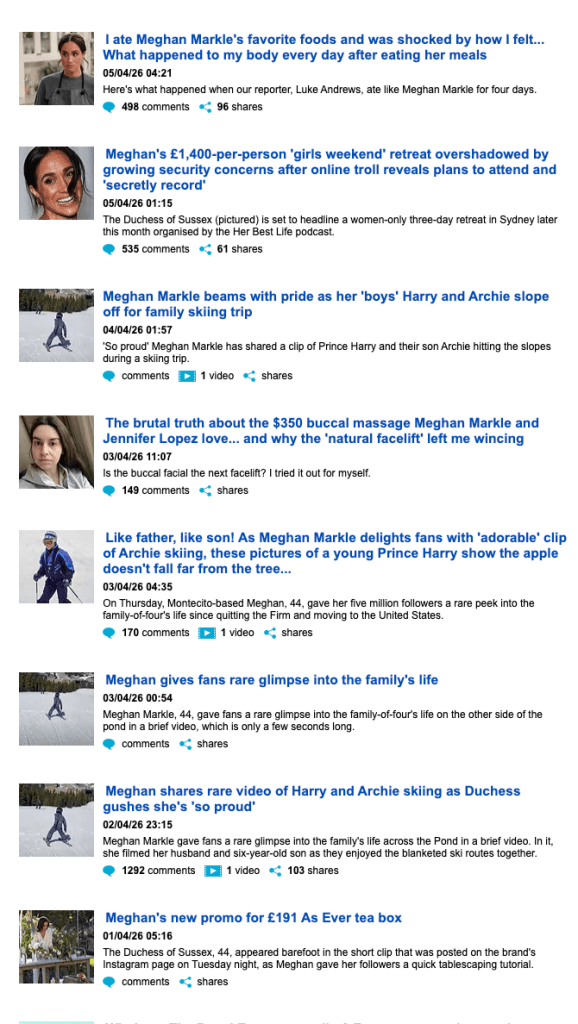
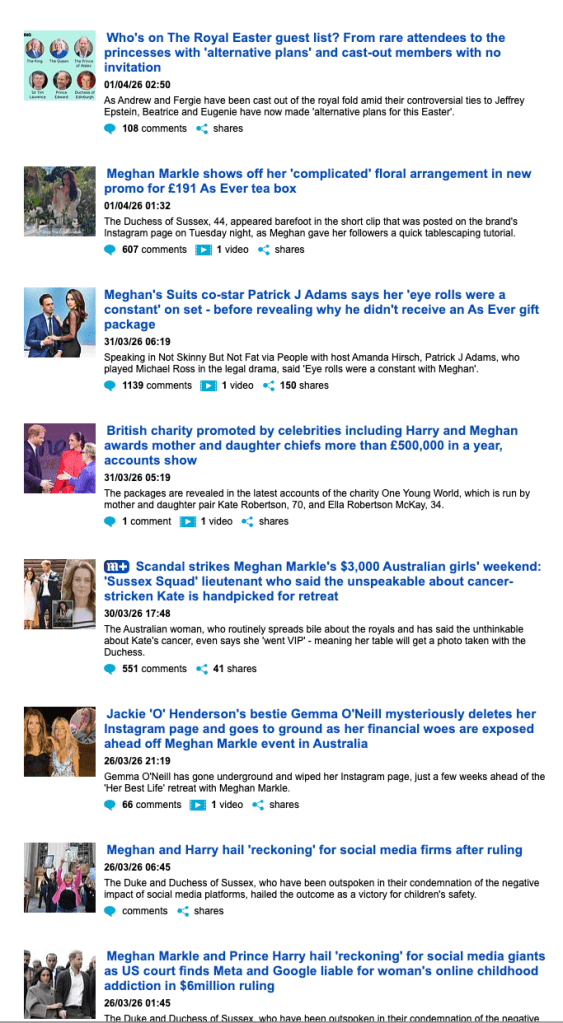
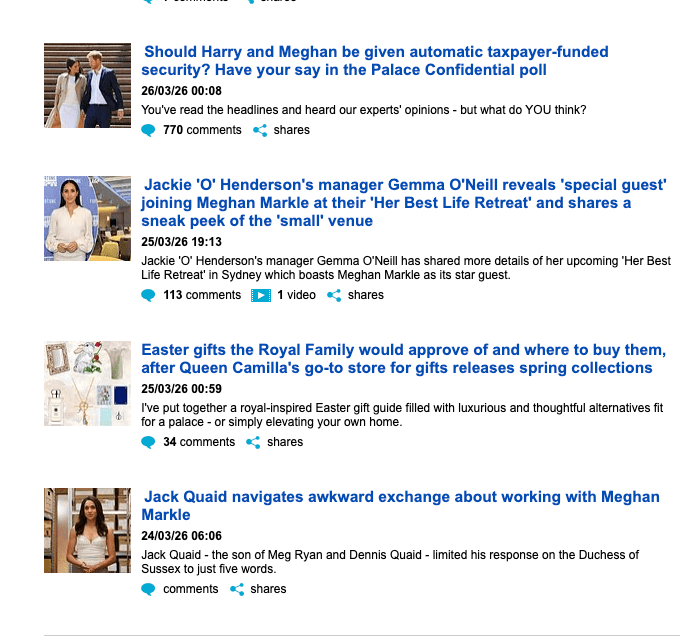
Between late March and April 19, 2026, the Daily Mail published approximately 70 articles about Prince Harry and Meghan Markle’s four-day trip to Australia. Seventy. For a four-day trip. During the same period, the paper published roughly three pieces touching on Prince Andrew’s Epstein ties and Queen Camilla’s refusal to meet Epstein’s victims.
That ratio is the story.
Not because the Sussex trip was unworthy of coverage, and not because the Epstein connection deserves more (it does, but that’s a separate argument). The ratio matters because it reveals how tabloid architecture works: what gets amplified, what gets buried, and how the machinery of one serves the interests behind the suppression of the other.
The “quasi-royal” trap
The Daily Mail’s preferred label for the Australia trip was “quasi-royal tour.” The phrase appeared in headlines repeatedly, and it does remarkably efficient rhetorical work. It strips legitimacy (they are not real royals conducting a real tour) while simultaneously justifying the level of scrutiny normally reserved for actual state visits. Under the “quasi-royal” frame, Meghan can be denied the authority of her position but never relieved of its obligations.
This is the tabloid having it both ways, and the structural function is important. If the Sussexes are irrelevant private citizens, there is no justification for 70 articles in three weeks. If they are working royals, the tone of the coverage would require some measure of institutional respect. “Quasi-royal” threads the needle. It creates a subject who can be watched like a royal and judged like a civilian, permanently locked into a category designed to maximize editorial hostility.
The coverage itself confirms the trap. The same publication that ran “Call me Meg, Duchess of Sussex tells Australian well-wishers” (mocking informality) also ran pieces scrutinizing her jewellery, her wardrobe, her body language at sub-second intervals. The surveillance intensity says “royal.” The editorial tone says “who does she think she is.” The two registers operate simultaneously by design.
Every headline has a price tag
A consistent feature of the coverage is economic framing. Not just mentioning costs, but leading with them. The retreat is “£1,700-a-head” or “$3,200-a-head” depending on the article. The wardrobe is “£57,000.” The summit is “$997-a-head.” Harry’s Movember appearance becomes a story about how much attendees paid.
This is not journalism about cost. It is cost deployed as a framing device.
The function is delegitimization through commercialism. Every price tag in a headline communicates the same underlying message: the Sussexes are not serving, they are selling. But the framing only works if you ignore that the British monarchy itself is an extraordinarily expensive commercial enterprise, from the Sovereign Grant to the Duchy revenues to the licensing and tourism economy that surrounds it. The Mail does not put price tags on royal engagements funded by the British taxpayer. The selectivity is the point.
The retreat coverage is a perfect micro-example. One article reports the event “fails to sell out,” framing it as a commercial embarrassment. Others describe attendees as “royally ripped off,” framing it as a commercial exploitation. The retreat cannot simultaneously be unpopular and a grift, but the coverage requires both framings because they serve the same editorial goal from different angles. One says “nobody wants this.” The other says “the people who want this are being cheated.” Both arrive at the same destination: Meghan should not be doing this.
Then, nested among the critical pieces, the Mail runs at least four articles offering readers affordable alternatives to Meghan’s outfits, a striped shirt “on sale with 30% off,” a suede co-ord lookalike, a Karen Millen version of her navy dress. The machine that delegitimizes the commercial Meghan simultaneously monetizes her as an aspirational fashion figure. The publication needs her to be both a cautionary tale and a shopping guide.
Displacement at scale
Which brings us back to the ratio.
During the weeks the Mail was producing this volume of Sussex content, the Epstein story continued to develop. Prince Andrew’s situation remained unresolved. Queen Camilla’s US visit raised the question of whether she would meet Epstein’s victims, and the answer was no, reportedly to avoid “jeopardising” the police investigation into Andrew.
That is, by any editorial measure, a significant story. A sitting member of the Royal Family is the subject of an active police investigation connected to one of the most consequential sex trafficking cases in recent history, and the Queen Consort’s diplomatic schedule is being shaped around it.
The Mail covered it. Briefly. Twice, arguably three times if you count the duplicate framing of the same Palace Confidential segment. Rebecca English delivered the Camilla line with protective framing: the decision not to meet victims was presented as responsible restraint rather than institutional avoidance.
Compare the treatment. Meghan Markle’s facial expression changing for one second at an event produced a 383-comment article with body language analysis. The Queen Consort declining to meet trafficking victims during a US visit in which the trafficking investigation into her brother-in-law was active produced a handful of pieces with single-digit engagement and a framing that pre-emptively excused the decision.
This is displacement at industrial scale. The Sussex content does not merely coexist with the Andrew coverage. It drowns it. The sheer volume creates an attention economy in which the most commercially and institutionally damaging story for the monarchy (Andrew, Epstein, institutional complicity or at minimum institutional avoidance) is structurally buried beneath an avalanche of content about hemlines, retreat guest lists, and whether a Bondi beachgoer wore budgie smugglers.
The Dr. Pemberton column
The most structurally revealing piece in the entire collection is arguably the one by Dr. Max Pemberton, headlined “As a psychiatrist this self-pitying quasi-royal tour has made me fear for Harry.”
A psychiatrist expressing concern for Harry’s mental health, published in the same outlet that has produced thousands of hostile articles about Harry and his wife over the past several years. The concern is genuine or it is not, but either way it exists inside a publication whose own output is, by any clinical standard, a contributing factor to the very distress being diagnosed.
This is the tabloid equivalent of a factory expressing concern about pollution levels downstream from its own discharge pipe. The column works because it reframes the subject: the problem is not the coverage, the problem is Harry’s response to the coverage. He is “self-pitying.” The coverage is simply the weather.
Pemberton’s piece is also doing legitimacy work. By medicalizing Harry’s public statements (his comments about wanting to leave royal life, his references to his mother’s death), the column shifts the conversation from what Harry is saying to what Harry’s saying reveals about his psychological state. The content of his claims becomes secondary to the diagnosis. It is a neat trick. You do not have to engage with whether the press played a role in Diana’s death if you can instead frame Harry’s mention of it as a symptom.
What the machine protects
Coverage decisions are resource allocation decisions. Every editorial meeting that assigns a reporter to Meghan’s outfit is a meeting that does not assign a reporter to the Duchy of Cornwall’s finances, Andrew’s legal exposure, or the structural questions about how the institution handled Epstein-adjacent relationships for years.
The 70:3 ratio between Sussex coverage and Epstein/Andrew coverage in this three-week window is not a conspiracy. It is a market operating exactly as designed. Sussex content generates engagement (one article alone drew 9,798 comments). Andrew/Epstein content generates institutional discomfort. The tabloid is a business. Engagement wins.
But the cumulative effect is not commercially neutral. It is institutionally protective. The monarchy’s most significant reputational threat is not a former working royal’s retreat in Sydney. It is the unresolved question of what the institution knew, when, and what it did about a member of the family’s association with a convicted sex trafficker. The volume of Sussex coverage does not make that question disappear. But it does make it very, very hard to find in the feed.
The machine runs itself. And it knows exactly who it protects.
 celebchai.com