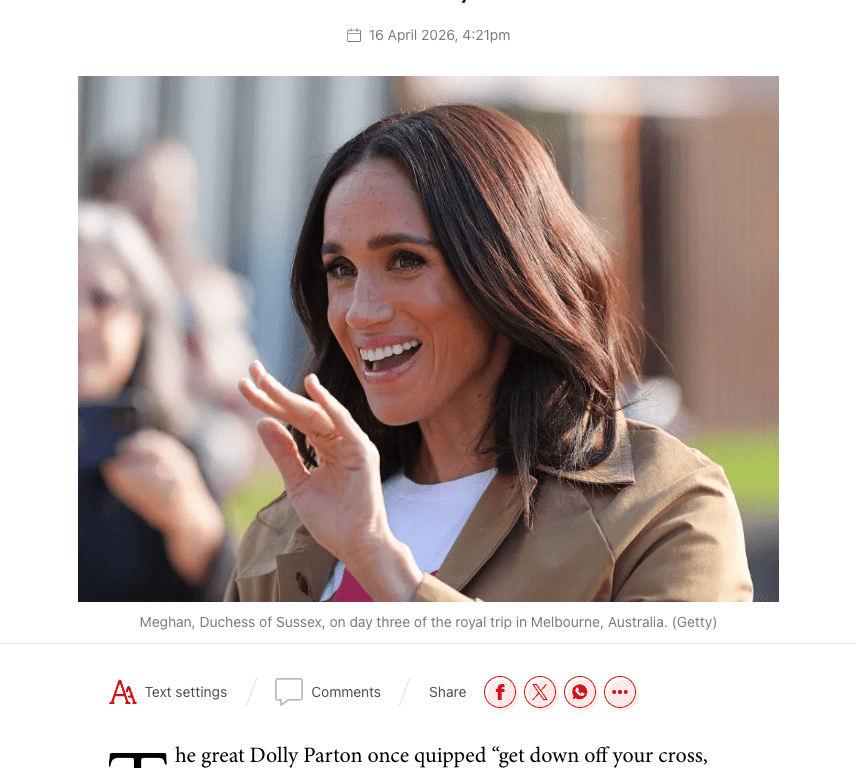
Two pieces, same author, 12 hours apart. April 15-16, 2026.
Alexander Larman published two Spectator pieces on the Sussex Australia tour within hours of each other. The first attacked the tour’s lack of dignity and commercial motive. The second attacks Meghan’s character and authenticity. Together, they demonstrate how institutional delegitimization operates through sequential escalation and strategic positioning.
The Architecture of Two-Strike Coverage
First strike (April 15): “What’s the point of the Sussexes’ undignified Australia tour?”
- Focus: Tour structure, dignity deficit, commercialism
- Comparative frame: King Charles vs. Sussexes
- Argument level: About the event itself
Second strike (April 16): “The banality of Meghan the Martyr”
- Focus: Meghan’s character, inauthenticity, performativity
- Comparative frame: Dolly Parton vs. Meghan (self-described martyr)
- Argument level: About the person behind the event
This is not redundancy. It is escalation. First establish that the thing being done is undignified. Then establish that the person doing it is inauthentic. Once both frames are in place, the subject is positioned outside the boundaries of legitimate discourse.
Technical Analysis: “The Banality of Meghan the Martyr”
Opening Move: The Epigraph as Permission
“Get down off your cross, honey, someone needs the wood.” Dolly Parton, attributed.
This epigraph performs multiple functions:
- It establishes a comedic frame (permission to laugh at the target)
- It position-shifts from analysis to judgment (Meghan is objectively attention-seeking)
- It pre-empts sympathy (martyr-playing is ridiculous)
- It uses a beloved figure (Dolly) to deliver the insult
The epigraph works because readers think “yes, I agree with Dolly.” By the time they reach the analysis, they’ve already been primed to see Meghan as a self-described martyr playing the victim.
The Foundational Collapse
“Meghan, along with her ever-subservient husband Prince Harry, is currently bringing the gospel according to Meghan to Australia.”
Several moves:
- “Ever-subservient” reduces Harry to a supporting character. He has no agency; he is Meghan’s accessory.
- “Gospel according to Meghan” suggests religious presumption. Meghan is positioning herself as prophet/savior.
- “Bringing…to Australia” frames the tour as imposition rather than invitation.
The Concession-and-Inversion Pattern
“However, it’s important to realize that Meghan is not just a clothes horse, but a very serious public figure.”
This sentence appears to grant ground. But “however” pivots immediately. And “very serious public figure” is sarcastic. The concession is fake. The meaning is: “she pretends to be serious but is actually shallow.”
Then: “One of the key themes of this visit is to emphasize ideas of mental health – how very 2026.”
The phrase “how very 2026” performs dismissal through temporal snobbishness. Mental health awareness is trendy, not substantive. Meghan is chasing current discourse rather than advancing it.
The Grandiose Self-Claim as Evidence of Character Flaw
“Every day for ten years, I have been bullied or attacked, and I was the most trolled woman in the entire world.”
Larman frames this as Meghan’s direct claim, then immediately attacks it:
“This sounds almost reminiscent of her enemy Donald Trump in its grandiosity.”
Notice the move: Trump is the comparison point for grandiosity and victim-playing. By comparing Meghan to Trump, Larman positions her as operating at his level of narcissism and self-aggrandizement. This is status inversion through comparison, not argument.
The phrase “her enemy Donald Trump” is interesting—it assumes the reader accepts that Trump is her enemy, establishing a frame in which Meghan’s grievance politics are equivalent to Trump’s.
The Hypocrisy Trap
“She railed against social media, which she claims is ‘that billion-dollar industry that is predicated on cruelty to get clicks.’ Her Instagram account (and its 4.5 million followers) that offers her the opportunity to connect with a wider public on her own terms went unmentioned.”
This is structural hypocrisy framing. Meghan criticizes social media while using it. The parenthetical “(and its 4.5 million followers)” does work: it emphasizes that she has significant platform. The implication is that her criticism of social media while maintaining Instagram presence reveals her as a liar or at minimum dishonest about her motivations.
This is a version of the financial motive reduction. If Meghan benefits from something, her criticism of it is invalidated.
The “Mere Quote” Technique
Larman quotes an inspirational statement Meghan shared: “My wish for you is that you continue, continue to be who and how you are, to astonish a mean world with your acts of kindness and to allow humor to lighten the burden of your tender heart.”
He then asks: “I was briefly agog at what this rousing statement of intent might be.”
He lists possibilities: “Don’t let the bastards grind you down?” “Another suitcase, another hall?” “I think, therefore I am?”
Then dismisses the actual quote: “Alas, the quote…is [banality]…It is not exactly profound wisdom, despite how Meghan has couched it. This rather fortune cookie-level sentiment indicates everything that is wrong with both the Duchess of Sussex’s PR campaign…”
Notice the architecture:
- Quote is presented
- Expectation is built (what could this be?)
- Actual quote is revealed
- Quote is characterized as “banality” and “fortune cookie-level”
- This becomes synecdoche for everything wrong with Meghan
The quote itself is not analyzed for content or authenticity. It is judged on whether it meets an invented standard of profundity. Anything offered by Meghan will fail this test because the standard is unstated and unfalsifiable.
The Authentic Abuse, Inauthentic Response
“Meghan has undeniably received an amount of racist, misogynist and personal abuse via social media that would send anyone into a paroxysm of depression.”
This concession is major. Larman grants that the abuse is real and severe. This is important because it prevents the argument from being “her complaints are invented.” Instead, it pivots to “her response to real complaints is inauthentic.”
The Performativity Clausula
“Yet the greatest difficulty is that, even when she says things that are empirically true, she remains extremely hard to warm to. It is hard to forget that she had a former career as an actress. Her public persona, which alternates between little smiles of solidarity and near-tearful expressions of sorrow at the bullying she has faced, feels less sincere and more the carefully curated display of someone who is calculating how much attention this particular remark of her is going to get worldwide.”
This is the killing move:
- “Even when she says things that are empirically true, she remains extremely hard to warm to”—truth-telling becomes evidence against her. Truth from an unlikable person is suspect.
- “Hard to forget she had a former career as an actress”—acting experience becomes permanent disqualification from authenticity. Everything she does is “performance.”
- “Her public persona…feels less sincere and more the carefully curated display of someone who is calculating”—all expression is performance. Smiles are calculated. Tears are calculated.
- The final phrase: “calculating how much attention this particular remark of her is going to get worldwide. (Including, of course, this article.)”—Larman positions himself as complicit in amplifying her calculated attention-seeking. He is the knowing observer; she is the calculating performer.
This is genius delegitimization architecture because it makes authenticity itself impossible. If she grieves publicly, she’s performing grief. If she advocates for mental health, she’s calculating attention. If she remains silent, she’s refusing accountability. There is no move that registers as authentic.
The Impossible Choice Final Frame
“There are countless ways in which she could help people with mental-health issues that do not have to be so self-regarding and so very public, but I cannot see any of those being pursued. Instead, we have the public face of Meghan the Martyr, the much-abused survivor who is coming out stronger and better for all those awful internet trolls.”
What Larman is saying: Whatever Meghan does, it will be framed as inauthentic. If she acts publicly, it’s performative. If she acts privately, it’s evidence that she doesn’t really care. She has been positioned in a frame where legitimacy is impossible.
The final sentence: “As one of her many nemeses didn’t quite put it, opinions might vary.”
This is a classical hedge-and-claim move. “Opinions might vary” suggests that some people disagree with Larman’s assessment. But “opinions might vary” on character judgment is just another way of saying “this is true but I’m leaving room for dissent.” It’s a false concession that reinforces the basic argument.
Coordination Across Two Pieces
Now compare this to the April 15 piece:
April 15 Framework: The tour is undignified and commercially motivated. Dignity vs. profit binary.
April 16 Framework: Meghan is inauthentic and performative. Authenticity vs. calculation binary.
Together, they establish a two-level delegitimization:
- Level 1 (Event): The thing is undignified
- Level 2 (Person): The person is inauthentic
Once both frames are in place, the subject is outside legitimate discourse. You cannot defend an undignified person doing an undignified thing, even if they’re doing good work, because the person and the event have both been positioned as inherently suspect.
The Spectator’s Strategic Positioning
This is not accident. This is institutional strategy. One author, same outlet, same subject, 12 hours apart, different angles:
- First piece sets the dignity frame
- Second piece sets the authenticity frame
- Together they create a comprehensive delegitimization that cannot be countered without confronting both frames simultaneously
If Meghan or her supporters respond to Larman’s April 15 piece (about dignity and commercialism), the April 16 piece (about inauthenticity and performance) remains unanswered. If they respond to the second, the first has been absorbed as established context.
This is how institutional media coordinates delegitimization. Not through conspiracy or explicit coordination, but through editorial positioning that appears as individual judgment but operates as systematic strategy.
What’s Remarkable Here
The remarkable part is the sophistication of impossibility framing. Larman doesn’t argue that Meghan is lying about abuse. He grants that the abuse is real. Instead, he argues that her response to real abuse is inauthentic. This is delegitimization at a higher level of technical sophistication because it cannot be countered by pointing to evidence. The evidence of real abuse becomes evidence that her performance of response is calculated.
This is how you systematically position someone as “extremely hard to warm to” (his phrase) even when the underlying facts support sympathy. You grant the facts and attack the frame in which they’re presented.
For Celeb Chai: this is the architectural move to track across coordinated coverage. How do hostile outlets layer frames so that defense of one becomes vulnerable to the other?

