The Frame Flip: How “She Wanted Out” Hides “He Wanted Control”
The line is presented as damaging. Look at her, the rota wants you to think. Always calculating. Always about money. She did the math on William’s eventual control of the purse strings and bolted.
But read the sentence with the agency clocked. The grammatical subject is Meghan. The verb is “realized.” The action is “departure.” Meghan does everything. William just sits there, a passive future fact she notices and reacts to.
The sentence is built so that you do not ask the obvious question.
The obvious question is: why was William going to control his adult brother’s household finances in the first place?
The arrangement Sykes needs you not to look at
Here is the situation the sentence is describing, with the agency restored to where it actually sat.
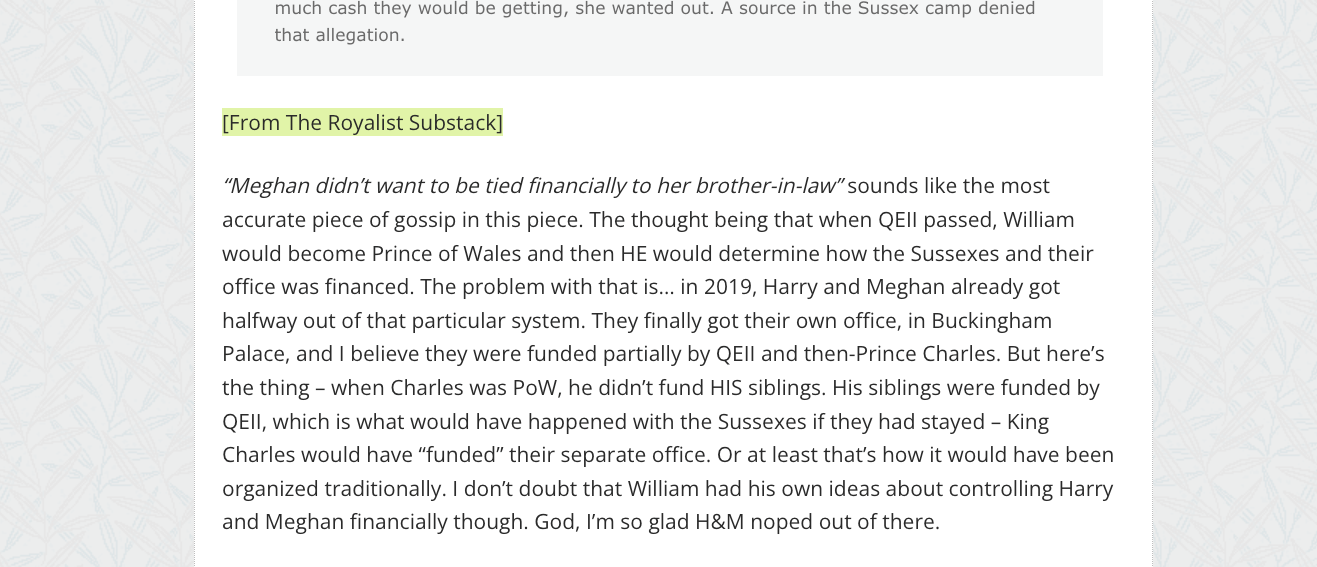
William, as the future Prince of Wales and future king, was positioned to eventually hold financial authority over his brother’s household. Not for a year. Not as a temporary arrangement. Indefinitely. The Duchy of Cornwall would pass to him when Charles became king. The Duchy of Lancaster would pass to him when he became king himself. Together those two estates were the discretionary funding sources that supported non-heir family members. William was the future custodian of both.
That meant William would decide what Harry’s household got. Which staff. Which office. Which travel budget. Which security arrangements. Which residences. Which level of support for Harry’s children. For the rest of Harry’s life, and into the next generation, William would hold financial authority over his younger brother’s family.
This is not a feature of married life that most adults sign up for. A 38-year-old man’s household budget being subject to his older brother’s discretion is not a normal kinship arrangement. It is an institutional artifact of a particular feudal-residual financing structure, and most adult humans, given the option, would exit.
Meghan looked at that setup and declined.
The rota frame requires you to read this as suspicious. The actual structure of what she declined is the part the frame cannot afford to make visible.
William wanted the control
This is the sentence the rota will never write, but it is the one the documented record supports.
William was not a passive future custodian who happened to inherit financial authority over his brother. William wanted that authority and intended to use it. The pattern is in the public record going back years. The briefing wars against Meghan that Harry has documented. The coordination between Kensington Palace communications and tabloid editors. The freezing-out that began before the wedding. The institutional containment Harry describes in Spare, in the Oprah interview, in the Netflix series, and in the various legal filings. William’s relationship with Harry since 2018 is not the relationship of a brother who happens to be in line for the throne. It is the relationship of a future authority figure positioning himself to manage, contain, and constrain his younger brother and his younger brother’s wife.
Once you see that pattern, the financial structure stops looking like a neutral background fact. It looks like a lever. One of several. The press treatment was a lever. The security arrangements were a lever. The patronages and titles were levers. The financial dependency was the longest-running and most permanent lever, because it was the one that would still be operative in 2055.
Harry has said this. Not in the words I am using, but in substance. He has said the institution wanted them contained. He has said the press treatment was coordinated rather than incidental. He has said the financial structure was used to control behavior. He has said his brother and his brother’s office were active participants in this rather than bystanders to it.
The rota has spent six years insisting Harry’s first-person account of his own life is unreliable. That insistence is not incidental to the Wakeford line. It is the precondition for the Wakeford line. If Harry’s testimony is allowed to count as evidence, the structure becomes visible and the frame collapses.
The exit and the explanation
When a woman exits a controlling arrangement, the controlling arrangement disappears from the story and the exit becomes the thing requiring explanation. This is not specific to the Sussexes. It is the standard structure of misogynist framing whenever a woman leaves.
“Why did she leave him?” gets asked a thousand times. “Why did he need to control her?” almost never gets asked at all. The exit is rendered as the deviation. The control is rendered as the baseline.
The Wakeford line does this with surgical precision. It takes a story about a man’s thwarted desire to control his brother’s wife and reframes it as a story about a woman’s calculation about money. William’s desire to control becomes invisible, just an institutional fact, a passive “being paid by Prince William.” Meghan’s refusal becomes visible and morally loaded. She “realized.” She “wanted out.” She is the one with the agency, and her agency is what the reader is invited to find suspicious.
Notice what the framing does to William specifically. He is removed from the moral frame entirely. He has no desires in this story. He is not depicted as wanting anything. He is just the future fact Meghan reacted to, like weather. Whether he would have used that financial authority well or badly, generously or punitively, is not even raised as a question. The rota’s audience is invited to assume the arrangement would have been fine and that Meghan’s preemptive exit reflects on her rather than on him.
This is the move the rota cannot afford to lose. If William’s desire for control is named, the institution becomes the actor and Meghan becomes a person who declined to be acted upon. That inverts the entire moral architecture the rota is paid to maintain. The institution must remain the neutral baseline. The people who leave must remain the ones requiring explanation. Otherwise the whole frame collapses, and with it the rota’s reason for existing.
What Meghan actually saw
The rota version of Meghan is a calculating American who did the math on William’s eventual control and bolted because she wanted more cash than he was going to give her.
The actual situation, with the agency restored, is this. A woman in her late thirties, married for less than two years, looked at the financial structure of the family she had married into and saw that her brother-in-law would hold permanent discretionary authority over her household for the rest of her life and into her children’s adulthood. She also saw, because the evidence was already accumulating in real time, that her brother-in-law’s office was actively coordinating with the tabloids that were attacking her. She saw, in other words, that the future financial authority and the current architect of her press treatment were the same person.
She declined.
This is not a calculation about money. It is a calculation about whether you want to spend the next forty years financially subject to a man whose office is currently feeding stories about you to the Mail. Most women, given that information, would make the same calculation. Most women, given that information, would think the calculation was so obvious it barely counted as a calculation at all.
The rota cannot tell the story this way because telling the story this way makes Meghan’s choice look like the most ordinary thing a person could do. The frame requires her choice to look like deviance. Deviance requires the institution to be a neutral baseline. The neutral baseline requires William’s desire for control to be invisible.
So William’s desire for control gets disappeared. Every time. In every piece. The Wakeford line is just a particularly clean example because it states the financial structure plainly while completely erasing the question of why that structure existed or who benefited from it.
The piece beneath the piece
What the Royalist excerpt is actually saying, when you put the agency back where it belongs, is this. William was set up to hold financial authority over Harry’s wife and children for the rest of their lives. Meghan understood this. She declined. Six years later, the rota is still working through what her declining means and how to frame it as her failure rather than as William’s loss.
That last part is the unspoken tell. The line is “explosive” to the rota because it is, from inside the institutional frame, a confession of grievance. William was supposed to have that control. He doesn’t. Someone has to be blamed for the fact that he doesn’t. The blame settles on Meghan, because the alternative is to notice that the control itself was the problem and that exiting it was the rational response of any adult woman who could see the arrangement clearly.
She could see it because she had not grown up inside it. Harry, raised in it, had to be shown. She could see from outside what he could only see once she pointed at it.
The rota cannot say any of this, so the rota says she wanted out because of money. The truth is closer to this: she wanted out because she could see what the money was for.

